Friday, 16 October 2015

Thrush Fest part 2

The good numbers of thrushes that moved over Billinge on Monday and Tuesday paled into insignificance compared with the numbers on the move on Wednesday (14th). Inevitably I was too busy ringing to devote much time to estimating numbers but in the region of 3,000 to 5,000 Redwings were involved with the upper figure probably being nearer the mark. A friend who lives nearby counted over 2,000 from the fairly restricted view point of his garden and after missing some of the early flocks so the upper estimate of 5,000 could even have been on the low side. A few Blackbirds and Fieldfares were also seen or heard and around 30 Song Thrush were noted but others would have gone through amongst the hordes of Redwings.


Many of the Redwings moving over Billinge will winter much further south in France or Spain.
During the morning a total of 138 birds were ringed as follows: Redwing 114; Song Thrush 7, Fieldfare 1, Blackbird 1; Goldcrest 6; Lesser Redpoll 5; Great Tit 3; Coal Tit 1. With so many Redwings about I could have easily caught a lot more than I did but I had to limit the catch to numbers I could safely deal with on my own.

On Thursday (15th) I was out again as it seemed likely that there would be plenty more thrushes on the move. This time as was joined by David Norman of Merseyside Ringing Group and initially it looked like there would be similar numbers of Redwings for a second day. After a very busy start numbers tailed off quite quickly compared to the previous day with around 1,000 Redwings going through along with 100 or so Fieldfare, a few Blackbirds and another 20 or so Song Thrush.


The big Fieldfare movements have yet to come. 
The thrushes attracted the attention of a minimum of 3 Sparrowhawks
Despite there being fewer Redwings on the move we still ended up with excellent ringing total of 111 new birds, 3 retraps and 1 control. Ringing totals were: Redwing 82; Song Thrush 3; Fieldfare 2; Long-tailed Tit 11 (2); Goldcrest 6 (1); Blackcap 1; Coal Tit 1; Blue Tit (1); Great Tit 1; Treecreeper 1; Lesser Redpoll; 1; Bullfinch 1, Sparrowhawk 1. The control (bird ringed elsewhere) being the only Blue Tit caught.

With little change in the weather and the likelihood of more Redwings I was back out again this morning. It was a much quieter than the previous day but at least 500 Redwings went through during the morning. Other sightings included 3 Bramblings with a cracking adult male being caught and a single Crossbill was noted going northeast. Ringing totals for this morning were: Redwing 42; Song Thrush 5; Blackbird 2; Goldcrest 7; Blue Tit 1; Lesser Redpoll 3; Chaffinch 3, Brambling 1. A total of 64 new birds.


Most of the Song Thrushes that have been caught recently are greyer continental birds like this fine example.
They don't get much greyer than this and look very different to the British race clarkei. 

...and here is an example of the warmer buff and brown British race clarkei for comparison. 
Finding this adult male Brambling in a net today was a really nice surprise. Only 2 had been heard going over before this one was caught.

Tuesday, 13 October 2015

Thrush Fest

The last couple of mornings have seen good numbers of Redwings and a few other thrushes moving over Billinge with the pattern of movement being similar on both days. Flocks of Redwings in double figures started to appear just after first light and continued periodically until 10am when most movement ceased. I was too busy ringing to do any proper counts but minima of 400 Redwings, 20 Song Thrush and 10 Fieldfare were involved yesterday and minima of 500 Redwings and 25 Song Thrush today. A few high flying Blackbirds were also noted on both mornings but no more than a handful. Woodpigeon migration also started in earnest with hundreds going south on both mornings but there were surprisingly few finches around or on the move.

Although there were a few rather well marked and darkish Redwings I didn't think any were Icelandic birds of the race 'coburni'. However, I did have another Redwing with a wing length of 128mm making it two of that size for this autumn compared with none in my preceding 35 plus years of ringing. I still haven't found the tables showing the full breakdown of wing lengths for iliacus but of 7,364 birds measured in Finland only 0.5% had a wing length over 126mm and Svennson (1992) gives an upper limit of 124 mm and Glutz von Blotzheim & Bauer give an upper limit of 126 mm with variation in sample size probably being the main cause of this difference. Basically wing length isn't much help in identifying Icelandic birds unless you catch a bird with a wing length over 128 mm.

This is the second Redwing with a wing length of 128 mm caught this autumn.

One adult Redwing had orange-red fringes to most of the greater coverts and even had some orangey-red feathers near the thighs.

This same well marked adult Redwing.
Quite a few of the Redwings had ticks on their faces but this bird had a lot more passengers than most.
Whilst separating the races of Redwings is difficult the differences between the races of Song Thrush are much easier to see in most cases. The main British race clarkei is much more richly coloured being much more ocherous-brown above with little or no contast between the mantle,rump, wings and tail and has more buff on the underparts in contrast to the continental race philomelos which is whiter below and the upper parts are more of a greyish olive-brown which contrasts with the browner wings and tail. The pictures below illustrate the difference quite well. All 10 of the Song Thrush caught today were continental birds and only 1 of the 6 caught yesterday was of the British race.

Continental race Song Thrush showing the contrast between the rump and tail.
Song Thrushes: British race on the left and Continental race on the right.
The thrush fest of the last two mornings has left me itching to back out into the field and I will probably be out again in the morning. There is a bit of a joke there somewhere for those of you who are 'canny' enough to notice.

Combined ringing totals for 12th & 13th October were: Redwing 119; Song Thrush 16; Goldcrest 12; Robin 2; Coal Tit 1; Blue Tit 1; Bullfinch 1, Chaffinch 1; Lesser Redpoll 1. Total 154 new birds.

Sunday, 11 October 2015

Billinge: 5th-11th October

I haven't had any more Yellow-browed Warblers or dodgy Redpolls but it has been a very productive week. I have managed to get out on 5 mornings, including today, and it is fair to say that those early starts have taken their toll and I am feeling cream crackered as I write this. Highlights have included the continued passage of Goldcrests, some reasonable thrush movements and a few late-ish warblers.

The number of Goldcrests moving through this site continues to impress me with the 95 ringed this week bringing the total for the month to 162 and the total for the autumn to 447. Redwings and other thrushes started arriving early this autumn with the first big arrival on the east coast and northern isles happening on the 5th. It didn't take long for some of these birds to move across and down to the west side of the country and around 200 passed over the site on the 8th. Similarly there has been a good movement of Song Thrush in the last week with small numbers 'zipping' over the site each day. Song Thrush is often under-recorded as a passage migrant as they can be hard to pick out when mixed in with flocks of Redwings but at least 20 have passed through on each of the last 2 days. Warblers are thin on the ground now but there was a little flurry of Chiffchaffs in the week with 5 on the 8th being a good number for the date. Many of the Blackcaps caught in recent weeks have been carrying a lot of of fat and one of the birds ringed today was probably the heaviest bird I have handled this autumn and weighed 22.2 g which could give it the range to reach Spain or Portugal in a single flight.

(Retraps and controls in brackets)
One of the Redwings still had some spotty juvenile feathers on the flanks suggesting it was from a late brood. It also had some juvenile median coverts..

One of today's Song Thrushes
The fat 22.2 g Blackcap is just over 5g heavier than the average weight of 17g.

Blow back the feathers of the upper breast and you can see the pinky-yellow fat bulging from the normally concave tracheal pit.
Coal Tits are very much in the birding news with an irruption of birds currently underway in Britain and on the continent. A couple of high flying birds were recorded today in addition to the one that was ringed.

A bobby dazzler of an adult male Lesser Redpoll. He will be a stunner in spring when those pale fringes have worn off the red feathers.

Looking at the forecast I could be seeing the sun rise a few more times next week although I may not have the time to appreciate it.

Sunday, 4 October 2015

1st to 4th October highlights include a YBW.

The new month has got off to a flying start, no pun intended, and I have been able to get out each morning. The 1st was fine and clear but the 2nd and 3rd were badly affected by mist and fog and this morning was murky and overcast although it did clear towards lunchtime.

Suprisingly the largest ringing total of the 4 mornings came on the 3rd when 83 birds were processed despite the foggy conditions, including 33 Chaffinches and 20 Goldcrests. The Chaffinches were presumably grounded by the fog although a party of Crossbills was heard and suggested some birds were on the move despite the conditions.


Although large numbers of Chaffinches move over the site on some days in autumn I don't usually catch many so the 33 ringed on the 3rd is quite exceptional.
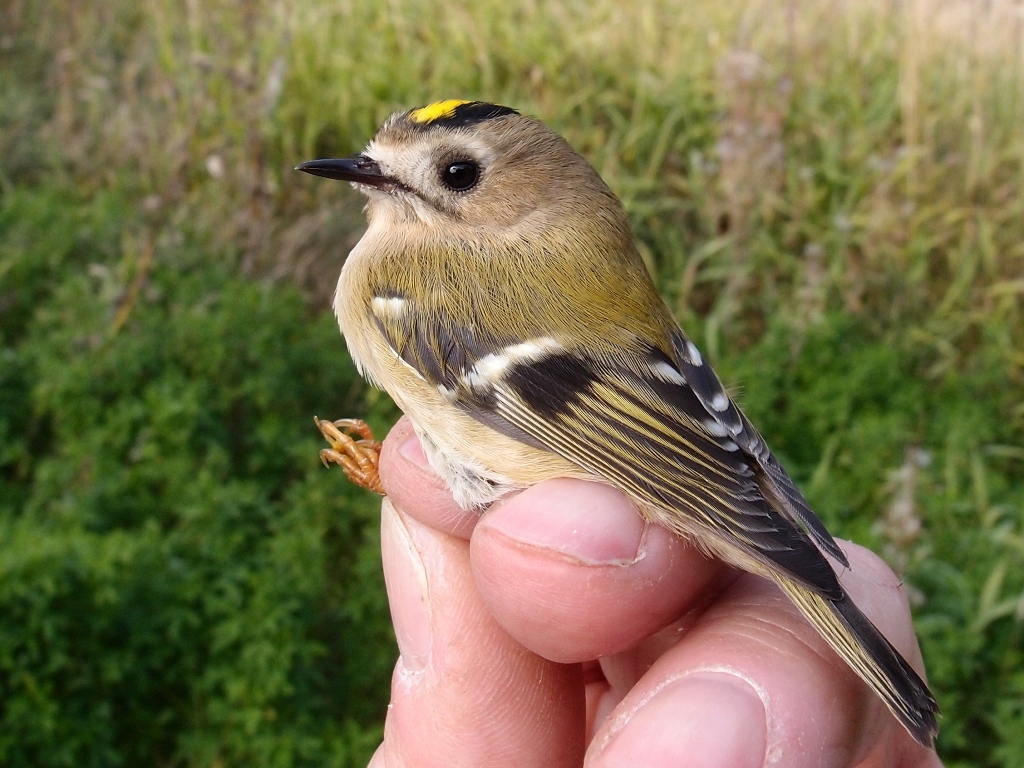
Goldcrests continue to move through the site in good numbers with 349 having been ringed so far this autumn. This Goldcrest was a fat 6.1g so will probably be on the move tonight.
Ringing highlights during the period included a Redwing on the 1st (first to be ringed this autumn), good numbers of Goldcrests each day, the aforementioned Chaffinches, more Lesser Redpolls, good numbers of Blackcaps and Chiffchaffs for October (up here at least) and today's gem - a Yellow-browed Warbler.


The first Redwing ringed this autumn was caught on the 1st just before sunrise, the only Redwing seen that day.


Today's Redwing (one of seven seen) had a wing length of 128mm which is at the top end of the range for 'iliacus' with only a tiny proportion being that large. More to be added on this subject when I have time to look up the stats.

The late breeding season means there are a few more Blackcaps around than usual at this time of year. Most have been juveniles but there have been a couple of adults recently including this female. The late breeding season has had a similar affect on some other migrants including Chiffchaffs.
A 'Poll' to ponder on. A bit paler than your average Lesser and larger too with a wing of 75mm. There seem to be more dodgy (paler) Lessers around this autumn or is it just me.
An adult female Lesser Redpoll with an amber poll. Thinking about it I am fairly sure that all the Redpolls with amber coloured polls that I have caught and was able to sex have been females.
With so many Yellow-browed Warblers in the country it was perhaps almost inevitable that one would come my way sooner or later.
Such a smart bird deserves a second photo.
Combined ringing totals for 1st to 4th October (retraps/controls in brackets) were: Great Spotted Woodpecker 1; Dunnock 1; Robin 4 (2); Song Thrush 2; Redwing 2; Blackcap 7; Yellow-browed Warbler 1; Chiffchaff 14 (1); Goldcrest 67 (1); Long-tailed Tit 8 (1); Willow Tit (1); Coal Tit 1 (1), Great Tit 1 (1); Chaffinch 40; Greenfinch 1; Goldfinch 1; Siskin 2; Lesser Redpoll 31 (1); Yellowhammer 1. Total 185 new birds, 8 retraps and 1 control.

Wednesday, 30 September 2015

Billinge 30/09/15

The last ringing session of the month was a modest affair and it was no surprise that Goldcrests and Lesser Redpolls made up the majority of the 29 birds ringed. As usual the Lesser Redpolls showed some variation in the ground colour of their plumage as shown below. Quite a few of the birds caught this month have been like the paler bird on the left so it is not a particularly unusual individual by any means.


These birds show some of the variation in ground colour of the birds caught today. Ideally they would have been photographed side by side but I don't have enough hands for that.
Although there have been a lot more Redpolls than usual this month the number moving through the site is likely to increase further during October. 
Visible migration was fairly low key with few birds on the move and no highlights, unlike yesterday when 7 Crossbills went east and the first 2 Redwings of the autumn were recorded. However, there were more Sparrowhawks around with a minimum of 3 females and 1 male seen and some of these are likely to have have been on the move.

Ringing totals for 30/09/15 were: Sparrowhawk 1; Blackcap 3; Chiffchaff 3; Goldcrest 12, Great Tit 1; Treecreeper 2; Lesser Redpoll 7. Total 29 new birds.


I don't catch Treecreepers very often but 4 have been caught in the last 2 days.
So September is over, well it will be in a few hours, and a total of 934 birds of 36 species were ringed at Billinge and I have shed a few pounds in the process. The top 5 species ringed during the month were:

Goldcrest            258
Lesser Redpoll   158
Chiffchaff           125
Goldfinch             60
Blackcap             56

..........................and it all starts again tomorrow.

Monday, 28 September 2015

A bit of moon gazing and more Goldcrests

I got up at 4am this morning to take a peek at the lunar eclipse and having ticked it I went back to bed for another hour. When I got up again and started getting ready to go ringing the moon was still partially shaded by the earth so I grabbed a shot while I still had the opportunity. It made a pleasant change to have crystal clear skies over the UK for a celestial event and I am sure the internet is now awash with photographs of the eclipse in its various stages.

The latter stage of the eclipse at 05:30 this morning.
I was out at Billinge shortly after 6:00am and had 3 nets up before sunrise. The first net round only produced 1 Blackcap but after the sun came up I heard the the first Goldcrests and Chiffchaff call.


Goldcrests dominated the next few net rounds and by 9am 23 had been caught and ringed. There wasn't much in the way of visible migration overhead and the little there was mainly involved Lesser Redpolls, Siskins and Meadow Pipits. A couple of migrant Song Thrushes came over at great height and, for a moment, looked like they were going to drop in before they carried on, heading southwest. A few Chaffinches, hirundines and the odd alba wagtail were also on the move but there were frequent gaps with no birds of any description going over. The catching rate slowed as the morning went on but I was more than happy with the final total of 54 new birds and 2 retraps especially as it included 30 Goldcrests.

The 30 Goldcrests ringed today brings the total ringed at Billinge so far this month to 235.
Adult male Lesser Redpoll
Adult male lesser Redpoll (same bird as above).
This Lesser Redpoll is presumably from a very late brood as it hadn't completed its post juvenile moult.
One of today's 3 Siskins 
Ringing totals (retraps in brackets) for 28/09/15 were: Blackcap 3; Chiffchaff 6; Goldcrest 30; Blue Tit (1); Coal Tit 3 (1); Goldfinch 1; Siskin 3, Lesser Redpoll. Total 54 new birds and 2 retraps.

Saturday, 26 September 2015

Firecrest and only a year late.

One scarce bird that I expected to find at Billinge last autumn was a Firecrest and I thought it was even more likely when it became apparent that large numbers of Goldcrests migrated through the site. Well I didn't see or hear one last autumn but one finally turned up today amongst another wave of Goldcrests, and a cracking male at that. With southeasterly winds forecast for the next few days there might be one or two more nice surprises like this with any luck.

Male Firecrest
A new species for the ringing site.
Another 22 Goldcrests were ringed today and only 1 was retrapped; a bird ringed 3 days ago. The lightest bird weighed 4.9g and the heaviest was 6.1g with the heavier birds being fat enough to undertake an overnight flight and migrate some distance. A weight of 5.0g is about average for a Goldcrest and most were above that so will be moving on pretty quickly, probably tonight.

Other birds caught were in line with recent visits although 4 Coal Tits perhaps hinted at some movement in that species. There was a bit more movement overhead today, although I didn't have time to do any counts, with a Tree Pipit being the highlight. 

Ringing totals (retraps in brackets) for 26/09/15 were: Meadow Pipit 7; Robin 3; Blackcap 2; Chiffchaff 8; Goldcrest 22 (1); Firecrest 1; Great Tit 2, Coal Tit 4; Goldfinch 1; Lesser Redpoll 8. Total 58 new birds and 1 retrap.