Saturday, 23 July 2016

Acros on cue.

I wasn't going to go out this morning but an ideal weather forecast and the likelihood of more warblers being on the move was just too tempting to pass up. We are at a time when more juvenile warblers will be dispersing from their natal areas and some of the early migrating species will be starting to head south in earnest, so I decided to go up to Billinge again. As I was driving towards the site I could see it was shrouded in fog, which hadn't been forecast, so I just had to hope it would lift and burn off quite quickly.

I arrived at the site just after 06:00, with the fog already starting to thin and lift, and I was greeted by a reeling Grasshopper Warbler. I don't think they have bred on site this year although one had been reeling in the spring in a different part of the site but that bird was only heard on one day for certain. Wherever it had come from it was the first record for the autumn and a good start to the morning.

Further promise of a good session came while I was putting up the nets with a few phylloscopus warblers flitting around and young Willow Warbler and Blackcap trying out their voices. I set the usual 3 nets in quick order and on going back to the first net I found it had already caught 7 Willow Warblers and a Chiffchaff, all of which were unringed.

It always feels like autumn migration has got going properly when you catch a species that doesn't breed at the site or even close by and is out of its usual habitat. Well that happened a few rounds in when a 1CY Reed Warbler turned up in a net and was quickly followed by an adult in the next net round. The nearest breeding site is a few kilometers away and although Reed Warblers can happily feed in willows it is far more unusual when those willows are at a dry site and near the top of a hill. I have only caught 6 Reed Warblers at the site in the previous 2 years but interestingly 5 of those were caught in the last week of July with the other being at the end of August.


1CY Reed Warbler. 
Adult Reed Warbler.

The dry willow scrub habitat at the ringing site with the farmland in the distance giving an idea of its elevation.
Two Reed Warblers had already made it a very interesting session but then I caught an adult Sedge Warbler and a little while later a juvenile found its way into a net. I obviously don't catch many Sedge Warblers either but these two are within the range of the 10 previous autumn records which run from 22nd July to 22nd August. Interestingly, the first Sedge Warbler was caught on 22nd July in both 2014 and 2015 so the two today were very much on cue.


Adult Sedge Warbler.
1CY Sedge Warbler
While the Reed and Sedge Warblers were the icing on the cake the cake wasn't bad either as can be seen in the totals below. The turnover of  Willow Warblers and Blackcaps has been greater than expected with 62 Willow Warblers and 50 Blackcaps ringed at the site in just the last 7 days. Once again it was a relatively titless session with Long-tailed Tits continuing to be absent.

Ringing totals (retraps in brackets) for 23/07/16 were: Sedge Warbler 2; Reed Warbler 2; Blackcap 15 (1); Willow Warbler 15 (1); Chiffchaff 7 (1); Wren 1; Blue Tit 1; Great Tit 2; Chaffinch 2; Goldfinch 17; Lesser Redpoll 2; Reed Bunting 1.


Juvenile Lesser Redpoll. The two juveniles ringed today add to the evidence of successful breeding at the site.


Thursday, 21 July 2016

Billinge: 21st July 2016

I still haven't quite got into full autumn mode as my body refuses to get going before it gets light so I only managed to get to Billinge at 06:00 and set 3 nets in the top willows by 06:30. I don't think I miss much by not being set up at first light at this time of year and the 71 new birds and 3 retraps caught by 11:00 this morning certainly didn't undermine that view. However, I will make more effort to get up before first light from early August onwards, when migration really starts to get going, by which time getting up a daft o'clock won't seem quite as daft and will be helped by the shortening days.

It was still very warm this morning and I was already starting to sweat by the time I had loaded the car. I don't mind heat and humidity but I am not so keen on some of the insect life that comes with it and Clegs and Horse Flies in particular. Clegs were a real nuisance today and they often seemed to strike when my hands were busy and I couldn't brush them away. On numerous occasions I would be taking a bird out of a net and then would feel something biting me on the shoulder or more annoyingly where I could see it on my arm or chest. I didn't keep count but I probably had as many encounters with Clegs as I did with birds today.

I did give this Cleg a bit of a smack before I photographed it, so it is stunned and not actually biting me. While I don't mind mosquitoes biting me and have photographed them doing so (link here) I draw the line with these critters - they hurt.
Flies aside it was an excellent ringing session with better than expected numbers of Blackcaps (18 new birds) and Willow Warblers (18 new birds & 2 retraps). Goldfinch numbers are starting to build now that some of the Knapweed is going to seed and they were well represented in the totals with 13 ringed. Once again tits were very thin on the ground and Long-tailed Tits were absent. Its not that I want to catch more tits, I don't, but I am concerned about the state of their populations as they seem to have had a really poor breeding season in this area this year.

Today's ringing totals (retraps in brackets) were: Wren 1; Blackbird 1; Goldcrest 1 (1); Blackcap 18; Chiffchaff 8; Willow Warbler 18 (2); Blue Tit 3; Great Tit 4; Goldfinch 13; Lesser Redpoll 1; Yellowhammer 2; Reed Bunting 1.

15 of the 18 Blackcaps ringed were juveniles like this bird.

Juvenile Goldfinch. All bar one of the Goldfinches ringed were juveniles.

Both Yellowhammers that were ringed were adult males.

Same adult male Yellowhammer as above.


Monday, 18 July 2016

That's more like it.

Back to back sessions at Billinge yesterday evening and again this morning produced the goods with a combined total of 106 birds ringed and just 4 recaptures. Yesterday's session only started at 19:30 with 2 nets erected in the young willows that are colonising the higher part of the site. This area can be very productive in the evening, even with such a limited amount of netting, as it is a favoured feeding area for phylloscopus warblers, when they are about, and it usually holds an early Swallow roost.

Both Willow Warblers and Chiffchaffs were around in reasonable numbers and 6 of each were ringed along with 4 Blackcaps, 5 Linnets and a Goldfinch. I didn't think any Swallows were going to come into roost as only a few were seen on the run up to sunset but then about 80 quickly gathered just after the sun had set and 45 were caught. Interestingly 10 were adults of which 8 were males, 1 was a female and one was left unsexed. One of the adult males was a retrap and had been ringed at the roost as a juvenile on 21st July 2014.

Swallows mainly use this site for roosting in July, when they are still breeding, and I suspect it develops as a nursery roost for juveniles reared at nearby farms and they are accompanied by the off duty adults. This may account for the relatively high proportion of adults and for the majority of those adults being males. This is only a pet theory but an early roost with a high proportion of adults has developed each summer since I started ringing at the site in 2014 and in that year the roost started at the end of June. Yesterday was the first time I have checked for the Swallow roost this summer so I don't know when the roost started this year.

This morning I set 3 nets in the north east part of the site and the catching was fairly steady from the off. Chiffchaffs, Willow Warblers and Blackcaps accounted for 34 of the 43 birds caught during the morning with the majority being juveniles. All the Willow Warblers were nearing the end of or had just completed their pj moult so could have included some birds that had dispersed or migrated from elsewhere rather than them all being locally bred. Once again there were very few tits around and there were certainly no signs of any tit flocks developing. Long-tailed Tits, in particular, were conspicuous by their absence with none seen or even heard during both ringing sessions.

Combined ringing totals (retraps in brackets) for 17th & 18th July were: Swallow 44 (1); Meadow Pipit (1); Goldcrest 1; Chiffchaff 20; Willow Warbler 15 (1); Blackcap 13 (1); Whitethroat 2; Blackbird 1; Blue Tit 2; Great Tit 1; Linnet 5; Goldfinch 1; Lesser Redpoll 1.


1CY Willow Warbler just finishing its post juvenile moult.

Adult female Blackcap

Adult Meadow Pipit looking strikingly brown and white in its worn plumage. It was a retrap and had been ringed last autumn, as a juvenile, when it would have looked very different.
This is what it would have looked like when ringed in autumn 2015.
Adult female Lesser Redpoll. Lesser Redpolls have bred at the site for the first time this year and this female had an active brood patch so is still breeding.


It also had a passenger in the form of a flat fly (hippoboscidae).  These parasites seem disproportionately large on small birds.


They don't look any better the closer you get. They sometimes leave their host when the bird is being handled and temporarily take up residence in your hair - just one of the many joys of ringing.

Wednesday, 13 July 2016

Billinge 12th July 2016: Hare we go

I eased myself into autumn ringing mode with a leisurely 06:30 start and set just a couple of nets in the north east corner of the site at Billinge. The local forecast was for a dry morning but a band of showers was also due to track west, just to the south of the site, so the risk of a sharp shower was never that far away and was the main reason for limiting the footage of netting.

At this time of year you can usually judge how well you are going to catch from the calls emanating from the bushes, especially those of juvenile Willow Warblers and Chiffchaffs, and it was unexpectedly quiet from the off. There should be plenty of young Willow Warblers and Chiffchaffs around by now but the lack of calls suggested otherwise and this was largely reflected in the catch. While I did catch 4 Willow Warblers only one was a juvenile and the other 3 were adult females that had finished breeding. I would usually expect to catch more juveniles than adults by this date so Willow Warblers may have had a poor breeding season in this area, although it is still far too early say with any degree of confidence. The 6 juvenile Chiffchaffs caught was nearer the norm, although still on the low side, but on the other hand the 4 juvenile Goldcrests ringed suggested they were doing ok.


Adult female Willow Warbler
I didn't see or hear any sizeable tit flocks and the few that were around also hinted at below par productivity but again only time will tell and I will have a much better idea of how they and the other species have fared by the end of the month. The ringing totals (retraps in brackets) were: Goldcrest 4; Willow Warbler 3 (1); Chiffchaff 5, Blackcap 1; Whitethroat 2; Blue Tit 2, Great Tit 3; Long-tailed Tit 1 (1).


Juvenile Chiffchaff
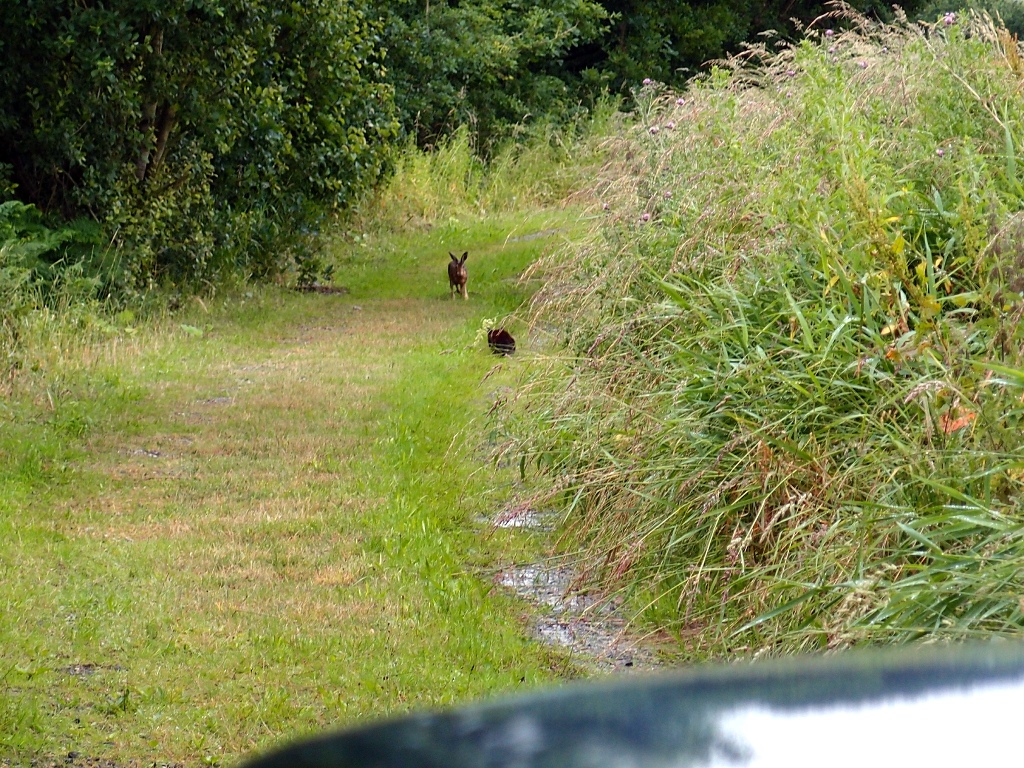
On the sightings front the only bird of note was a Siskin flying south and it will be interesting to see what their numbers are like this autumn compared to last year's huge and protracted irruption. However, the most interesting sighting of the morning actually turned out to be a close encounter between a young Brown Hare and a feral cat. It was one of those occasions where part of me wanted to see what would have happened had the hare got within the cat's striking distance but another part of me didn't want anything unfortunate to happen to the hare. Hares don't always seem to see what is straight in front of them (if it keeps still enough) and this was a perfect example of that. It was my movement at the back of the car that caused the hare to stop and turn side on and it sat motionless for at least a minute before turning round and steadily hopping away; I am not sure that it even noticed the cat.


Brown Hare slowly moving down the track directly towards a feral or farm cat. I only had a compact camera with a small zoom so I didn't manage to get any close-ups.
I am fairly certain that the hare would have carried on towards the cat had it not noticed me moving from behind the car. 
Anyway I will now never know how such an encounter would have turned out but at least the hare didn't come to any harm.

Wednesday, 6 July 2016

Long distance Dove.

Regular readers of this blog may just remember a post (link here) in which I detailed my failure to catch a French ringed Blackcap in a friends garden. While I didn't catch the Blackcap that day, way back on 30/12/14, I did manage to catch a Wren, 3 Dunnocks, 4 Blackbirds, 4 Blue Tits, 2 Coal Tits and a Collared Dove. The chances of getting a recovery from that small catch is extremely low and the chances of getting a long distance recovery is even lower so you can imagine my surprise when I received a recovery report for the Collared Dove and it had been found 308 km away in Scotland.

ES10154    Collared Dove
Ringed        30/12/2014     Hindley Green, near Hindley, Greater Manchester
Found         07/06/2016     Buchlyvie, Stirling, Scotland.   308 km NNW, duration 525 days.
It was reported as being found unwell and that it died overnight.


This is the first recovery I have ever had for a Collared Dove and it prompted me to do a bit of reading up on the species. The section on Collared Dove in the BTO Migration Atlas starts with the usual summary of its colonisation of the UK - first recorded in 1952, first recorded breeding in 1955, firmly established by 1963 and that current abundance broadly mirrors that of the human population. However it goes on to say that dispersal distances have reduced since the mid-1970s and that there is little recent evidence for the long distance dispersal that assisted their spread across Europe and subsequent colonisation of Britain & Ireland.

The Migration Atlas was published in 2002 so I also trawled through the Online Ringing Reports on the BTO website to look at more recent recoveries. The Online Ringing Report currently shows data for the last 9 years (2007 - 2015) and, interestingly, there were only 5 movements of over 100km reported within Britain & Ireland during that period. In addition there were no recoveries abroad of birds ringed in Britain & Ireland and only one foreign ringed Collared Dove was found here, a bird ringed in western France that travelled 843 km north to South Yorkshire. This strongly suggests that the reduction in long distance dispersal since the mid 1970s has been maintained.

The number of Collared Doves ringed each year has been broadly similar for many years with the average for the last 9 years being 771. This is less than I had expected given how common they are but then they are very adept at avoiding and getting out of mist-nets which is the most commonly used trapping method employed by ringers. Even looking all the way back to 1966 the annual totals are generally in the mid to high hundreds and only exceed the 1,000 mark occasionally, with the highest total being 1,817 in 1971, so the continued low occurrence of long distance movements over the last 9 years isn't a result of fewer Collared Doves being ringed each year.

So the recent recovery of ES10154 in Scotland is more unusual than I initially realised as reports of long distance movements are less than annual and seem likely to remain that way. It's hardly surprising that Collared Doves became more sedentary following the colonisation of our islands as those birds that continued to disperse over long distances to the west or northwest would increasingly find themselves over the sea and perish. It seems, therefore, that long distance dispersal has largely been bred out of British and Irish Collared Doves and that long distance movements will remain the exception and serve as an occasional reminder of a previously more commonly held trait that helped the species spread from their ancestral haunts in Turkey and the Middle East.

Collared Dove
References:
BTO, Wernham C., et al. ‘’The Migration Atlas: Movements of the Birds of Britain and Ireland.’’ London: T & AD Poyser Ltd (A & C Black) (2002).

Robinson, R.A., Leech, D.I. & Clark, J.A.(2015) The Online Demography Report: Bird ringing and nest recording in Britain & Ireland in 2015 BTO, Thetford (link here)


Thursday, 23 June 2016

Down by the seaside.

Yesterday I had a ride over to Ainsdale beach, near Southport, with my son, Jack, and the dogs and although we had primarily gone there for a walk I had my camera gear with me, just in case we came across anything interesting. This is a very popular stretch of coast but there were very few people about, as is to be hoped during weekday working hours outside the school holidays. In fact we only saw about ten people in the four hours we were there and some of them were in the distance.

We walked south along the strandline for a mile or so before gradually working our way out towards the incoming tide. The dogs got a good run but they were brought under control well before we got near to any roosting or feeding birds to avoid causing any disturbance.

Good numbers of Cormorants were gathered at intervals along the beach.
The vast majority of the Cormorants were pale-bellied sub-adults.
The incoming tide pushed some waders towards us and they were soon left huddled on a small sand bar as the tide raced in and around them. The majority were Knot but there were smaller numbers of Oystercatchers and a couple of Bar-tailed Godwits.
Surprisingly the longer legged Oystercatchers were the first to leave the rapidly shrinking sand bar.
The Knot pushed closer and closer together as the tide rose.
Eventually they had to move.


The Knot didn't go far and they landed closer to us so I grabbed a few shots in the hope of finding a colour-ringed or leg-flagged bird. On reviewing the photos at home I didn't manage to pick out any colour-marked birds.


It wasn't long before the tide moved them and us on again.


I estimated that there were about 400 Knot and no I haven't gone through them to check.
Having enjoyed the unexpected spectacle provided by the Knot we headed back up the beach to one of the higher strand lines before slowly making our way back north. We hadn't gone far when my eye was drawn to a photo opportunity provided by roosting gulls, Oystercatchers and Cormorants with Blackpool Tower and the 65m high 'Big One' roller coaster on the horizon behind them.

The roller coaster and tower are approximately 20km and 22km north from this part of Ainsdale beach.
There were about 100 Cormorants in this roost including a few that are just out of the frame. 
Still heading north we walked closer to the dune edge and associated marshy areas at the top of the beach. This is quite a good area for nesting Skylarks, Meadow Pipits and Reed Buntings. It is also heavily walked which means the birds are used to seeing people and some of the Skylarks are particularly confiding.

I would like to claim that I intended to capture the flying bee in this photo but I obviously didn't. However, the Skylark is in there on purpose.
The Skylark was by a path and it allowed me to approach to within a few metres.
Squatting down changed the background to one of a hazy blue sky. The impressive hind claw can be clearly seen.
We moved on, leaving the Skylark to go about its business, and ventured further along the edge of the dunes. As we walked on a Little Egret flew south, to our left, along the top of the beach and a little while later a Grey Heron also flew south but this time to our right, over the edge of the dunes.

As big and as white as it is we nearly missed this Little Egret.

Grey Heron.
We ventured into the sand dunes for the final leg of the walk and the trail we followed was bordered with a good scattering of Pyramidal Orchids. Further along the trail our attention was drawn to the pink and white flowers of Broad-leaved Everlasting Pea that was growing up the side of one of the smaller dunes.

Pyramidal Orchid
Broad-leaved Everlasting Pea added a real splash of colour.
Almost back to the car park and the walk was rounded off with some feeding Jackdaws. That pale powder-blue eye on the lookout for any morsel of food.

Adult Jackdaw
All in all a good day and I am sure the dogs would say so too.

Friday, 17 June 2016

Chiffchaff to Norway and another closer to home

Recent recoveries included details of two Chiffchaffs that were ringed on Billinge Hill last autumn. Both were ringed as first-year birds and both were controlled (caught by other ringers) this spring, but in very different places. One was caught at Lista Bird Observatory in southern Norway while the other was caught just north of Liverpool.

JBX573         Chiffchaff
Ringed          29/08/2015     Billinge Hill, Merseyside.
Controlled     08/05/2016     Lista Fyr, Farsund, Vest-Agder, Norway.   773 km NE,  253 days.


It should be remembered that the line on the recovery maps simply joins the ringing and finding places and does not represent the route taken by the bird.

A check of the BTO Online Ringing Report (link here) for 2015 revealed there had only been a total of 7 BTO ringed Chiffchaffs found in Norway (includes all records received up to the end of April this year) although a total 26 Norwegian ringed birds have been found here. This shows that recoveries in Norway are particularly uncommon and this bird is potentially only the 8th British ringed Chiffchaff to be found there.


JBX773        Chiffchaff      
Ringed         17/09/2016     Billinge Hill, Merseyside.
Controlled    14/05/2016     Fulwood Marsh, Merseyside. 19 km W, 240 days.


The recovery of JBX773 fits in with the more usual pattern of recoveries for birds returning to the general area they came from. In fact this bird may have returned to the site or close to the site where it was originally bred. Many warblers disperse in random directions before migrating south in the autumn and this bird could have moved east to Billinge, where it was ringed, as part of its post juvenile dispersal last autumn.

256 first-year Chiffchaffs were ringed at Billinge last autumn. Peak migration was in September when 122 were ringed, including the bird in this photograph.