Friday, 24 November 2017

Goldcrests: interesting from head to tail

Seeing is believing sometimes and certainly is when it comes to a Goldcrest I caught earlier this month and another one I caught today. The first of the two was carrying an old injury, the likes of which I have never seen before, and the second is yet another known age adult with quite pointed tail feathers.

The first bird was caught at Billinge on 15/11/17 and appeared to be fit and healthy apart from having no skin and feathers on the rear of the skull. It was obviously an old injury as the edges of the skin than surrounded the expose portion of skull were dry and showed no signs of redness or infection. I have no idea what caused the injury but it shows how resilient such a small bird can be. It weighed 5.5g and was heavier than 6 of the 7 other Goldcrests caught that morning, 2 of which were larger males, so it was clearly doing OK. The biggest problem that this type of injury will cause is increased heat loss so while it appears to be thriving now its survival chances may be reduced as the weather gets colder, but then all Goldcrests have a tough time surviving when it comes to a cold winter.

Just looks a little ruffled from the front.

Wow! Now that is what you call a bald patch. Would you have believed a bird could survive that if you hadn't seen it.

The condition and shape of the tail feathers suggested it was an adult.

A real survivor

The second Goldcrest was a retrap that I caught in the garden this afternoon. It was a male and when I looked at the tail it certainly didn't shout adult but the bird's ring number was from a sequence I was using at the beginning of the year so it had to be one. When I looked up the original ringing details it had been ringed in the garden on 22nd January so there is no question the tail you see in the images below is that of an adult.

Tail of adult male Goldcrest caught 24/11/17

Tail of adult male Goldcrest caught 24/11/17
The outer tail feathers were a bit paler and a bit more pointed than the others but they didn't appear to be as worn or as bleached as I would expect them to be if they were feathers that hadn't been replaced in the last moult. Having said that I have never caught a Goldcrest just prior to undergoing a complete moult or seen one with two generations of feathers so I don't know how worn or bleached old tail feathers get by the time they are normally moulted, let alone a couple of months on. However, I would expect them to look very bleached and extremely worn by now, especially the outers, and be much more obvious than appears to be the case with this bird. Forgetting the outer feathers the rest are quite pointed anyway and nearer the shape many associate with juveniles rather than adults. All 3 of the known age adults I have caught recently have had quite pointed tail feathers and it wouldn't surprise me if most adults have tail feathers with a shape that falls in the intermediate range of adults and juveniles and a good number probably get incorrectly aged as juveniles rather than being left unaged.

Images of the tails of the other known age adults can be found here and here.

Friday, 17 November 2017

Siberian Chiffchaff

This was a very nice surprise this morning as it is a bird I thought was likely to stay on my 'Billinge possibles' come 'wish list'. The site is looking quite bleak now that most of the trees and bushes have lost their leaves and being on a hill it does not have the sort of micro climate that attracts and holds late autumn and winter warblers. However, it is a great site for migrants and this Siberian Chiffchaff ('tristis') is presumably still on route to a nice warm sewage works or some wetland scrub on lower ground.


I am not going to go through all the plumage criteria as the images speak for themselves and there is plenty of information out there on the web, but it ticks all the boxes with one teeny weeny exception. The one thing it has that 'tristis' is not supposed to have is a hint of yellow in the supercillium immediately above the eye but then the full plumage limits of 'tristis' have yet to be determined so it isn't necessarily a problem. However, if a clincher was needed it came when it conveniently called, once in the hand and several times after release, with the call being a monosyllabic 'peep', a bit like a high pitched Bullfinch, and perfectly fitting the diagnostic call of 'tristis'.

Given that hint of yellow in the supercillium (not that I think it would have been noticed in the field) and as the plumage limits of 'tristis' are not fully understood I retained a couple of small feathers that the bird dropped. Hopefully, they will allow the bird's identity to be confirmed from their DNA so this may not be the last you here about this particular Chiffchaff.

Ringing totals for 17/11/17 were: Goldcrest 1; Siberian Chiffchaff 1; Blackbird 1; Redwing 11; Chaffinch 1.

Tuesday, 14 November 2017

Billinge: 11th & 13th November

It is that time of year when ringing forays on the hill go all country music which is OK if you don't mind slim pickings. The first hour or so usually manages to provide a few birds but the capture rate usually tapers off quite quickly and the remainder of the session often feels like there would be plenty of time to start learning to play the banjo. While the quantity and variety may not be there a degree of quality usually is and there is always a chance that something really interesting or unusual may turn up.

A fog hampered session on the 11th produce a total of 18 birds - 4 Goldrest, 3 Blackbird, a Fieldfare, 7 Redwing and 3 Chaffinches. Two of the Blackbirds were quite long-winged so likely to be of continental origin as were a couple of the Chaffinches. There haven't been as many Fieldfare passing through this autumn so catching one was a real bonus.

Adult female Fieldfare 11/11/17
A session in clearer conditions on the 13th also resulted in a total of 18 birds being caught - 5 Goldcrest, 12 Redwing and a retrap Robin. The stand out highlight of this session was an Icelandic Redwing which stood out as looking different even as I approached it in the net.

Previous posts with images of 'coburni' types have always attracted a lot of views and there is clearly a lot of interest in the identification of Icelandic Redwings. Some people think wing length is the key to identifying Icelandic birds but there is a huge overlap between 'coburni' and and the nominate race 'iliacus' and wing length will only identify the biggest 'coburni'. Icelandic birds are generally darker and more heavily marked than the nominate race and while that can lead to a bias of only identifying the darkest and most heavily marked birds it will identify more birds than wing length. Anyway you can decide for yourself by looking at the images below and the previous ones I have posted here and here.

Note the brownish-buff washed ground colour to the heavily marked flanks and undertail coverts.

Obviously the Icelandic bird is on the left with a nominate 'iliacus' on the right for comparison.
By the way there is a country music outfit called Slim Pickins and there is another band called Slim Pickings although they play different genre altogether, not that either is really my cup of tea.

Sunday, 5 November 2017

Billinge: 1st - 4th November 2017

The new month started with a better than expected catch of 50 birds but numbers were much lower over the following 3 days and only resulted a combined capture total of 49. Early November can be quite productive but it looks like migration is drawing to a close a little earlier this year, although there could still be enough of interest to make occasional visits worthwhile right through to the end of the month.

Ist November
Ringing highlights included a Blackcap, a Fieldfare, 15 Goldcrest and a control Lesser Redpoll. Interestingly, the Redpoll was one I had encountered before; it was originally ringed on 03/04/14 in Llanfyllin, Powys, North Wales and subsequently recaptured at Crawford five times in spring/summer 2015, and again at Crawford in spring 2016. The ringing site at Crawford is only a couple of kilometres from the site Billinge but the distance from Llanfyllin to Billinge is 88km NNE. Sightings of note included a Woodcock, 4 Crossbills heading SSW and hundreds of Chaffinches heading north.


Now we are in November there is an increasingly likelihood that any Blackcap caught is an arriving winter visitor rather than a late departing summer visitor.
2nd November
A relatively short and quiet session with only 17 birds caught but a small movement of Lesser Redpolls resulted in 7 being ringed. This was made all the more remarkable by the fact that they were all adults. I have previously remarked on the unusually high proportion of adult Redpolls recorded at Billinge this autumn but a total absence of first-year birds in a catch of that size is unprecedented in my experience. A total of only 2 Goldcrest was also noteworthy because it contrasted sharply with the 15 ringed the previous day.


Adult male Lesser Redpoll.

I don't usually mention movements of Pink-footed Geese as they are a regular occurrence over the site at this time of year and may involve local feeding movements as well as cross country migration.


There are around 290 Pink-feet in this photo.
3rd November
Another quiet session that had a real end of season feel to it. Only 12 birds were caught of 4 species but they did included another Lesser Redpoll and yes it was another adult.

4th November
A slight improvement in both numbers and variety with 20 birds of 7 species being handled. A Blackcap was the best the nets produced but a noisy Hawfinch, that gave good views as it headed NNE at close range, was the standout highlight of the session. The penultimate bird ringed was a Lesser Redpoll and no prizes for guessing it was yet another adult. I have caught 12 Lesser Redpolls so far this month and every one has been an adult which is exceptional to say the least. On the theme of adults a Goldcrest that had been ringed as a juvenile in July 2016 was recaptured and provided another opportunity to photograph and show the tail shape of a known adult.


Adult female Lesser Redpoll 04/11/17

This adult had very rounded tail feathers but some adults can have tail feathers that are a bit more pointed in shape but still with a slightly rounded tip. In either case they always look very fresh at this time of year.

Another known age adult Goldcrest that has a relatively pointed shape to the tail feathers.  This tail shape is probably quite common in adults and why it is safest to leave intermediates unaged as recommended by Svensson.

It is just as pointed whichever way you look at it. JJH333 was ringed as a 3J on 12/07/16 which confirmed it was an adult when retrapped 04/11/17.

Combined ringing totals (retraps/controls in brackets) for the period were: Goldcrest 22(4); Blue Tit 5 (3); Willow Tit (1); Long-tailed Tit 3; Blackcap 2; Fieldfare 1; Song Thrush 1; Redwing 31; Robin (1); Dunnock 1; Chaffinch 9; Lesser Redpoll 11(1) Goldfinch 3. Total 89 new birds, 9 retraps and 1 control.

Wednesday, 1 November 2017

October 2017

A session at Billinge on the last day of the month produced a catch of 38 birds and was made up of 36 new birds, a retrap and a control. There were a few Goldcrests in every net round and they easily took top slot with 24 ringed. There weren't many thrushes moving but a Fieldfare found its way into a net and was the first to be ringed this autumn. Just a couple of Lesser Redpolls were caught but I was pleased to discover that one of them was a control (a bird ringed elsewhere) so it will be interesting to find out where that one has come from.

The control Lesser Redpoll was an adult female with ring number S341203.
Ringing totals (retraps/controls in brackets) for 31/10/17 were; Great Spotted Woodpecker 1; Goldcrest 24; Blue Tit 1; Great Tit 1 (1); Fieldfare 1; Redwing 7; Lesser Redpoll 1 (1).

A total of 746 birds were ringed at Billinge during October which is disappointing by that site's standards and is roughly half the total achieved in previous years. The main reason for this has been the lack of easterly winds which has resulted in much lower numbers of Redwings and Goldcrests passing through the site. However, Redwing and Goldcrest were still the most numerous species ringed by far and they topped the totals for the month with 292 and 259 respectively. Song Thrush came in third with 50 followed by Lesser Redpoll with 29 and Blackbird with 21. At the other end of the scale a Tawny Owl was only the second to be ringed at the site and a Firecrest was only the third ringing and sighting record of that species.

Sunday, 29 October 2017

Billinge 29/10/17 and a bit on ageing Redwings too.

A cool northerly breeze and relatively clear conditions contributed to a fairly low-key session at Billinge this morning. A few thrushes were moving early on and most of those that were ringed were caught in the first hour. Otherwise it was fairly quiet which, combined with single figure temperatures, gave the morning an end of season feeling.

Only 1 Lesser Redpoll was caught today but, interestingly, it was another that had a yellowish-orange poll rather than the usual red colour and is the 3rd to be caught with this pigmentation variation this month.  It has been a relatively poor autumn for Redpolls so far with only 37 caught to date. The ages of these birds suggest they have had a poor breeding season as 20 (including today's bird) have been adults, only 15 were first-year birds and 2 were left unaged.


Adult Lesser Redpoll


The 3rd to be caught with an 'Amber' poll this month.
Far fewer Redwings and Fieldfares have been recorded this autumn due to the lack of easterly winds but the same can't be said for migrant Song Thrushes. Their numbers have held up surprisingly well and are only a little down on the number recorded last autumn. Another 3 Song Thrush were ringed today and all 3 were obvious 'continental' birds.


Continental Song Thrushes don't get much more obvious than this one. Cold grey toned above, more extensive white below and smaller than our warmer brown British subspecies 'clarkei'. 
Ringing totals for 29/10/17 were: Goldcrest 8; Blue Tit 2; Blackbird 1; Song Thrush 3; Redwing 14; Greenfinch 1; Lesser Redpoll 1.


I have been meaning to post some photos on ageing Redwings as I have encountered a few interesting individuals recently but here is one from the 27th and another from today to ponder on.


The very plain wing (lack of well defined pales spots on any of the greater coverts and lack of tertial markings) suggest it is an adult but see the image of the tail below. 

Two old tail feathers in an otherwise adult tail show this bird to be a first-year. This bird appears to have undergone a very extensive pj moult and had it replaced all the tail feathers this bird would have been indistinguishable from an adult. According to the literature juvenile Redwings rarely replace any tail feathers as part of their pj moult and if they do it is only supposed to be one or two. This bird obviously didn't read the literature and perhaps we shouldn't be surprised as many species are having more extensive pj moults these days which is probably linked to climate change. There is also the possibility that it replaced most of its tail feathers following accidental loss but the fact that it appears to have replaced all its greater coverts and tertials suggest a more extensive pj moult is the more likely cause of the tail feather replacement.
A very well marked wing with well defined pale tips to the greater coverts, especially the outers, and large, fairly angular pale tips to two of the tertials but what does the tail tell us.


The tail feathers are fresh, broad and quite rounded with some almost being square ended so it is clearly an adult. 


Here is the whole bird just in case you didn't think the wing and tail could be from the same bird. It is just a very well marked adult.


Thursday, 26 October 2017

Starling Down

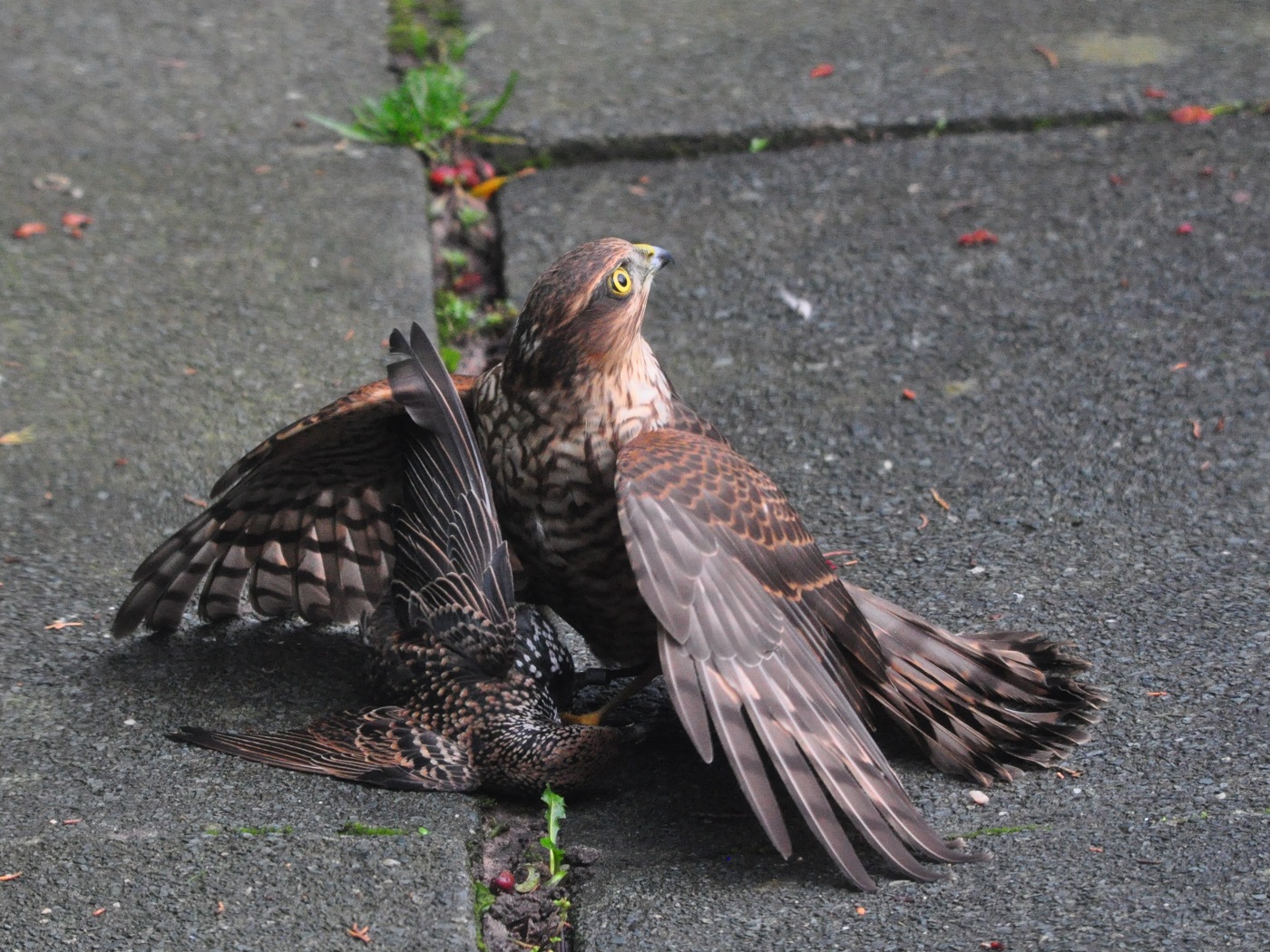
A thud against the window drew my attention to a commotion in the garden late this afternoon and when I looked out a young male Sparrowhawk was trying to pin down a Starling on the garden path. I think the Sparrowhawk had caused the Starling to veer into the window and had grabbed it on the rebound before taking it down on to the path. The Starling did its best to try and get away and it took the Sparrowhawk a good 2 or 3 minutes to get it fully under control.

I grabbed the camera and took a few photos through the window but it was very overcast and the light levels were really poor. Even at ISO 1600 I could only get a shutter speed of 1/50th of a second so most of the images were a blur from the birds' movements and an element of camera shake. I only shoot JPEGs so that doesn't leave much scope for fancy editing but most couldn't have been salvaged even if they had been taken in RAW format as they were far too blurred and or out of focus. However, there were four images that didn't turn out too bad with a bit of basic tweaking and as long as you don't look at them too closely.


The Starling was one of my colour-ringed birds but I didn't manage to get the ring number before the Sparrowhawk carried it away which is a really unfortunate. I am fairly sure it will have been a first-year bird as most of the Starlings that have been visiting the feeders recently are birds that were ringed as juveniles in the spring and early summer.