Showing posts with label Anglesey. Show all posts

Monday, 2 May 2016

Anglesey 23rd - 30th April 2016

A week long break on Anglesey coincided with an unkind jet stream that resulted in a blast of cold arctic air. Fortunately the worst of the heavy and occasionally wintry showers missed us and the chill from moderate to strong north-westerly wind was partially offset by plenty of glorious sunshine. It wasn't a birding trip as such but I still got quite a few hours in, especially first thing in the morning, and you always have to carry bins or camera with you, don't you.

The breakwater at Holyhead certainly served its purpose in the face of a strong north-westerly.
The sea didn't seem to be particularly rough so it would be interesting to see what it is like during a big storm.
This is one of two Black Guillemots that were taking advantage of calmer conditions behind the breakwater
An Oystercatcher viewed from the living room window. This was one of a pair holding territory by the cottage that we stayed in, near Church Bay.
There were good numbers of Whimbrel around. Up to 39 commuted between the fields and the shore near the cottage.
Up to 70 did the same just a couple of kilometers down the coast .
There was a good scattering of Rock Pipits as you would expect.
Back near the cottage a pair of Stonechats were busily feeding young in the nest.
There were a few Wheatears passing through (mostly large Greenland birds).

Another Wheatear gets a bit of shelter from that cold north-westerly wind.
The barbed wire fence makes this photo for me.
While your not guaranteed to get good weather on Anglesey you would be unlucky not to see Choughs along any suitable stretch of coast.

This pair frequented the cliffs and clifftop pasture close to the cottage and coastal footpath. The male displays with quivering outstretched wings to a rather disinterested looking female.
She continued to feed and he continued to work those wings as they made their way along the bank. This was followed by a bit of an aerial display.
So the island wasn't lifting with migrants, as it could have been in late April, but it was still a good a week and a change of scenery that has set me up for several weeks of watching Starlings for my RAS project. In fact I started as soon as I got home and logged sightings of 34 colour-ringed Starlings coming to the fat cakes; I also caught and colour-ringed another three.

Thursday, 25 July 2013

Beauty and the beast on Anglesey

I have just returned from a few days camping on Anglesey with my youngest son, Jack, and Bryn, the dog. We managed to get away in time to take advantage of the end of the spell of hot sunny weather before it finally broke. The first three days were hot with wall to wall sunshine but the last day was cloudier and very muggy.

One of our favourite walks is around the southern shore of Red Wharf Bay below Pentraeth Forest. The first day we walked this section of the coastal path the sun was beating down and there were plenty insects around. Whilst walking the section of the path that runs along the top of a wall we spotted a Common Hawker dragonfly laying eggs in a small pool below. A still pool at the top of a salt marsh is not somewhere I would normally expect to see a dragonfly laying eggs so this pool must rarely get inundated with sea water and may also be spring fed.

I had left the DSLR at home and we only had a couple of compact cameras with us but we still managed to get some decent shots. This female was so engrossed in egg laying that she allowed extremely close approach.


female Common Hawker (Aeshna juncea)

When I say she allowed close approach I mean extremely close. The following sequence of shots was taken by Jack and show just how close I was able to get. I haven't seen such a confiding dragonfly before so getting this close and watching her behaviour was a real pleasure. The odd time I disturbed her, when I dropped the cap off the front of the camera or got too cheeky and removed the odd rush stem, she only flew round and fed for a minute before returning to lay more eggs.


Who needs a telephoto lens when you can get this close to the subject.
Getting close wasn't a problem but getting focus lock in the right place often was. We probably spent the best part of an hour taking photos and the dog got extremely bored. He eventually got fed up of waiting for his walk to continue and went to sleep.
Bryn yawns at all the fuss over a common dragonfly


While we were taking photos of the dragonfly another insect visited the pool but we couldn't work out what it was. It was about the size of a queen bumble bee but it moved so fast you couldn't really focus on it, all you could see was a blurred shape. It was a noisy beast and made a low buzzing noise but we still hadn't a clue what sort of insect it was. Whatever it was it would suddenly appear about 18 inches over the water and then drop down a few times in quick succession and you only really knew that from the ripples it made from contact with the water. The action was far too fast to see any details and all we were aware of was the buzz, the blur and the ripples. We pondered over what it could be but we hadn't a clue. I hadn't encountered anything like it before in all my years of working and ringing in wetland habitats.

We decided to visit the area the next day and Jack suggested we take a butterfly net should we happen on the mystery creature again. When we got to the pool where we had photographed the dragonfly the day before the mystery creature was there and causing ripples in the water. I climbed down from the wall as fast as I could but it had gone before I had chance to make a sweep with the net. I decided to wait and after about 20 minutes another or the same returned. I saw the first set of ripples and swept the net over the pool. I could hear I had caught something and put the net on the ground closing the bag of the net in the process.

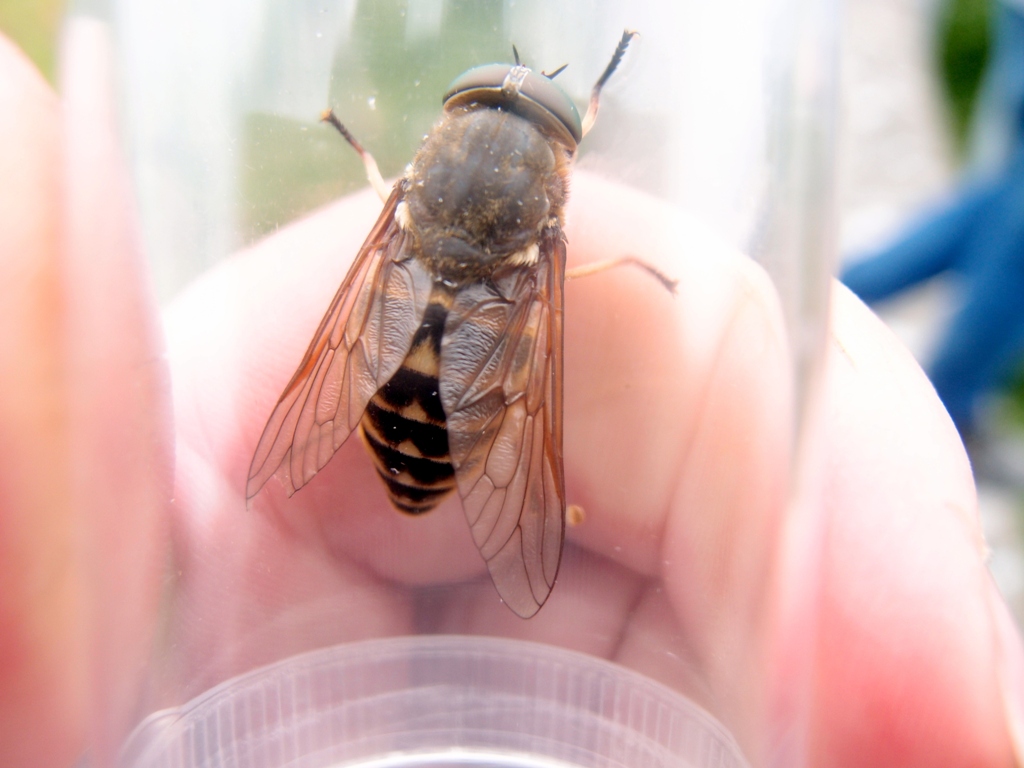
On looking at what I had caught I could see it was a very large fly of some description but it wasn't like anything I had seen before in terms of size that is. It was huge as flies go and very scary looking too. I put it in a tub to get a closer look and to take some photos for identification. It was over an inch long and looked like it could give a nasty bite so I wasn't prepared to try and handle it outside of a tub. I tried to search for what it could be via the internet on my phone but I couldn't get a good enough signal so had to give up. We were due to go home that evening so it would have to remain a mystery until then.


Mystery a fly. Surely something this big was going to be easy to identify.

On getting home a few internet searches using phrases like 'largest fly in the UK' soon revealed it to be a large tabanid fly and probably the Dark Giant Horsefly (Tabanus sudeticus). There is a very similar and equally large insect called, unsurprisingly, the Pale Giant Horse-fly (Tabanus bovinus) but that is much rarer in the UK. I just didn't know we had horseflies that size in this country and it is not something you would easily overlook. It is the heaviest fly in Europe and is also known as the Dark Behemothic Horsefly. It seems to have a patchy distribution in the UK and is fairly common in parts of the southern England, Wales, the Lake District and in parts of Scotland. Thankfully it appears to be absent from this part of northwest England.


Dark Giant Horsefly (Tabanus sudeticus).
This is one scary mother of an insect. Only the female drinks blood prior to egg laying with the males only feeding on nectar. The eggs are laid on vegetation by water or over damp ground and the larvae are aquatic predators or predators of damp soils and rotting vegetation. I can only assume that the quick dips in the pool were the insect's way of grabbing a quick drink as I can't find any reference to them laying eggs in water.


Dark Giant Horsefly (Tabanus sudeticus).
Apparently they rarely bite people and it is hardly surprising as this beast makes too much noise to sneak up on you. Whilst searching the internet I did find a reference to a story of someone who wanted to know what the bite was like and if you want to find out more you can read about it by clicking here.

The insects in this post have something in common in that they have been around in some form or other for a very long time. Both descend from a lineage that dates back to prehistoric times and both had much larger relatives in the past. Prehistoric dragonflies had wing spans of over two feet so I wouldn't want to have encountered the dinosaur blood sucking equivalent of our horsefly.

Sunday, 2 June 2013

To Anglesey and back.

I spent the last week camping on Anglesey with my youngest son, Jack and Bryn the dog. It was more of a getaway than a birding or mothing trip but we do a bit of both pretty much wherever we go. The weather was not on our side as the cold spring continued to hold its grip for most of the week; the first few days were more like early March than late May.

I had taken an actinic moth trap with me but the first night drew a blank as it was so cold. The weather was even worse the next night with strong winds and heavy rain so I didn't even bother putting it out. Things only improved marginally from there with catches in low single figures. Only 10 moths were caught over 5 nights which is a dismal total for the location at this time of year and testimony to the protracted winter and cold spring. Best of the meagre pickings were a Water Carpet and a Puss Moth neither of which I catch at home.

Water Carpet (Lampropteryx suffumata)

Puss Moth (Cerura vinula), a rather worn and weather beaten individual.

What birding we did was secondary to walks around some of our favourite parts of the coast but then you can't do one without the other. A few migrants were still in evidence with 3 Greenland Wheatears present in one of our favourite bays. Amongst the waders groups of migrant Ringed Plovers stood out in particular. Generally though birds were perhaps thinner on the ground than might be expected especially in the case of some of the breeding species, if you exclude corvids that is. Lapwings were conspicuous by their absence from all the farmland areas we drove through and visited not least the farm we camped at.
 
female Wheatear and almost certainly of the Greenland race or 
at least as certain as you can be without catching and measuring it.

 
Same female as above.


Male Wheatear but a bit more tricky as to race and not an obvious
'Greenland' type but certainly still on migration.
 
Although there are more Dunlin in this shot groups of Ringed Plover were much in evidence.

Bryn has learned that he has to be patient when we are taking photos,
 some of the time at least.
On the plus side the increase in Little Egrets is hard to overlook and doesn't seem to have been dented by the recent hard winters. On one of our walks around Red Wharf Bay 5 were feeding on the falling tide including a colour ringed bird which was probably ringed at Bangor on the mainland. I have sent the details of the sighting off and will give an update on its life history in due course.


Little Egrets, colour ringed bird on right.
Colour ringed Little Egret.
On returning home yesterday I set the moth trap in the garden out of habit rather than expectation of a good catch. On checking it this morning there were only 3 moths but all 3 were new for the year - a Lime Hawk-moth, a Flame Shoulder and a Diamond-back Moth which is a migrant to the UK. The latter being the least expected given the cold weather and wind direction. The lack of moths and insects in general over the last few weeks is likely to have a profound effect on breeding birds that normally feed their young on insects and caterpillars in particular. The effects of the long winter and cold spring are likely to be felt and reported on for a long time yet.

Lime Hawk-moth (Mimas tiliae)

Flame Shoulder (Ochropleura plecta)
Diamond-back Moth (Plutella xylostella)


Sunday, 19 August 2012

Back after a short break on Anglesey 7th - 11th August

It is over two months since my last post, this has been largely due to protracted problems with my broadband connection which was only finally resolved after I changed service provider. Pressure of work and the miserable weather also playing a part. Hopefully I will be able to post more regularly from now on.

Back to the subject of the post and a recent camping trip with my youngest son, Jack, and the dog on Anglesey. It wasn't a birding trip and was just a chance to get away and relax for a few days. My holidays coincided with a spell of fine weather so we packed the car and headed off to our favourite camp site near Malltraeth. We arrived in the late afternoon and were greeted by 3 Little Egrets on the pool by the entrance to the site. This pool held up to six Little Egrets and 3 Grey Herons over the next few days.

Once we had set up camp we went for an evening walk at Aberffraw. We hadn't gone far towards the beach when I noticed a Short-eared Owl flying over quite high. This was a bird I hadn't expected to see so I was really surprised when it was followed in quick succession by another two.

One of 3 Short-eared Owls at Aberffraw
I didn't take a moth trap but the lights are left on all night in the camp site toilets and usually attract a variety of critters. Pick of the bunch was a Small Blood-vein.

Small Blood-vein
We made our usual pilgrimage to St Cwyfan, the Church in the sea, on what turned out to be another glorious day. The Sand Martin colony in the earth cliff at the top of the beach was still quite active. I tried to get a few shots of the birds in flight but failed to get anything other than record shots. Two Grey Herons made easier subjects when they had an aerial battle over a feeding area.

St Cwyfan's, near Aberffraw

St Cwyfan's, near Aberffraw
 
Juvenile Sand Martin.

Adult Sand Martin preening on the wing.

Grey Herons

Grey Herons
The first longish walk of the trip was along the beach from Newborough Forest to Abermenai point on a scorcher of a day. Best of birds here was a Merlin attacking a small flock of Linnets at the point.

Bryn enjoys the beach off Newborough Warren

and the impressive dunes

View to Snowdonia from Abermenai point.
Field Grasshopper picked up in the dunes
We also made a couple of visits to Red Wharf Bay and explored the southern side below Pentraeth Forest. The habitat along this section of coast looks really good for holding migrants and is an area I will visit again.

Red Wharf Bay

Yours truly with Bryn

An obliging Common Darter

An obliging Common Darter
One constant of any visit to Anglesey are the Hawk trainers flying out of RAF Valley and there are great viewing areas near Rhosneigr.