Showing posts with label Blue Tit. Show all posts

Monday, 3 April 2023

Another Un-bill-ievable Blue Tit

 A Blue Tit with a deformed beak has been visiting the garden for the past couple of months. Its very overgrown mandibles clearly cause it problems when feeding but it has adapted by tilting its head to one side and searching through suet pellets on the bird table to try and find smaller pieces and crumbs it can pick up and eat. It frequently feeds on the ground below a fat ball feeder where it can also find small pieces and crumbs that other birds drop or dislodge when feeding on the fat balls.


More recently it has taken to using a window feeder that allows it to pick through sunflower hearts, suet pellets and partially crushed dried mealworms. I wouldn't normally use a window feeder but it was bought for me as a Christmas present so I decided to give it a go and I am really glad that I did. Birds didn't go near this feeder for ages but this Blue Tit eventually started to take advantage of it and brought it close enough for me to photograph it.


This isn't the first Blue Tit with an overgrown beak I have recorded in the garden and I did a blog post about one I caught in the garden nearly 10 years ago (blog post link here). That bird was more extreme case and had an even longer lower mandible. One thing I have noticed with the current bird is that its bill still appears to be growing, especially the lower mandible. When I first saw it in the garden the lower mandible barely seemed to extend much beyond the upper mandible where they cross but now it clearly extends past the upper by a few millimetres. I suspect both mandibles are still growing but it is just easier to see the change in the lower mandible. If it hangs around long enough I may be able to take more photographs to show that its bill is still growing in the absence of normal wear from pecking, feeding and bill wiping.


Sunday, 12 February 2017

Garden Goldcrest and other visitors

It is not uncommon to hear or see a Goldcrest in or near the garden but it is relatively unusual to see one taking advantage of any of the feeders. A couple of days a ago I noticed a female Goldcrest gleaning food items from the branches below some of the feeders and the following day it was also pecking fragments of fat from the wire mesh of the fat block holder. This morning I noticed it was coming to the fat block and feeding on it fairly regularly so I decided to try and get a few photos.


Goldcrest 12/02/2016


Caught in the act.


In previous years I have occasionally seen the odd one taking food particles that had fallen onto twigs below some of the feeders, also taking small fragments from the base of a sunflower heart feeder and occasionally pecking at the fat blocks but it doesn't happen every winter.


The blunt and rounded tail shape shows this bird is an adult. There doesn't appear to be any orange in the crown so we can be reasonably sure it is a female. Males can keep their orange crown feathers concealed under yellow feathers but you usually get a glimpse of it every now and again, especially if they get a bit agitated. 


It must have found a really good bit up there.
 I make my own fat blocks which contain a very high proportion of dried mealworms and birds certainly seem to know if a fat block is giving them a good nutritional return for their effort. In the past I have experimented when feeding adult Starlings in the early part of the breeding season and the blocks with the higher proportion of mealworms were preferred and attracted more birds despite the fat blocks with the lower mealworm content being almost identical in appearance. It may be trial and error at first but whatever the mechanism they certainly seemed to know which had the better nutritional content.

The Goldcrest came to the fat block about every 20 minutes and only stayed for about a minute on each visit so I ended up taking quite a few photos of some of the other visitors. And, as I have commented on before, there wasn't a single House Sparrow amongst them.


Adult male Starling.
This male is just about in full breeding condition now that its bill has completed the change from being black to the full breeding colours of blue and yellow. The fine and limited spotting to the long throat feathers and flanks shows this bird is an adult (2CY+). 


Male Pied Wagtail.
Two Pied Wagtails regularly come to feed on scraps below the feeders, this male and a very grey backed female that looks similar to some White Wagtails 


Blue Tit
Tits had a fairly poor breeding season last year and very few have been coming to the feeders this winter


Coal Tit
Like Blue and Great Tits there have been fewer Coal Tits coming to the feeders this winter.


This adult female Chaffinch has badly encrusted legs and feet (either mange or avian papillomavirus) and you can just see part of the left foot. It only uses one leg and holds the other up under the feathers but in all other respects it seems to be quite healthy.


This first-year female has escaped infection, so far at least.
Adult male Blackbird
There have been a lot of Blackbirds around this winter with more visiting the garden than I have ever seen before. It is not uncommon for there to be 10 in the garden at one time and many more must visit over the course of a day.


Female Blackbird


There seemed to be a few more Goldfinches around today with up to 25 in the garden at any one time.


Adult male Siskin and what a stunner.

There was plenty of argy-bargy at the feeders.
A nice selection of birds that brightened up what was a rather grey, cold and windy day.


Tuesday, 17 February 2015

Waxwing lyrical part 43 - Ruby Wax

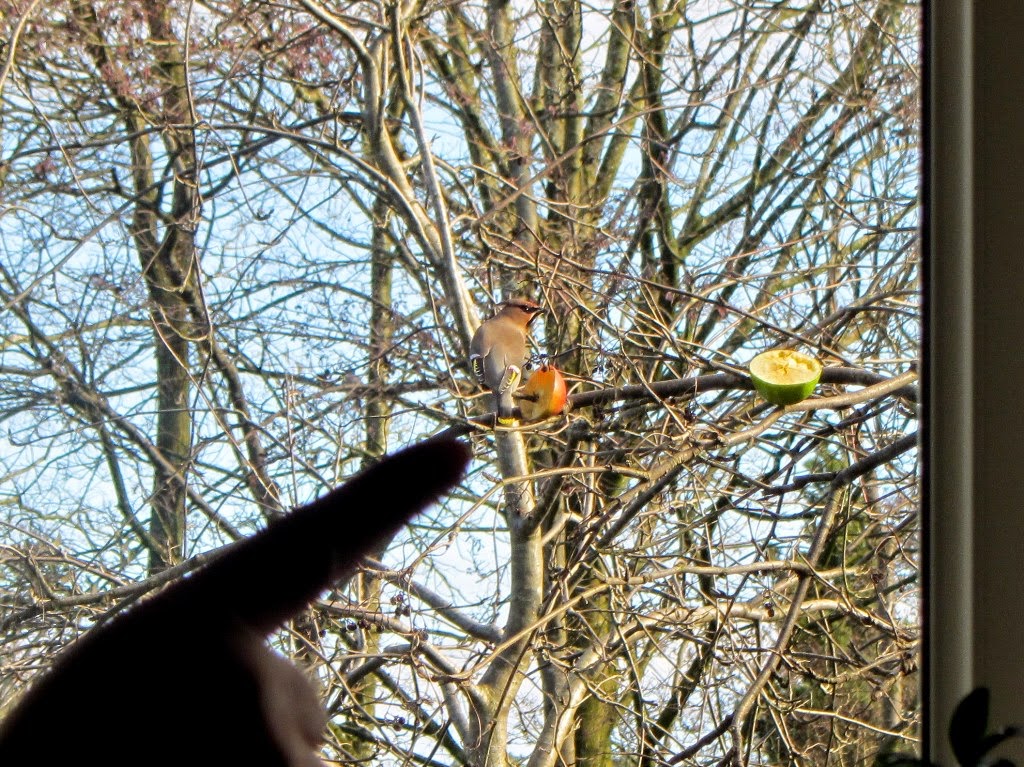
Well the Waxwing is still here and attracting a steady stream of admirers which is hardly surprising with so few in the country. There was a bit more in the way of sunshine on Sunday and a lot more today so I couldn't resist taking even more photographs. Most of them get deleted as it can be difficult to get results I am happy with and that show different aspects of behaviour. I don't always like taking photos in strong sunlight but it certainly does help bring out the colour of the Waxwing's ruby red eye.


Get the light right and that ruby red eye really stands out.
A close up showing the feeding action. The bird seems to favour apples in certain positions that allow it to take a really firm bite and remove a piece with a snipping and pulling or twisting action that involves using the whole of the body. 
The bird's forehead is almost permanently wet with apple juice and bits of apple pulp get stuck on the bill. Wiping the bill on a twig deals with apple pulp on the sides of the bill but does not always clear any that has found its way onto the culmen.
If bill wiping doesn't remove all of the pulp a quick shake of the head throws off the rest.
All the stuff on the branch to the left of the apple is Waxwing poo. Waxwings eat a lot and poo a lot. When feeding continuously it can defecate as frequently as every one to two minutes. Yes I have timed it.
This photograph shows the Waxwing blinking by drawing the nictitating membrane across the eye. This membrane or third eyelid is much more transparent in Waxwings and is not as obvious as it can be in some other species. The transparency of the membrane in Waxwings is presumably an adaptation to help maintain vision and so make it less vulnerable to predation. You can see the forehead is wet from apple juice so it must get quite a lot in its eyes too and therefore it needs to blink frequently when feeding. From what I have seen they appear to blink with every peck but you would need a slow motion camera to confirm that.
Time for a scratch
The nictitating membrane is covering the eye as it scratches. I couldn't tell if it held the membrane across its eye for the duration of its scratching or if it involved a series of blinks.
When alarmed it tries to make itself inconspicuous by elongating and narrowing itself. Basically it tries to make itself look like a twig and part of the tree. The body feathers of a Waxwing closely resemble the bark of trees such as Rowan as can be seen in all of these photographs. 
Still very alert and with a very erect posture.
Blue Tits like a bit of apple too and you get a closer view of that Waxwing apple poo. 

..........and what other photographs can you take when you have a Waxwing in your garden.


and finally.................


The dog is jealous of all the attention the Waxwing gets and consoles himself with his sheep.


Friday, 23 January 2015

Tits Up

A ringing session at Crawford yesterday (22nd) produced far more Blue Tits than expected given its farmland setting. I have been baiting the site with the aim of attracting buntings, finches and sparrows but they failed to turn up in a any number and those that did mainly approached the feeders along the hedge line and largely avoided the nets. There are plenty of stubble fields in the area so they may not be struggling for food yet and although it has been cold we haven't had enough snow to cover them and restrict the feeding opportunities they provide. Ringing totals (retraps in brackets) were: Blue Tit 13 (4), Great Tit 3 (1), Willow Tit (1), Dunnock 1 (2), Robin 1 (1), Blackbird 2 (4), Woodpigeon 1, Bullfinch 1, Goldfinch 5, Greenfinch 5 (2), Chaffinch 3 (1), Reed Bunting 1, Yellowhammer 1. 

This adult Blue Tit had a long wing length of 69 mm
The site still has plenty of potential and catches may improve once the food supplies in the surrounding farmland are depleted. Birds around included 32 Tree Sparrows, 2 Reed Buntings, 3 Bullfinches, 4 Corn Buntings and 8 Yellowhammers. Chaffinches were surprisngly scarce and the only birds seen were the 4 that were caught. Up to a 18 Greenfinches frequented the feeders and few Goldfinches joined them from a flock of 44 that were feeding in some alders nearby.

This male Bullfinch was a nice addition to the finch total.
Male Reed Bunting.
Watching how the birds arrived at the site and then approached the feeders and the food on the ground caused me to have a rethink about the current set up. After I had taken down the nets I improvised some additional cover by digging in some large branches and I also repositioned some of the feeders. Hopefully this will result in more birds crossing the net rides when approaching the food and lead to better catches of the target species.

Tree Sparrows have a very patchy distribution in the area and they are absent from many sites they used to occupy.

The area still holds a small population of Yellowhammers but like Tree Sparrows they are not as common as they once were.


Saturday, 31 May 2014

Exhausted Blue Tits

Blue Tits will occasionally pick some very strange places to nest in. This usually happens when natural holes in trees or nest boxes are in short supply. I was visiting one of my birding sites today when I noticed a Blue Tit carrying food towards a pumping station near to where I had parked. I got back in the car to use it as a hide and watched to see where the Blue Tits were going. It wasn't long before a Blue Tit returned with a beak full of caterpillars and landed on some kind of vertical exhaust pipe. It then dropped inside and came out a few seconds later. 


I repositioned the car to get some photos of the birds entering and leaving this unusual nest site. I have seen Blue Tit nests in street lights and uncapped sign posts but this is the first I have seen in an exhaust pipe.


Exhausting work rearing chicks and literally in this case. Sorry I couldn't resist.


I assume the exhaust pipe is part of some equipment that is no longer used or only gets used in certain circumstances. I just hope it doesn't need to be used before the chicks leave the nest.

Saturday, 30 November 2013

Un-bill-ievable Blue Tit

It was a beautiful day today and far too sunny to put a net up in the garden until the sun moved round behind the house and put the front garden net site and feeders in shade. I put a net up at around 2:15 with the intention of catching a few more Goldfinches and the first birds were caught within a few minutes. These were a Starling, a Goldfinch and a Blue Tit with an incredibly deformed bill.


Un-bill-ievable Blue Tit
I have caught birds with deformed bills before but nothing like on this scale. Both the upper and lower mandibles were hugely overgrown. How it feeds is any ones guess but it clearly does well enough as it was a healthy adult. That makes it in the region of 18 months old at the very least but it could be much older.

The uniform blue colour of all the coverts and blue primary coverts
in particular show that this bird is an adult.
I have not seen this bird in the garden before and it wasn't a bird I had ringed previously so I don't know any of its history. It will be interesting to see if it turns up in the garden again as I would like to see how it feeds. It is always tempting to interfere and trim the bill in a case like this but I didn't and wouldn't. It is a natural deformity and ringing is all about studying birds without any undue interference.

Whichever way you look at this bird it sure looks odd.
BTO garden bird surveys have revealed Blue Tits to be the most frequently recorded species with beak deformities and you can read more by clicking here. Coincidentally a post about a Blue Tit with a deformed bill has been published recently on the BTO 'Demog Blog' and can be seen by clicking here.

Here are some of the measurements.
Ringing totals for 30/11/13 with retraps in brackets.
Goldfinch 5 (1)
Starling 1
Blue Tit 1
Robin 1
Long-tailed Tit (1)
Total 8 (2)