Showing posts with label behaviour. Show all posts

Tuesday, 16 January 2018

Long-tailed Tit feeding behaviour.

Way back in December 2013, the 24th to be precise, I was watching birds visiting the feeders in the garden when I noticed a Long-tailed Tit hanging from a twig by one leg whilst holding a sunflower heart in the foot of the free leg and feeding on it. I had never seen a Long-tailed Tit feeding on a sunflower heart in this manner before and I couldn't find any descriptions or reports of this behaviour in the literature I had to hand or from internet searches. I posted a brief account of what I had seen on the blog at the time and a link to that post can be found here.

It didn't appear to be common behaviour amongst the many Long-tailed Tits visiting the garden back then and although I observed this feeding behaviour on more than one occasion later that winter it may have been limited to just one individual. This was one of those situations when it would have been really informative if the Long-tailed Tits were colour-ringed as I would have been able to establish how many individuals were involved but what I can say is I didn't see more than one bird feeding in this manner at the same time.

I have seen and photographed Long-tailed Tits using this feeding method each winter since that first encounter and it has gradually become more common amongst the birds that visit the garden. I haven't started colour-ringing my Long-tailed Tits (yet) so it is still not possible to be certain of the number of individuals involved but last weekend (13th & 14th Jan) at least 4 were using the 'hanging and holding' feeding method simultaneously out of a total of ten or so that were in the garden at that time. Establishing numbers is further complicated by the fact that more than one Long-tailed Tit flock may visit the garden over the course of a day and birds from the same flock may switch between feeding on sunflower hearts and fat cakes but there is no doubt it has become more prevalent amongst the the birds that visit my garden. This also begs the question as to what extent it is an innate skill as opposed to having to be learned. Again colour-ring could help answer that as it could show if there are any differences between age groups (potentially a nice line of research for someone).


There is a bit more to it than just hanging upside down and eating - a Long-tailed Tit will take a sunflower heart from the feeder and carry it in its bill to a suitable twig and then hang upside down before transferring the seed to one of its feet. Now I don't know if individuals have a preference over which foot they hang from and which foot they hold the seed in or if they can be ambipedal but I have seen individuals hang from either foot and photos in this post show that (now there is another research project for someone). The twig that an individual chooses to hang from may be near the feeder but is often one or two metres away, presumably to avoid disturbance from larger species that may come to use the feeder. The twig selected obviously has to be a suitable diameter to enable the bird to get a good grip and the way the tendons work in the birds leg and foot probably allows it to hang with little or no effort.


There are a couple of aspects of this feeding behaviour that I find really interesting, one is that they seem to be increasingly taking advantage of a relatively new food source in the form of sunflower hearts and the other is the question of how common and widespread it has become. With that in mind I contacted Kate Risely, who runs the BTO Garden Birdwatch project, to see if it was something she was aware of and if had been reported before. Kate wasn't aware of any reports of this behaviour and thought it was interesting enough to try and find out how common and widespread it is by putting a request out on Twitter (link here). 

Kate also did a little digging and kindly pointed me to some references in the literature on Long-tailed Tits feeding whilst holding food items in one foot and hanging from the other. Two of them were notes in British Birds, one from 1959 and the other from 1989, and related to food items that had been provided. Ornithologist Derek Goodwin commented on the latter report saying: 'this is normal and usual behaviour if a Long-tailed Tit finds an insect too big to be swallowed immediately'. This shows the feeding method itself is not that unusual, although I would say I think it is one that is easily missed or overlooked in anything other than a garden or feeding station setting as Long-tailed Tit flocks are usually always on the move. However, the use of this feeding method to exploit sunflower hearts taken from feeders does appear to be relatively new.  It remains to be seen how common and widespread it is or if it is an increasing trend as has been the experience in my garden. Early replies to the BTO tweet show it has been noted elsewhere but none make comment on how long it has been happening or if it is increasing at the locations concerned.


References:
Hall-Craggs, J (1959) British Birds 52, 21-2.
Shackleton, K (1989) British Birds 82, 373-4.

Tuesday, 17 February 2015

Waxwing lyrical part 43 - Ruby Wax

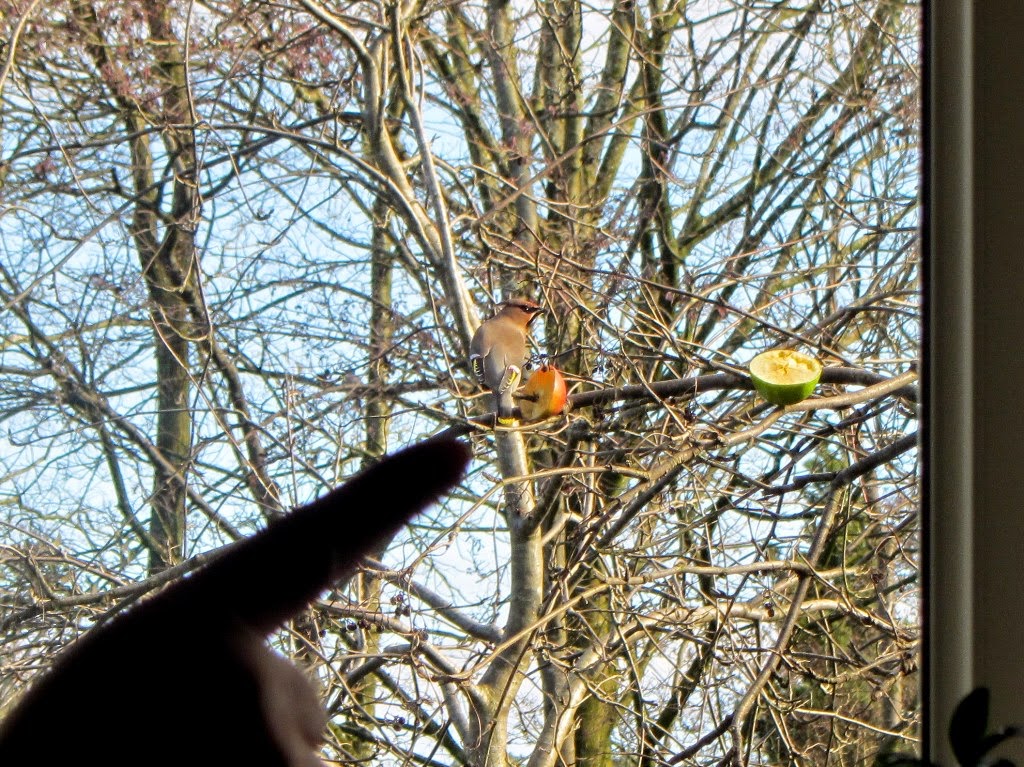
Well the Waxwing is still here and attracting a steady stream of admirers which is hardly surprising with so few in the country. There was a bit more in the way of sunshine on Sunday and a lot more today so I couldn't resist taking even more photographs. Most of them get deleted as it can be difficult to get results I am happy with and that show different aspects of behaviour. I don't always like taking photos in strong sunlight but it certainly does help bring out the colour of the Waxwing's ruby red eye.


Get the light right and that ruby red eye really stands out.
A close up showing the feeding action. The bird seems to favour apples in certain positions that allow it to take a really firm bite and remove a piece with a snipping and pulling or twisting action that involves using the whole of the body. 
The bird's forehead is almost permanently wet with apple juice and bits of apple pulp get stuck on the bill. Wiping the bill on a twig deals with apple pulp on the sides of the bill but does not always clear any that has found its way onto the culmen.
If bill wiping doesn't remove all of the pulp a quick shake of the head throws off the rest.
All the stuff on the branch to the left of the apple is Waxwing poo. Waxwings eat a lot and poo a lot. When feeding continuously it can defecate as frequently as every one to two minutes. Yes I have timed it.
This photograph shows the Waxwing blinking by drawing the nictitating membrane across the eye. This membrane or third eyelid is much more transparent in Waxwings and is not as obvious as it can be in some other species. The transparency of the membrane in Waxwings is presumably an adaptation to help maintain vision and so make it less vulnerable to predation. You can see the forehead is wet from apple juice so it must get quite a lot in its eyes too and therefore it needs to blink frequently when feeding. From what I have seen they appear to blink with every peck but you would need a slow motion camera to confirm that.
Time for a scratch
The nictitating membrane is covering the eye as it scratches. I couldn't tell if it held the membrane across its eye for the duration of its scratching or if it involved a series of blinks.
When alarmed it tries to make itself inconspicuous by elongating and narrowing itself. Basically it tries to make itself look like a twig and part of the tree. The body feathers of a Waxwing closely resemble the bark of trees such as Rowan as can be seen in all of these photographs. 
Still very alert and with a very erect posture.
Blue Tits like a bit of apple too and you get a closer view of that Waxwing apple poo. 

..........and what other photographs can you take when you have a Waxwing in your garden.


and finally.................


The dog is jealous of all the attention the Waxwing gets and consoles himself with his sheep.


Saturday, 11 January 2014

Twitching Chaffinch

No I haven't taken to twitching but I have got a Chaffinch coming into the garden with a disorder that causes it to twitch. I first noticed it earlier this week but I have only been able to get some half decent video of it today. It is feeding ok and it can fly, if a little erratically from what I have seen. It can perch but fidgets about quite a lot and I have seen it trying to preen but in a twitch interrupted way.

I have not seen anything like this before and I have no idea what is wrong with it. I don't think it is caused by any external parasites as I would expect it to try and preen more than it seems to. Something is presumably affecting its central nervous system but what??? Could it be caused by some sort of virus or has it collided with something and suffered some sort of brain injury??? I simply don't know what is causing this abnormal behaviour at this stage.

The bird is ringed and it is probably one I have ringed but I doubt it had this condition at the time of ringing as I am sure it would have been obvious. Also I haven't caught a Chaffinch in the garden since early December and I would have noticed a bird displaying this behaviour sooner if it had been affected for that long.


I will make a few enquiries and do a bit more research to see if I can find out what has caused this. I will also keep a record of subsequent sightings of this bird to see how long it survives with or exhibits this condition. I just hope it isn't caused by a disease that can spread to other birds. If anything comes from this I will keep you posted.