Showing posts with label Great Crested Grebe. Show all posts

Saturday, 18 February 2017

The wrong kind of nice.

It was a nice day today but the wrong kind of nice for me. Nice days in February should be crisp and cold not pleasantly mild and touching on being warm. Our seasons have become messed up, to say the least, with winter increasingly being a thing of the past, spring is often cold and wet, summer is increasingly an unsettled none event while autumn is becoming more like summer than summer.

Temperatures are forecast to be well above average for the next few days and while that may help me save money on my heating bill it won't do our wildlife any favours. It is likely to be warm enough to bring some butterflies, moths and bats out of hibernation prematurely and cause them to waste valuable energy. Basically some of our wildlife will get off to a false start and things will get out of sync.

Anyway I went for a walk with the dog this afternoon and as soon as I got into the park I noticed that a pair of Great Crested Grebes were back on one of the lakes, and they were displaying. Sods law I hadn't got a camera with me so I nipped back home and picked one up. I thought I was going to be treated to the full courtship display and weed dance but while there was some weed carrying it was a case of head waving rather than dancing.


The grebes moved out of range after a while so I continued my walk and checked out a nearby field of winter cereals for roosting Common Snipe. The winter cereal crop is starting to put on a bit of a growth spurt but I was still able to pick out 7 Snipe and there could have been a few more.


I first noticed snipe roosting in this field last November (post here) and they have used it all winter or what has counted for winter so far. I have never heard of Common Snipe using a field of winter cereal as a regular roost site before and as far as I am aware this is the first record of such behaviour. Snipe duly recorded and photographed I headed for home and was treated to another performance by the Great Crested Grebes as I passed through the park.


Yes, it was nice afternoon weather wise but the wrong kind of nice for mid-February. Still it was great to see the grebes displaying and that the snipe are still roosting in the cereal field.

Thursday, 1 December 2016

A walk in the park.

I took one of the dogs for a walk through Orrell Water Park and around some of the adjacent farmland at lunchtime and it produced some really good sightings. I had only just walked into the park when I came across 15 Goosanders on the top lake which is easily a record count for the site. There has been a really confiding bird recently and that one even comes out of the water for bread, but the species is normally a scarce and visitor (in low single figures) and they usually fly off as soon as there are a few people around. This flock was remarkably settled and didn't seem to mind numerous people and their dogs walking round what is only a very small lake. The light wasn't very good but I thought it was worth getting a few record shots so I nipped back home for the camera.


After getting a few photos I carried on through the park and around one of the adjacent fields that has been holding a small roost of Snipe. I only counted 9 but there could have been a few more as they can be difficult to see if they are well hunkered down. I first noticed that Snipe were roosting in this field on 12th November, when I counted 19, and a few days later (15th) there were at least 27. I have not seen Snipe roosting in a field of winter cereal before and it was even more surprising because there is a very popular dog walking route that goes around the perimeter of this field.

There are at least 9 Snipe in this photo, 6 in the little huddle and at least 3 others dotted about to the right.


A zoomed in view of the huddle taken from a closer vantage point.
After checking out the Snipe and throwing a ball for the dog for a while I headed back towards the park and home. The light was a little better as I was passing the top lake in the park and the Goosanders were still there so I took a few more photographs.


12 of the 15 Goosanders plus a Great Crested Grebe.


This Great Crested Grebe is a youngster from a late brood and semi-mingled with the Goosanders. It also indulged in a bit of display towards them at one point as can be seen from the sequence of shots below.


After photographing the Goosanders I decided to check out the gulls by the car park so I took the dog home and grabbed a few slices of bread. Somebody was already feeding the gulls and tame wildfowl as I approached and it wasn't long before I saw a familiar ringed bird. It was the German ringed Black-headed Gull that I first recorded on 27/10/2012 and has wintered at the site each year since. It is usually present from late October to late February and is often one of the first birds to come to any handouts.


German ringed Black-headed Gull.
IA141745    Black-headed Gull (ringed as an adult)
Ringed              29/04/2012  Bohmke und Werder, Mecklenburg-Vorpommern, Germany.
Photographed   01/12/2016 Orrell Water Park, Orrell, Greater Manchester. 1102 km W.


IA141745 wasn't the only ringed Black-headed Gull and I also noticed one with a green colour ring inscribed J360P. This is a bird I hadn't seen or photographed before and it also had a metal ring with number K06036 and Stavanger as part of the address, so it was obviously a Norwegian ringed bird. A did a quick search on the internet when I returned home and soon found the colour ringing scheme and a site where I could report the bird and access the ringing data as detailed below.


Norwegian ringed Black-headed Gull
K06036 (J36P)  Black-headed Gull (ringed as a chick)
Ringed              14/06/2015  Søndre Langåra, Frogn, Akershus & Oslo, Norway.
Photographed   01/12/2016  Orrell Water Park, Orrell, Greater Manchester. 1065 km SW.


I also photographed a colour-ringed Canada Goose. This bird was originally ringed in Cheshire and I have recorded it numerous times already this year.


Canada Goose C75
5260475   Canada Goose (ringed as a first year)
Ringed              05/09/2013  Baddiley Meres, Natwich, Cheshire.
Photographed   01/12/2016  Orrell Water Park, Orrell, Greater Manchester. 53 km N.

All in all not a bad set of sightings in the space of an hour or so.

Sunday, 17 April 2016

Great Crested Grebe follow-up

It is about a month since I blogged about the Great Crested Grebes having hatched at least one chick at Orrell Water Park (link to that post here). At that time I could only see one chick poking its head out from between the wings of one of the parents but I thought there could others that were hidden. The parent carrying the young tended to stay partially concealed under overhanging branches for much of the first couple of weeks, or at least when I went to look, which made it difficult to see if there was more than one chick but as time went on it became clear they were only feeding one.

For one reason or another (mainly ringing Siskins and other birds) I haven't photographed the progress of this breeding attempt as often as I would have liked but I finally got round to taking a few photographs yesterday. The photos are not as good as I would have liked as the birds were either too far away or in badly lit situations but they will have to do for now.

One adult bathes and they all get a shower. 

This chick is about 5 weeks old now but it still has quite a bit of growing to do. It could be another 6 weeks before it is looking after itself.

Feeding time.
It will be interesting to see if this pair has another breeding attempt and if they do will they start before this chick is fully independent?

Saturday, 19 March 2016

First young of 2016

The Great Crested Grebes on Orrell Water Park have young or perhaps I should say at least one youngster, as one is all I have seen so far. I am not sure when the eggs hatched but I got my first brief glimpse of a chick on the female's back last Sunday. I didn't managed to get any photos of them then and only managed to get some badly lit record shots yesterday.


There could be up to 4 youngsters keeping warm under the parent's wings and the way she is holding them I am sure there is more than one.
This is the earliest I have known them hatch eggs successfully at this particular site and with incubation lasting around a month the eggs must have been laid in the second week of February. While this is an early breeding attempt for this particular site it isn't all that unusual for the species, although the main laying period doesn't usually start before March as a general rule.

Hopefully I'll  find out how many chicks there are in due course and get some better photos in the process.

Wednesday, 24 February 2016

Fair weather birding

Today has been a thoroughly nice day. It started with a very brief ringing session in the garden that produced 8 new and 4 retrap Siskins but only 1 new Goldfinch. I then went for a walk around Orrell Water Park to make the most of the glorious weather and got a few nice photos in the process.


It was interesting to see the German-ringed Black-headed Gull now that it is close to having a full brown hood.

Hood development of the German ringed Black-headed Gull IA141745.
It is a shame I didn't photograph it in early February

I nearly missed the drake Mandarin asleep on the bank.


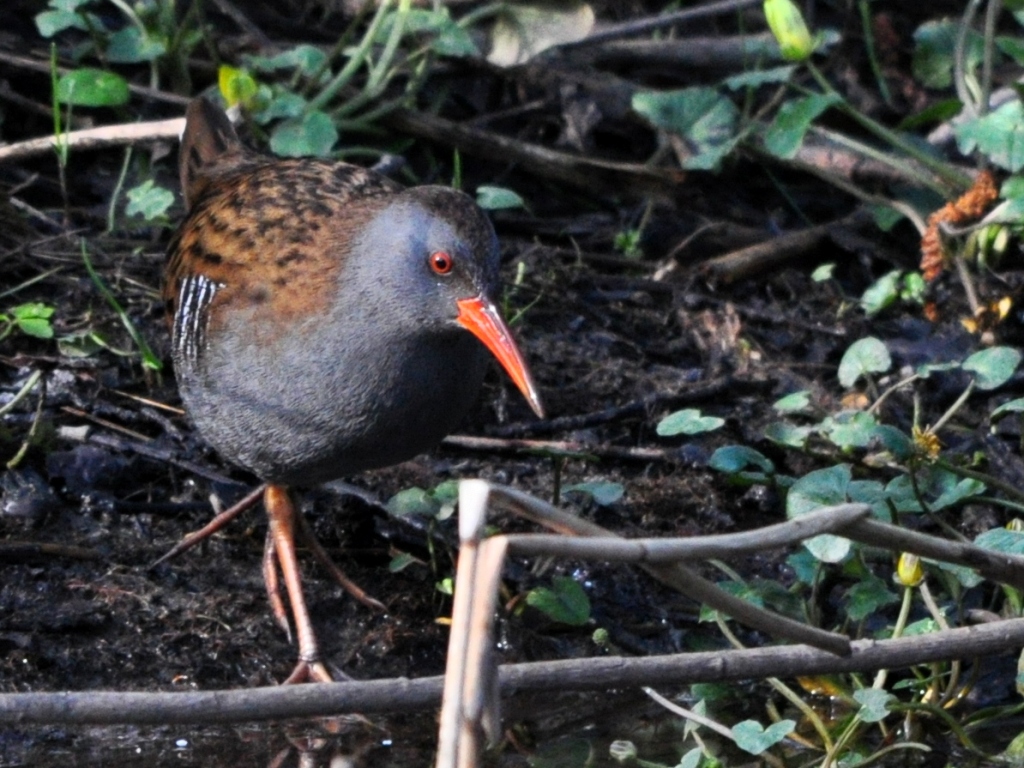
Although the Water Rail showed well it was often partially obscured by vegetation or was in the shade as in this photo.
Eventually I got some photos in better light.
That long bill is being put to good use again but they will also push the whole of the head under water if they need to. The eye isn't clear in this photo because it is covered by the nictitating membrane which is used to protect the eye whilst maintaining some vision at the same time. It mainly seemed to be finding and eating caddisfly larvae.


Birds are accustomed to people putting seed on the top of the fence and quickly respond to any fresh handouts. I managed to get part of this male Reed Bunting's ring number and it is from a sequence that was used between 4 and 6 years ago. It wasn't ringed in the park but it could have been ringed at the nearby Longshaw site.


Female Yellowhammer.
Yellowhammers only take advantage of this food source in late winter and early spring and sometimes allow fairly close approach.

Male Yellowhammer

Male Yellowhammer
I hadn't seen Moorhens feeding on the fence top before today.

The fine weather stimulated many birds to sing and this Robins was in fine voice.

The Mandarin was out on the water when I was making my way back home.

I am not sure how long this Great Crested Grebe has been sitting but I think it has been at least a couple of weeks. 

When I got home I checked through the Siskins that were feeding in the garden and most were unringed. I never see more than about a dozen in the garden at any one time but there could be as many as 30 or 40 that come to the feeders over the course of a day.

Unringed male Siskin

To cap off a good day the Belgian-ringed Blackcap showed well in the late afternoon. 
It spent more time feeding on the ground than it usually does and was eating the scraps that fall from the sunflower heart feeders and fat cakes.