Showing posts with label Robin. Show all posts

Friday, 23 February 2018

Curly claws, pigeon porn and other garden goings on.

I was photographing birds in the garden yesterday afternoon when I noticed a Goldfinch that was sat belly down on a branch. It had its back to me but its abnormal posture clearly indicated that something was wrong. At first I thought it was a sickly individual, perhaps suffering from trichomonosis, but then I realised it had abnormally long claws and couldn't grip the branch normally.


I eventually managed to get some photos of it face on and apart from its feet it appears to be in good condition.


I have occasionally come across birds with overgrown bills but it is more unusual to see birds with hugely overgrown claws. It obviously had some form of skin condition affecting its feet, possibly knemidocoptic mange, and this has presumably led to the overgrowth of the claws. It was able to use the feeders that have perches but the state of its feet must impede it when more acrobatic feeding methods are required. Diseases that affect birds feet are becoming an increasing health issue for birds that are attracted to garden and other feeding stations with Chaffinches being the most affected species.

As for the pigeon porn, it was, as you may have guessed, just a pair of Woodpigeons mating. It is quite early for them to be breeding but then a pair of Woodpigeons usually manages to rear an early brood near the garden. I have seen recently fledged young in early to mid April in previous years and allowing for a nestling period of about 33 days and and incubation period of 17 days that gives a first egg date in mid to late February, so this pair is continuing that early breeding trend.


Mating Woodpigeons. Spring was certainly in the air for this pair.
The last week has seen a increase in the number of Siskins visiting the garden feeders, not a big increase but a noticeable one nevertheless. I still haven't seen more than 10 at the feeders at any one time but the varying proportions of males and females along with ringed and unringed birds shows there is quite a bit of turnover during the course of a day. In addition, recent ringing activity has produced 16 new birds and photography has shown that some of the savvy returning ringed birds are still present and avoiding recapture. However, the most obvious sign of the higher numbers has been the increase in the volume of chatter coming from the birds when they sit in the tops of the trees between bouts of feeding.


Almost two thirds of the Siskins caught this winter have been adults which suggests they didn't have a particularly good breeding season last year.


Although I wasn't able to get the full ring number this bird is almost certainly one that was ringed in the garden last winter or early spring.
Long-tailed Tits are still regular visitors but the flocks have largely split into pairs now. With some very cold temperatures forecast for the next week it will be interesting to see if any of the flocks reform temporarily or if they remain in pairs.


I managed to read just enough of this bird's ring number to be able to say that this one was ringed during the winter of 2014/15.
Robins don't feature in the blog very often but an unringed bird appeared to be a newcomer to the garden and was doing its best to assert its place in the pecking order. There was a lot more in the way of chasing than I have seen of late and it seemed to have claimed top slot by the end of yesterday. Its reign may only be temporary though as there is likely to be a lot more competition and far more aggression between the local Robins as we move into the spring.


Cock Robin 22/02/17.
Goldcrests have been regulars at the feeders this winter and, even though there is usually only one bird in attendance, ringing has shown that four birds have acquired the habit of feeding on the fat cakes and fragments of sunflower hearts.


Lastly, a Wren has also taken to feeding on the fat cakes and is a frequent visitor to the fat cake in the bird table trap. It is free to come and go as often as it likes as the trap has a manually operated door that is left open and is only used very selectively.


For the record all of the photos were taken through double glazing which does have an effect on image quality, well that is my excuse. I have come to the conclusion that it is better to make that compromise on image quality rather than risk missing out on photo opportunities and adding to global warming by leaving the windows wide open for hours at a time. That's all for now and I hope you found something of interest.

Sunday, 3 September 2017

2nd is better than 1st

The ringing session at Billinge on the 1st was good but the 2nd's proved to be even better. It was similar in many respects but had the added bonus of some infrequently caught species in the form of 2 Redstarts and a Spotted Flycatcher. Both are scarce passage migrants in the area these days and I consider myself lucky if I catch one or two of each over the autumn. The 2 Redstarts brought this autumn's total to 5 which is exceptional as I have never caught more than 2 in previous years and the Spotted Flycatcher was the second of the autumn. Interestingly, the Spotted Flycatcher was caught in the same part of the same net as the previous one and while no more than a coincidence such 'deja vu' type occurrences always stand out and stick in one's mind.

Both Redstarts were 1cy females.

1cy Spotted Flycatcher. Only the 6th to be ringed at the site in the last 4 years.
Once again Goldcrests dominated proceedings with most of the 23 new birds and single retrap being caught in the first couple of hours. The retrap wasn't from the previous day as some might expect and was originally ringed on 13th August when part way through its post-juvenile moult. At this time of year there are frequent movement of Goldcrests through the site and it is rare for any to hang about for more than a day once they start moving.

Chiffchaff was the second most numerous species with 14 new birds and 1 retrap being caught and while numbers were down on those of the 1st it is still a good total for that species. Once again the retrap hadn't been ringed recently and had been ringed as a scruffy juvenile on 9th July this year which gives an indication of how long it takes them to complete their protracted post-juvenile moult.

There were more Robins about than there have been recently and the 5 ringed is a sign they were on the move. The first half of September usually sees quite a few Robins pass through site, more so following a good breeding season, and is largely made up of displaced birds that are looking for somewhere to carve out a winter territory but may also include some genuine migrants.

The weather is looking pretty ropey for the next week so opportunities to get out ringing could be very limited to say the least. Is this going to be a year we don't get an Indian summer ? 

Ringing totals (retraps in brackets) for 02/09/17 were: Goldcrest 23(1); Blue Tit 2(1); Great Tit 6; Chiffchaff 14(1); Willow Warbler 4; Blackcap 4; Spotted Flycatcher 1; Robin 5; Redstart 2; Tree Pipit 1; Chaffinch 4; Goldfinch 4; Reed Bunting 1. A total of 71 new birds and 3 retraps.

Monday, 19 September 2016

Billinge: 15th & 18th September 2016

The 15th was one of those days were expectations were high but very murky conditions stifled overhead passage and kiboshed my hopes of a good catch of Meadow Pipits and Grey Wagtails. Visibility was poor and restricted to about 1 or 2 km for much of the morning and while you could call it misty the vegetation and nets remained bone dry because of the high temperature. Some birds were moving despite the conditions and a few Meadow Pipits shot through and the odd Siskin and Song Thrush was heard calling through the murk but there were big gaps with nothing moving overhead.

Fortunately there were a good few birds in the bushes and a total of 49 were caught. Chiffchaffs topped the totals once again with 15 new birds and 1 retrap but Goldcrests weren't far behind with 12 new birds and a control (a bird ringed elsewhere). It shouldn't take long to get the ringing details back for this bird and it will be interesting to find out when and where it was ringed as we are still in the early stages of autumn migration for this species.

Control Goldcrest.
Details of when and where it was ringed will be posted in due course.
The remainder of the catch didn't produce any surprises and the totals for the morning were: Goldcrest 12 (1); Blue Tit 1; Coal Tit 1; Chiffchaff 15 (1); Willow Warbler 1; Blackcap 6 (1); Robin 4; Dunnock 1; Bullfinch 1; Lesser Redpoll 1; Reed Bunting 3. Total 46 new birds, 2 retraps and 1 control.

The crown feathers of one of the Blackcaps was a mixture of brown and black with the individual feathers being a mixture of colours rather than some of the feathers being brown and others being black. A small proportion of male Blackcaps have some brown in the crown like this bird although the amount does vary.
I suppose you could call it a brown crown with black highlights or streaks.

September usually sees some good movements of Robins through the site but numbers have been much lower than usual so far this autumn. 
The 18th started off a bit misty but soon became depressingly foggy. The fog just wouldn't burn off and although it thinned from time to time it didn't finally clear until late in the morning when it was time to start packing up. The conditions severely limited movement overhead, as you would expect, although the occasional stratospheric Siskin was heard and the fog also made the nets more visible for much of the session.

One or two Song Thrushes were calling as I was setting up so it wasn't a surprise when one was in the net on the first round. However, it wasn't one of the locals and its colder and more olive upper parts pointed to it being of continental origin. The first migrant Song Thrushes usually arrive in early to mid September and more continental birds reach this part of the country than is often appreciated.

The catching rate was much slower than the final total of 40 new birds might suggest and there were several blank net rounds. Goldcrests topped the totals and the 18 ringed is the biggest catch of the autumn to date. It also brought the number ringed so far this month to 106. There were very few Chiffchaffs around compared to recent visits and only 4 were ringed but Blackcaps continue to move through the site in similar numbers with another 6 being caught.

Ringing totals for 18/09/16 were: Goldcrest 18; Blue Tit 1; Great Tit 1; Chiffchaff 4; Blackcap 6; Wren 1; Song Thrush 1; Robin 3; Chaffinch 5. Total 40 new birds.

Sunday, 21 August 2016

Billinge: 15th to 18th August 2016

Four similar sessions at Billinge on consecutive mornings produced smaller catches than of late. The number of Willow Warblers moving through the site has dropped markedly compared to the highs of last week and was largely responsible for the lower totals.


Willow Warblers - adult left and first year right. Adults generally have whiter bellies than first year birds but ageing this species also involves checking the wear and shape of the tail feathers.
The main target species was Tree Pipit and although 15 were ringed over the four mornings this was less than expected. The passage of this species usually peaks at the site in mid August but has turned out to be weaker than in previous years so far. It remains to be seen how things will turn out and hopefully there will be some good movements to come.


Tree Pipit
Robin is a species that doesn't get mentioned in this blog very often but one ringed on the 15th and another 3 on the 17th hinted at the dispersal and passage that will be a feature of September. The site doesn't hold many breeding pairs or wintering individuals, especially in the vicinity of the net rides, so the majority of birds caught are dispersing or on passage.

Less frequently caught species included a Nuthatch (the 2nd of the year), a Willow Tit (the 5th individual of the year but only the 2nd juvenile of the autumn) and a Reed Warbler (the 5th of the autumn with the previous 4 being in late July).


First year Willow Tit.

A view of the underside of the Willow Tit's tail and included for those interested in separating Willow Tit and Marsh Tit in the hand. It is all to do with the relative distances between the tips of the tail feathers and distance between the tip of the longest and shortest tail feather in particular. Willow Tits usually have more rounded corners to the tail and this results in more of the tips of the tail feathers being visible on the underside of the closed tail. This particular Willow Tit had a tail that was closer in appearance to that usually illustrated for Marsh Tit and demonstrates why separating these two species can be tricky for those who rarely handle them as they are more likely to consider such features.


First year Reed Warbler
Last but not least 2 Wood Pigeon nestlings were ringed on the 17th with the nest being noteworthy for being very low down in a hawthorn at just over a metre off the ground. A similarly low nest was found in the same area at this time last year and it is tempting to conclude that the same pair may have been involved in each case.

Combined ringing totals (retraps in brackets) for 15th to 18th August 2016 were: Woodpigeon 2 pulli; Goldcrest 2; Blue Tit 4 (1); Great Tit 3; Coal Tit 2; Willow Tit 1; Long-tailed Tit 3 (3); Chiffchaff 6 (1); Willow Warbler 29; Blackcap 3; Reed Warbler 1; Nuthatch 1; Wren 1; Robin 4; Dunnock 1; Tree Pipit 15; Chaffinch 8; Linnet 9; Yellowhammer 1; Reed Bunting 2. Total 99 new birds and 6 retraps.

Tuesday, 22 March 2016

Belgian Blackcap is still here.

The Belgian ringed Blackcap was still in the garden today but is starting to look very fat so could be about to depart. It is also singing more frequently and louder so is clearly getting into breeding condition too. Research has shown that Blackcaps that winter in the UK gain an advantage over those that winter in the Mediterranean and Africa by having a shorter return journey to the breeding grounds in central Europe. They also return a little earlier and are able to claim the best territories as a result and this in turn allows pairs to lay larger clutches and rear more young. Further reading on some of this research can be found here.


Judging by its appearance it has, or very nearly has, put on enough fat to make a non-stop flight back to its breeding grounds. This could be a journey of up to 1000km or 1200km and take around 24 hours.
It looks rather plump from this angle too.
Another garden regular is a rather scruffy looking Robin. It has numerous displaced feathers and has been like this for several weeks, if not longer. Initially I thought its appearance was due to fights with other Robins but it has had this scruffy appearance for far too long for that to be the case. It wouldn't have left displaced feathers after a fight and would have preened them back into place if it could. It has presumably sustained some damage to its skin that causes some of the feathers to grow out of the usual alignment. Perhaps it has been injured in a fight in the past or has had a close encounter with a predator, whatever the cause it can't preen the affected feathers back into place.


Scruffy Robin.
When I reviewed this photo on the back of the camera I zoomed in on the ring and could see it started with the letter V. This mean't it was a fairly old bird so I took enough photos to get the full ring number. The full number turned out to be V070535 and it was ringed in the garden on 16/02/2011 so would have hatched in 2010 or before. This makes it around 6 years old and possibly older so is quite a good age for a Robin. Looking at the current BTO Online ringing Report the oldest Robin recorded from UK ringing stands at 8 years, 4 months and 30 days.


It looks just as rough from the front.
Whatever the cause of its appearance it is a survivor and quite old for a Robin.
There are still at least a dozen Siskins visiting the feeders and chomping their way through large quantities of sunflower hearts. There may even be as many as 20 or 30 that visit the garden over the course of a day as the proportion of males and females and ringed and unringed birds changes throughout the day.


They remove the skin of the sunflower heart before breaking it into smaller pieces and eating it. If they drop the seed or any part of it during this process they simply take another if they are at a suspended feeder. If they are feeding on a bird table, like this bird, there is a chance they will finish off a seed they have dropped but they often just start again with a fresh seed.

I still haven't seen any summer visitors yet but with migration starting to pick up on the south coast I shouldn't have much longer to wait.

Wednesday, 24 February 2016

Fair weather birding

Today has been a thoroughly nice day. It started with a very brief ringing session in the garden that produced 8 new and 4 retrap Siskins but only 1 new Goldfinch. I then went for a walk around Orrell Water Park to make the most of the glorious weather and got a few nice photos in the process.


It was interesting to see the German-ringed Black-headed Gull now that it is close to having a full brown hood.

Hood development of the German ringed Black-headed Gull IA141745.
It is a shame I didn't photograph it in early February

I nearly missed the drake Mandarin asleep on the bank.


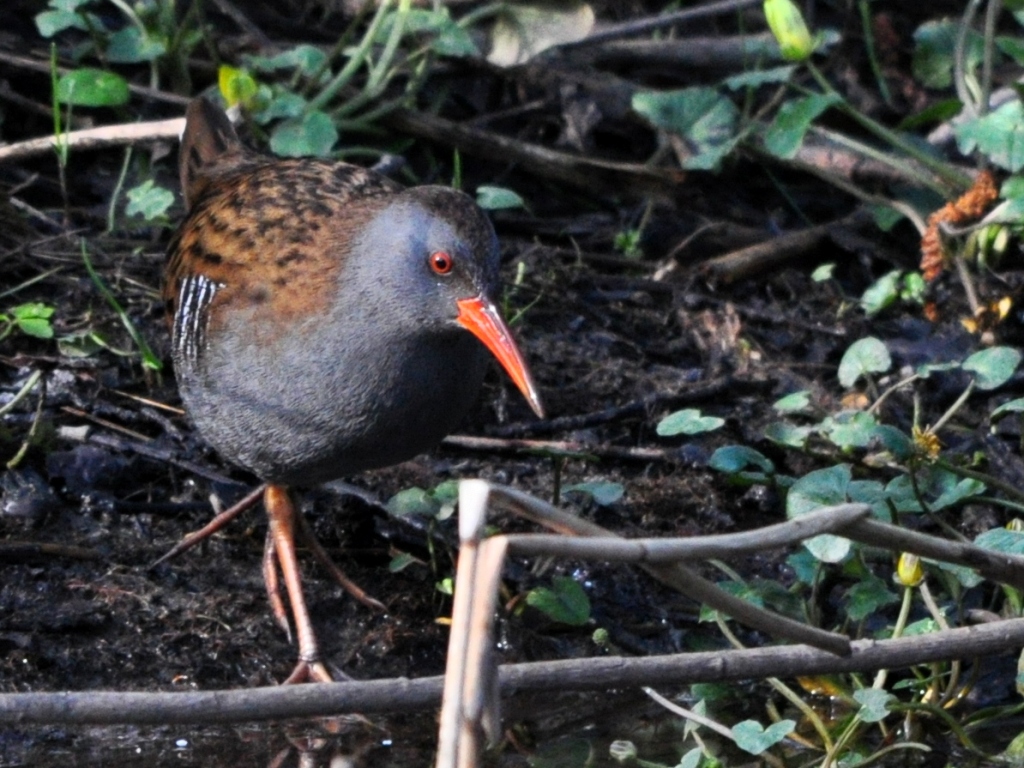
Although the Water Rail showed well it was often partially obscured by vegetation or was in the shade as in this photo.
Eventually I got some photos in better light.
That long bill is being put to good use again but they will also push the whole of the head under water if they need to. The eye isn't clear in this photo because it is covered by the nictitating membrane which is used to protect the eye whilst maintaining some vision at the same time. It mainly seemed to be finding and eating caddisfly larvae.


Birds are accustomed to people putting seed on the top of the fence and quickly respond to any fresh handouts. I managed to get part of this male Reed Bunting's ring number and it is from a sequence that was used between 4 and 6 years ago. It wasn't ringed in the park but it could have been ringed at the nearby Longshaw site.


Female Yellowhammer.
Yellowhammers only take advantage of this food source in late winter and early spring and sometimes allow fairly close approach.

Male Yellowhammer

Male Yellowhammer
I hadn't seen Moorhens feeding on the fence top before today.

The fine weather stimulated many birds to sing and this Robins was in fine voice.

The Mandarin was out on the water when I was making my way back home.

I am not sure how long this Great Crested Grebe has been sitting but I think it has been at least a couple of weeks. 

When I got home I checked through the Siskins that were feeding in the garden and most were unringed. I never see more than about a dozen in the garden at any one time but there could be as many as 30 or 40 that come to the feeders over the course of a day.

Unringed male Siskin

To cap off a good day the Belgian-ringed Blackcap showed well in the late afternoon. 
It spent more time feeding on the ground than it usually does and was eating the scraps that fall from the sunflower heart feeders and fat cakes.