Showing posts with label nestlings. Show all posts

Saturday, 2 June 2018

Tawny Owl tumble.

Last weekend I received a call about two young Tawny Owls that had been picked up below a nest box and the family who had found then weren't sure what they should do for the best. I quickly established that the bottom had fallen out of the nest box so I arranged to go round to see if it was possible to do a repair but I also took a spare owl box with me to try and cover all eventualities.

It was only a 5 minute drive to the house of the family that had found the owls and on examining the young Tawnies it was clear they were none the worse for their tumble but they were a bit too young to be out of the nest. It turned out the nest box was one the family had put up many years before in a tree at the end of their long garden and it had been used by owls for most of that time. Luckily the box was only about 4 metres off the ground and there was a deep layer of leaf litter below it which will have helped give the youngters a soft landing.

The ideal solution would have been a permanent or temporary repair to the box and to simply put the youngsters back in it so that is what I tried first. The bottom of the box hadn't completely fallen away and was hanging open but, unfortunately, the box had become far too fragile and flimsy to allow even a temporary repair. With a repair out of the question I decided to try plan B and put up the new box immediately below the old box and put the youngsters in that. The young owls were bill snapping and would have no problem attracting their parents attention by that means or with hunger calls so I had no concerns about the parents finding them. I was reasonably confident that the calls of the young and the parents desire to feed them would overcome any caution they may have about the sudden appearance of an additional box. The new box was quickly erected and the young placed inside and I arranged to go back a few days later to see how they were doing and to ring them if everything was going OK.
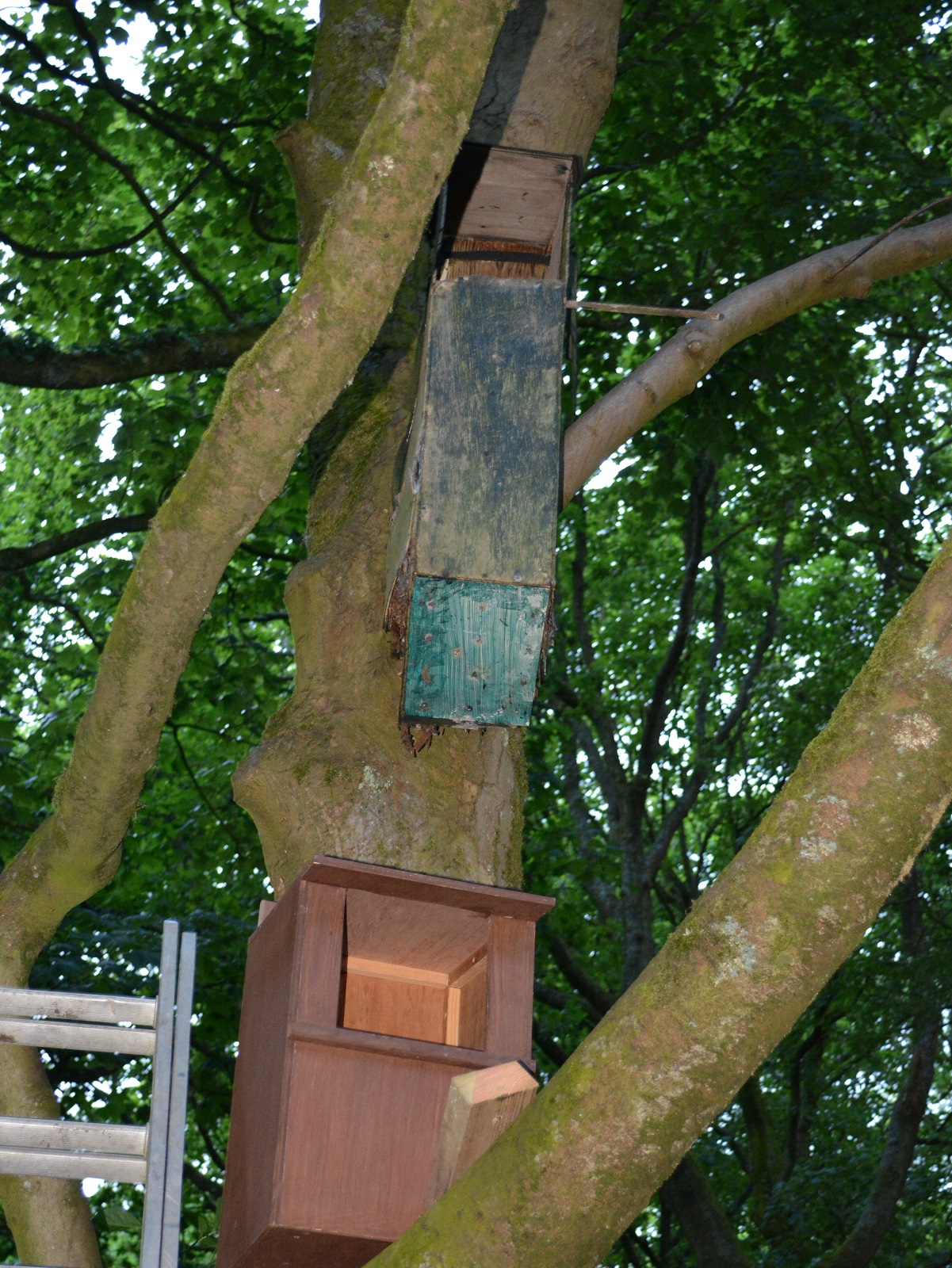

Plan B, the temporary box below the old box. 
So I went back a couple of days ago and was delighted to see both youngsters very much alive and well and looking very comfortable in their new home. Both were at an ideal size for ringing with the smaller chick having its primary feathers just emerging from their pins (sheaths) and the bigger one being a bit more advanced and noticeably heavier. Both were duly ringed and quickly returned to the new box. The parents had obviously taken to the new situation well and hadn't been put off by the new box in any way.


Little and large but both seem to be doing well in their new home.
That isn't the end of this story as there will be further follow up and the old box will be replaced by a new one in late summer or early autumn and the temporary box will be taken down and become my spare box again. Beyond that I will stay in touch with the family and help monitor their owl box in future years.


Sunday, 18 May 2014

A touch of 'nesters arm'

As the post title suggests I came home suffering from this condition yesterday afternoon. It was only a mild case caused by my efforts to check or find nests amongst hawthorns, brambles and nettles along with the glorious warm sunny weather and my resultant sleeveless apparel. Apart from a bit of mild tingling I didn't notice until someone said what on earth have you been doing when I got home.

Nettle rash combined with various minor cuts and a myriad of scratches but all in a good cause.
In the morning I had checked a Song Thrush nest in a tight hawthorn hedge which meant there was no easy way in or out for my arm. It contained small young so a repeat visit will be required in a few days time assuming they don't get predated. A search for a Willow Tits nest proved fruitless, not that they nest in hawthorns, brambles or nettles, but to access suitable dead wood I had to battle my way through some nettles and thorny thickets.

The best was saved for last when I checked out a new ringing site late in the afternoon. This site is a small overgrown field in a prime agricultural area and belongs to a relative. I was mainly checking it out as a winter feeding site for finches and buntings but quickly noticed the potential for breeding birds. There were 4 pairs of Whitethroats for starters but I was soon absorbed by a pair of Yellowhammers which were carrying food. They were clearly not used to seeing anyone in the field so I had to squat down in the vegetation and watch them from a good 75 metres away before they would ignore my presence.

I watched them carrying food back to the potential nest site for around an hour before I managed to narrow down the location. At first I thought they may be feeding recently fledged young as I could here some begging calls of young birds in the vicinity but my patience paid off and I eventually pinpointed the area they were visiting and marked it as being near a dead S shaped stem.

Yellowhammer nest location. There or thereabouts from about 10 metres away.
That was the easy bit, while I knew what my marker looked like through binoculars from 75 metres away the hard part was walking towards the location without losing sight of it. A stem which looks a distinctive S shape from a distance looks anything but a few metres closer and from a slightly different angle, especially when it is amongst hundreds of other dead stems. My first attempt to walk to it failed so I had to go back and wait for the birds to go in again and select a new marker. Both birds dropped into the same spot and this time I marked the location with different stems that I hoped to be able to keep better track of when I approached.

When I went in the second time I was able to keep sight of these markers and found the nest straight away. It was well concealed under some bramble trailers and amongst some willow herb. The nest contained 3 young that were about 7 or 8 days old and the ideal age for ringing.

Yellowhammer nest containing 3 young, The nest was quite a substantial structure made from coarse grass, other dead stems and lined with horse hair.

Yellowhammer nestling. The parents were mainly bringing green caterpillars to feed the hungry chicks. One of the nestlings was slightly smaller than the other two so the parents may have been struggling to find enough food for all three. Unfortunately the weed free fields and reduced headlands of modern agriculture provide much less in the way of caterpillars and other insect food for many of our once common farmland birds.

Yellowhammer nestlings about to be returned to the nest. The rings have been blackened with a marker pen so they don't stand out in the nest and get noticed by the parent birds.
After ringing the nestlings I made sure the nest was as concealed as when I found it and I also carefully covered my tracks as I walked away. I will return in about a week and just watch from a distance to check on progress. The young should be ready to fledge by then or may have just started to wander a little way from the nest as Buntings often leave before they can fly.

Hopefully I will suffer quite a bit of 'nesters arm' over the coming weeks now that the breeding season is getting into full swing.

Sunday, 11 May 2014

Early May catch-up

Frequent heavy and blustery showers over much of the last week have really put a dampener on ringing activities. We had been spoiled by the weather for much of April so this unsettled period has drastically reduced the amount of time spent in the field and just when nesting activity was really taking off. It probably isn't doing nesting birds any good either as some of the downpours have been really heavy and wind gusts have approached near gale force at times; not good if you are a ground nesting Willow Warbler or a Reed Warbler trying to build a suspended nest in swaying reeds.

We had started to ring a few broods from some of the earlier nesting passerines before the weather changed. Robins topped the nestling ringing totals with 27 ringed from 6 nests followed by 2 broods each of Blackbird and Song Thrush. Quite a few other nests were in the pipeline largely thanks to Wayne's nest finding ability but it will be a case of finding a suitable weather window to follow-up on these until the weather picks up again.

Brood of Robins that have just been ringed and are about to be returned to the nest.

Song Thrush nestlings in the distinctive mud lined nest.

This Blackbird nest was on the root-ball of a small fallen tree.

Only 2 Blackbird chicks in this nest but they all count.

This weather has also affected catches in the moth trap. Catches were fairly low at the end of April but have fallen further with low single figure counts being the norm so far this month. However a few firsts for the year are turning up just now and again to keep a bit of interest going and a White-pinion Spotted on the morning of the 7th being a good example. This morning the catch was particularly dire with only a rather worn Clouded Drab, similarly worn Common Quaker, a Shuttle Shaped Dart and a slug in the trap. It goes to show how wet it has been when slugs are seeking shelter.

This White-pinion Spotted didn't quite find its way into the trap and was found resting on
the wall nearby. This is a species that has become a bit more common in recent years
but it is still a fairly scarce visitor to the garden.
Male Muslin Moths have put in an appearance on 3 days so far this month.

Leopard Slug in the moth trap this morning.
These can grow really quite big so this is a relative youngster.
The weather is looking better from mid-week so hopefully we can catch up with some nest recording and ringing from then.

Friday, 17 May 2013

Back to black

On my way home from work I stopped off  to see how the Blackbird nest was doing that I mentioned in my last post. I was hardly dressed for the occasion but I thought I would give it a go. I managed to make my way down the bank and along the edge of the river to the nest without ruining my shoes so that was a good start. To my delight the Blackbird nest was still there and contained 4 healthy young; this was despite some recent heavy rain that could have caused a further bank collapse.


The young Blackbirds were the ideal size for ringing with their primary feathers just emerging from their sheaths. Based on the initial assessment they are now 7 days old but they won't fledge for another 7 days. It is a fairly exposed nest so they have done well to get to this stage. I will try and check on the nest again to see if they fledge successfully.


Feed me now.
During the visit a duck and drake Mandarin flew down the river which was nice to see. I haven't seen them on this stretch for a while so it is good to know they are still around.

Sunday, 12 May 2013

Lazy Sunday

I had my first decent lie-in for months this morning and only got up at around 9am. After lounging about for a while I decided I should get out for a couple hours as it was forecast to rain in the afternoon. It was too late and too breezy to go to any of my usual ringing sites so I went to a very sheltered stretch of the river Douglas to see if there were any juvenile Dippers about.

I had just made my way down to the river when a Blackbird flew out of a steep section of bank. I thought the Blackbird may have been foraging but something made me have a closer look. On a earth ledge about three quarters up the bank there was a nest with 4 small young. The young were about 2 days old as they were still naked and blind. The outer part of the nest was largely constructed from small pieces of root which helped to camouflage the nest.


Spot the Blackbird nest
 
2 day old Blackbirds

Nest location. Did you spot it?
This bank is quite unstable and prone to collapse when the river levels are high but it looks like this section had collapsed not too long ago so hopefully there will be no further collapses for a while. I have found a few Blackbird nests on ledges in outbuildings but this is the first I have found in a river bank. I will check the nest in a few days to see how they are getting on.

I put a net across another section of the river while I checked out the areas up and down stream. I had seen Dippers carrying food a couple of weeks ago so I hoped the nesting attempt had been successful and the young had fledged by now. I didn't see any young Dippers or any adults carrying food but I did see a Grey Wagtail carrying food and a Mallard with some recently hatched ducklings. I was just about to pack up because the first few drops of rain had arrived when this Dipper turned up in the net. It was a new bird and its wing length showed it was a male.

male Dipper
The rain put a stop to any further survey work so I returned home having spent an interesting couple of hours on the river. I then spent the rest of the day as I started it and just lounged about. It is nice to slow life down and be really lazy now and again and that certainly sums up today.