Showing posts with label Orrell. Show all posts

Monday, 4 November 2019

Late breeding

The breeding season is well and truly over for most birds in this part of the world but for at least one species it is not over yet. I was on the phone to my broadband provider at lunchtime today when I noticed a juvenile Woodpigeon on the privet hedge in the front garden and it appeared to be a young juvenile at that. The phone call quickly became the least of my concerns and I grabbed my camera and hastily took a few record shots through the window.

The original Boaty McBoatface.
Juvenile Woodpigeons have a wide almost boat shaped bill which helps them take pigeon milk, a crop secretion they are fed on, from their parents. 

You can see it had already replaced a few feathers on the head and the shoulder of its wings but that could have started immediately on fledging or even before it left the nest. Juveniles of some species start moulting before they leave the nest and this can be accelerated later in the season.
It quivered its wings from time to time which immediately suggested it was trying to solicit food from a parent and then I noticed an adult Woodpigeon a couple of metres away on the bird bath. The adult Woodpigeon then joined the juvenile and started to feed it. There is nothing subtle about an adult Woodpigeon feeding a juvenile and it often looks like a tussle and a trial of strength.


Get in there.


Woodpigeons have quite a long breeding season which can start as early as February and can extend into November and even December, although there can be some variation between years, regions and habitats. While this record of late breeding isn't without precedent for Woodpigeons it is certainly the latest I have recorded locally and for my garden in particular. Woodpigeons are one of the few species that are on the up and have benefitted from both garden feeding and some changes in agricultural practices.

Thursday, 24 May 2018

First 100 juvs and counting.


The first juvenile Starling caught for ringing this morning was the 100th of this season and it was quickly followed by another 24. Productivity seems to be good despite the cold start to the spring and many pairs have 4 juveniles in tow. I haven't had time to total up the number of colour-ringed adults that have been resighted since 21st April but it is at least 130 and in addition another 40 new adults have been ringed and colour-ringed for the RAS project. 


A typical scene on the lawn taken through the window. A similar number of birds were feeding on the suspended fat block and bird table out of the shot
There are usually around 30 Starlings in the garden at any one time but well over 100 individuals visit over the course of a day and the true number could be over 200. They are currently getting through 2kg of home made fat blocks,15 or so shop bought fat balls and the odd loaf of bread each day. The warm and very sunny weather we have been experiencing is helping the Starlings get through the fat blocks and fat balls a bit faster than they otherwise would as it is softens them as the day warms up, so I am currently making batches of the home made fat blocks 3 times a week to keep up with demand.


Melt 6 blocks of dripping in a large jam pan.

Add about 7 margarine tub size scoops of meal worms.

Then add about 20 crushed shop bought fat balls.


Mix well until you have a nice even consistency and fill old margarine tubs to form blocks.


The result is yummy if you're a Starling and should be given how much it costs.
It is not just the Starlings that benefit from the feeding regime and we have one or two Hedgehogs that visits the garden every night to feed on any crumbs from the fat blocks that fall to the ground and don't get cleared up by the Starlings. I also put out a few meal worms for them in a purpose made feeding station.


The current run of sunny weather has resulted in a few of the young Starlings flying into windows from time to time and one of my neighbours upstairs windows in particular. Thankfully the young Starlings don't fly that fast so there haven't been any injuries or fatalities or at least none that I am aware of but they have certainly left their mark on the glass.


My neighbours will get value for money from the window cleaners the next time they come round. I may also have to power wash their garden path by way of a thank you for their tolerance not least because the Starlings are extremely noisy in addition to being a bit messy; the noise being more noticeable as most people have some windows open because of the very warm weather.
That's all for now as I have another batch of fat blocks to make and lots of other stuff to do.

Monday, 14 May 2018

Quick Update and Starling RAS progress.

Apologies for the lack of posts recently but I have been busy with one thing or another and there has not been a great deal of interest to report on the migration front. The dearth of migrants at Billinge and other sites I visit has continued with hirundines being particulary scarce. While it has not been a silent spring it has been a pretty quiet one and it wouldn't surprise me if national population declines are reported for many species when all the data is in.

Much of my ringing effort over the last 3 weeks has been directed towards my Starling RAS project and I have clocked up around 75 hours of recording colour-ringed Starlings feeding on the fat blocks in the garden. As I have been running the project for a few years most of my local Starlings are colour-ringed and I have resighted 100 Starlings that were ringed prior to the start of this year's recording period with over 25% of those birds being more than 3 years old. It didn't take long to record the first 60 or so individuals but after that it became more like looking for a needle in a haystack as it gets progressively harder to pick out any that haven't been recorded before from all the ones that visit the fat blocks on numerous occasions each day. In addition to recording all the previously ringed birds I selectively trap and ring any unringed Starlings to add them to the study population with 20 new adults being ringed and colour-ringed so far.

With at least 70+ different Starlings coming they are currently getting through 1.5 to 2 kg of home made fat blocks each day. This will increase as more young fledge.

It is often a bit of a scrum at the fat blocks with the birds jostling for position. This can make reading the codes on the colour-rings quite difficult.
The timing of breeding has been pretty much as expected and the first adult was seen carrying food on 21st April and this was soon followed by many others. The first young started to fledge about 6 days ago and the first juveniles started to follow their parents to the the fat blocks in the garden in the last couple of days. This is very similar to last year and just over a week later than 2016, which was an earlier than average breeding season anyway. While the severe cold spells in the early part of this spring delayed the onset of breeding in many resident species it doesn't appear to have had much of an affect on Starlings, in this area at least, or that is the initial impression. It still remains to be seen what the fledging rates and brood sizes are like overall so it will be later in June before we get a more complete picture.

Adult male A12 is one of the many regulars and was originally ringed in December 2014. This male has been recorded numerous times in each breeding season since being ringed.

The first juvenile ringed in 2018. This bird was caught earlier this morning (14/05/2018). The first juvenile was ringed on the same date last year and on 7th May in 2016.


Wednesday, 18 April 2018

Tit knocker

Tit and knocker, and more commonly their plural forms, are often used synonymously in slang and certain types of humour but in this case the tit and knocker is a Great Tit that acts like and old fashioned knocker-up by tapping on the bedroom window every morning. If you are not familiar with the term 'knocker-up' it was a profession in Britain and Ireland that developed during the industrial revolution when alarm clocks were relatively expensive and not very reliable. The knocker-upper would go around and wake clients up, often by tapping on their bedroom window with a long stick, so they wouldn't be late for work and it was common job in the industrial towns of northern England (link here).

Our knocker-upper has been coming to the bedroom window for about a week now and the tapping usually starts about 6:30am and continues periodically throughout the morning and possibly longer. It is probably attacking its reflection but it is not a male as might be expected, no, our knocker-upper is a female Great Tit and can be sexed by the narrow and broken black stripe on the underparts.

This bird isn't coming across it reflection and then attacking it on each occasion as it usually appears from a direction that wouldn't allow it to see its reflection first. I suspect it has developed this behaviour from an initial chance direct encounter with its reflection and all of the return visits are to check for an intruder but when it gets level with the window it obviously sees its reflection again and responds as if an intruder has returned. This behaviour is very similar to the Dunnock that displayed to its reflection in the car wing mirrors last year. It returned to the mirrors in anticipation of seeing another Dunnock and not because its reflection suddenly came into view (link here) and I confirmed that when I covered the mirrors in bags and it still came back looking for its reflection. I think the female Great Tit is doing something very similar and is flying up to the window in anticipation of seeing what it thinks is another Great Tit rather than responding to something it has just seen.


Now you may be wondering why I am posting about this Great Tit rather than any ringing I have been doing at Billinge. Well, the simple answer is that it has been extremely slow going at Billinge over the last ten days with only a very slow increase in the number of summer visitors present and virtually nothing in the way of visible migration. Hopefully that will change now that some warmer weather with a more favourable wind direction has finally arrived and with a bit of luck I could have a visit worth posting about in the next few days.

Monday, 9 April 2018

Tales of the unexpected.

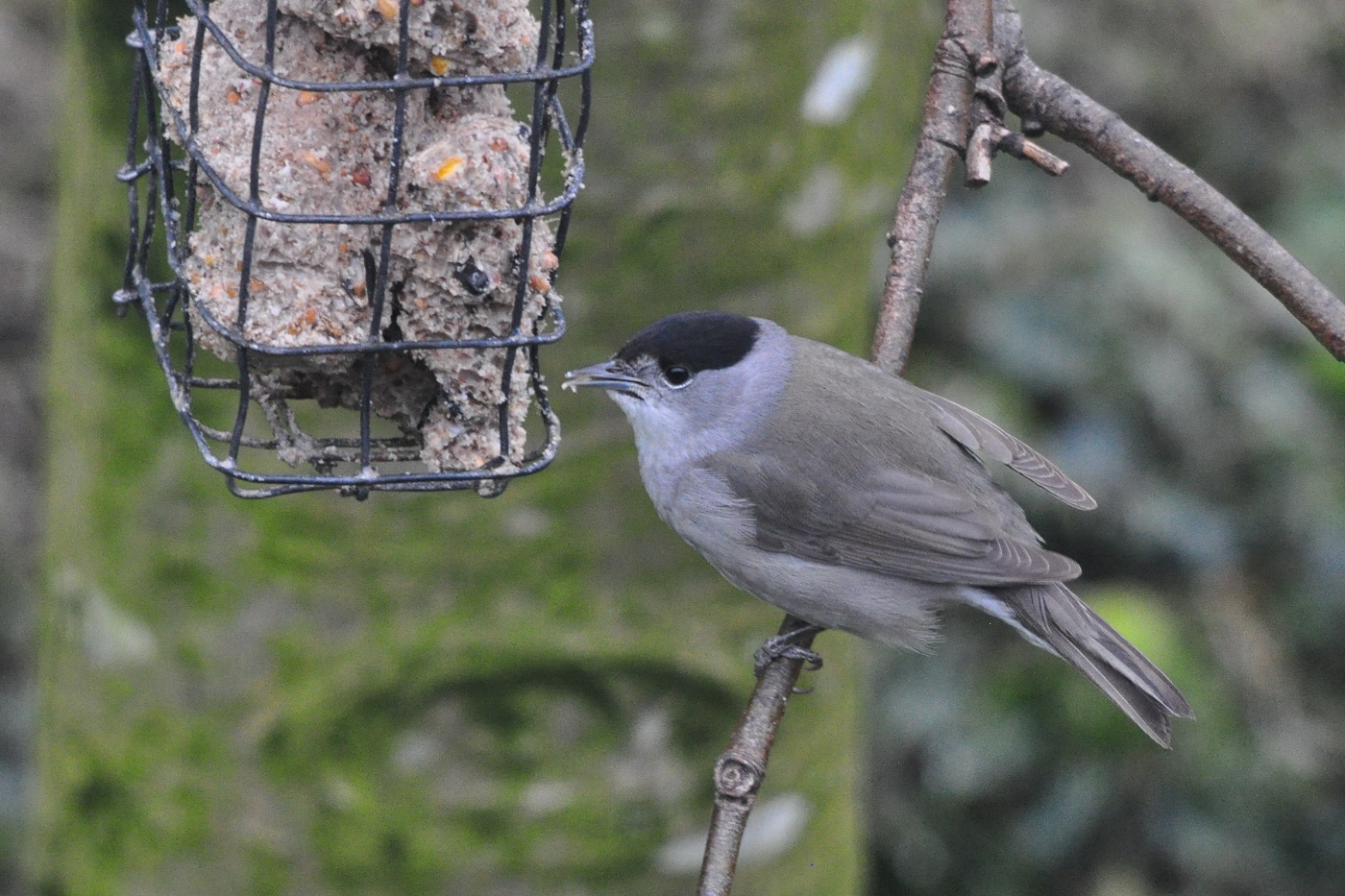
I had an unexpected visitor in the garden on the 6th in the form of a Blackcap. I had been keeping an eye on the feeders when I suddenly noticed there was a male Blackcap feeding on the fat blocks. There hadn't been any Blackcaps in the garden during the winter nor had I encountered any of the summer visiting variety this spring so it was my first sighting for the year, anywhere. As it seemed quite at home feeding on the fat blocks I suspected it could be a bird that had wintered in the UK rather than one that had just returned to breed as I wouldn't have thought the latter would recognise the fat blocks as food. Obviously it is only a suspicion but I think it is a reasonable one.


Not the sort of feeding behaviour you would expect to see if this were a returning summer visitor or at least that is my thinking. 

It looked to be an experienced garden hand-out junkie and chose the fat block over the apples that were available.
I put a net up in the garden the next morning (7th) with the primary aim of catching Siskins as a few were still visiting the feeders. The first bird caught was a Blackcap and it was almost certainly the bird I had seen on the fat blocks the previous day. It was a 2nd calendar year bird, so hatched last year, and it was carrying a moderate amount of fat with a score of 3 on the ESF scale. More importantly it now has a ring on it so there as a chance of finding out which type of Blackcap it is, winter visitor or summer visitor.

I only caught one other bird before rain curtailed proceedings and that was a Siskin, the target species, and it was the fattest Siskin I have caught this spring. It weighed 17.0g which means at least one third of its weight was fat. Siskins that attain such weights are likely to be of Scandinavian origin or from further east as it is far more fuel than would be required if it was just returning to Scotland to breed.

Yesterday (the 8th) I went up to the site at Billinge in the hope there would be a marked increase in warblers and some Redpolls moving through. Unfortunately the session was marred by fog which was very slow to clear and when it finally did some banks of fog or murk lingered in the surrounding areas. There were one or two more Chiffchaffs and Willow Warblers singing but that was about it and there were no Redpolls or anything else on the move overhead. However, it wasn't a complete waste of time as I did catch a bird that I would never have predicted, and that was a Fieldfare. They are pretty scarce on this side of the country once you get into April and they are never easy to catch so ringing one today was totally unexpected. It wasn't the only Fieldfare present as another was heard and seen through the gloom along with a Redwing.


Fieldfare 08/04/2018
Ringing totals (retraps in brackets) for 8th April 2018 were: Goldcrest 3; Blue Tit (1); Willow Warbler 1; Blackbird 1; Fieldfare 1.

Friday, 30 March 2018

Siskin Summary

It has been a reasonable winter and early spring for Siskins in the garden and it isn't over yet. The first Siskins were seen on the feeders back in late November which is relatively early for my garden and, interestingly, both were adult males and both were already wearing rings. Counts stayed in single figures through December, January and the early part of February, although ringing showed there was a little bit of  turnover. Numbers increased in the second half of February and peaked in early March when up to 20 were counted but there was some turnover over the course of each day so the actual peak was probably closer to 30. Counts fluctuated markedly through the middle of March and continued fluctuating as numbers dropped off through the latter part of the month. That brings us right up to today when 5 were present.


Adult male Siskin ringed 28/03/2018
A total of 77 have been ringed and there has been 1 control and that had been ringed 4 days earlier at a site 6km away. Regular readers of the blog will know I have photographed several birds that were ringed prior to this winter and although I wasn't able read the full ring numbers I could read enough to be reasonably confident that they had been ringed in the garden. Frustratingly, they all managed to avoid being recaptured but a different returning bird was retrapped recently; S144917 had been ringed on 19/04/2016 and was retrapped a couple of days ago, on 28/03/2018.


Adult female Siskin S144917 was originally ringed in the garden on 19/04/2016 and retrapped there on 28/03/2018
I have had similar retraps in subsequent years before and they are interesting because Siskins are irruptive migrants. The proportion of the population that migrates and the distance they move varies from one year to the next in response to the availability of food. In some years, like autumn/winter 2014/15, they don't migrate and are able to stay on or very near their breeding areas because of an abundance of natural food. I didn't get any Siskins in my garden that winter or in the following spring, as was the experience of most ringers. The recapture of birds from one winter or spring to the next or after intervals of more than a year shows that some birds use traditional routes and traditional feeding sites, including well stocked gardens like mine, but only when they need to move that far.

Friday, 9 March 2018

8th March 2018 and it's snow joke.

A real dump of snow greeted me first thing this morning and it continued to snow for a good few hours. Some snow had been forecast but I had expected it to be wet sleety stuff and soon turn to rain but this was the real deal and covered everything in a good 3 to 4 inches of the white stuff before it finally stopped.


The view from the front door.

The view towards Orrell Water Park.
The snow clearly had an impact on the birds and the garden feeders were busier than they had been during the recent severe cold spell. We didn't get much snow then and many species, especially seed eaters, still had access to natural food sources and didn't seem pushed for food despite the very cold temperatures. This morning was a different story with the thick covering of snow limiting their feeding options and causing more birds to come to the feeders. 


Birds were queuing up to use the feeders and I have quite a few dotted around the garden.


The birds gather in the trees across the road from the garden before dropping down to feed.


Another group on its way in.


You could imagine this Goldfinch thinking 'Where did this lot come from'.


and this one was really shaking its head.


Some Goldfinches were clearly in pairs.


and another pair.
This male Chaffinch is in one of those 'what are you looking at' poses.


Looking at its tail shape this female Chaffinch is almost certainly an adult.


Female Chaffinch. I only included this photo because of the lump of snow on her head. The snow really did come down thick and fast.


It was nice to see a few more Greenfinches at the feeders but they are nowhere near as numerous as they used to be in the 'good old days', when Greenfinches were ten a penny.


Male Siskin

I was able to read part of the ring number on this female Siskin and it is not one that I have ringed. It will be really frustrating if I don't manage to catch her and establish where she has come from.
Three Pied Wagtails fed on the lawn below the feeders including this fine male. This bird has been a regular in the garden for much of this winter.

It won't be long before my Starling RAS starts. This adult male (A57) was originally ringed as a juvenile in June 2012.

Female Starling


Male Blackbird


Female Blackbird


Judging by the size of of its bib this Coal Tit is a male.


Woodpigeons haven't visited the garden much recently as they have been spending a lot of time feeding in a nearby field of oil seed rape.


The fat cakes have certainly helped this Goldcrest survive this winter.
Winter may not have released its grip just yet but give it another week and I should be writing posts about returning Chiffchaffs and other spring migrants.