Showing posts with label Blackcap. Show all posts

Wednesday, 10 March 2021

Garden birds: winter 2020-21

It has been a very poor winter for birds in my garden, except for the Moorhen which stayed around until mid December, and it has not been for the lack of food on offer. The number of Goldfinches using the feeders has been low and only in single figures throughout. Perhaps the lockdowns have encouraged more people to feed birds in their gardens and this has provided species like Goldfinch with more options than in previous winters. It could also be because there is more natural food available this winter or a combination of the two. Siskins had been totally absent until recently with the first and only sighting of the winter being a fine adult male that visited the feeders yesterday. Use of garden feeders by Siskins is closely linked to availability of natural food supplies so it suggests there has been an abundance of natural food for that species, at least.

Adult male Siskin
Adult male Siskin 09/03/2021

The rounded tail shape and uniform greater coverts and tertials make this Siskin easy to age as an adult (2CY+)

Blackbirds appear to have used the garden in slightly larger numbers with 26 being ringed over the course of the winter but that may be a consequence of the lockdowns and increased time spent catching and ringing Blackbirds rather than any real increase. 
One species that has seen a real increase in numbers is House Sparrow with up to a dozen visiting the feeders every day and a nice roost gathering in a neighbours conifer hedge. They had become very scarce in recent years so it is nice to see that they have made a bit of a comeback.

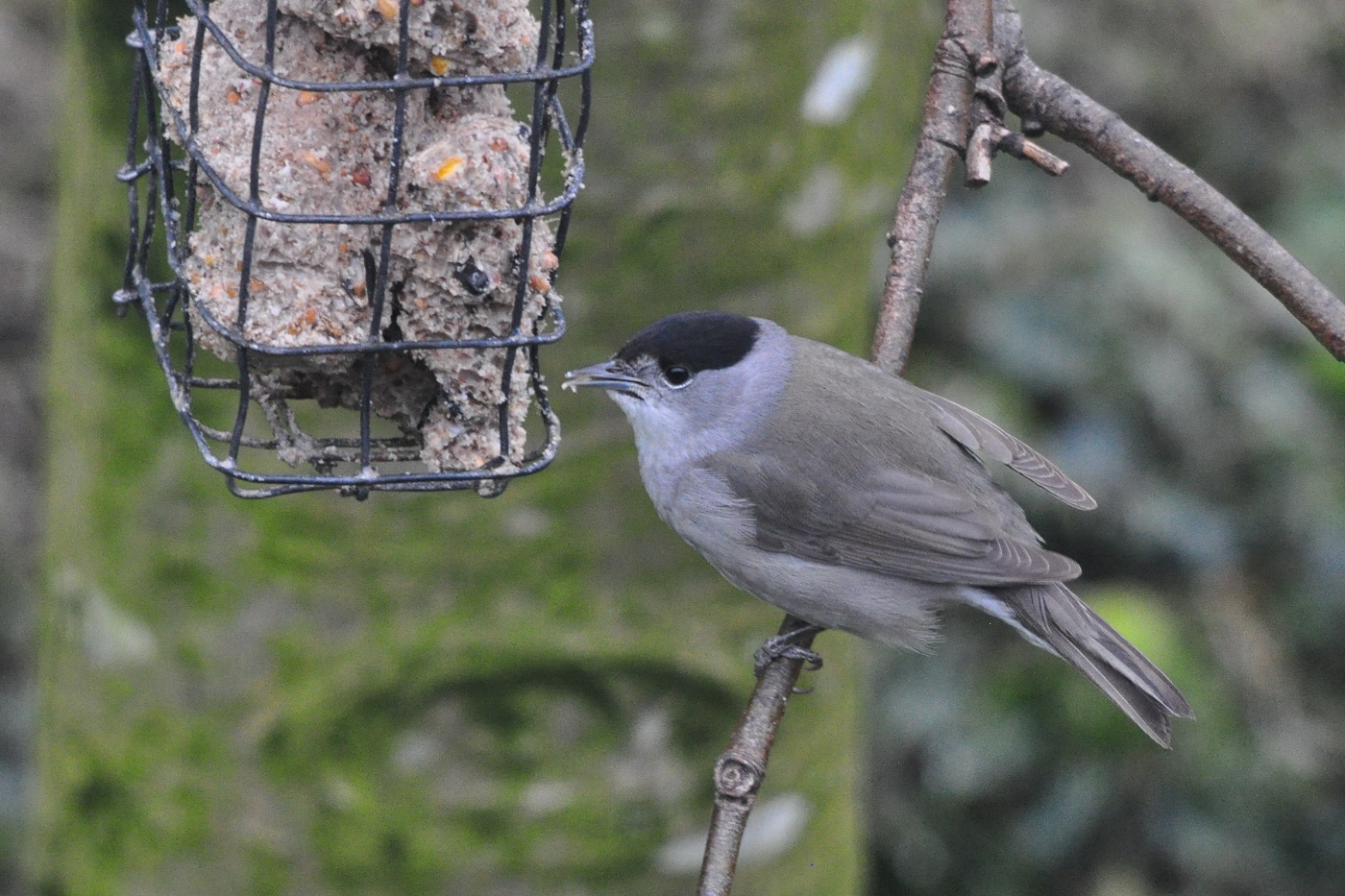
Also on a positive note it has been good to have a Blackcap visiting the feeders since the start of the year. It was an occasional visitor at first but has become a regular visitor over the past month or so. I assumed it was the same individual each time until 2 males were on the same feeder on 22nd February. I caught and colour-ringed one of them on 6th March and that bird has been seen in the garden numerous times each day since then but an unringed male was also present yesterday so perhaps there have been 2 birds all along.

Ringed male Blackcap 08/03/2021

Ringed male Blackcap 08/03/2021

Ringed male Blackcap 08/03/2021

Unringed male Blackcap 09/03/2021

Both Blackcaps are likely to stay around until late March by which time they will have fattened up and be ready to migrate to breeding areas in Europe or possibly elsewhere in the UK.


Monday, 22 April 2019

Billinge: 6th to 22nd April

I have been up to the ringing site at Billinge twelve times since 6th April but the catches have been quite small, hence the lack of blog posts about individual visits.  While the catches have been small they haven't been without interest and what you don't catch can be as important as what you do, or at least that is what I tell myself.

It looks like being another poor spring for Redpoll passage but that is hardly surprising as last autumn was very poor for Redpolls going south so a poor showing the following spring is no big surprise. Having said that you have to put the effort in to find out and I can certainly say I have put the effort in with only 18 Lesser Redpolls caught over twelve visits. One of the Redpolls caught on 10/04/2019 was a retrap that had been ringed at the site on 13/08/2017 as an adult female so perhaps a bird that breeds not too far away.

The most interesting Redpoll, for me at least, was a little adult male caught yesterday (21/04/2019). I say little as its wing length was 69mm which is fairly small or very small for a male of any race. We still don't know what to do with Redpoll species and races because they don't play by the rules as we would like to apply them. If my understanding is correct they should all be lumped at a genetic level, every last one of them, into one species because they are not distinct enough genetically despite their varying appearance. Arctic, Common, Lesser or whatever you want to call them they are all far more similar on the inside than they appear on the outside but that is what makes them even more fascinating. While they may be similar on the inside the difference on the outside largely determines where they will breed and that is why we like them so much.

A bit or quite a bit greyer than your typical Lesser and probably breeds well north of Billinge.

Broad white fringes to the greater coverts, tertials and inner webs of tail feathers.
A touch of tram lines up the mantle too.

Broad white fringes to the greater coverts and tertials.

Broad white fringes to inner webs of tail feathers.

Unstreaked under-tail coverts which is normally a feature of Arctic Redpolls.

Pure white, unstreaked, under-tail coverts, including the feather shafts. If you hadn't seen the rest of the bird you could be thinking Arctic Redpoll. I have seen Lesser types like this before so not as exceptional as it may appear.
The first Willow Warbler was noted on the 6th and it was good to find that 9 of the 20 that were caught between the 10th and 22nd were retraps. Of the retraps one was originally ringed in 2016 and eight were originally ringed in 2017. On the other hand Chiffchaffs have been thin on the ground this spring with only 3 caught but all were retraps - one from 2017 and two from 2018. Blackcaps have put in a pretty good showing so far with 12 caught - 10 new, 1 retrap and 1 control. The retrap was ringed as a first-year in August 2017 and the control was ringed 16 km away at Woolston Eyes in April 2018.

Unusual captures were a pair of Mistle Thrushes that found their way into one of the nets on the 16th and were a first to be ringed at the site. However, the highlight of the period, and what made the effort worthwhile, was the capture of six Tree Pipits with the first caught on the 13th.

Tree Pipit 19/04/2019

Tree Pipit 21/04/2019
The twelve visits yielded 54 new birds, 18 retraps and 1 control as follows (retraps in brackets): Lesser Redpoll 17 (1); Willow Warbler 11 (9); Chiffchaff  (3); Goldcrest 2 (1); Blackicap 10 (1) +1 control; Robin 3; Long-tailed Tit (1); Tree Pipit 6; Mistle Thrush 2; Bullfinch 1 (1); Dunnock 1; Yellowhammer 1; Willow Tit (1).

Saturday, 13 April 2019

11/04/2018: Ivy berry Blackcaps and continental Song Thrush.

I went up to Billinge first thing but there wasn't much doing so I packed up early and went to Crawford to top up the feeders. As I had my ringing gear with me I decided to put a net up there for an hour and as things turned out I am certainly glad that I did. There weren't many birds coming to the feeders, at least not while I was there, but the ivy berries worked their magic and I caught 6 new Blackcaps, all males. These 6 Blackcaps came hot on the heels of 5 that were caught at the site on the 7th and made me wonder how many have taken advantage of this particular abundance of ivy berries so far this spring or will do so while the they last.

Some parts of the ivy have been stripped of their berries but there are plenty left.

 Today's 6 Blackcaps came hot on the heels of 5 caught at the site on the 7th. Everyone is familiar with concentrations of birds on berries in autumn but less so with returning birds in spring. 

While it was good to catch the Blackcaps the highlight, for me least, was catching 2 Song Thrush as one of them was a small and very grey individual of the continental race (T. p. philomelos).

Continental Song Thrushes don't get any greyer than this one.

I would put money on this bird originating from a long way east. Song Thrush of the British race (T. p. clarkei) are much browner and are generally bigger.

There wasn't a hint of warm brown anywhere in its plumage.

Ringing totals (retraps in brackets) for 11/04/ 2019 were: Blue Tit 1; Long-tailed Tit (1); Blackcap 6; Blackbird (2); Song Thrush 2; Dunnock (1) ;Chaffinch (1).

Sunday, 7 April 2019

Unexpected Blackcaps

I had a bit of a lie in today because the forecast was for heavily overcast conditions and little or no breeze that would last throughout morning. Luckily the forecast looked like it was going to hold true and I headed off to the baited site at Crawford at 8:00am under a completely grey sky and with little or no breeze to speak of. I didn't go earlier as there doesn't seem to be any advantage in setting up at dawn at this site now the days are much longer and had I thought the conditions would have remained the same throughout the day I would have opted for another afternoon visit.

First job was topping up the feeders and judging by how much the food had gone down since they were filled on Friday they were still being well used. I quickly set up the usual 18m net and I didn't have long to wait before the first bird was caught. There were a few Goldfinches and Tree Sparrows around but the first bird caught turned out to be a Blackcap. One had been singing while I was setting up and I assumed it was the bird I had first heard a few days ago (on the 3rd). A pair normally breed at the site so a singing Blackcap wasn't unexpected and nor was catching it. However, I didn't expect that 5 of the total of 20 birds caught over the next 3 hours would be Blackcaps (4 males and 1 female).

Male Blackcap

Female Blackcap
Looking at other blogs and sightings reports there appears to have been a bit of an influx of Blackcaps into the region overnight and it is likely that some of the Crawford birds fall into that category. The glut of ivy berries in the hedge by the feeders probably helped by providing a good refuelling point for recently arrived migrants.

The rest of the catch was pretty much as expected in terms of species but wasn't without interest. Two of the Goldfinches were fat with the heaviest weighing 19.7g which was 5.3g heavier than the lightest Goldfinch caught. The retrap Tree Sparrow was interesting as it was the first one from a previous year and was originally ringed as a breeding female on 9th June 2016. It was also interesting because of the state of its plumage. It basically looked like it had been attacked by a mad hairdresser for want of a better description. Many of the barbs of the feathers of the underparts appeared to have broken off and other feathers were similarly affected to a lesser degree. As to the cause I have no idea but I have caught Blue Tits that were similarly affected in the past.

Female Tree Sparrow S144976

A close up of the junction between the affected and the seemingly unaffected feathers.

Many of the wing feathers had a ragged edge.

The tail was in a poor state, the breakages didn't follow any fault lines and appeared to be quite random. It is as if the feathers have become brittle and the breakages happened during preening and that is perhaps why the head and neck appear to be the least affected.

Ringing totals (retraps in brackets) for 07/04/2019 were: Blue Tit 1; Great Tit 1; Blackcap 5; Blackbird 1; Tree Sparrow 3 (1); Robin 1; Chaffinch 1; Goldfinch 4(2).

Tuesday, 25 September 2018

Billinge: 25th September 2018

The prospect of catching more Redpolls tempted me out again this morning and the usual 3 nets produced 34 birds in just over 3 hours but no Redpolls were ringed.

Highlights and observations of note were as follows:

  • A Willow Warbler was ringed and is a fairly late record but still well short of the latest for the site which was on 23/10/2014.
  • Goldcrests just managed to scrape into double figures for the first time this month with 10 ringed but it still looks like the UK population has taken a tumble as double figure totals should be the norm for much of September. Interestingly, 9 of the 10 Goldcrests were females.
  • This was the first session of the autumn without a Blackcap being ringed and none were seen or even heard.
  • Tits are starting to show signs of getting itchy feet with Coal Tits becoming much more vocal and flighty. While I sure some do move others may just go through the motions and turn back or only go a relatively short distance.
  • Great Tits also showed a sex bias today with the 7 ringed all being females.
  • There was next to no visible migration despite the clear conditions and fairly light breeze with only a handful of Meadow Pipits, a few Skylarks, 4 Reed Buntings, 2 Siskins and 3 Redpolls being noted.
Ringing totals for 25/09/2018 were: Coal Tit 3; Blue Tit 4; Great Tit 7; Willow Warbler 1; Chiffchaff 4; Goldcrest 10; Chaffinch 2; Yellowhammer 2; Reed Bunting 1.

Willow Warbler 25/09/2018


Tuesday, 11 September 2018

Billinge: 5th & 10th September 2018

September is a month when autumn migration is normally in full swing and even if one species doesn't deliver another usually does. However, this September is starting to look very different to those of the past 4 years at Billinge and although there is still time for things to change things don't look very promising at the moment.

5th September 2018
A morning that got off to a good start with a Song Thrush caught in the first net just as the last guy rope was being tied off. September sees British Song Thrushes starting to move and the first continental migrants arriving with this bird likely to be one of the former. After that it was generally a lacklustre session with the numbers bulked up by a few too many tits. If I had to pick a highlight it would be the capture of the first 4 Meadow Pipits of the autumn although 4 is a relatively poor total for this date in September. The biggest news, if you can call it that, was the near absence of Goldcrests with only 2 caught. Goldcrests usually start to move through the site in good numbers from the start of September so a total of 2 is well below the norm of the past 4 years.


Meadow Pipit 05/09/2018
Totals for 05/09/2018 were: Blue Tit 11; Great Tit 6;  Willow Warbler 2; Chiffchaff 6; Blackcap 4; Goldcrest 2; Song Thrush 1; Meadow Pipit 4; Chaffinch 1; Linnet 3.

10th September 2018
If the session on the 5th fell short of what I have come to expect from the site in September this one was even more disappointing. The near absence of Goldcrests of the 5th became a total absence with none being caught, seen or even heard. To give that some context last September saw 21 ringed on the 1st, 17 ringed on the 10th September and a total of 77 over the first 10 days. In 2016 it was a similar picture with 50 ringed over the first ten days of the month and no blank sessions. It is starting to look like Goldcrests were hit really hard by spell of severe cold weather back in March.
It is getting a bit late for Willow Warblers so the capture of 2 was noteworthy but the near absence of Chiffchaffs was far more unusual with none caught and only 2 heard all morning. Chiffchaffs numbers normally peak in September and a capture total in low double figures should have been on the cards. The quiet theme was also reflected in the visible migration with only a few Meadow Pipits moving. It was the quietest I have known the site to be in September by some margin and it is to be hoped the rest of the month doesn't carry on that way.

Totals for 10/09/2018 (retrap in brackets) were: Sparrowhawk 1; Blue Tit 4 (1); Willow Warbler 2; Blackcap 2; Dunnock 1; Meadow Pipit 7; Chaffinch 2.


One of the Blackcaps caught on the 10th was still largely in juvenile plumage which is suggestive of some very late breeding.

The last bird caught on the 10th was this juvenile female Sparrowhawk.


Monday, 3 September 2018

Back to blogging

It has taken a while, and much longer than I would have liked, but I have finally got round to posting on the blog again. I am not one for mentioning much about my personal life but the ups and downs of life, with all their twists and turns, have taken up a lot of my time over the last few months and pushed the blog to the bottom of the things to do list. Principal amongst the lows was the failing health of my 97 year old mother and the difficulty of trying to meet her wish of staying in her own home. Eventually, caring for her there became impractical and we had to move her in with us until old age and age related heart failure finally got the better of her. That is more detail than I would normally give on such matters and was only one of the factors involved but I thought such a long absence from the blog merited some explanation.

So enough about that stuff, this blog is about birds and other wildlife and I have managed to fit in some ringing despite all the other things that have been going on. Back in late May I completed my Starling RAS project for this year and it was another successful season with a total of 168 different adults encountered (31 new birds and 137 colour-ringed birds re-sighted). Starlings appear to have had a good breeding season and I have ringed more juvenile Starlings in the garden than in any previous year with the total currently standing at 489 (it increased by 3 whilst writing this post). I don't usually catch many juvenile Starlings after the middle of June and, initially, that was the case again this year but numbers visiting the feeders started to pick up again in late July and small numbers have been making regular raids on the fat feeders since then. This has resulted in 85 being ringed since late July compared to only 25 over the same period last year.

Visits to other sites have been less frequent than in other years but I started to rectify that once we got into August. A visit to the site at Billinge on 30th August was the most productive of the recent sessions and is worthy of specific mention. I had been joined by Mark, who was over from America to visit family, and we set 3 nets in the top willows. Conditions were ideal for mist netting, being calm and largely overcast, and while ideal netting conditions don't always coincide with good numbers of migrants this was one day when they did. Blackcaps were the most numerous species and the total of 20 ringed was a new day record for the site. Twenty isn't a big catch by the standards of some sites but it is for the Billinge site which isn't blessed with much in the way of berries. The most unusual captures were a male Redstart, which Mark was especially pleased to see in the hand, and 2 Spotted Flycatchers which were caught just after he had to leave, well you can't win them all. A catch of 9 Willow Warblers was also a decent number for late August. A total of 60 birds were ringed which broke down as follows: Blue Tit 10; Great Tit 5; Chiffchaff 9; Willow Warbler 9; Blackcap 20; Robin 2; Spotted Flycatcher 2; Redstart 1; Goldfinch 1; Yellowhammer 1.


1cy male Redstart


1cy Spotted Flycatcher
I can't promise when the next post will be but hopefully there won't be anything like a gap of 3 months before the next one comes along. In fact it should be fairly soon as I hope to get out on Wednesday and failing that there are some interesting recoveries that I want to share.

Sunday, 29 April 2018

Quiet at Billinge but busy in the garden.

It has been very quiet at Billinge over the last week and 4 visits (22nd, 24th, 25th & 28th) only resulted in a combined total of 7 birds caught [Willow Warbler 1, Blackcap 2, Robin 1, Tree Pipit 1, Great Tit 1 (1)]. Visible migration was minimal, to say the least, and there was no significant change in the numbers of warblers present with Chiffchaff, Willow Warbler and Blackcap the only species on territory.


It may have been a poor week but a Tree Pipit, the 2nd to be ringed this spring, provided some consolation.
While there has not been much happening at Billinge the garden has been getting very busy. The cold spring has delayed breeding in many species but it doesn't appear to have had much of an effect on the local Starlings and most pairs are feeding nestlings now. I run a RAS project on Starlings and attract them to the garden with home made fat blocks but more about that in a future post.


The vast majority of Starlings coming to the feeders were colour-ringed in previous years and 77 individuals have been re-sighted in the last week.

Sunday, 22 April 2018

Billinge: 21st April 2018

There was a general lack of birds and in many respects it was very disappointing morning but there were a few bits of interest that were topped off in fine style by an Osprey that flew directly over me towards the end of the session. Only 9 birds were caught over the best part of 5 hours but they did include a Tree Pipit and a couple of interesting retraps. Once again visible migration was virtually none existent with 3 Tree Pipits, 5 Lesser Redpolls and the aforementioned Osprey being the only birds seen moving north.


You can't complain about only catching 9 birds when one of them is a Tree Pipit. 
The first of the interesting retraps was a female Blackcap which was originally ringed as a first-year bird in August 2014 and hadn't been recaptured during the intervening period.

At nearly 4 years old this Blackcap has reached quite a good age.
The other interesting retrap was a Willow Warbler that, at first glance, looked more like a Chiffchaff than your typical spring Willow Warbler. 

You can make your own mind up from the photos but the supercillium is quite dull and indistinct, especially behind the eye.

There was no doubt about it being a Willow Warbler albeit a rather drab looking one. It had been ringed as an adult in August 2015 and retrapped in May & August 2016 and again in May 2017 and was sexed as a male. The wing formula was as it should be for Willow Warbler and the wing length was 69mm. 

Interestingly, the legs were quite dark too.

There has been a distinct lack of Lesser Redpolls moving through so far this month and the 5 seen on this visit is the largest count. They have been absent on most days and on the few occasions any have been recorded it has only been ones and twos.

Only 3 Lesser Redpolls have been ringed so far this month compared with 66 from a similar amount of effort in the same period last year. Numbers and timing do vary from year to year but this April looks like being an exceptionally poor one for this species.
Ringing totals (retraps in brackets) for 21st April 2018 were: Willow Warbler 1 (2); Blackcap 1 (2); Dunnock 1; Tree Pipit 1; Lesser Redpoll 1.

Monday, 9 April 2018

Tales of the unexpected.

I had an unexpected visitor in the garden on the 6th in the form of a Blackcap. I had been keeping an eye on the feeders when I suddenly noticed there was a male Blackcap feeding on the fat blocks. There hadn't been any Blackcaps in the garden during the winter nor had I encountered any of the summer visiting variety this spring so it was my first sighting for the year, anywhere. As it seemed quite at home feeding on the fat blocks I suspected it could be a bird that had wintered in the UK rather than one that had just returned to breed as I wouldn't have thought the latter would recognise the fat blocks as food. Obviously it is only a suspicion but I think it is a reasonable one.


Not the sort of feeding behaviour you would expect to see if this were a returning summer visitor or at least that is my thinking. 

It looked to be an experienced garden hand-out junkie and chose the fat block over the apples that were available.
I put a net up in the garden the next morning (7th) with the primary aim of catching Siskins as a few were still visiting the feeders. The first bird caught was a Blackcap and it was almost certainly the bird I had seen on the fat blocks the previous day. It was a 2nd calendar year bird, so hatched last year, and it was carrying a moderate amount of fat with a score of 3 on the ESF scale. More importantly it now has a ring on it so there as a chance of finding out which type of Blackcap it is, winter visitor or summer visitor.

I only caught one other bird before rain curtailed proceedings and that was a Siskin, the target species, and it was the fattest Siskin I have caught this spring. It weighed 17.0g which means at least one third of its weight was fat. Siskins that attain such weights are likely to be of Scandinavian origin or from further east as it is far more fuel than would be required if it was just returning to Scotland to breed.

Yesterday (the 8th) I went up to the site at Billinge in the hope there would be a marked increase in warblers and some Redpolls moving through. Unfortunately the session was marred by fog which was very slow to clear and when it finally did some banks of fog or murk lingered in the surrounding areas. There were one or two more Chiffchaffs and Willow Warblers singing but that was about it and there were no Redpolls or anything else on the move overhead. However, it wasn't a complete waste of time as I did catch a bird that I would never have predicted, and that was a Fieldfare. They are pretty scarce on this side of the country once you get into April and they are never easy to catch so ringing one today was totally unexpected. It wasn't the only Fieldfare present as another was heard and seen through the gloom along with a Redwing.


Fieldfare 08/04/2018
Ringing totals (retraps in brackets) for 8th April 2018 were: Goldcrest 3; Blue Tit (1); Willow Warbler 1; Blackbird 1; Fieldfare 1.

Friday, 12 January 2018

Still here, and ageing.

Apologies for the lack of posts in recent weeks but there has been a lot going on on the domestic and family front to say the least. Added to that the birding has been fairly quiet around here so there hasn't been a huge amount of interest to blog about anyway. For what it is worth here is a summary of what I have been doing on the avian front over the last few weeks.

A total of 121 birds were ringed during December and another 68 were retrapped or resighted with much of that total coming from birds ringed in the garden. Goldfinches topped the totals with 36 ringed and Starling topped the retraps / resightings with 39 records, mainly resightings of colour-ringed birds. The only unusual ringing activity involved Siskins with a total of 7 ringed (6 in the garden and 1 at Billinge) which is an exceptional number for December.

Interestingly, the first Siskin was seen on the feeders in garden on 20th November and it was already ringed. A few days later 2 were coming to the feeders, both of which were wearing rings and both were adults so there is a chance they were returnees rather than birds that had been ringed elsewhere. I expected to catch one or both of theses birds as they continued to visit fairly regularly so it was a bit of a surprise when I caught 3 new birds in early December. A few Siskins continued to visit the feeders on a daily basis throughout December and at least 8 individuals were involved. In previous winters it has been mid to late January before they start coming to the garden on a regular basis so to have them start two months early is really unusual for here. This change doesn't seem to have been caused by any sort of food shortage as there are still plenty seeds in the alder cones. In fact Goldfinches were more hit and miss in the garden during December and this has continued on into January as they are spending quite a lot of time feeding in alders. This shows there is still an abundance of alder seeds to be had in the local area and it is probably also true of the wider countryside.

I have almost finished submitting my 2017 ringing data to the BTO and just need to do some final checks. Provisional totals for 2017 ended up at 4183 new birds and there were another 958 recaptures or resightings. The top 5 species ringed accounted for more than half the total as detailed below (again provisional totals for now):

Species        New Birds         Retraps/resightings
Goldcrest         669                            30
Starling            621                          567
Redwing          425                              0
Goldfinch         366                            41
Chiffchaff         295                            30

I have also been checking through the gulls and waterfowl that come to bread at Orrell Water Park (as usual) and have photographed the ring numbers of 3 Black-headed Gulls (2 from Germany and 1 from Scotland), a ringed Coot (from south Wales) and a Canada Goose (from Cheshire). All could be considered regulars to a greater or lesser degree as they were all recorded more than once during December and one of the German gulls, the Coot and Canada Goose have been recorded in previous winters.

EZ33149 was ringed as a chick at Elvanfoot, South Lanarkshire on 20/06/2017 which is 222 km NNW of Orrell Water Park.


Sometimes I only need to take a few photos to get the full ring number but in many cases I have to take dozens to be sure. While these are crops most of my photos of ringed birds are just of their legs rather that the whole bird.

Best foot forward. This is the German ringed bird from the Helgoland scheme. It has been recorded 11 times so far this winter but I still haven't received the ringing details so don't know when or where in Germany it was ringed.

I am spoiled for choice when it comes to photos of this bird, or at least its legs. IA141745 has been recorded 15 times so far this winter and over 70 times since the first sighting in October 2012. It was originally ringed as an adult in Bohmke und Werder, Mecklenburg - Vorpommern, Germany on 29/04/2012 and is pretty much a fixture at the park between October and February.

GR03863 is what you could call an old(ish) Coot as it was originally ringed as a first-year on 23/12/10 so is a little over 7 years old. It is well short of the UK longevity record for the species which currently stands at just over 15 years but it is probably older than your average Coot. It was ringed 236 km south at Comeston Lakes, near Penarth in the Vale of Glamorgan during a spell of very cold weather but has been recorded up here 17 times since, most recently on 27/12/2017, so was probably a cold weather refugee when ringed.

The New Year hasn't seen much in the way of change as yet. Both German ringed Black-headed Gulls were photographed on the 1st and both have been recorded since. A few Siskins continue to visit the feeders in the garden on a daily basis and another 2 have been ringed. I have also resighted 25 different colour-ringed Starlings at the feeders and caught and colour-ringed another 2.


7 of the 8 Siskins ringed this winter have been adults. This adult male was caught on 10/01/2018. All the wing feathers including the coverts were relatively fresh, the colours were intense so there was no sign of any moult limits


The tail was equally unworn and again the colours were intense but the shape of the tail feathers was at the more pointed end of the range for adults. Adults with a relatively pointed tail like this can catch out the inexperienced and unwary but close examination reveals a neat pale fringe to the edges of all tail feathers and no signs of wear. In this shot you can just see that the primary tips are similarly fresh looking so no doubt it is an adult.

N34 is a female and was originally ringed as a juvenile on 18th May last year.
One notable absentee from the garden this winter has been Blackcap. I usually get one or two over the course of a winter and the first sighting usually comes before the end of December so to not have seen one by now is bucking the trend of the last few years. While Blackcaps have been absent I have got 2 Goldcrests feeding on the fat balls and fat cakes. This is relatively new behaviour for Goldcrests in my garden and although I have seen it before it is unlikely to become common and widespread, as happened with Long-tailed Tits some years back, as they are not very social in winter or long lived so the opportunities for such behaviour to spread in the population are not there.

Not the best photo but it is what you might call a decent record shot. The tail shape is in the intermediate range but it could be an adult and is possibly an individual that came to the feeders last winter. In addition to feeding on the fat balls and fat cakes direct it also picks up tiny fragments that have fallen on to the wire mesh and branches below or on fragments that have been wiped on the wire mesh and branches by other birds when cleaning their bills.
Another even more notable absentee from the garden, and one that is getting increasingly easy to forget, has been the humble House Sparrow. I haven't seen one at the feeders this year and only saw one during the whole of December, which is a really sorry state of affairs. If records from my garden and the local area are anything to go by they are still in marked decline around here.

So that brings things up to date, more or less, and with a bit of luck it won't be the best part of 4 weeks before my next post.