Showing posts with label Chiffchaff. Show all posts

Monday, 22 April 2019

Billinge: 6th to 22nd April

I have been up to the ringing site at Billinge twelve times since 6th April but the catches have been quite small, hence the lack of blog posts about individual visits.  While the catches have been small they haven't been without interest and what you don't catch can be as important as what you do, or at least that is what I tell myself.

It looks like being another poor spring for Redpoll passage but that is hardly surprising as last autumn was very poor for Redpolls going south so a poor showing the following spring is no big surprise. Having said that you have to put the effort in to find out and I can certainly say I have put the effort in with only 18 Lesser Redpolls caught over twelve visits. One of the Redpolls caught on 10/04/2019 was a retrap that had been ringed at the site on 13/08/2017 as an adult female so perhaps a bird that breeds not too far away.

The most interesting Redpoll, for me at least, was a little adult male caught yesterday (21/04/2019). I say little as its wing length was 69mm which is fairly small or very small for a male of any race. We still don't know what to do with Redpoll species and races because they don't play by the rules as we would like to apply them. If my understanding is correct they should all be lumped at a genetic level, every last one of them, into one species because they are not distinct enough genetically despite their varying appearance. Arctic, Common, Lesser or whatever you want to call them they are all far more similar on the inside than they appear on the outside but that is what makes them even more fascinating. While they may be similar on the inside the difference on the outside largely determines where they will breed and that is why we like them so much.

A bit or quite a bit greyer than your typical Lesser and probably breeds well north of Billinge.

Broad white fringes to the greater coverts, tertials and inner webs of tail feathers.
A touch of tram lines up the mantle too.

Broad white fringes to the greater coverts and tertials.

Broad white fringes to inner webs of tail feathers.

Unstreaked under-tail coverts which is normally a feature of Arctic Redpolls.

Pure white, unstreaked, under-tail coverts, including the feather shafts. If you hadn't seen the rest of the bird you could be thinking Arctic Redpoll. I have seen Lesser types like this before so not as exceptional as it may appear.
The first Willow Warbler was noted on the 6th and it was good to find that 9 of the 20 that were caught between the 10th and 22nd were retraps. Of the retraps one was originally ringed in 2016 and eight were originally ringed in 2017. On the other hand Chiffchaffs have been thin on the ground this spring with only 3 caught but all were retraps - one from 2017 and two from 2018. Blackcaps have put in a pretty good showing so far with 12 caught - 10 new, 1 retrap and 1 control. The retrap was ringed as a first-year in August 2017 and the control was ringed 16 km away at Woolston Eyes in April 2018.

Unusual captures were a pair of Mistle Thrushes that found their way into one of the nets on the 16th and were a first to be ringed at the site. However, the highlight of the period, and what made the effort worthwhile, was the capture of six Tree Pipits with the first caught on the 13th.

Tree Pipit 19/04/2019

Tree Pipit 21/04/2019
The twelve visits yielded 54 new birds, 18 retraps and 1 control as follows (retraps in brackets): Lesser Redpoll 17 (1); Willow Warbler 11 (9); Chiffchaff  (3); Goldcrest 2 (1); Blackicap 10 (1) +1 control; Robin 3; Long-tailed Tit (1); Tree Pipit 6; Mistle Thrush 2; Bullfinch 1 (1); Dunnock 1; Yellowhammer 1; Willow Tit (1).

Friday, 9 November 2018

Collybita, abietinus or tristis: the Chiffchaff conundrum.

Regular readers of the blog may remember that I caught a very interesting looking Chiffchaff back in September (link here). Its largely greyish-green and white livery was very different to the standard olive-green and mustard-yellow of the nominate race (collybita) Chiffchaffs that I normally catch in autumn. I thought it was likely to be a Chiffchaff of the race abietinus (the range of which includes large parts of Scandinavia, parts of eastern Europe and European Russia) but, as I commented in that earlier post, I also thought it had a look about it that potentially gave it more easterly credentials, although the early date (23/09/2018) seemed to make that unlikely.


Luckily I was able to salvage a few small feathers that it dropped in a bird bag and submitted them to Professor Martin Collinson for DNA analysis. I was certain that it would prove to be a very interesting individual whatever the result of the DNA analysis turned out to be:
  1. It would be very interesting if it turned out to be collybita simply because its appearance is so unlike that of collybita.
  2. It would be equally if not more interesting if it proved to be abietinus as very few have been confirmed by DNA in western Europe and also because there had been no easterly winds up to that point in September to help drift a migrant of such origin to the UK (especially the west side of the UK).
  3. It would also be very interesting (if not remarkable) if it was shown to have tristis origins because of the early date, again because there had been no easterly winds up to that point in September and because its abietinus like appearance would point to it being a abietinus x tristis hybrid.
Greyish-green and white Chiffchaff caught at Billinge 23/09/2018.
Unfortunately it was not heard to call so there were no clues there. Its appearance most closely matches the descriptions for abietinus but I also knew the identification of abietinus was not necessarily that straightforward. A genetic study of migrant Chiffchaffs caught in the Netherlands found that all 23 of the birds that were identified by ringers as being abietinus, based on their appearance, turned out to have tristis mtDNA (de Knijff et al.)


The flanks were washed with pale brown similar to a tea or coffee stain on a white cloth.


The belly, breast and throat were largely white. The undertail coverts were similar to the flanks but there was a stronger buff to yellowish-buff suffusion around the vent.


The supercillium had yellow tones above and in front of the eye but was pale brown and much less distinct behind the eye. 
To say the result was eagerly awaited is a bit of an understatement and my interest was heightened after reading a paper on the genetics of Chiffchaffs caught in Britain and Ireland (Collinson et al.that was published in British Birds earlier this year (link here). That paper looked at the genetics of 149 migrant and wintering Chiffchaffs caught during 2009 - 2017. It was interesting to see that only 9 birds in that study were found to have abietinus mtDNA and only one of those 9 was actually identified as abietinus by the ringer with the other 8 being tentatively identified as collybita or at least 'not tristis'. As for timing of autumn occurrences the few abietinus were within the same period that tristis were found with the earliest of either race being a tristis caught on the Isle of May on 28/09/2015. The study also found one Chiffchaff that was submitted as a potential tristis actually had collybita mtDNA, however, its quite dull grey appearance was considered to be unlike any of the Chiffchaff races and it was suggested that it was an aberrantly plumaged collybita.

Well I didn't have to wait too long to get the DNA result and I received an email from Thom Shannon, a PhD student working with Martin Collinson, saying that the mtDNA they recovered was that of a tristis Chiffchaff. Thom also commented that the plumage was a much better fit for an abietinus type and that they were of the opinion that it was a clear abietinus/tristis intergrade. As I said earlier the result was going to be interesting whichever way it went and to my mind the combination of its abietinus type appearance, its tristis mtDNA and the early date is the most intriguing outcome of all. 

For those of you that may not know mtDNA is only inherited through the maternal line so it only tells us that its Mum, Grandma or a direct female relative further back through the generations was a 'pure' tristis Chiffchaff. There is no way of knowing from the mtDNA or the bird's appearance if its genetic make-up is more tristis than abietinus or vice versa. Some may be tempted to think it is more abietinus than tristis because its appearance is a much better fit for abietinus but genetic studies on the breeding grounds have shown that is not necessarily the case (Shipilina et al.; Marova et al.). In those studies some birds with abietinus morphology (appearance) were found to have tristis mtDNA and a predominance of tristis DNA overall.


So the mismatch between the Billinge bird's appearance and its mtDNA points to it being an abietinus/tristis intergrade (hybrid) and one thing we can we can say with some certainty about such intergrades is where they originate. The contact zone (the area where the two races meet and overlap) is a relatively narrow band running from the southern Urals northwards to the White Sea and genetic studies have shown that past and ongoing hybridisation occurs in this area and that a similar mismatch of appearance and mtDNA is not found in other parts of either subspecies breeding range (Marova et al and Shipilina et al). Therefore, it is reasonable to conclude that this particular bird originated in that contact zone and will have travelled around 3250 km to reach Billinge.


Approximate zone of contact between abietinus and tristis (redrawn from Shipilina et al. and Marova et al.) and location of the site where the bird was caught.

There are other aspects to this record that make it particularly interesting with the early date being one of them. The Billinge bird is a week earlier than the earliest tristis identified in genetic study by Collinson et al and if you factor in the westerly location and absence of easterly winds up to that point in September it makes that early date even more exceptional. We will never know when it actually arrived in the UK but it was presumably at least a day or two before the capture date at Billinge, if not longer. In addition, it is a bird that calls into question what we know or think we know about the likelihood of abietinus occurring in western Europe and the UK in particular. I appreciate it is not safe to draw any firm conclusions from just one individual but if abietinus is the regular, if relatively scarce, passage migrant it is generally thought to be then the Billinge bird should have had a much greater chance of being found to have abietinus mtDNA as opposed to the tristis mtDNA that was found.


I am no expert on the subject but I would have thought there are far more 'pure' abietinus in this world (birds with abietinus appearance and abietinus mtDNA) than there are abietinus looking hybrids that have tristis mtDNA, especially when you consider the large range that abietinus occupies west of the overlap zone and the relatively small area of overlap zone itself, where all abietinus x tristis intergrades are thought to originate. It has been suggested, by some who know far more about this subject than me, that many abietinus are so similar to collybita that they probably go unnoticed in western Europe but even if that is the case I would have still thought that should leave enough abietinus that look sufficiently different to be picked out with relative ease, at least in the hand if not in the field. More importantly I would have also thought it more likely that those abietinus that can be identified from their appearance should still outnumber abietinus/tristis intergrades with abietinus morphology, assuming they are the regular and more common passage migrant that presumed wisdom suggests.


As I said earlier it is not safe to draw any conclusions from one individual but the Billinge bird is another record that adds to the uncertainty that surrounds the true status of abietinus as a migrant to the UK. In addition it extends the period when birds of tristis origin can occur and, if nothing else, is simply a very interesting record in its own right as we can be reasonably certain of the region it came from.


References:
Collinson, J.M., Murcia, A., Ladeira, G., Dewars, K., Roberts, F. & Shannon, T. 2018. Siberian and Scandinavian Common Chiffchaffs in Britain and Ireland - a genetic study. British Birds 111: 384-394.

Shipilina, D., Serbyn, M., Ivanitskii, V., Marova, I. &  Backström, N. 2017. Patterns of genetic, phenotypic, and acoustic variation across a chiffchaff (Phylloscopus collybita abietinus/tristis) hybrid zone. Ecology and Evolution 2017; 1–12.


Marova, I.M.,
Shipilina, D., Federov, V., Alekseev, V. & Ivanitskii, V. 2017. Interaction between Common and Siberian Chiffchaff in a contact zone. Ornis Fennica 94: 66-81.

de Knijff, P., van der Spek, V. & Fisher, J. 2012. Genetic identity of grey chiffchaffs trapped in the Netherlands in autumns of 2009 - 2011. Dutch Birding 34: 386-392.


Sunday, 23 September 2018

Two good birds save the day.

The silence that greeted me at dawn this morning did not bode well for a ringing session in the top willows at Billinge and pointed to another poor showing by Goldcrests in particular. In previous autumns, when Goldcrests have passed through in large numbers, they have usually been the first species to call at daybreak and early net rounds nearly always produced the bulk of the birds. This morning the first Goldcrest wasn't heard until well after after sunrise and there wasn't much happening at the nets either.

To say it was quiet and slow going is an understatement and I thought I would end up cutting my losses by packing up early. However, the first Chiffchaff caught was really quite striking and wasn't your typical September green and mustard-yellow 'collybita'.  It was distinctly paler having much greyer tones to the upperparts, was much whiter underneath and the flanks were washed with pale brown and I immediately thought this must be a Scandinavian 'abietinus' Chiffchaff. It was certainly very different to any 'collybita' I have ever seen and I have ringed well over a thousand at Billinge and many more elsewhere.


A very grey and white looking Chiffchaff compared to your typical autumn 'collybita'. It was aged as a first-year from the shape and wear of the tail feathers.
A typical autumn 'collybita' photographed the same day in similar lighting conditions and also aged as a first-year.
The different races of Chiffchaffs present all manner of problems when it comes to identification as shown by the DNA analysis of birds caught in Holland that were identified as 'abietinus' on appearance and proved to be 'tristis' from their DNA. This and other studies have thrown the status of abietinus in western Europe into question and it now appears to be much rarer than its more easterly Siberian (tristis) counterpart. 

There are a couple of other factors that make today's bird even more interesting: one is the date, it is quite early for seeing a dodgy looking Chiffchaff which are usually associated with late autumn or winter; the other is lack of easterly winds so far this autumn which are generally needed to drift birds of such origin to the UK. Had I caught this bird in late October or early November I may have thought it to be a bird with more easterly credentials and possibly from the intergrade zone between abietinus and tristis. It has certainly got some of that look about it.


A collage of both birds. Whatever it is, and potentially proves to be in due course from its DNA, is going to be interesting.
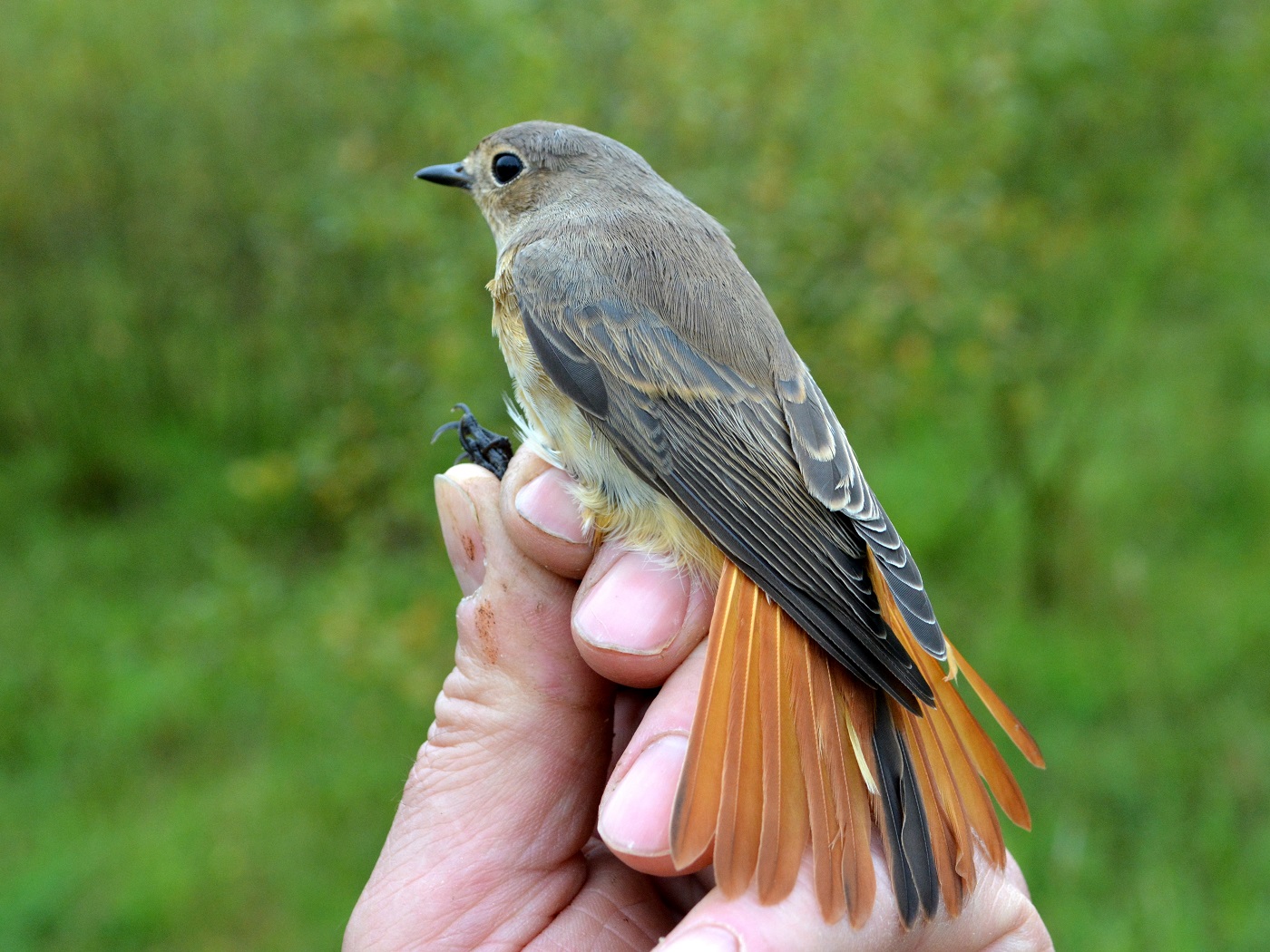
Had I not caught that Chiffchaff I may have packed up by 9:00 but I decided to stick it out and I am glad I did as the second bird that helped 'save the day' was a 1cy female Redstart. This species is a regular but scarce passage migrant at the site and this one was only my second of the autumn and my latest by some margin. Redstarts are usually a bird of late August and early September at this site and my previous latest was caught on 14th September 2017 with all the others recorded between 23rd August and 7th September.


1cy female Redstart


The are not called Redstarts for nothing.
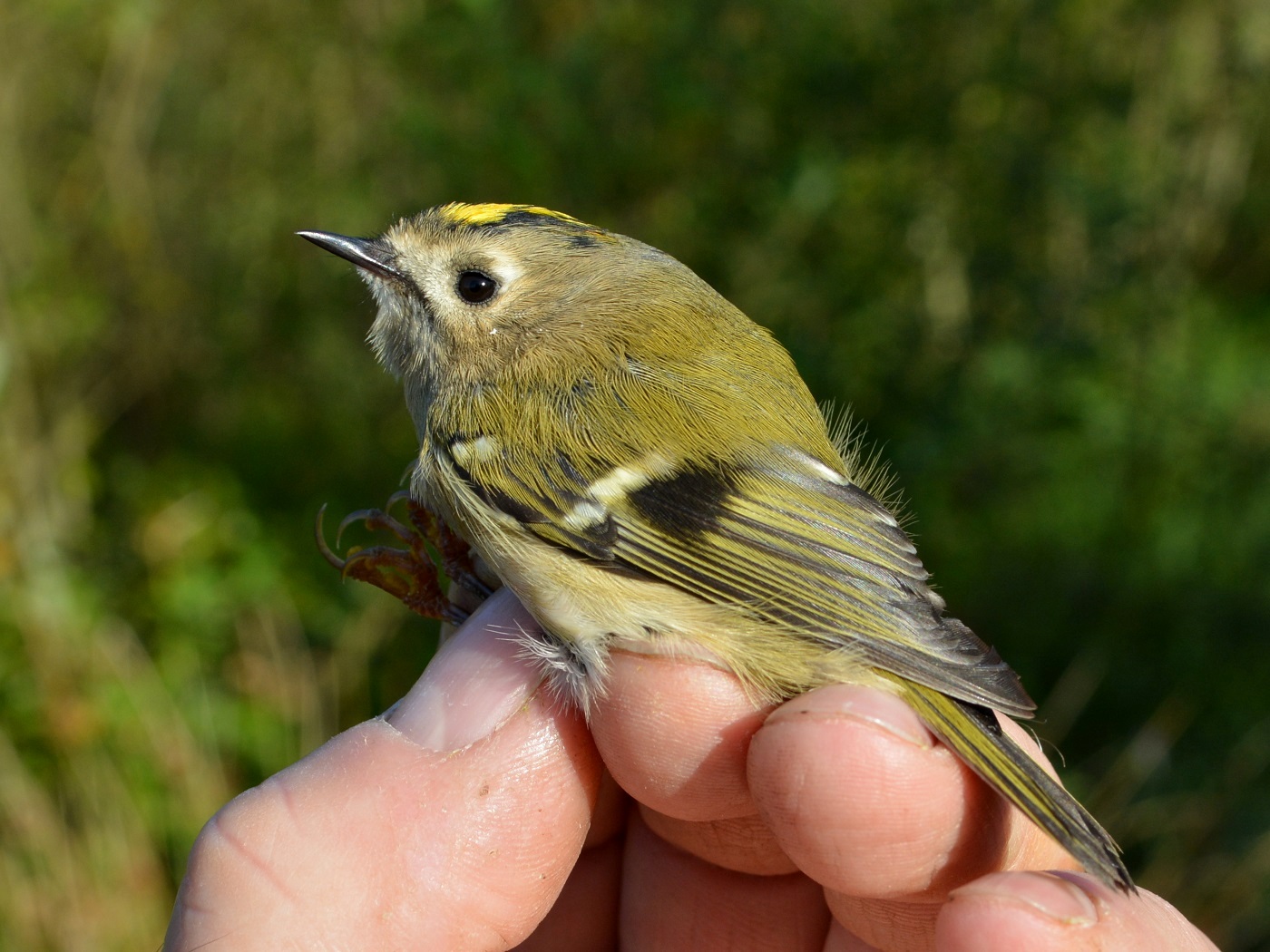
The final total of 30 new birds wasn't too bad but was below the average for the time of year, largely due to the continued lack of Goldcrests. Only 5 Goldcrests were caught compared to 25 on the same date in 2016 and 14 on the same date last year. One minor point of interest about today's Goldcrests is that they were all first-year females, not that anything significant should be read into that as the sex ratios usually even out over time. So while the catching rate was slow from start to finish a couple of interesting birds really did 'save the day' and made staying the course worthwhile.

Ringing totals for 23/09/2018 were: Coal Tit 1; Blue Tit 4; Great Tit 2;  Chiffchaff 6; Blackcap 2; Goldcrest 5; Wren 3; Robin 2; Redstart 1; Chaffinch 1; Linnet 1; Reed Bunting 2.

Wednesday, 19 September 2018

No significant improvement.

It was another below par session at Billinge on the 17th and not helped by an unexpectedly foggy start. The bushes were extremely quiet from the off and the fog, which only lifted quite slowly, ensured there was little in the way of any visible migration until I was leaving. Only 1 Chiffchaff was caught which continues the very poor numbers for that species this autumn. It appears that Chiffchaffs returned in much lower numbers than usual (nationally) back in the spring and that is the primary cause of their poor showing this autumn. If that is the case there is unlikely to be any significant improvement in their numbers over the remainder of the autumn.

There was a slight improvement in the number of Goldcrests with a total of 6 ringed but that is still well below the average for the date compared with the previous 4 years. As with Chiffchaffs the cause goes back to much earlier in the year and a low breeding population rather than a particularly poor breeding season. Again there is little prospect of any significant improvement in their numbers through the remainder of September although with Goldcrests there is always the possibility of a influx of migrants from the continent if we get easterly winds (and they have to be the right easterly winds) in early October.

It looks like the exceptionally low numbers of Goldcrests (compared to the previous 4 years) will continue to be a feature of blog posts for the remainder of this month and probably all of next month.  The severe cold of late February and early March appears to be the culprit and seems to have had a much bigger impact on the British breeding population than I had hoped. I thought the impact may not have been too severe as it came quite late in the winter, when day length is longer and gives birds more time for feeding, but it is looking like that was a far too optimistic outlook for this species.

As previously mentioned 'viz' was almost none existent because of the fog and murk but a couple of dozen Meadow Pipits and a Grey Wagtail did push through along with 6 or so House Martins. However, things did start to brighten up towards the end of the session which prompted a few Swallows to start moving along with 3 Siskins.

Ringing totals (retraps in brackets) for 17/09/2018 were: Coal Tit (1); Blue Tit 1; Great Tit 3; Chiffchaff 1; Blackcap 4; Goldcrest 6; Chaffinch 1; Bullfinch 1(1); Yellowhammer 1; Reed Bunting 1.

Saturday, 15 September 2018

Mainly negative news

Another 2 disappointing visits to the site at Billinge but at least the garden is producing better than expected results.

Billinge 12th September 2018
A total of 31 birds from 3 nests may not sound too bad but it was well below what I have come to expect from this site in mid-September. The big news was the continued lack of Goldcrests, only 1 caught and that was the only one seen or heard, and the low numbers of Chiffchaffs, 2 being a pitiful total for the date. Visible migration was almost none existent and the few Meadow Pipits that were moving were not even passing over at the rate of a trickle, more of an an intermittent drip. The only highlights were a late(ish) Willow Warbler and a similar late(ish) Whitethroat.
Ringing totals (retraps in brackets) were: Blue Tit 8 (1); Great Tit 4; Willow Warbler 1; Chiffchaff 2; Blackcap 2; Whitethroat 1; Goldcrest 1, Song Thrush 1, Robin 1, Meadow Pipit 4, Linnet 2, Goldfinch 2, Reed Bunting 1.


Willow Warbler 12/09/2018


Whitethroat 12/09/2018

Billinge 13th September 2018
If I thought the 12th was poor the 13th was even worse. Nothing was caught in the first hour and only 9 birds were caught after 3 hours so I cut my losses and packed up early. Goldcrests were absent again which continues to suggest there has been a crash in their population; I have only ringed 3 so far this September compared to 56 by the same date in 2014, 34 in 2015, 58 in 2016, and 90 in 2018. The lower than usual numbers of Chiffchaff also continued. Sightings of note were limited to a high flying Song Thrush that was heading south, a Siskin south and another or the same north later, and a grounded Wheatear.
Ringing totals were: Blue Tit 1; Great Tit 3; Chiffchaff 3; Blackcap 1; Reed Bunting 1.

Garden 1st to 14th September 2018
Back home Starlings are visiting the feeders in bigger numbers and more often than they usually do at this time of year. A total of 53 were ringed from the 1st to the 13th and I manged to ring another 8 on the 14th which is unprecedented for my garden. While I catch large numbers in May and June numbers usually fall off sharply in July and I don't normally catch any in August or September. This year numbers dropped off as usual through most of July but then they started to pick up again towards the end of that month and they have continued to increase since then. Now a mob of up to 30 Starlings visit the feeders periodically throughout the day and more than one mob may be involved.


A retrap Starling caught on the 13th was suffering from avian pox. It had at least 11 lesions of various sizes dotted about its body although most (6) were on its head. It was originally ringed on 20th May when it showed no sign of the disease. A set of images and details will be sent to the Garden Wildlife Health project via their website.


Tuesday, 11 September 2018

Billinge: 5th & 10th September 2018

September is a month when autumn migration is normally in full swing and even if one species doesn't deliver another usually does. However, this September is starting to look very different to those of the past 4 years at Billinge and although there is still time for things to change things don't look very promising at the moment.

5th September 2018
A morning that got off to a good start with a Song Thrush caught in the first net just as the last guy rope was being tied off. September sees British Song Thrushes starting to move and the first continental migrants arriving with this bird likely to be one of the former. After that it was generally a lacklustre session with the numbers bulked up by a few too many tits. If I had to pick a highlight it would be the capture of the first 4 Meadow Pipits of the autumn although 4 is a relatively poor total for this date in September. The biggest news, if you can call it that, was the near absence of Goldcrests with only 2 caught. Goldcrests usually start to move through the site in good numbers from the start of September so a total of 2 is well below the norm of the past 4 years.


Meadow Pipit 05/09/2018
Totals for 05/09/2018 were: Blue Tit 11; Great Tit 6;  Willow Warbler 2; Chiffchaff 6; Blackcap 4; Goldcrest 2; Song Thrush 1; Meadow Pipit 4; Chaffinch 1; Linnet 3.

10th September 2018
If the session on the 5th fell short of what I have come to expect from the site in September this one was even more disappointing. The near absence of Goldcrests of the 5th became a total absence with none being caught, seen or even heard. To give that some context last September saw 21 ringed on the 1st, 17 ringed on the 10th September and a total of 77 over the first 10 days. In 2016 it was a similar picture with 50 ringed over the first ten days of the month and no blank sessions. It is starting to look like Goldcrests were hit really hard by spell of severe cold weather back in March.
It is getting a bit late for Willow Warblers so the capture of 2 was noteworthy but the near absence of Chiffchaffs was far more unusual with none caught and only 2 heard all morning. Chiffchaffs numbers normally peak in September and a capture total in low double figures should have been on the cards. The quiet theme was also reflected in the visible migration with only a few Meadow Pipits moving. It was the quietest I have known the site to be in September by some margin and it is to be hoped the rest of the month doesn't carry on that way.

Totals for 10/09/2018 (retrap in brackets) were: Sparrowhawk 1; Blue Tit 4 (1); Willow Warbler 2; Blackcap 2; Dunnock 1; Meadow Pipit 7; Chaffinch 2.


One of the Blackcaps caught on the 10th was still largely in juvenile plumage which is suggestive of some very late breeding.

The last bird caught on the 10th was this juvenile female Sparrowhawk.


Sunday, 29 April 2018

Quiet at Billinge but busy in the garden.

It has been very quiet at Billinge over the last week and 4 visits (22nd, 24th, 25th & 28th) only resulted in a combined total of 7 birds caught [Willow Warbler 1, Blackcap 2, Robin 1, Tree Pipit 1, Great Tit 1 (1)]. Visible migration was minimal, to say the least, and there was no significant change in the numbers of warblers present with Chiffchaff, Willow Warbler and Blackcap the only species on territory.


It may have been a poor week but a Tree Pipit, the 2nd to be ringed this spring, provided some consolation.
While there has not been much happening at Billinge the garden has been getting very busy. The cold spring has delayed breeding in many species but it doesn't appear to have had much of an effect on the local Starlings and most pairs are feeding nestlings now. I run a RAS project on Starlings and attract them to the garden with home made fat blocks but more about that in a future post.


The vast majority of Starlings coming to the feeders were colour-ringed in previous years and 77 individuals have been re-sighted in the last week.

Thursday, 5 April 2018

A few morsels of interest.

Lots of sunshine but not many birds just about sums up the visit to Billinge this morning. I had thought the clear conditions would prompt some vis mig and that there could be a few warblers working their way through the bushes but the birds clearly had other plans. There was virtually nothing moving overhead save for the merest trickle of Meadow Pipits and that soon petered out. There wasn't much happening in the bushes either, apart from a couple of singing Chiffchaffs that were sorting out their territories, and the nets only produced 1 Blackbird in the first couple of hours.

It did look like it was going to be a complete write-off of a morning but then a fine male Brambling was caught and lifted my spirits. Shortly after a Willow Warbler uttered a few subdued snippets of song and while I was trying to locate it a Tree Pipit called as it flew over; both were firsts for the year and helped give the morning a whole new feel. I didn't manage to get any views of the Willow Warbler where it had been singing but that didn't matter as it turned up in one of the nets a little while later.


Male Brambling. There are still a few around in the area and I even had one on the feeders in the garden yesterday.

Willow Warbler.
Things slowed down after that little flurry of activity but another morsel of interest came when a ringed Chiffchaff was caught in the last net round. It was a retrap from last year and had been ringed as a juvenile on 5th August. It is always good to retrap returning migrants and hopefully there will be many more in the coming weeks.

Returning Chiffchaff  KJX121 was ringed as a juvenile on 5th August last year.
It may have been a very slow morning for the most part but it was an interesting one nevertheless.

Ringing totals (retraps in brackets) for 5th April 2018 were: Blue Tit (1); Great Tit 1; Chiffchaff (1); Willow Warbler 1, Blackbird 1; Brambling 1.


Tuesday, 27 March 2018

Billinge: 26/03/2018

It was the first visit without a chill in the air and it even got warm enough to tempt a few bumble bees out but summer visitors were in short supply. I had expected a few Chiffchaffs to be back on territory and singing their hearts out but only one silent bird was present and that one may not have been noticed had it not been caught. Meadow Pipits were the most conspicuous migrant with at least 200 heading north over the course of the morning and another 30 or so were grounded. Some Woodpigeons were also moving north but that movement was partially masked by local birds moving between feeding areas. There was little else moving overhead with just a few Linnets, 2 Lesser Redpolls, a Siskin and a couple of alba Wagtails being noted.


While this was the first Chiffchaff to be ringed this spring the first one was seen at the site on the 24th.
Winter visitors provided some compensation for the lack of summer migrants with totals of 7 Redwing and 9 Brambling recorded. They also provided the ringing highlights as 4 of the Redwings and 2 of the Bramblings found their way into the nets. As I have mentioned before I don't usually catch any Redwings at this site in late winter or spring but the 4 caught brought the total for this year to 10, all of which have been caught in the last couple of weeks. The 2 Bramblings were even more unusual in that they were the first to be ringed at the site in spring.


Ringing another 4 Redwings certainly made up for the lack of Chiffchaffs.

Catching 2 Bramblings was an unexpected bonus, both were females and neither was carrying any fat so they may be around for a little while yet.


All in all it turned out to be good morning for late March with some really nice spring weather and a decent variety of birds too.

Ringing totals (retraps in brackets) for 26/03/2018 were: Goldcrest 2; Blue Tit 2 (1); Great Tit 2 (4) Chiffchaff 1; Long-tailed Tit (1); Blackbird 1; Redwing 4; Robin 1; Brambling 2; Chaffinch (1); Bullfinch 1 (1);  Lesser Redpoll 1. A total of 17 new birds and 8 retraps.

Sunday, 10 September 2017

More Goldcrests on the move.

There was a brief lull in the unsettled weather this morning so I headed up to Billinge to make the most of the calmer conditions. I set 3 nets in the top willows but used a different net configuration to the one I have been using recently as the breeze was due to strengthen from mid morning. It would have been a fairly quiet session but there was a rush of birds about an hour after sunrise that boosted the totals and accounted for nearly half of the 50 birds that were caught over the course of the morning.

The catch was dominated by Goldcrests (19) and Chiffchaffs (14) as is often the case at this time of year and one of the Goldcrest, a 1cy female, was a control (a bird ringed elsewhere). I suspect this Goldcrest may have been ringed on Walney Island (68km NNW of Billinge) as the ring number was fairly close to one I have had from there before, although that is only an educated guess at this stage and I will only know its origin for certain when the recovery report comes through. The best of the rest were a Grey Wagtail, the first Willow Tit for a while and 2 Yellowhammers.


Control 1cy female Goldcrest HDB637

1cy Willow Tit
There were a few more Meadow Pipits moving overhead than there have been so far this autumn but it was still not much more than a trickle and petered out as the breeze picked up. A few Reed Buntings were also on the move early on and was the first obvious movement of that species this autumn and resulted in 3 being caught. However, it very much had the feel that the weather was holding up diurnal migrants and more would have been moving had the conditions been clearer and the breeze hadn't increased so much.

Ringing totals (retraps/controls in brackets) for 10/09/17 were: Goldcrest 17(2); Blue Tit 1; Great Tit 1; Willow Tit 1; Long-tailed Tit 1; Chiffchaff 13(1); Willow Warbler 2; Blackcap 1; Wren 1; Grey Wagtail 1; Chaffinch 1; Greenfinch 2; Yellowhammer 2; Reed Bunting 3.

Sunday, 3 September 2017

2nd is better than 1st

The ringing session at Billinge on the 1st was good but the 2nd's proved to be even better. It was similar in many respects but had the added bonus of some infrequently caught species in the form of 2 Redstarts and a Spotted Flycatcher. Both are scarce passage migrants in the area these days and I consider myself lucky if I catch one or two of each over the autumn. The 2 Redstarts brought this autumn's total to 5 which is exceptional as I have never caught more than 2 in previous years and the Spotted Flycatcher was the second of the autumn. Interestingly, the Spotted Flycatcher was caught in the same part of the same net as the previous one and while no more than a coincidence such 'deja vu' type occurrences always stand out and stick in one's mind.

Both Redstarts were 1cy females.

1cy Spotted Flycatcher. Only the 6th to be ringed at the site in the last 4 years.
Once again Goldcrests dominated proceedings with most of the 23 new birds and single retrap being caught in the first couple of hours. The retrap wasn't from the previous day as some might expect and was originally ringed on 13th August when part way through its post-juvenile moult. At this time of year there are frequent movement of Goldcrests through the site and it is rare for any to hang about for more than a day once they start moving.

Chiffchaff was the second most numerous species with 14 new birds and 1 retrap being caught and while numbers were down on those of the 1st it is still a good total for that species. Once again the retrap hadn't been ringed recently and had been ringed as a scruffy juvenile on 9th July this year which gives an indication of how long it takes them to complete their protracted post-juvenile moult.

There were more Robins about than there have been recently and the 5 ringed is a sign they were on the move. The first half of September usually sees quite a few Robins pass through site, more so following a good breeding season, and is largely made up of displaced birds that are looking for somewhere to carve out a winter territory but may also include some genuine migrants.

The weather is looking pretty ropey for the next week so opportunities to get out ringing could be very limited to say the least. Is this going to be a year we don't get an Indian summer ? 

Ringing totals (retraps in brackets) for 02/09/17 were: Goldcrest 23(1); Blue Tit 2(1); Great Tit 6; Chiffchaff 14(1); Willow Warbler 4; Blackcap 4; Spotted Flycatcher 1; Robin 5; Redstart 2; Tree Pipit 1; Chaffinch 4; Goldfinch 4; Reed Bunting 1. A total of 71 new birds and 3 retraps.

Friday, 1 September 2017

A good start to September.

I arrived at Billinge a little later than planned but early enough to get the nets up just before sunrise. A Goldcrest was calling as I lugged my gear up to the net rides in the top willows and a dozen or so Swallows were exiting their roost as I approached the first net ride. It had been a cool, clear night and could have resulted in a clear out of birds but I heard another Goldcrest and a couple of Chiffchaffs calling as I was putting up the second of the three nets so I was reasonably optimistic about the prospects for the morning. As I was putting up the last net a Chiffchaff flew into it before it was fully open which was another promising sign.

As soon as the last net was set I went straight back to the first and found 5 Goldcrest, 3 Chiffchaff and a Willow Warbler had been caught. On completing the first round of the nets 12 Goldcrests, 8 Chiffchaffs and a Willow Warbler had been extracted which was a cracking start to the morning and the new month. Goldcrests and Chiffchaffs were clearly on the move and more filtered through the bushes over the next couple of hours and kept me quite busy.  The catching rate slowed to a more steady pace from about 09:30 and I packed up just over an hour later when a check of the rainfall radar confirmed a hefty looking shower was heading my way.

1cy Chiffchaff
The final total of 70 new birds and 3 retraps included 21 Goldcrests and 24 Chiffchaffs with the later being a new day record for the site. Goldcrests continue to look like they have had a very good breeding season with today's 21 following record totals in July (19) and August (42) so, weather permitting, it could prove to be a record September too.

1cy male Goldcrest
Ringing totals (retraps in brackets) for 01/09/17 were: Goldcrest 21; Blue Tit 4 (2); Great Tit 1 (1); Chiffchaff 24; Willow Warbler 4; Blackcap 5; Tree Pipit 1; Chaffinch 6; Goldfinch 3; Reed Bunting 1.

Billinge 22nd - 30th August 2017

I have managed to get out nearly every morning since my last post although some of the sessions were affected by fog, delayed and/or curtailed by showers or a strengthening breeze. A total of 200 birds were ringed and another 13 were retrapped over the period which is reasonable number given the mixed weather conditions and the limited number of nets used. There were no major surprises although sylvia warblers were in short supply throughout. Chiffchaffs took over from Willow Warblers as the most numerous warbler species as is usual in late August and all the less frequently caught species were what could be termed the usual suspects.


Species
New
Retrap
Species
New
Retrap
Goldcrest
18
1
Blackbird
2
0
Blue Tit
11
1
Song Thrush
2
0
Great Tit
15
2
Robin
5
0
Coal Tit
2
0
Redstart
3
0
Long-tailed Tit
0
3
Dunnock
1
0
Chiffchaff
54
3
Tree Sparrow
1
0
Willow Warbler
20
1
Grey Wagtail
2
0
Blackcap
8
0
Tree Pipit
9
0
Garden Warbler
0
1
Chaffinch
21
0
Grasshopper Warbler
1
0
Bullfinch
6
0
Reed Warbler
1
0
Greenfinch
3
0
Nuthatch
1
0
Linnet
3
0
Treecreeper
2
0
Goldfinch
5
0
Wren
1
1
Yellowhammer
3
0
Total for the period: 200 new birds and 13 retraps

Ringing highlights and noteworthy sightings were as follows:

22/08/17 - At least 12 Tree Pipits were on the move despite early fog and generally poor visibility but only 1 was ringed.

23/08/17 - This session was also affected by fog, some light drizzle and stayed quite murky once the fog cleared. It went so dark at one point birds went very quiet and some seemed to go to roost. However, this visit produce the first Redstart of the autumn, a 1cy female, amongst a catch of only 15 birds. At least 7 Tree Pipits headed south despite the conditions and 2 of them were caught. As the light drizzle stopped there was an unexpected sighting of a flock of 11 Dunlin flying low over the site and heading NNE, they may have been disorientated in the very murky conditions or simply been forced down by the very low cloud.

25/08/17 - Chiffchaffs really took over from Willow Warblers with ringing totals of 14 and 1 respectively. Another 2 Tree Pipits were ringed from a total of 6 recorded.

27/08/17 - Grey Wagtail passage got going with at least 4 passing over the site and 1 was ringed. Interestingly, similar movements were reported from sites across the country. Another 2 Tree Pipits were ringed from a total of 9 recorded. A juvenile Tree Sparrow was an unusual capture although a few had been recorded flying high over the site on the previous 2 days.


The first Grey Wagtail ringed this autumn
28/08/17 - A 1cy Reed Warbler was well away from its usual habitat and was only the 2nd to be ringed this autumn. This species is a scarce but regular autumn passage migrant at the site and 9 of the previous 13 records have been in the narrow period 23rd to 31st July with the remainder being on widespread dates in August. This session was also noteworthy for being the first of the autumn without a Willow Warbler being ringed or recorded.

1cy Reed Warbler
29/08/17 - A short, rain delayed session produced a Blackbird with an interesting plumage and not much else.


This 1cy male Blackbird is similar to what is sometimes referred to as the 'Stockamsel' variety. Had this bird been seen later in the autumn or during the winter it may have been thought to be of continental origin but there is virtually no chance of that in late August.

Its post-juvenile moult was almost complete.

It had a wing length of 131 mm which is towards the longer end of the range for locally bred birds but is not exceptional by any means.

1cy male Blackbird. A locally bred 'Stockamsel' type.
30/08/17 - Highlights were a Grasshopper Warbler and 2 Redstarts. At least 9 Tree Pipits were recorded 2 of which were caught. A few Grey Wagtails were on the move but only 1 was caught. There was a little flurry of Willow Warblers with 8 being ringed and this was more noteworthy as it followed a total absence of the species on the previous two days and was the only day that they outnumbered Chiffchaffs during the period.


1cy female Redstart 30/08/17

1cy male Redstart 30/08/17
S881488 adult Tree Pipit. This adult had retained 2 old lesser coverts. Apparently it is not uncommon to see this in adult Tree Pipits. There is certainly no doubt about the age of such birds. 

S881488 adult Tree Pipit. The tail feathers were much more rounded than those of the adults shown in my last post.

S881489 1cy Tree Pipit

S881489 1cy Tree Pipit. The 2nd outermost tail feather was missing on the right side of the tail. The shape of the tail is similar to the adult above but the contrast between the light and dark areas on the tail feathers isn't quite as strong. This difference in contrast can be a useful feature when ageing, according to some guides, although it isn't an easy difference to get to grips with and reportedly takes plenty of practice.


S881489 1cy Tree Pipit