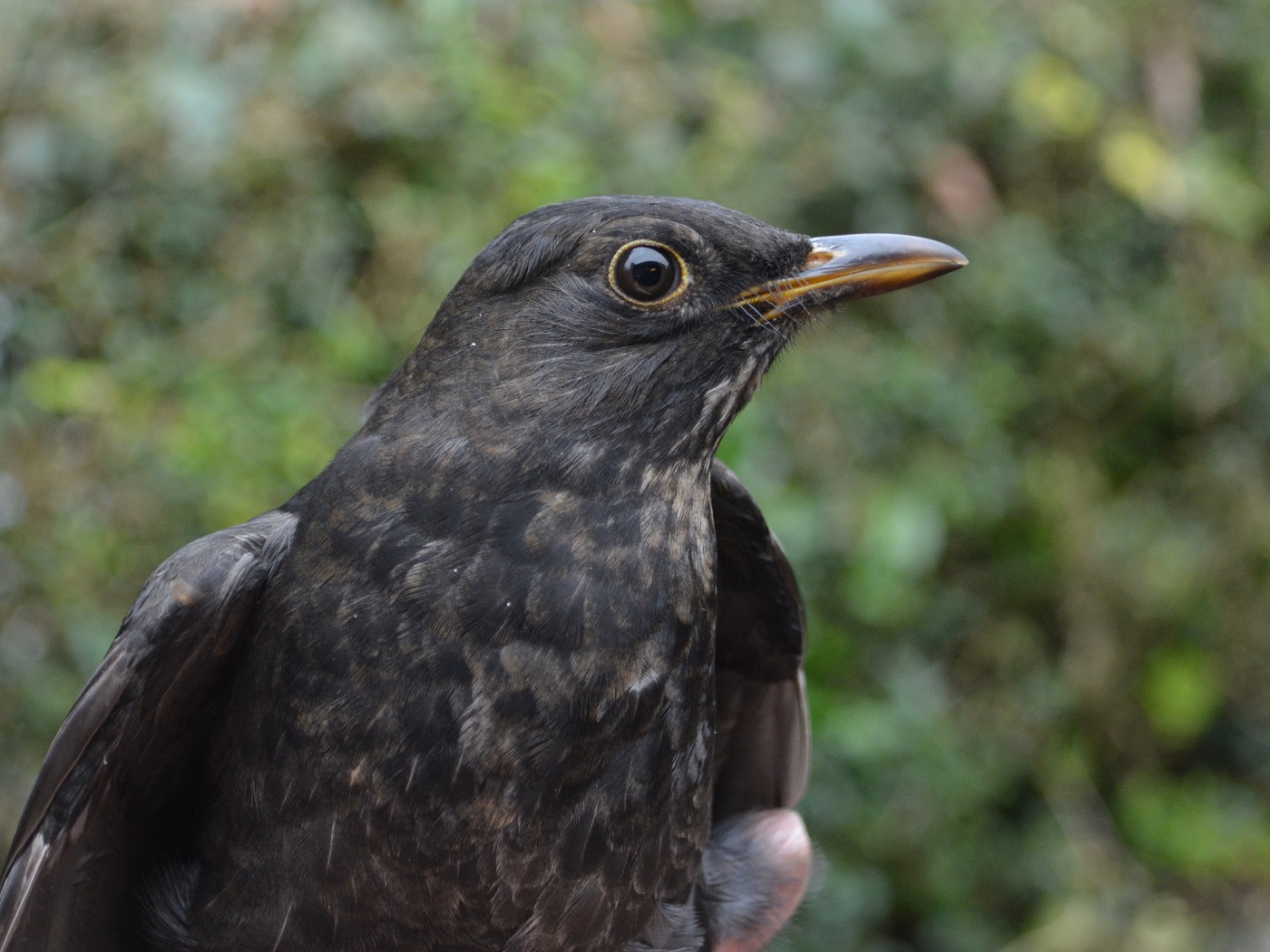
My use of the term ‘Stockamsel’ and or the associated images of Blackbirds usually prompts some feedback and discussion so I thought I would give the subject a bit more of an airing. I should start by saying ‘Stockamsel’ is not a valid term as such; however, historic misconceptions and misinterpretations have generally led to it being associated with first-year male Blackbirds that have a distinct plumage type. They are also supposed to originate in a particular geographic region and that idea has persisted to a greater or lesser degree into the modern era.
I have previously mentioned that there is an illustration of a ‘Stockamsel’ type Blackbird in the Handbook of the Birds of Europe, the Middle East and Africa (BWP for short) that was published as recently as 1988. In that authoritative work the plate of Blackbirds shows a dark-billed individual with quite scaly underparts and captions it: ‘first adult male (autumn) ‘stockamsel’ variety’ so it is hardly surprising the term still has some traction, although there was no explanation the text for its inclusion. However, the term 'Stockamsel' does get a mention in the text of the Helm Guide to Bird Identification (Vinicombe et al) that was published in 2014. In the section covering Ring Ouzel and Blackird and under the sub-heading 'Abberant Blackbirds' it states 'Confusion could also arise with first-winter male Blackbirds of the so-called 'stockamsel' type (from Germany and Poland) which have a dull bill and eye ring, browner wings, a paler chin, and heavy pale fringing to the underparts feathers' but note the qualified use of the term by referring to it as a so-called type.
I am no expert on the origin of the term ‘Stockamsel’ or how it was originally applied but the ‘amsel’ bit is easy as it is German for Blackbird. It would appear that ‘Stockamsel’ is simply an alternate/historic German name for Blackbird and is similar to how we, in the UK, have used Hedge Sparrow as a name for Dunnock. Whether it was originally meant to be used for birds with a particular distinctive appearance has probably been lost through the mists of time and the notion that Stockamsel type Blackbirds are of continental origin seems to have largely come from the origin of the word and not much else.
To what extent I am right or wrong about the origins of the term 'Stockamsel' doesn’t really matter but like others I have used it for those first-autumn/early winter male Blackbirds that are quite female like and often scaly in appearance. I have also speculated about their origins because there has been the notion that birds with that type of appearance are more likely to be continental.
I did stretch my use of the term in my last post as all the Blackbirds had yellow bills but I did say forget the bill in one of the captions as each of those birds would have looked quite female like with an all dark bill, as would have been likely up to the turn of the year. I also commented on their possible origin and considered local origin as likely as any. So if I have confused anyone or added to the centuries old misunderstandings about what a Stockamsel Blackbird actually is then I hope this blog post goes some way to clearing that up. Stockamsel is a term that probably should be confined to history but I don’t regret using it for drawing attention to first-year male Blackbirds with a female-like appearance, which was the real point.
Blackbirds are common birds and often don’t get a second look and being sexually dimorphic they are generally considered easy to sex, especially in the hand, but that is not always the case. It is worth having another look at the images of the bird that first tempted me to use the term ‘Stockamsel’.
So, hopefully, I have explained my use of the term 'Stockamsel' but the real interest lies in the variability of first-year male Blackbirds and those with a scaly and more female-like appearance in particular. I don't hold with the idea that it means they are necessarily of continental origin and more likely to come from Germany and Poland but they are interesting nevertheless.
References:
Cramp, S., ed. (1988) The Birds of the Western Palearctic, Vol. 5. Oxford University Press, Oxford
Vinicombe, K., Harris, A., Tucker, L., (2014) The Helm Guide to Bird Identification, page 323, Bloomsbury Publishing, London.
Showing posts with label stockamsel. Show all posts
Saturday, 16 March 2019
Sunday, 10 March 2019
Crawford 08/03/2019: more Goldfinches and some dodgy looking Blackbirds
The weather has been pretty poor for mist-netting recently and the forecast looks even worse for next week so I decided to make the most of a brief weather window on Friday morning. A weak ridge of high pressure provided near perfect mist netting conditions for a few hours and, luckily, I was able to rearrange other commitments to take advantage of it.
The ringing site is baited every two or three days with the aim of ensuring food is never allowed to run out or run too low and ringing visits are generally limited to once per week or less, depending on the weather. As a general rule I would rather skip a week or two when it comes to ringing visits than try mist-netting in suboptimal conditions. That approach paid off again on Friday morning as the 3 hour session with one 18m net resulted in a catch of 48 new birds and 11 retraps.
Goldfinches topped the totals yet again, although that is not surprising given the success the species is currently enjoying and the high proportion of nyger and sunflower hearts in the seed on offer, but on the other hand Yellowhammers have been absent full stop and Greenfinches had been absent prior to this visit. The 2 Greenfinches caught in this session were the only ones recorded which is a very poor showing given the site has been baited for well over a month now. Greenfinch populations have seen a massive decline nationally large due to disease (trichomonosis) and there doesn't appear to be any prospect of that situation improving any time soon, if anything their decline appears to be continuing.
I don't catch many Reed Buntings at the site (only 11 individuals over the past 5 years) so it was good to catch one and more so because it was a retrap. Interestingly this male Reed Bunting was originally ringed 3km away on Billinge Hill in September 2015 and was previously retrapped at Crawford in March 2016. Most of the other retraps were from recent visits but all 3 retrap Blue Tits were much older with one having been ringed as a juvenile in June 2014 and the other two were ringed as first-years in December 2015.
The second Blackbird caught during the session was interesting in that it had an unusual plumage. It was a brownish individual but the orange-yellow bill was strongly suggestive of it being a male. Some first year male Blackbirds can have a female like plumage and these birds are often termed 'Stockamsel' types which I have blogged about before (link here). However, it also had some feathers with what could be termed a frosted or white appearance. These frosty looking feathers were asymmetrical in that more were present left wing than the right. The tail was also affected but there was a bit more symmetry in the appearance of the tail.
The term 'Stockamsel' is attributed to the naturalist Johann Andreas Naumann and was first used a couple of centuries ago and has been used in the literature occasionally since then for those first-year male Blackbirds that have a more female like plumage. There is also the possibility that some of these 'Stockamsel' type birds are actually intersex as they display a mixture of male and female characteristics. That doesn't appear to have been considered before and I don't know that it has ever been ruled out. I found an interesting blog post which touches on this subject relating to wildfowl and possible confusion between hybrids and intersex birds which is worth a read (link here). I am no expert so I will stick with calling these dodgy looking Blackbirds 'Stockamsel' types until some research is done that confirms their sex and establishes the cause or causes for their appearance.
Now one 'Stockamsel' type Blackbird in a ringing session is interesting but I ended up catching another two which is exceptional in my experience.The other two didn't have the white frosting but in other respects were similar. In my previous blog post on the subject I refer to two I caught in the garden just over a week apart and I commented that if such birds weren't supposed to be of continental origin you would have thought they came out of the same nest. Now I have caught 3 on the same day and at the same site I do think local origin and same parentage could be a real possibility. Perhaps 'Stockamsel' types can originate anywhere in the species range if both parents possess a particular gene. There was nothing about the wing lengths of the three birds to suggest they were of continental origin in fact 2 of the 3 had relatively short wing lengths which, if anything, suggests they were more likely to be of British origin but then the fact that they have aberrant plumages probably means we shouldn't try and read anything into their wing lengths. Catching 3 on the same day certainly seems to make the chances of any of them being intersex a bit less likely but it can't be ruled out entirely.
I didn't photograph the 3rd Stockamsel type as it was very similar to the 2nd plus I had quite a few other birds to deal with at the time. The main difference was that it only had one old greater covert plus it was slightly longer winged (the wing lengths of the three birds were 126mm, 129mm and 132mm if you were wondering). Bottom line I caught 3 Stockamsel types out a total of 6 Blackbirds trapped in one session which, as I said before, is exceptional in my experience.
I am sure there could be a PhD for some upcoming ornithologist or geneticist if they do some research into this phenomena. Are they all males with some female characteristics or females with some male characteristics or something in between? Is there more than one cause? Do they originate more frequently in some parts of the species range than others? Is it purely a first-year phenomena and do they always conform to type with the first full moult or is it the fact that Stockamsel types are relatively rare that makes finding a Stockamsel type adult that much rarer? If anyone out there has more information or has answers to any of these questions then please get in touch as I would be interested to know.
Ringing totals (retraps in brackets) for 08/03/2019 were: Collared Dove 1; Coal Tit 1; Blue Tit (3); Great Tit 2; Long-tailed Tit (2); Blackbird 5 (1); House Sparrow 2; Tree Sparrow 5 (1); Dunnock 1 (1); Chaffinch 1; Greenfinch 2; Goldfinch 28 (2); Reed Bunting (1). A total of 48 new birds and 11 retraps.
The ringing site is baited every two or three days with the aim of ensuring food is never allowed to run out or run too low and ringing visits are generally limited to once per week or less, depending on the weather. As a general rule I would rather skip a week or two when it comes to ringing visits than try mist-netting in suboptimal conditions. That approach paid off again on Friday morning as the 3 hour session with one 18m net resulted in a catch of 48 new birds and 11 retraps.
Goldfinches topped the totals yet again, although that is not surprising given the success the species is currently enjoying and the high proportion of nyger and sunflower hearts in the seed on offer, but on the other hand Yellowhammers have been absent full stop and Greenfinches had been absent prior to this visit. The 2 Greenfinches caught in this session were the only ones recorded which is a very poor showing given the site has been baited for well over a month now. Greenfinch populations have seen a massive decline nationally large due to disease (trichomonosis) and there doesn't appear to be any prospect of that situation improving any time soon, if anything their decline appears to be continuing.
I don't catch many Reed Buntings at the site (only 11 individuals over the past 5 years) so it was good to catch one and more so because it was a retrap. Interestingly this male Reed Bunting was originally ringed 3km away on Billinge Hill in September 2015 and was previously retrapped at Crawford in March 2016. Most of the other retraps were from recent visits but all 3 retrap Blue Tits were much older with one having been ringed as a juvenile in June 2014 and the other two were ringed as first-years in December 2015.
| Retrap male Reed Bunting |
| The appearance of the head and neck was not dissimilar to an old adult (2CY+) female as female Blackbirds occasionally acquire a near full yellow or orange-yellow bill with age. |
The term 'Stockamsel' is attributed to the naturalist Johann Andreas Naumann and was first used a couple of centuries ago and has been used in the literature occasionally since then for those first-year male Blackbirds that have a more female like plumage. There is also the possibility that some of these 'Stockamsel' type birds are actually intersex as they display a mixture of male and female characteristics. That doesn't appear to have been considered before and I don't know that it has ever been ruled out. I found an interesting blog post which touches on this subject relating to wildfowl and possible confusion between hybrids and intersex birds which is worth a read (link here). I am no expert so I will stick with calling these dodgy looking Blackbirds 'Stockamsel' types until some research is done that confirms their sex and establishes the cause or causes for their appearance.
Now one 'Stockamsel' type Blackbird in a ringing session is interesting but I ended up catching another two which is exceptional in my experience.The other two didn't have the white frosting but in other respects were similar. In my previous blog post on the subject I refer to two I caught in the garden just over a week apart and I commented that if such birds weren't supposed to be of continental origin you would have thought they came out of the same nest. Now I have caught 3 on the same day and at the same site I do think local origin and same parentage could be a real possibility. Perhaps 'Stockamsel' types can originate anywhere in the species range if both parents possess a particular gene. There was nothing about the wing lengths of the three birds to suggest they were of continental origin in fact 2 of the 3 had relatively short wing lengths which, if anything, suggests they were more likely to be of British origin but then the fact that they have aberrant plumages probably means we shouldn't try and read anything into their wing lengths. Catching 3 on the same day certainly seems to make the chances of any of them being intersex a bit less likely but it can't be ruled out entirely.
| Overall the 2nd bird was a bit blacker than the first individual but it is certainly not your typical first year male Blackbird |
| As with the first bird it is the near full orange-yellow bill that draws the eye and makes it look more like a male. Forget the bill and the plumage is intermediate. |
I am sure there could be a PhD for some upcoming ornithologist or geneticist if they do some research into this phenomena. Are they all males with some female characteristics or females with some male characteristics or something in between? Is there more than one cause? Do they originate more frequently in some parts of the species range than others? Is it purely a first-year phenomena and do they always conform to type with the first full moult or is it the fact that Stockamsel types are relatively rare that makes finding a Stockamsel type adult that much rarer? If anyone out there has more information or has answers to any of these questions then please get in touch as I would be interested to know.
Ringing totals (retraps in brackets) for 08/03/2019 were: Collared Dove 1; Coal Tit 1; Blue Tit (3); Great Tit 2; Long-tailed Tit (2); Blackbird 5 (1); House Sparrow 2; Tree Sparrow 5 (1); Dunnock 1 (1); Chaffinch 1; Greenfinch 2; Goldfinch 28 (2); Reed Bunting (1). A total of 48 new birds and 11 retraps.
Friday, 1 September 2017
Billinge 22nd - 30th August 2017
I have managed to get out nearly every morning since my last post although some of the sessions were affected by fog, delayed and/or curtailed by showers or a strengthening breeze. A total of 200 birds were ringed and another 13 were retrapped over the period which is reasonable number given the mixed weather conditions and the limited number of nets used. There were no major surprises although sylvia warblers were in short supply throughout. Chiffchaffs took over from Willow Warblers as the most numerous warbler species as is usual in late August and all the less frequently caught species were what could be termed the usual suspects.
Ringing highlights and noteworthy sightings were as follows:
22/08/17 - At least 12 Tree Pipits were on the move despite early fog and generally poor visibility but only 1 was ringed.
23/08/17 - This session was also affected by fog, some light drizzle and stayed quite murky once the fog cleared. It went so dark at one point birds went very quiet and some seemed to go to roost. However, this visit produce the first Redstart of the autumn, a 1cy female, amongst a catch of only 15 birds. At least 7 Tree Pipits headed south despite the conditions and 2 of them were caught. As the light drizzle stopped there was an unexpected sighting of a flock of 11 Dunlin flying low over the site and heading NNE, they may have been disorientated in the very murky conditions or simply been forced down by the very low cloud.
25/08/17 - Chiffchaffs really took over from Willow Warblers with ringing totals of 14 and 1 respectively. Another 2 Tree Pipits were ringed from a total of 6 recorded.
27/08/17 - Grey Wagtail passage got going with at least 4 passing over the site and 1 was ringed. Interestingly, similar movements were reported from sites across the country. Another 2 Tree Pipits were ringed from a total of 9 recorded. A juvenile Tree Sparrow was an unusual capture although a few had been recorded flying high over the site on the previous 2 days.
28/08/17 - A 1cy Reed Warbler was well away from its usual habitat and was only the 2nd to be ringed this autumn. This species is a scarce but regular autumn passage migrant at the site and 9 of the previous 13 records have been in the narrow period 23rd to 31st July with the remainder being on widespread dates in August. This session was also noteworthy for being the first of the autumn without a Willow Warbler being ringed or recorded.
29/08/17 - A short, rain delayed session produced a Blackbird with an interesting plumage and not much else.
30/08/17 - Highlights were a Grasshopper Warbler and 2 Redstarts. At least 9 Tree Pipits were recorded 2 of which were caught. A few Grey Wagtails were on the move but only 1 was caught. There was a little flurry of Willow Warblers with 8 being ringed and this was more noteworthy as it followed a total absence of the species on the previous two days and was the only day that they outnumbered Chiffchaffs during the period.
Species
|
New
|
Retrap
|
Species
|
New
|
Retrap
|
Goldcrest
|
18
|
1
|
Blackbird
|
2
|
0
|
Blue Tit
|
11
|
1
|
Song Thrush
|
2
|
0
|
Great Tit
|
15
|
2
|
Robin
|
5
|
0
|
Coal Tit
|
2
|
0
|
Redstart
|
3
|
0
|
Long-tailed Tit
|
0
|
3
|
Dunnock
|
1
|
0
|
Chiffchaff
|
54
|
3
|
Tree Sparrow
|
1
|
0
|
Willow Warbler
|
20
|
1
|
Grey Wagtail
|
2
|
0
|
Blackcap
|
8
|
0
|
Tree Pipit
|
9
|
0
|
Garden Warbler
|
0
|
1
|
Chaffinch
|
21
|
0
|
Grasshopper
Warbler
|
1
|
0
|
Bullfinch
|
6
|
0
|
Reed Warbler
|
1
|
0
|
Greenfinch
|
3
|
0
|
Nuthatch
|
1
|
0
|
Linnet
|
3
|
0
|
Treecreeper
|
2
|
0
|
Goldfinch
|
5
|
0
|
Wren
|
1
|
1
|
Yellowhammer
|
3
|
0
|
Total
for the period: 200 new birds and 13 retraps
|
|||||
Ringing highlights and noteworthy sightings were as follows:
22/08/17 - At least 12 Tree Pipits were on the move despite early fog and generally poor visibility but only 1 was ringed.
23/08/17 - This session was also affected by fog, some light drizzle and stayed quite murky once the fog cleared. It went so dark at one point birds went very quiet and some seemed to go to roost. However, this visit produce the first Redstart of the autumn, a 1cy female, amongst a catch of only 15 birds. At least 7 Tree Pipits headed south despite the conditions and 2 of them were caught. As the light drizzle stopped there was an unexpected sighting of a flock of 11 Dunlin flying low over the site and heading NNE, they may have been disorientated in the very murky conditions or simply been forced down by the very low cloud.
25/08/17 - Chiffchaffs really took over from Willow Warblers with ringing totals of 14 and 1 respectively. Another 2 Tree Pipits were ringed from a total of 6 recorded.
27/08/17 - Grey Wagtail passage got going with at least 4 passing over the site and 1 was ringed. Interestingly, similar movements were reported from sites across the country. Another 2 Tree Pipits were ringed from a total of 9 recorded. A juvenile Tree Sparrow was an unusual capture although a few had been recorded flying high over the site on the previous 2 days.
| The first Grey Wagtail ringed this autumn |
| 1cy Reed Warbler |
| Its post-juvenile moult was almost complete. |
| It had a wing length of 131 mm which is towards the longer end of the range for locally bred birds but is not exceptional by any means. |
| 1cy male Blackbird. A locally bred 'Stockamsel' type. |
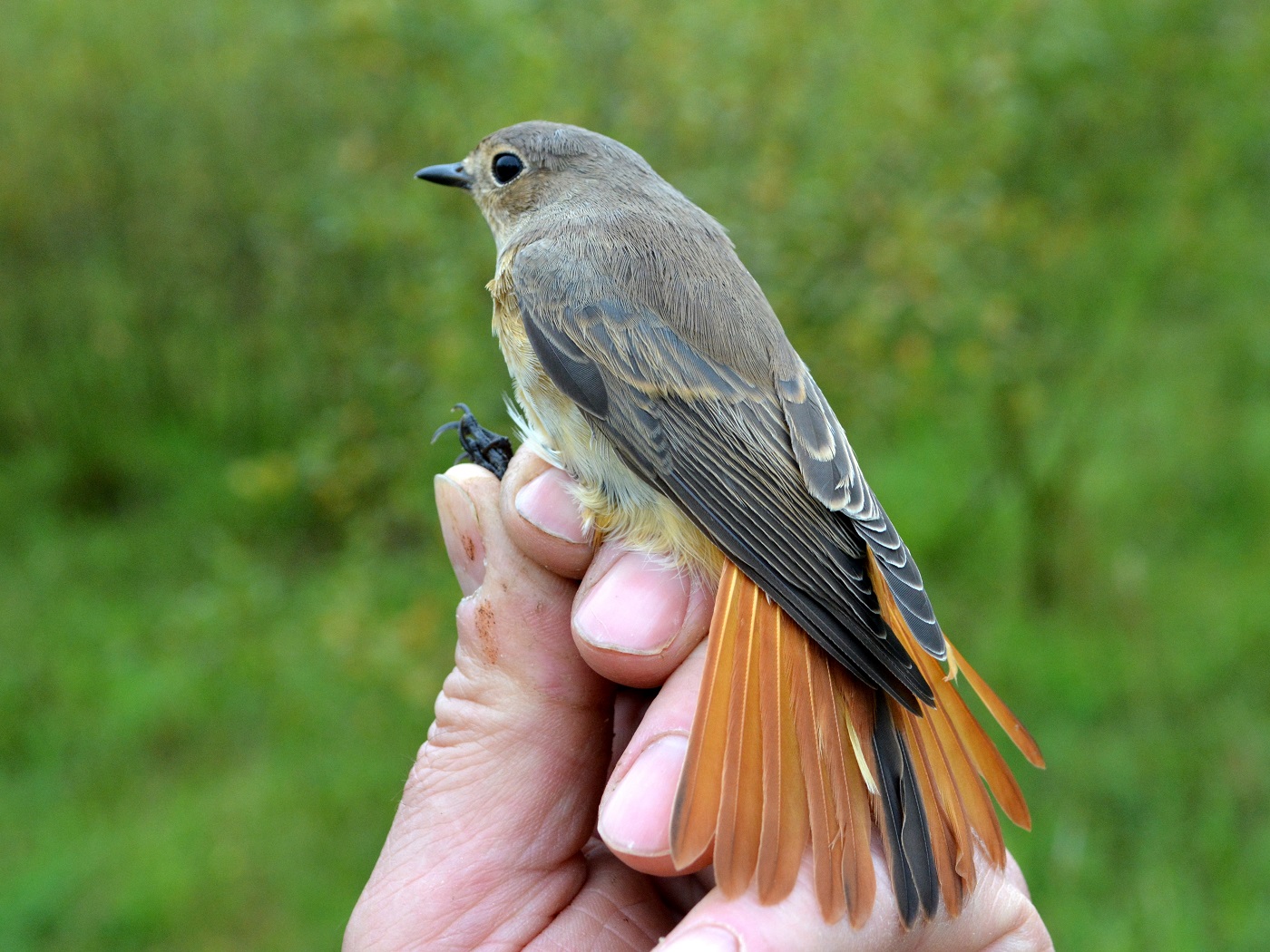
| 1cy female Redstart 30/08/17 |
| 1cy male Redstart 30/08/17 |
| S881488 adult Tree Pipit. This adult had retained 2 old lesser coverts. Apparently it is not uncommon to see this in adult Tree Pipits. There is certainly no doubt about the age of such birds. |
| S881488 adult Tree Pipit. The tail feathers were much more rounded than those of the adults shown in my last post. |
| S881489 1cy Tree Pipit |
| S881489 1cy Tree Pipit |
Sunday, 11 December 2016
Blackish
Blackbirds don't feature in the blog very often but I caught one in the garden yesterday (10/12/2016) that merits showing. It was one of those birds that looked a bit different and got me thinking about what sex it was while I was taking it out of the net.
Over the years I have caught a good number of first year male Blackbirds that have had paler fringes to some of the body feathers giving them a quite scalloped appearance and some had quite pale throats but they were all basically black and obviously male. This male Blackbird certainly qualifies as the brownest and most female looking 'stockamsel' type that I have ever caught.
One 'stockamsel' type in the garden is quite interesting but this bird was actually the second I have caught recently. The previous one was caught in the garden just over a week ago, on 02/12/2016. It was just a little blacker than yesterday's bird and there was a bit more of a 'patchwork' appearance to the plumage as can be seen in the images below.
So two 'stockamsel' types in a little over a week and if they weren't supposed to be birds of continental origin you could almost think they had come from the same nest. If you try and look for references to 'stockamsel' Blackbirds they are hard to come by but there is an illustration of one in BWP although it gets no further mention in the text. Stockamsel Blackbirds also get a mention in the Helm Guide to Bird Identification in the section on Ring Ouzels. There are a few others out there on the net and one that throws some light on the origin of the term can be found here.
The unusual plumages didn't end there and yesterday's garden catch also included a Goldfinch that had black feathers peppered throughout the red mask. I have caught thousands of Goldfinches over the years and never seen one like this before. Now I know it is not that dramatic as plumage variations go but I though it was interesting and worth sharing.
As for the ringing totals for 10/12/2016 I started the day off at Billinge where I caught 12 Redwings in the period around dawn. The catch would have been higher had it not been for the presence of a Sparrowhawk which spooked some groups of Redwings just as they were heading for the nets. When I got home I set a 6m net in the garden and, over the next 3 hours, caught (retraps in brackets): Goldcrest (1); Blue Tit 1; Blackbird 2; Goldfinch 19 (1).
The retrap Goldcrest had been ringed in the garden just over a year ago, on 26/11/2015 and the retrap Goldfinch was ringed in the garden almost 2 year ago to the day, on 12/12/2014.
| At first glance it looked like a well marked female Blackbird. |
| The tail was dark brown as you would expect for a female and the pointed shape of the tail feathers indicated that it was a first year bird. |
Over the years I have caught a good number of first year male Blackbirds that have had paler fringes to some of the body feathers giving them a quite scalloped appearance and some had quite pale throats but they were all basically black and obviously male. This male Blackbird certainly qualifies as the brownest and most female looking 'stockamsel' type that I have ever caught.
One 'stockamsel' type in the garden is quite interesting but this bird was actually the second I have caught recently. The previous one was caught in the garden just over a week ago, on 02/12/2016. It was just a little blacker than yesterday's bird and there was a bit more of a 'patchwork' appearance to the plumage as can be seen in the images below.
| The feathers at the rear of the crown were blacker than you would expect on a female. |
| The new charcoal-black greater coverts were the big giveaway that this bird is a male, if an odd looking one at that. |
So two 'stockamsel' types in a little over a week and if they weren't supposed to be birds of continental origin you could almost think they had come from the same nest. If you try and look for references to 'stockamsel' Blackbirds they are hard to come by but there is an illustration of one in BWP although it gets no further mention in the text. Stockamsel Blackbirds also get a mention in the Helm Guide to Bird Identification in the section on Ring Ouzels. There are a few others out there on the net and one that throws some light on the origin of the term can be found here.
The unusual plumages didn't end there and yesterday's garden catch also included a Goldfinch that had black feathers peppered throughout the red mask. I have caught thousands of Goldfinches over the years and never seen one like this before. Now I know it is not that dramatic as plumage variations go but I though it was interesting and worth sharing.
| Almost half of the feathers that would normally be red were black in this individual. |
As for the ringing totals for 10/12/2016 I started the day off at Billinge where I caught 12 Redwings in the period around dawn. The catch would have been higher had it not been for the presence of a Sparrowhawk which spooked some groups of Redwings just as they were heading for the nets. When I got home I set a 6m net in the garden and, over the next 3 hours, caught (retraps in brackets): Goldcrest (1); Blue Tit 1; Blackbird 2; Goldfinch 19 (1).
The retrap Goldcrest had been ringed in the garden just over a year ago, on 26/11/2015 and the retrap Goldfinch was ringed in the garden almost 2 year ago to the day, on 12/12/2014.
Subscribe to:
Posts (Atom)