Showing posts with label Reed Bunting. Show all posts

Sunday, 10 March 2019

Crawford 08/03/2019: more Goldfinches and some dodgy looking Blackbirds

The weather has been pretty poor for mist-netting recently and the forecast looks even worse for next week so I decided to make the most of a brief weather window on Friday morning. A weak ridge of high pressure provided near perfect mist netting conditions for a few hours and, luckily, I was able to rearrange other commitments to take advantage of it.

The ringing site is baited every two or three days with the aim of ensuring food is never allowed to run out or run too low and ringing visits are generally limited to once per week or less, depending on the weather. As a general rule I would rather skip a week or two when it comes to ringing visits than try mist-netting in suboptimal conditions. 
That approach paid off again on Friday morning as the 3 hour session with one 18m net resulted in a catch of 48 new birds and 11 retraps.

Goldfinches topped the totals yet again, although that is not surprising given the success the species is currently enjoying and the high proportion of nyger and sunflower hearts in the seed on offer, but on the other hand Yellowhammers have been absent full stop and Greenfinches had been absent prior to this visit. The 2 Greenfinches caught in this session were the only ones recorded which is a very poor showing given the site has been baited for well over a month now. Greenfinch populations have seen a massive decline nationally large due to disease (trichomonosis) and there doesn't appear to be any prospect of that situation improving any time soon, if anything their decline appears to be continuing.

I don't catch many Reed Buntings at the site (only 11 individuals over the past 5 years) so it was good to catch one and more so because it was a retrap. Interestingly this male Reed Bunting was originally ringed 3km away on Billinge Hill in September 2015 and was previously retrapped at Crawford in March 2016. Most of the other retraps were from recent visits but all 3 retrap Blue Tits were much older with one having been ringed as a juvenile in June 2014 and the other two were ringed as first-years in December 2015.


Retrap male Reed Bunting
The second Blackbird caught during the session was interesting in that it had an unusual plumage. It was a brownish individual but the orange-yellow bill was strongly suggestive of it being a male. Some first year male Blackbirds can have a female like plumage and these birds are often termed 'Stockamsel' types which I have blogged about before (link here). However, it also had some feathers with what could be termed a frosted or white appearance. These frosty looking feathers were asymmetrical in that more were present left wing than the right. The tail was also affected but there was a bit more symmetry in the appearance of the tail. 


The appearance of the head and neck was not dissimilar to an old adult (2CY+) female as female Blackbirds occasionally acquire a near full yellow or orange-yellow bill with age.


The right wing was more female like than male with some slight frosting to the inner secondaries. There were 3 old greater coverts which points to it being a first-year bird and  is part of my reasoning for thinking it is more likely to be a male as the bill is far too orange-yellow for it to be a first-year female.


The frosty effect was much more extensive on the left wing but it still looks brownish overall and generally a bit more like a female than a male. There is one old greater covert which is shorter and just visible by the 2 heavily frosted greater coverts so points to it being a first-year bird like the right wing. The asymmetry wasn't just in the frosting as there were 3 old greater coverts on the right wing and there was only 1 on the left.


The tail was interesting in that the shape of the feathers was not dissimilar to those of an adult by being quite square ended but there are some obvious fault bars and other structural issues. The right central tail feather was a bit more pointed than the left but in all other respects (colour and wear) they were the same so it didn't look like one had been replaced. The frosting affected the the end portions of the 3rd, 4th and 5th feathers on the right and 2nd,3rd and 4th on the left. The outermost (6th) tail feather on the left was being replaced but you can see from the part that has emerged from the sheath that it is a similar colour to the main part of the other tail feathers and isn't coming through jet black like a male. It suggests this bird's appearance will remain similar to how it is now with any difference being more to do with the freshness of the feathers as can be seen in the upper-tail coverts with the newer longest upper-tail covert being a darker blackish-brown compared to the old worn brown upper-tail coverts. So this bird may not get any or much blacker as it gets older


The term 'Stockamsel' is attributed to the naturalist Johann Andreas Naumann and was first used a couple of centuries ago and has been used in the literature occasionally since then for those first-year male Blackbirds that have a more female like plumage. There is also the possibility that some of these 'Stockamsel' type birds are actually intersex as they display a mixture of male and female characteristics. That doesn't appear to have been considered before and I don't know that it has ever been ruled out. I found an interesting blog post which touches on this subject relating to wildfowl and possible confusion between hybrids and intersex birds which is worth a read (link here). I am no expert so I will stick with calling these dodgy looking Blackbirds 'Stockamsel' types until some research is done that confirms their sex and establishes the cause or causes for their appearance.

Now one 'Stockamsel' type Blackbird in a ringing session is interesting but I ended up catching another two which is exceptional in my experience.The other two didn't have the white frosting but in other respects were similar. In my previous blog post on the subject I refer to two I caught in the garden just over a week apart and I commented that if such birds weren't supposed to be of continental origin you would have thought they came out of the same nest. Now I have caught 3 on the same day and at the same site I do think local origin and same parentage could be a real possibility. Perhaps 'Stockamsel' types can originate anywhere in the species range if both parents possess a particular gene. There was nothing about the wing lengths of the three birds to suggest they were of continental origin in fact 2 of the 3 had relatively short wing lengths which, if anything, suggests they were more likely to be of British origin but then the fact that they have aberrant plumages probably means we shouldn't try and read anything into their wing lengths. Catching 3 on the same day certainly seems to make the chances of any of them being intersex a bit less likely but it can't be ruled out entirely.


Stockamsel type number 2 appeared to have 4 old greater coverts although the 3 outer were paler and shorter than the 4th but the outer 4 were browner than the blacker and newer looking next 3 inner greater coverts. Aberrant plumages can make ageing feathers more difficult for a variety of reasons not least because feathers of different colour can wear differently and birds with plumage aberrations may not always moult in the normal way, we simply don't know or can't be 100% sure. The 3 black greater coverts help make this one look more like a male.


Overall the 2nd bird was a bit blacker than the first individual but it is certainly not your typical first year male Blackbird


As with the first bird it is the near full orange-yellow bill that draws the eye and makes it look more like a male. Forget the bill and the plumage is intermediate.
I didn't photograph the 3rd Stockamsel type as it was very similar to the 2nd plus I had quite a few other birds to deal with at the time. The main difference was that it only had one old greater covert plus it was slightly longer winged (the wing lengths of the three birds were 126mm, 129mm and 132mm if you were wondering). Bottom line I caught 3 Stockamsel types out a total of 6 Blackbirds trapped in one session which, as I said before, is exceptional in my experience.

I am sure there could be a PhD for some upcoming ornithologist or geneticist if they do some research into this phenomena. Are they all males with some female characteristics or females with some male characteristics or something in between? Is there more than one cause?  Do they originate more frequently in some parts of the species range than others? Is it purely a first-year phenomena and do they always conform to type with the first full moult or is it the fact that Stockamsel types are relatively rare that makes finding a Stockamsel type adult that much rarer? If anyone out there has more information or has answers to any of these questions then please get in touch as I would be interested to know.

Ringing totals
 (retraps in brackets) for 08/03/2019 were: Collared Dove 1; Coal Tit 1; Blue Tit (3); Great Tit 2; Long-tailed Tit (2); Blackbird 5 (1); House Sparrow 2; Tree Sparrow 5 (1); Dunnock 1 (1); Chaffinch 1; Greenfinch 2; Goldfinch 28 (2); Reed Bunting (1). A total of 48 new birds and 11 retraps.

Sunday, 10 September 2017

More Goldcrests on the move.

There was a brief lull in the unsettled weather this morning so I headed up to Billinge to make the most of the calmer conditions. I set 3 nets in the top willows but used a different net configuration to the one I have been using recently as the breeze was due to strengthen from mid morning. It would have been a fairly quiet session but there was a rush of birds about an hour after sunrise that boosted the totals and accounted for nearly half of the 50 birds that were caught over the course of the morning.

The catch was dominated by Goldcrests (19) and Chiffchaffs (14) as is often the case at this time of year and one of the Goldcrest, a 1cy female, was a control (a bird ringed elsewhere). I suspect this Goldcrest may have been ringed on Walney Island (68km NNW of Billinge) as the ring number was fairly close to one I have had from there before, although that is only an educated guess at this stage and I will only know its origin for certain when the recovery report comes through. The best of the rest were a Grey Wagtail, the first Willow Tit for a while and 2 Yellowhammers.


Control 1cy female Goldcrest HDB637

1cy Willow Tit
There were a few more Meadow Pipits moving overhead than there have been so far this autumn but it was still not much more than a trickle and petered out as the breeze picked up. A few Reed Buntings were also on the move early on and was the first obvious movement of that species this autumn and resulted in 3 being caught. However, it very much had the feel that the weather was holding up diurnal migrants and more would have been moving had the conditions been clearer and the breeze hadn't increased so much.

Ringing totals (retraps/controls in brackets) for 10/09/17 were: Goldcrest 17(2); Blue Tit 1; Great Tit 1; Willow Tit 1; Long-tailed Tit 1; Chiffchaff 13(1); Willow Warbler 2; Blackcap 1; Wren 1; Grey Wagtail 1; Chaffinch 1; Greenfinch 2; Yellowhammer 2; Reed Bunting 3.

Friday, 30 September 2016

Billinge: 30th September 2016

A relatively cool start with crisp clear skies gave this morning much more of a autumnal feel for a change. I didn't expect to catch much but the three nets produced a better than expected catch of 60 new birds and 2 retraps. Linnets topped the totals with 24 ringed from a flock of at least 100 that were feeding nearby and others that were moving south. There were fewer Goldcrest around than of late but this was partially offset by a good number of Chiffchaffs with the 11 ringed being an excellent total for the last day of September. The only disappointment was that only 1 Meadow Pipit found its way into the nets despite a steady stream of birds going south throughout the morning. Other bits of visible migration noted between net rounds included 50+ Skylarks, 9 Swallows, 8 Siskins, 1 Redpoll and 6 Reed Buntings.

1cy male Linnet
Ringing totals for 30/09/2016 were: Goldcrest 11 (1); Blue Tit 2 (1); Great Tit 5; Coal Tit 1; Chiffchaff 11; Blackcap 1; Dunnock 1; Meadow Pipit 1; Chaffinch 1; Linnet 24; Goldfinch 1; Reed Bunting 1. Total 60 new birds and 2 retraps.

A total of of 778 new birds of 30 species were ringed at the site during September with the top 5 being: Goldcrest 237; Chiffchaff 175; Blackcap 88; Linnet 32; Great Tit 30. It all starts again tomorrow, assuming the weather allows me to get out, and while Goldcrest is likely to remain in the top 5 for October Redwing should top the totals if the last 2 years are anything to go by. I caught the first Redwing of last year on 1st October but doubt that will be repeated this year; however, the weather for Sunday going into Monday is looking interesting and may just see the the first Redwings reaching this part of the country.

1cy female Reed Bunting.
Reed Buntings narrowly failed to make the top 5 in September with 29 ringed. 

Sunday, 14 August 2016

Billinge: 14th August 2016

Just a quick post as I need to get some sleep ahead of another early start tomorrow. Another good session at Billinge produced 59 new birds and only 1 retrap in the form of a recently ringed Blue Tit.

Willow Warblers continue to move through the site in good numbers and topped the totals yet again with 28 ringed. The proportion of adult Willow Warblers has increased now that most have finished their moult and are migrating with 6 being caught today. Adult Willow Warblers do not hang around once they have moulted and may even start to fatten up in preparation for migration before the end of their moult.


Freshly moulted adult Willow Warblers


Adult Willow Warblers usually have a much whiter belly and stand out from the more lemon yellow juveniles.
The majority of Chiffchaffs are still in their scruffy juvenile plumage or in the early stages of their protracted post juvenile moult so it was a bit of a surprise to catch one that had completed its moult. It is not particularly early for it to have done so but it was well in advance of all the others that have been caught recently. The only Blackcap caught had also completed its post juvenile moult and both were a reminder of just how quickly the season is advancing.


1cy Chiffchaff looking much sleeker now that it has completed its pj moult.
I was hoping today would see the first good passage of Tree Pipits but again it wasn't to be and only 4 were ringed from a maximum of 4 or 5 recorded. It was very overcast this morning (even the odd spot of rain at one point) and there was very little in the way of wind so that may have suppressed movement. It is not often I wish for brighter conditions and a bit more of a breeze when I am ringing but that is what it might take to get more Tree Pipits on the move.


One of today's Tree Pipits.
An interesting Reed Bunting was caught in that it was one of those birds that can easily catch out the unwary and it would almost certainly be wrongly sexed if just being viewed at a distance with binoculars. Even in the hand it looked like a male at first glance having a largely black head and blackish bib and it even had a noticeably white collar. However, careful examination revealed it to be a well worn adult female with a brood patch. The state of the brood patch suggested she was in the later stages of a breeding cycle and had probably just fledged a late brood. That was supported by the calls of recently fledged Reed Buntings that were heard near to where she was caught. Having said all that I am sure there will be some people that will find it hard to believe that it is a female and not a male given its appearance.


Adult female Reed Bunting looking rather male like. The cloacal shape and brood patch confirmed it was a female. It also had a very short wing length.
Ringing totals for 14/08/2016 were: Goldcrest 3; Blue Tit 4 (1); Great Tit 3; Coal Tit 1; Swallow 1; Chiffchaff 4; Willow Warbler 28; Blackcap 1; Whitethroat 1; Wren 1; Robin; Tree Pipit 4; Chaffinch 3; Bullfinch 1; Goldfinch 1; Reed Bunting 2. Total 59 new birds and 1 retraps.

Wednesday, 24 February 2016

Fair weather birding

Today has been a thoroughly nice day. It started with a very brief ringing session in the garden that produced 8 new and 4 retrap Siskins but only 1 new Goldfinch. I then went for a walk around Orrell Water Park to make the most of the glorious weather and got a few nice photos in the process.


It was interesting to see the German-ringed Black-headed Gull now that it is close to having a full brown hood.

Hood development of the German ringed Black-headed Gull IA141745.
It is a shame I didn't photograph it in early February

I nearly missed the drake Mandarin asleep on the bank.


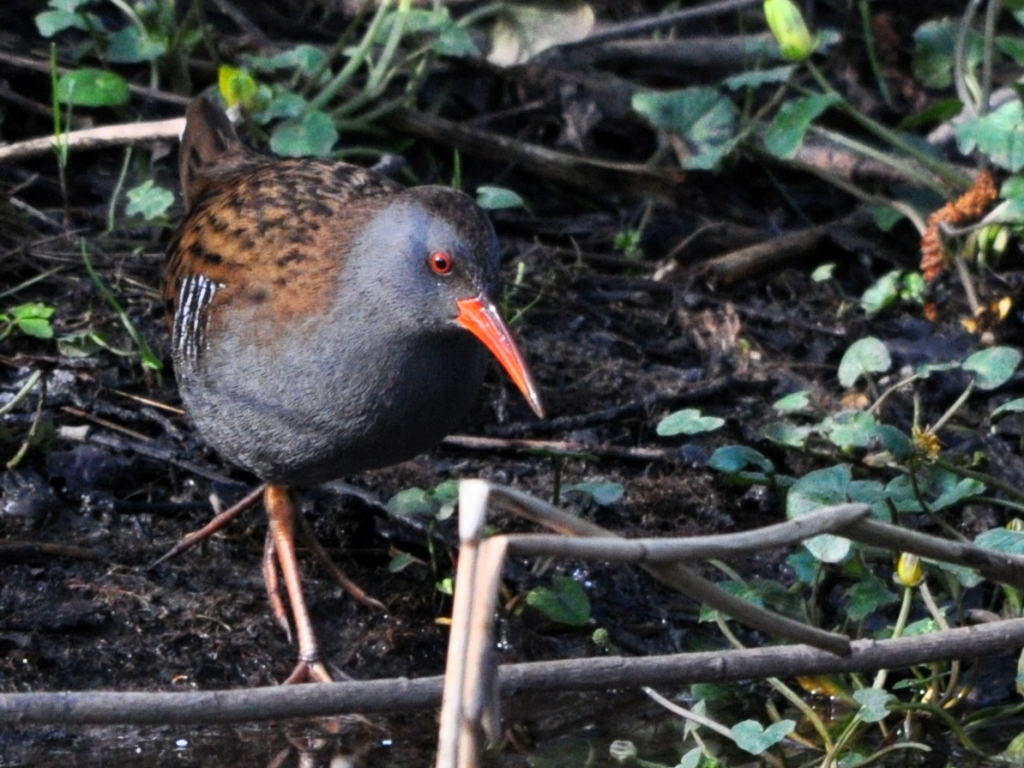
Although the Water Rail showed well it was often partially obscured by vegetation or was in the shade as in this photo.
Eventually I got some photos in better light.
That long bill is being put to good use again but they will also push the whole of the head under water if they need to. The eye isn't clear in this photo because it is covered by the nictitating membrane which is used to protect the eye whilst maintaining some vision at the same time. It mainly seemed to be finding and eating caddisfly larvae.


Birds are accustomed to people putting seed on the top of the fence and quickly respond to any fresh handouts. I managed to get part of this male Reed Bunting's ring number and it is from a sequence that was used between 4 and 6 years ago. It wasn't ringed in the park but it could have been ringed at the nearby Longshaw site.


Female Yellowhammer.
Yellowhammers only take advantage of this food source in late winter and early spring and sometimes allow fairly close approach.

Male Yellowhammer

Male Yellowhammer
I hadn't seen Moorhens feeding on the fence top before today.

The fine weather stimulated many birds to sing and this Robins was in fine voice.

The Mandarin was out on the water when I was making my way back home.

I am not sure how long this Great Crested Grebe has been sitting but I think it has been at least a couple of weeks. 

When I got home I checked through the Siskins that were feeding in the garden and most were unringed. I never see more than about a dozen in the garden at any one time but there could be as many as 30 or 40 that come to the feeders over the course of a day.

Unringed male Siskin

To cap off a good day the Belgian-ringed Blackcap showed well in the late afternoon. 
It spent more time feeding on the ground than it usually does and was eating the scraps that fall from the sunflower heart feeders and fat cakes.

Saturday, 12 September 2015

Billinge 10/09/15

Being up at 5 am has become the norm for me in recent weeks, so much so that I now wake up before the first alarm goes off. The 10th was no different and I was out and setting up at Billinge by first light under a crystal clear sky. Although the forthcoming sunrise was starting to brighten the sky to the east it was impossible not to notice and be impressed by the sight of the Crescent Moon with Venus close by. It was one of those sights that would have been worth getting up for in its own right although my photograph doesn't really do it justice. Had I taken the photo a little earlier Mars would have been just visible in the left of the image.


The Crescent Moon and Venus stood out as dawn broke on the 10th.
Anyway back to birds and the stand out species were ones that continue to be conspicuous by their near absence. Meadow Pipit passage is normally well underway by now and this species usually makes up a good proportion of the birds ringed and the majority of the birds passing overhead but yet again there was hardly a Meadow Pipit to be seen. The odd one that was seen or heard seemed to be from the small local breeding population rather than being birds on passage. This is being noted elsewhere across the country and it looks like Meadow Pipits have had a particularly unsuccessful breeding season overall. There is still a slim chance that breeding was just delayed by the cold spring and that the birds will move later as a result but as each day goes by this becomes an increasingly unlikely outcome. Similarly there hasn't been any movement of Reed Buntings as yet and a poor breeding season seems to be the most likely scenario there too. On the other hand Grey Wagtails may have had a reasonably productive summer as passage started more or less on time and small numbers are now passing through daily.

Grey Wagtail
I have said this before but Yellow-vented Wagtail would have been a more appropriate name for the species, not that I am suggesting a change in name now.
The most regular of the migrants passing overhead at the moment are Siskins and frustratingly they have generally been dots in the sky with none coming down to the trees and net level. Today that changed and first 2 were caught in the last couple of rounds of the nets. Hopefully, these will be the first of many and more will drop into the trees to feed in the coming weeks as the the alder cones start to ripen. It is certainly turning out to be an interesting autumn and I am sure there are going to be more ups and downs in terms of numbers of birds to come.
1CY male Siskin

Adult female Siskin
Ringing totals for 10th September (retraps in brackets) were: Grey Wagtail 2; Dunnock 2; Blackcap (1); Chiffchaff 5; Goldcrest 2; Long-tailed Tit (4); Blue Tit 3; Great Tit 2 (2); Chaffinch 4; Goldfinch 5, Siskin 2. Total 27 (7)

Friday, 20 February 2015

Waxwing lyrical part 44 - Same Waxwing but some other stuff too.

The Waxwing is still here and reports to 'Rare Bird Alert' show how low their numbers are this winter with only 50 reported in the UK for the period 11th - 17th February (link here). Although it has been here for two weeks now a few birders and photographers are still coming to have a look and others have come back for a second or third time. The bird has become a bit of a local celebrity and many local people glance up at the tree to see if it is there when passing on foot or slow to have a look if driving past.


Waxwing in the rain 19/02/15


Blackcap and Waxwing 19/02/15. The Blackcap has been around since New Years Day but only visits the garden occasionally.

Male Blackcap 19/02/15
Waxwing 20/02/15.


I haven't just been watching the Waxwing, although it is hard not to at times, and I have done some ringing at Crawford. The ringing sessions were only short but were fairly productive.

Ringing totals for 17/02/15 (control in brackets) were: Blackbird 3; Goldfinch 6; Tree Sparrow 1; Yellowhammer 2 (1); Greenfinch 2; Dunnock 2. Total 16 new birds and 1 control (ringed elsewhere).

Ringing totals for 20/02/15 (controls/retraps in brackets) were: Goldfinch 4; Reed Bunting 3; Tree Sparrow 3; Blue Tit 3; Greenfinch 1; Yellowhammer 1; Song Thrush 1; Long-tailed Tit (2). Total 16 new birds, 1 retrap and 1 control (ringed elsewhere).


Tree Sparrow 17/02/15


Female Yellowhammer 17/02/15.


Male Reed Bunting 20/02/15.


Male Goldfinch 20/02/15. This bird had some orange feathers in its mask.


Long-tailed Tit 20/02/15


Long-tailed Tit 20/02/15