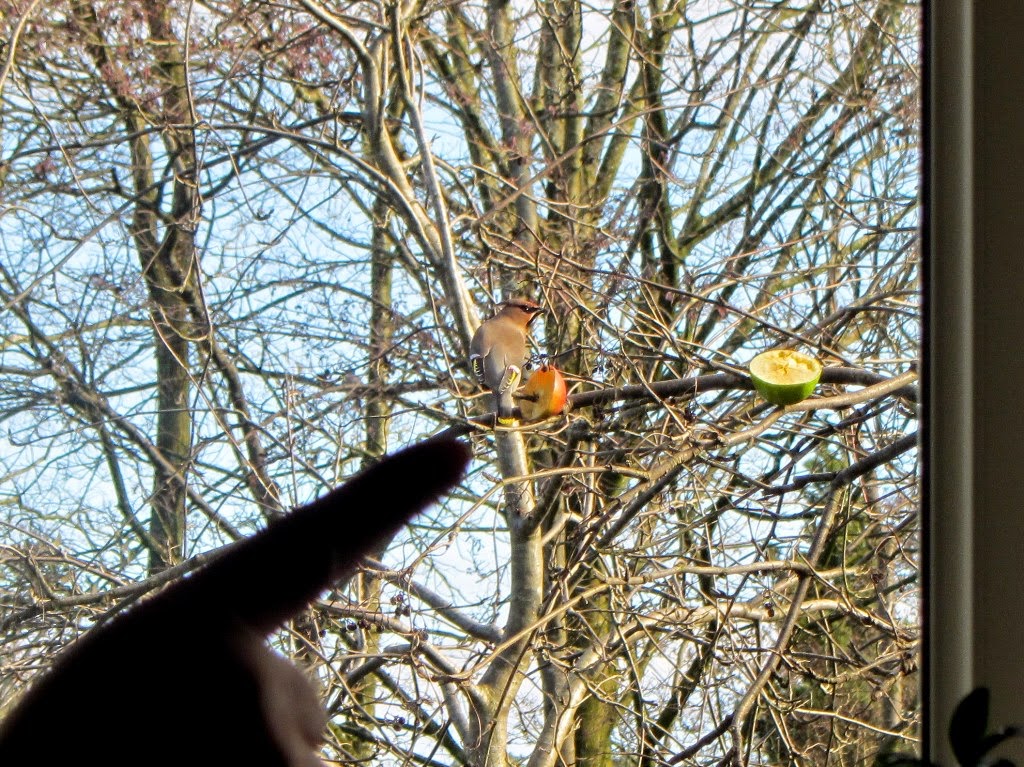
Showing posts with label Waxwing. Show all posts

Saturday, 17 December 2016

From Red to Wax, wing that is.

I went up to Billinge this morning with a view to catching a few more Redwings. It was a little bit misty in places on the drive up but nice and clear when I got to site. I quickly set 3 nets just before first light and heard the odd Redwing going over in the darkness while doing so. Fog started to roll in as the sky started to brighten to the east but, luckily, it didn't get too dense and the sky directly above the site remained visible to some degree for most of the time I was there. There was a nice flurry of activity for the first hour or so during which 11 Redwings and 2 Fieldfare were caught. Not big numbers but very good for the site this late in the year and considering the conditions.


Both Fieldfare were first year birds with one being a male (image above) and the other a female. They showed some of the plumage differences between the sexes really well as can be in the collage below.


The male on the left has broader dark centres to the crown feathers and much darker centres to the feathers of the mantle. The differences aren't always as obvious as they are in these two birds. There is also a difference in the colour of the tail feathers with males having black or blackish tail feathers whereas in females they are more of a dark brown to blackish-brown colour.


I know I have shown loads of photos of Redwings but there is always room for one more.
Things went very quiet after the initial flurry of activity so I took the opportunity to have a quick walk around the site before the next net round was due. There was very little to be seen or heard but on the way back I thought I could hear Waxwings calling and as I got nearer 12 Waxwings flew from the direction of the nets and over my head. On checking the nets only 2 birds had been caught with one being a Redwing but the other was a Waxwing, the first I have caught this winter.


1CY female Waxwing. The bird was fitted with a coded colour-ring in addition to the usual BTO ring which will increase the chance of finding out about its movements.
Only one ringed but hopefully there will be more as the winter progresses.
There are no berries on any of the trees at the site other than those I sometimes place (speculatively) in one the bushes along one of the net rides when I have nets up. I hadn't put many berries out this morning as the supplies in my freezer have nearly run out but it certainly proved to be worthwhile, this time at least. Trying to catch Waxwings this way is a bit of long shot, even with the added assistance of an audio lure, but as Billinge is such a good site for migrants it was always going to be worth giving it a try, especially in a good Waxwing winter like this one. The fog closed in shortly after the Waxwing was caught so I decided to pack up having ringed 12 Redwings, 2 Fieldfare and 1 Waxwing.

With good numbers of Waxwings in the country and a few starting to be seen locally I am often asked if I have started to put apples out in the garden or if I have had any Waxwings back. The truth is I have been putting a few apples out in the garden since early October as I do every year as part of my routine winter feeding and they are not just there in the hope of attracting Waxwings. If I am lucky enough to get any Waxwings in the garden again this winter I wouldn't expect it to happen before February or March, when berries usually start to get in short supply.

When I got home today one of the first birds I saw in the garden was a male Blackcap feeding on one of the apples and that is one of the species I always put them out for in winter. This particular Blackcap has been visiting the apples and fat feeders for the last three days and is easily recognised as it is re-growing most of its tail. The garden was really buzzing with birds with Brambling being the most unusual visitor. 


This Blackcap is the second I have seen in the garden this winter with the first being a female that was only seen on one day.


Bramblings are usually a garden rarity but a female I ringed nearly a month ago has been coming to the feeders regularly and this new female appeared today.


Goldfinches are by far the commonest bird with up to 60 coming to the feeders on any one day and its anyone's guess what the turnover of birds is during the course of a day.

I don't usually get many Starlings in the first half of the winter but good numbers have been coming to the fat cakes over the last 6 weeks or so.

All in all a really good day with a nice selection of species.

Saturday, 12 November 2016

Billinge: 8th & 11th November 2016

We may be at the tail end of the autumn but we haven't quite reached the end, just yet. I am still ringing at Billinge now and again but only when there is little or no wind in the forecast. The trees at the ringing site have lost more than 50% of their leaves so there is a lot less shelter than there was and I have to be even more picky about the weather as a result.

The 8th provided suitable conditions and I had 3 nets set up by first light. There were a few thrushes moving first thing but Redwing and Fieldfare totals combined only just got into 3 figures. A few Blackbirds were present with one of the birds caught having a long wing length suggesting continental origin. A Woodcock, flushed near one of the net rides, was only the second sighting of the autumn and may well have been newly arrived. However, the sighting of the morning was a Waxwing which was a site tick for me and also my first of the autumn. It wasn't a huge surprise given the numbers that have been coming into the country and it certainly looks like a we are in for good Waxwing winter.

Ringing totals (retraps in brackets) for 08/11/2016 were: Goldcrest 9; Great Tit 2; Blackbird 2 (2); Redwing 2; Robin (2) Chaffinch 1. Total 16 new birds and 4 retraps.

The 11th was more productive in terms of numbers ringed and Goldcrests topped the totals again with 15 ringed. This is a very good number for the date and shows that some are still moving. The total ringed this autumn now stands at 722 and there could be a few more to come.


And they keep coming. I never expected I would catch so many Goldcrests when I started ringing at the site.
Other than Goldcrests there was little evidence of migration save for a couple of hundred Woodpigeon heading north. Late movements of Woodpigeons are often in a northerly direction and it is tempting to speculate that these movements involve birds that previously went south and then return north for some reason. However, it is one of those mysteries of migration that we don't have the answer to and may never fully understand.

Other sightings of note were limited to 7 Brambling and 21 Mistle Thrush. The Bramblings were taking seeds from alder cones in the manner of Redpolls and this is something I have seen Bramblings do before at this time of year. The 21 Mistle Thrush was by far the largest flock I have seen for some time and was a bit of a surprise as it has been a poor autumn for this species at the site.

Ringing totals (retraps in brackets) for 11/11/2016 were: Goldcrest 15; Blue Tit 1; Great Tit 2; Coal Tit 1; Long-tailed Tit 3; Wren 1; Blackbird 1 (2); Fieldfare 1; Song Thrush 1; Redwing 3; Dunnock 1; Chaffinch 1. Totals 31 new birds and 2 retraps.

Sunday, 29 November 2015

Waiting for Waxwings

Autumn migration more or less fizzled out at Billinge in the last week with a diminishing number of birds seen and ringed on the 3 visits I manged to fit in. The weather was reasonable on the 23rd and produced 27 new birds and 4 retraps with Goldcrests, Redwings, and Lesser Redpolls accounting for all but 2 of the birds caught. The weather was much less favourable on the 26th and only 10 birds were ringed but another 3 Redwing, 2 Goldcrest and 2 Lesser Redpoll were added to the autumn's excellent totals for those species. A similar weather hampered and shortened session the following day only saw 2 new Goldcrests and 1 new Blackbird find their way into the nets. Combined totals (retraps in brackets) for the week were: Redwing 11; Goldcrest 9; Lesser Redpoll 15 (3), Blackbird 2; Dunnock 1; Bullfinch 1; Goldfinch 1; Blue Tit (1). Highlights from the sightings were a Green Woodpecker (26th) and Water Rail and Woodcock (27th).

The first Redwing out of the net on the 23rd had a deformed bill with the lower mandible being overgrown. It had also lost the tip of the upper mandible and the deformity is presumably the result of an injury rather than disease.
It looked even stranger when the bill was closed.
One of the other Redwings caught on the 23rd stood out as being darker with more extensive markings below and was considered to be an Icelandic bird although the picture doesn't quite do it justice.
A Lesser Redpoll with an amber coloured poll. It has been a great autumn for Redpolls at Billinge although October was not the peak month like it usually is. A total of 290 have been ringed as follows: August 1, September 159; October 82; November 48.
So what am I going to do now? Well as the post title suggests one of the things I will be doing is monitoring the reports of Waxwings to assess the likelihood of birds finding their way to this part of the country. It doesn't look like there will be a massive influx this winter but there are certainly going to be more than were recorded in the last two winters. There have already been a a good scattering of sightings along the east coast from the Northern Isles down to Suffolk and a few birds have penetrated further west to the Outer Hebrides, Northern Ireland and Cumbria. Birds could continue to arrive through December and into the new year and there have been some encouraging reports from the near continent in recent days including a flock of around 1,000 feeding in the botanical gardens in Oslo (Oslo Birder blog link here). Oslo is only a little over 650 miles away so it will be interesting to see what happens over the next few weeks. There seems to be the potential for a moderately good influx at least.

Many more Waxwings could arrive in the UK in the coming weeks and the patchy distribution of berries that are left could mean they move inland quite quickly.
Fingers crossed.


Tuesday, 3 March 2015

Waxwing lyrical part 45 - Unexpected departure.

The Waxwing was not seen at all yesterday or so far today and it appears the bird has moved on. There is also the possibility that she has been predated or met some other fate but I prefer to think that it has started the long return migration to the breeding grounds in north eastern Fenno-Scandinavia or Siberia. This departure was a little sooner than I had expected but then her arrival was not expected at all so what do I know. There was a clear sky yesterday evening so the conditions were potentially suitable for a nocturnal departure if that is what Waxwings do.

This was one of the last photos taken on 01/03/15. Gone but never to be forgotten.
Despite extensive searching I have not been able to find any references to Waxwings being described as nocturnal migrants but I assume they are or perhaps I should say have that ability. The reality is probably quite complicated with Waxwings having the flexibility to migrate by day or by night but I suspect that long distance movements are mainly undertaken at night. If anyone can point me to any published information on nocturnal v diurnal movements of Waxwings in spring or autumn then please let me know.

It is back to normal birding in the garden but I will continue to put out a few apples for a while as I still have a wintering Blackcap and other species take advantage of them occasionally. The Grey Wagtail still visits the garden and looks particularly scruffy at the moment as it is undertaking its partial winter moult. Up to 20 Goldfinches continue to visit the feeders each day but Siskins are conspicuous by their absence. This appears to be due to a bumper crop of Sitka Spruce seeds which may mean an absence of Siskins from our gardens but should result in an early and bumper breeding season for them.

Despite the regular supply of apples this was the first time I recorded a Song Thrush feeding on them this winter. My garden Song Thrushes prefer to feed on the meal worm laced fat cakes.

This Grey Wagtail is undergoing an extensive partial moult. Some tertials were in the process of being replaced, some feathers are in pin on the head and new yellow feathers can be seen coming through on the breast. This photo also reminds me that I need to start cutting the lawn.

Just a few of the Goldfinches in the garden 01/03/15.
So Waxwing lyrical posts will go back on hold again, but just for how long this time is anybody's guess. We are probably due a Waxwing winter and autumn 2015 may well see the next big irruption.


Friday, 27 February 2015

More recoveries and a Waxwing update

Notification came through of some additional recoveries and the following are some of the more interesting (to me at least). I should say all recoveries are of value and provide useful information but it is always good to share details of long distance movements or birds that have lived to a good age.

Magpie ET04848 was ringed as a first year bird at Pennington Flash, near Leigh on 28/09/2002 and was found dead in Leigh on 18/01/2015. It was reported as being a road casualty which is quite unusual for an adult of this species. Magpies are clever birds and take advantage of road kill as food but experienced birds don't usually get hit by cars themselves. It will have been around twelve and a half years old when it died which is not a bad age for a Magpie and it must have dodged plenty of cars during its life.


Chiffchaff CDJ970 was ringed as a first year bird at Longshaw, near Orrell on 02/10/2011 and was controlled at Etang-de-Moisan, MessangesLandes, France on 14/10/2014 some 1084km south. At just over 3 years old it is doing quite well for a Chiffchaff and it would be fantastic if it turns up in a net again in the spring. A map of this recovery can be viewed here.


Lesser Redpoll Z019197 was ringed as a 1Y male at Sctotmans Flash, near Wigan on 24/04/2014 and was controlled at EdgehillsGloucestershire on 28/12/2014; a distance of 188km south. There wasn't much southward passage of Redpolls last autumn but this one bucked that trend. A map of this recovery can be viewed here.


Black-headed Gull ES50278 was ringed as a chick at Pennington Flash, near Leigh on 04/06/2000 and was found dead in BallyforanRoscommon, Ireland on 22/02/2015; a distance of 379 km W. At around fourteen and half it had also lived to a good age.


Black-headed Gull ST252229 was ringed a a chick at Rovaniemi, LappiLappi, Finland on 17/06/2013 and was controlled (ring read and photographed in the field) at Orrell Water Park, near Orrell on 05/01/2014 12/01/2014 and 20/01/2014. A map showing both Black-headed Gull movements can be viewed here.

Blackcap 7085090 was ringed as a first year female at Dunes du Fort Vert, MarckPas-de-Calais, France on 03/10/2013 and was controlled (ring number read from photographs by Andy Makin) in a garden at Hindley Green, near Wigan on 29/12/2014; a movement of 420km NW. This was the bird that I failed to catch and mentioned in a post at the time. It had been seen in the garden for several days prior to the ring number being read but didn't stay into the new year. A map of this recovery can be viewed here.


As for the Waxwing it is still following its daily routine and feeds on the apples in the garden for much of the day. If you don't already know I have created a page for it that can be accessed via the 'Waxwing 2015' tab just under the header near the top of this page. The aim is to update the Waxwing page daily with a few pictures or some video taken that day.


Waxwing 27/02/2015

Monday, 23 February 2015

Recent recoveries

It has been a while since I posted details of any recoveries but the three I received today are of particular interest. All three birds were ringed on Billinge Hill and were subsequently recovered abroad.

Redwing RS60485 was ringed on 17/10/14 during the first big wave of arrivals last autumn and was recovered (shot) in FiteroNavarra, northern Spain 44 days later on 30/11/2014, 1272 km S . All the Redwings that moved over Billinge in the autumn carried on south and were not just arriving to winter in the UK as this recovery shows.


Blackcap Z219583 was ringed on 23/07/2014 and had probably hatched locally as it was still in juvenile plumage when ringed. It was controlled (recaptured by ringers) in Fonte da BenemolaFaro, Portugal on 01/11/2014 and was sexed as a male when recaught. A movement of 1856 km SSW in 98 days.

Chiffchaff HNN757 was ringed on 31/08/2014 and was controlled (recaptured by ringers) in Trunvel, TreogatFinistère, France on 13th October 2014, a distance of 635 km SSW in 43 days. This bird was probably still on passage when recaptured in France and may have continued further south to winter in Spain or Portugal.


The Waxwing is still visiting the garden and I have created a separate page to display the most recent photographs. This page can be accessed via the 'Waxwing 2015' tab under the header and the blog posts like this one are now on the 'Home' page. I will try and update the Waxwing page each day but she may still feature in the regular posts from time to time, assuming she stays for a while yet.


Waxwing 23/02/15


Friday, 20 February 2015

Waxwing lyrical part 44 - Same Waxwing but some other stuff too.

The Waxwing is still here and reports to 'Rare Bird Alert' show how low their numbers are this winter with only 50 reported in the UK for the period 11th - 17th February (link here). Although it has been here for two weeks now a few birders and photographers are still coming to have a look and others have come back for a second or third time. The bird has become a bit of a local celebrity and many local people glance up at the tree to see if it is there when passing on foot or slow to have a look if driving past.


Waxwing in the rain 19/02/15


Blackcap and Waxwing 19/02/15. The Blackcap has been around since New Years Day but only visits the garden occasionally.

Male Blackcap 19/02/15
Waxwing 20/02/15.


I haven't just been watching the Waxwing, although it is hard not to at times, and I have done some ringing at Crawford. The ringing sessions were only short but were fairly productive.

Ringing totals for 17/02/15 (control in brackets) were: Blackbird 3; Goldfinch 6; Tree Sparrow 1; Yellowhammer 2 (1); Greenfinch 2; Dunnock 2. Total 16 new birds and 1 control (ringed elsewhere).

Ringing totals for 20/02/15 (controls/retraps in brackets) were: Goldfinch 4; Reed Bunting 3; Tree Sparrow 3; Blue Tit 3; Greenfinch 1; Yellowhammer 1; Song Thrush 1; Long-tailed Tit (2). Total 16 new birds, 1 retrap and 1 control (ringed elsewhere).


Tree Sparrow 17/02/15


Female Yellowhammer 17/02/15.


Male Reed Bunting 20/02/15.


Male Goldfinch 20/02/15. This bird had some orange feathers in its mask.


Long-tailed Tit 20/02/15


Long-tailed Tit 20/02/15

Tuesday, 17 February 2015

Waxwing lyrical part 43 - Ruby Wax

Well the Waxwing is still here and attracting a steady stream of admirers which is hardly surprising with so few in the country. There was a bit more in the way of sunshine on Sunday and a lot more today so I couldn't resist taking even more photographs. Most of them get deleted as it can be difficult to get results I am happy with and that show different aspects of behaviour. I don't always like taking photos in strong sunlight but it certainly does help bring out the colour of the Waxwing's ruby red eye.


Get the light right and that ruby red eye really stands out.
A close up showing the feeding action. The bird seems to favour apples in certain positions that allow it to take a really firm bite and remove a piece with a snipping and pulling or twisting action that involves using the whole of the body. 
The bird's forehead is almost permanently wet with apple juice and bits of apple pulp get stuck on the bill. Wiping the bill on a twig deals with apple pulp on the sides of the bill but does not always clear any that has found its way onto the culmen.
If bill wiping doesn't remove all of the pulp a quick shake of the head throws off the rest.
All the stuff on the branch to the left of the apple is Waxwing poo. Waxwings eat a lot and poo a lot. When feeding continuously it can defecate as frequently as every one to two minutes. Yes I have timed it.
This photograph shows the Waxwing blinking by drawing the nictitating membrane across the eye. This membrane or third eyelid is much more transparent in Waxwings and is not as obvious as it can be in some other species. The transparency of the membrane in Waxwings is presumably an adaptation to help maintain vision and so make it less vulnerable to predation. You can see the forehead is wet from apple juice so it must get quite a lot in its eyes too and therefore it needs to blink frequently when feeding. From what I have seen they appear to blink with every peck but you would need a slow motion camera to confirm that.
Time for a scratch
The nictitating membrane is covering the eye as it scratches. I couldn't tell if it held the membrane across its eye for the duration of its scratching or if it involved a series of blinks.
When alarmed it tries to make itself inconspicuous by elongating and narrowing itself. Basically it tries to make itself look like a twig and part of the tree. The body feathers of a Waxwing closely resemble the bark of trees such as Rowan as can be seen in all of these photographs. 
Still very alert and with a very erect posture.
Blue Tits like a bit of apple too and you get a closer view of that Waxwing apple poo. 

..........and what other photographs can you take when you have a Waxwing in your garden.


and finally.................


The dog is jealous of all the attention the Waxwing gets and consoles himself with his sheep.


Saturday, 14 February 2015

Waxwing lyrical part 42 - Billie no mates.

Is there only one?  Is it on its own? Why is it on its own? Isn't it unusual for it to be on its own? - these questions and variations of them have been asked frequently by visiting birders over the last week. It may be on its own in terms of other Waxwings but it has been attracting a good number of birders and photographers since I put the news out last Monday. There has been a steady trickle of birders through the week and around 100 people in total have been to see it today.

Luckily my neighbours don't mind and most visiting birders have shown due consideration. The main issue is parking and a few haven't heeded or perhaps been aware of the requests to use the nearby car park and have parked in the street. This causes far more problems than they seem to realise and the situation becomes compounded when passing traffic slows to see what all the fuss is about. If you happen to be reading this and are thinking about visiting then please use the nearby car park, it is only 50 metres away, and do not park in the street. My garden is near a junction that is difficult enough to see out of without parked cars and pavements full of birders.


The only other issue is photographers being just a bit too keen to get a good photo. I am sorry the house is in the background and twigs may be in the way but please don't be tempted to creep up the garden path or walk up the drive at the side of the garden; it does get noticed as some were informed today. I am expecting it to be even busier tomorrow as so many people still seem to be slaves to routine, sporting fixtures and the Saturday shop. You are all welcome and I hope the bird shows for you but please don't push it when it comes to taking photographs. If you do you may just appear on this blog as we (me and the family) spend as much time people watching as we do watching the bird. We don't mind being in the proverbial Goldfish bowl but we do get to look out from it.

Anyway back to the bird and she has shown quite well today (holding back from calling her Billie and saying she sounds wrong too). There was a period from late morning through early afternoon when she, it, Billie was much more mobile and spent a lot of time fly-catching. That behaviour is worth seeing in itself and is far more entertaining than just watching it eat apples. You have a chance of seeing the bird anytime between about 07:30 and 16:00 based on today's performance.


I do like apples and recognisable twigs in my photos as I want to show that it is in my garden and not just a portrait of a Waxwing that could have been taken anywhere.

.............and here is a bit of video on You Tube