Showing posts with label Grey Wagtail. Show all posts

Sunday, 10 September 2017

More Goldcrests on the move.

There was a brief lull in the unsettled weather this morning so I headed up to Billinge to make the most of the calmer conditions. I set 3 nets in the top willows but used a different net configuration to the one I have been using recently as the breeze was due to strengthen from mid morning. It would have been a fairly quiet session but there was a rush of birds about an hour after sunrise that boosted the totals and accounted for nearly half of the 50 birds that were caught over the course of the morning.

The catch was dominated by Goldcrests (19) and Chiffchaffs (14) as is often the case at this time of year and one of the Goldcrest, a 1cy female, was a control (a bird ringed elsewhere). I suspect this Goldcrest may have been ringed on Walney Island (68km NNW of Billinge) as the ring number was fairly close to one I have had from there before, although that is only an educated guess at this stage and I will only know its origin for certain when the recovery report comes through. The best of the rest were a Grey Wagtail, the first Willow Tit for a while and 2 Yellowhammers.


Control 1cy female Goldcrest HDB637

1cy Willow Tit
There were a few more Meadow Pipits moving overhead than there have been so far this autumn but it was still not much more than a trickle and petered out as the breeze picked up. A few Reed Buntings were also on the move early on and was the first obvious movement of that species this autumn and resulted in 3 being caught. However, it very much had the feel that the weather was holding up diurnal migrants and more would have been moving had the conditions been clearer and the breeze hadn't increased so much.

Ringing totals (retraps/controls in brackets) for 10/09/17 were: Goldcrest 17(2); Blue Tit 1; Great Tit 1; Willow Tit 1; Long-tailed Tit 1; Chiffchaff 13(1); Willow Warbler 2; Blackcap 1; Wren 1; Grey Wagtail 1; Chaffinch 1; Greenfinch 2; Yellowhammer 2; Reed Bunting 3.

Friday, 8 September 2017

Billinge 7th September 2017

The 7th provided a brief interlude in the current run of unsettled weather so got up at daft o'clock to make the most of it. I set the usual 3 nets in the top willows at first light and the following few hours produced a decent catch of 60 new birds and 1 retrap. Ringing highlights were a Redstart which continued the exceptional run of records of that species, 3 Grey Wagtails was a good total as I didn't see more than 6 going south and 4 1cy Coal Tits hinted at the start of some movement in that species.

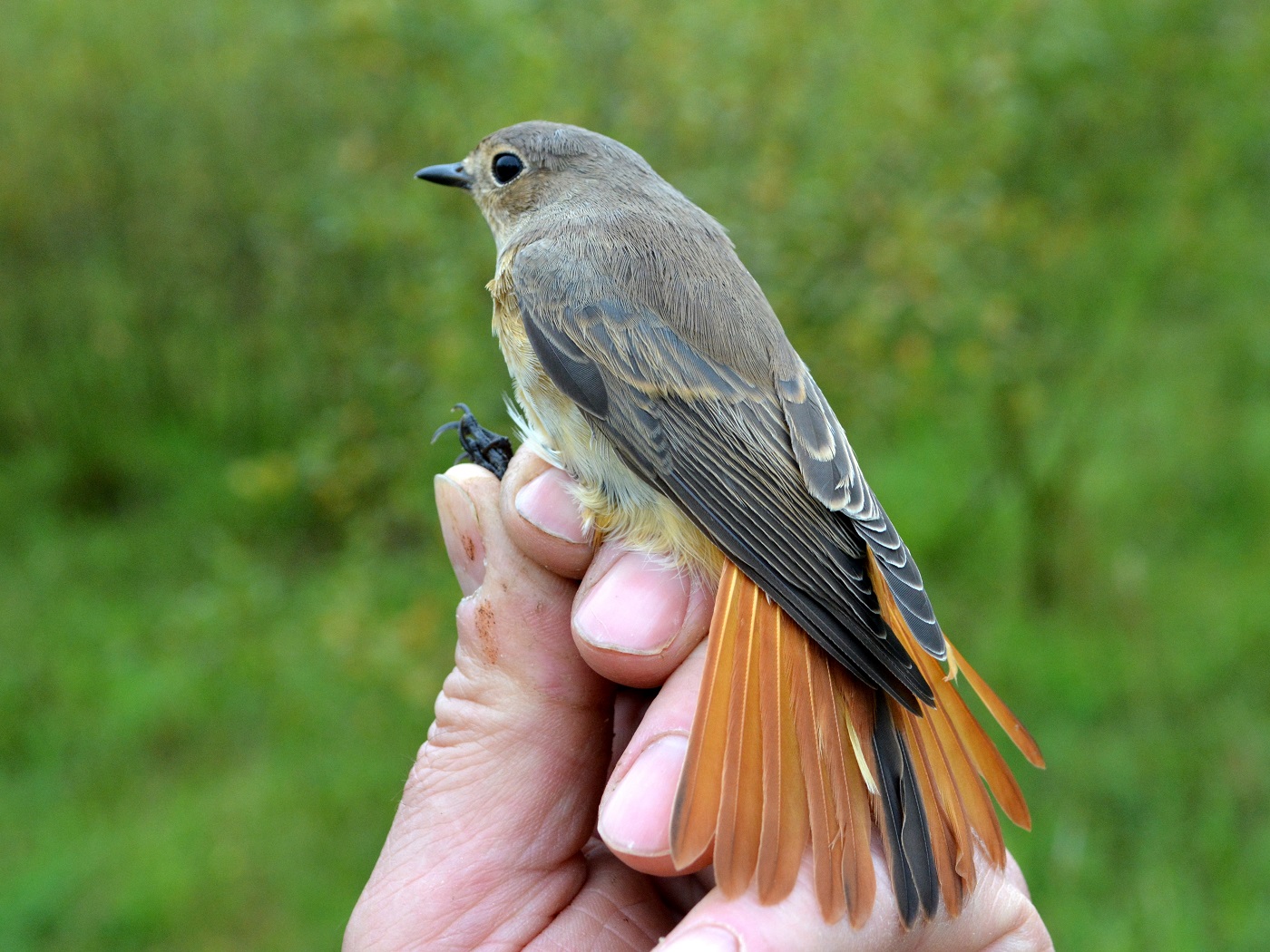
The Redstart was the 6th to be ringed this autumn and to put that into context only 4 were ringed during the previous three. Interestingly 5 of the 6 have been females.

1cy Coal Tit, noisy individuals and the occasional small group are usually seen or heard heading south on fine days through much of September and well into October.
There was very little movement overhead but there were a few interesting bits a pieces in the form of a group of 3 Song Thrush flying very high to the west, 2 Tree Pipits going south and a Crossbill also going south. There were surprisingly few Meadow Pipits going over and a trickle amounting to no more than about 30 were noted heading SSW. The only other sighting of note was another Redstart that was seen after I had packed up and was carrying my gear back to the car.

Only 2 Willow Warblers were caught and this one hadn't finished its pj moult but it had a weight of 9.4g and enough fat to migrate a good distance.
Ringing totals for 07/09/17 were: Goldcrest 9; Blue Tit 8; Great Tit 2; Coal Tit 4; Chiffchaff 14 (1); Willow Warbler 2; Blackcap 2; Whitethroat 1; Robin 2; Redstart 1; Grey Wagtail 3; Chaffinch 6; Goldfinch 6.

Friday, 1 September 2017

Billinge 22nd - 30th August 2017

I have managed to get out nearly every morning since my last post although some of the sessions were affected by fog, delayed and/or curtailed by showers or a strengthening breeze. A total of 200 birds were ringed and another 13 were retrapped over the period which is reasonable number given the mixed weather conditions and the limited number of nets used. There were no major surprises although sylvia warblers were in short supply throughout. Chiffchaffs took over from Willow Warblers as the most numerous warbler species as is usual in late August and all the less frequently caught species were what could be termed the usual suspects.


Species
New
Retrap
Species
New
Retrap
Goldcrest
18
1
Blackbird
2
0
Blue Tit
11
1
Song Thrush
2
0
Great Tit
15
2
Robin
5
0
Coal Tit
2
0
Redstart
3
0
Long-tailed Tit
0
3
Dunnock
1
0
Chiffchaff
54
3
Tree Sparrow
1
0
Willow Warbler
20
1
Grey Wagtail
2
0
Blackcap
8
0
Tree Pipit
9
0
Garden Warbler
0
1
Chaffinch
21
0
Grasshopper Warbler
1
0
Bullfinch
6
0
Reed Warbler
1
0
Greenfinch
3
0
Nuthatch
1
0
Linnet
3
0
Treecreeper
2
0
Goldfinch
5
0
Wren
1
1
Yellowhammer
3
0
Total for the period: 200 new birds and 13 retraps

Ringing highlights and noteworthy sightings were as follows:

22/08/17 - At least 12 Tree Pipits were on the move despite early fog and generally poor visibility but only 1 was ringed.

23/08/17 - This session was also affected by fog, some light drizzle and stayed quite murky once the fog cleared. It went so dark at one point birds went very quiet and some seemed to go to roost. However, this visit produce the first Redstart of the autumn, a 1cy female, amongst a catch of only 15 birds. At least 7 Tree Pipits headed south despite the conditions and 2 of them were caught. As the light drizzle stopped there was an unexpected sighting of a flock of 11 Dunlin flying low over the site and heading NNE, they may have been disorientated in the very murky conditions or simply been forced down by the very low cloud.

25/08/17 - Chiffchaffs really took over from Willow Warblers with ringing totals of 14 and 1 respectively. Another 2 Tree Pipits were ringed from a total of 6 recorded.

27/08/17 - Grey Wagtail passage got going with at least 4 passing over the site and 1 was ringed. Interestingly, similar movements were reported from sites across the country. Another 2 Tree Pipits were ringed from a total of 9 recorded. A juvenile Tree Sparrow was an unusual capture although a few had been recorded flying high over the site on the previous 2 days.


The first Grey Wagtail ringed this autumn
28/08/17 - A 1cy Reed Warbler was well away from its usual habitat and was only the 2nd to be ringed this autumn. This species is a scarce but regular autumn passage migrant at the site and 9 of the previous 13 records have been in the narrow period 23rd to 31st July with the remainder being on widespread dates in August. This session was also noteworthy for being the first of the autumn without a Willow Warbler being ringed or recorded.

1cy Reed Warbler
29/08/17 - A short, rain delayed session produced a Blackbird with an interesting plumage and not much else.


This 1cy male Blackbird is similar to what is sometimes referred to as the 'Stockamsel' variety. Had this bird been seen later in the autumn or during the winter it may have been thought to be of continental origin but there is virtually no chance of that in late August.

Its post-juvenile moult was almost complete.

It had a wing length of 131 mm which is towards the longer end of the range for locally bred birds but is not exceptional by any means.

1cy male Blackbird. A locally bred 'Stockamsel' type.
30/08/17 - Highlights were a Grasshopper Warbler and 2 Redstarts. At least 9 Tree Pipits were recorded 2 of which were caught. A few Grey Wagtails were on the move but only 1 was caught. There was a little flurry of Willow Warblers with 8 being ringed and this was more noteworthy as it followed a total absence of the species on the previous two days and was the only day that they outnumbered Chiffchaffs during the period.


1cy female Redstart 30/08/17

1cy male Redstart 30/08/17
S881488 adult Tree Pipit. This adult had retained 2 old lesser coverts. Apparently it is not uncommon to see this in adult Tree Pipits. There is certainly no doubt about the age of such birds. 

S881488 adult Tree Pipit. The tail feathers were much more rounded than those of the adults shown in my last post.

S881489 1cy Tree Pipit

S881489 1cy Tree Pipit. The 2nd outermost tail feather was missing on the right side of the tail. The shape of the tail is similar to the adult above but the contrast between the light and dark areas on the tail feathers isn't quite as strong. This difference in contrast can be a useful feature when ageing, according to some guides, although it isn't an easy difference to get to grips with and reportedly takes plenty of practice.


S881489 1cy Tree Pipit

Sunday, 13 November 2016

A late morning Firecrest

The forecast was for near calm conditions so I headed up to Billinge again this morning. I arrived half an hour later than planned and Redwings were already leaving their roost before I had time to get the first of the three nets up. So not the best start to the day but at least the forecast was spot on with hardly a leaf turning on any of the trees.

The first net round only produced 1 Blackbird and clearly wasn't helped by the late start which mean't I had missed the best chance of catching some Redwings. The catching rate remained fairly slow for the next couple rounds although there was some quality with a Fieldfare and a Grey Wagtail finding their way into the nets. The Grey Wagtail was a big surprise as there are no water bodies at the site and it must have been attracted to the size 11 puddles in the muddy part of the net ride where it was caught. There didn't seem to be any Goldcrests around to help make up the numbers and it was a little after 8am before the first 2 were caught.


The catching rate didn't really improve as the morning went on but another Fieldfare, a couple of Lesser Redpoll and a few more Goldcrests provided just enough interest to keep me going. Things then ground to a halt with nothing captured for a good hour and I was thinking about packing up when 2 Goldcrests and a Firecrest turned up in the nets. This encouraged me to stay on longer and another 3 Goldcrest were ringed, bringing their total to a respectable ten. When I eventually went to take the nets down a flock of Long-tailed Tits had been just been caught and gave the ringing totals a last minute of extra time boost. Sticking with it certainly paid off in the end with the Firecrest being the stand out highlight.


1CY female Firecrest, this is only the 2nd Firecrest to be ringed at the site making them rarer than Yellow-browed Warblers! 
Information from other ringers suggests there has been a small influx of Firecrests into the region in recent days.

A cracking little bird and one that made today's ringing session even more worthwhile.

Ringing totals (retraps in brackets) for 13/11/2016 were: Goldcrest 10; Firecrest 1; Blue Tit 1; Long-tailed Tit 9; Wren 1; Blackbird 5 (1); Fieldfare 2; Grey Wagtail; 1 Bullfinch 1 (1); Lesser Redpoll 2. Total 33 new birds and 2 retraps.


While I catch quite a few Grey Wagtails during their peak passage in September this was the first I have caught at the site in November and without the aid of an audio lure.

Monday, 12 September 2016

Billinge: 11th September 2016

The forecast was for clear blue skies and a light south to southeasterly breeze and given we are approaching mid September a fair amount of visible migration was expected. While the weather forecast was spot on the visible migration failed to materialise. There was no southerly passage of Meadow Pipits, just a bit of random movement of a few birds (all presumably locals), and there was a complete absence of Grey Wagtails heading south or otherwise. It has been a relatively poor autumn for visible migration at the site so far, both in terms of numbers and variety, but the brakes should come off fairly soon.

Fortunately there was a bit more activity in the bushes and the 3 nets produced the best catch of Chiffchaffs this autumn with 20 ringed. At the other end of the scale less expected captures were a Spotted Flycatcher (3rd of the autumn and only the 4th in the last 3 years) and a Nuthatch (also 3rd of the autumn but 4th of this year).

One of today's 20 Chiffchaffs
Spotted Flycatcher 11/09/16
The 6 Blackcaps caught included one that was still in scruffy juvenile plumage and must have fledged fairly recently. The relatively poor summer weather appears to have caused more late breeding than is usual in some species of warbler and I have seen more examples of birds in juvenile plumage this September than I have noted before.

Recently fledged juvenile Blackcap.
Ringing totals (retraps in brackets) for 11/09/16 were: Goldcrest 3; Blue Tit 1; Great Tit 6; Coal Tit (1); Chiffchaff 20; Blackcap 6; Nuthatch 1; Spotted Flycatcher 1; Robin 1; Chaffinch 1; Greenfinch 1; Yellowhammer 3. Total 44 new birds and 1 retrap.

While I haven't posted anything on the blog since the 3rd I did manage to fit in quite a few sessions at Billinge in the meantime. Catches were much as expected with highlights being 4 Grey Wagtails (6th) and another 3 (7th) and single Tree Pipits (5th & 6th), although they were far from unusual for the time of year.

Grey Wagtail 06/09/16
Tree Pipit 06/09/16
This Tree Pipit had sheep's wool wrapped around the top of the foot. The wool was cut very carefully to prevent any further constriction and loss of circulation.
Combined ringing totals (retraps in brackets) for the period 4th to 10th September were: Jay 1; Goldcrest 25 (1); Blue Tit 2; Great Tit 3; Coal Tit 3; Long-tailed Tit 1 (4); Chiffchaff 31 (3); Willow Warbler 5; Blackcap 28 (1); Whitethroat 1; Blackbird 1; Robin 1; Dunnock 4; Grey Wagtail 7; Tree Pipit 2; Chaffinch 6; Bullfinch 5; Yellowhammer 5; Reed Bunting 5 (2). Total 136 new birds and 11 retraps.

Chiffchaff 05/09/16. Now and again a bird has a minute before flying off although most don't wait for the camera.

Monday, 18 January 2016

17/01/16: Water Rail and BLB Blackcap steal the show.

I woke to find there was a decent covering of snow so I decided to have a walk around the park across the road from my home before everybody and their dogs decided to do so. I headed up to the small reserve area to see if the Water Rail would put in an appearance before the site got too busy but as a made my way there it was clear that many dog walkers were already out and about.

The wintry scene that greeted me as I made my way through the park.
There was no sign of the Water Rail at first but Robins were following me around hoping I had some food in my pocket. I have loads of photos of Robins but it is hard to resist taking more when they pose in the snow, so now I have even more.


Robin
The feeding station was attracting quite a few birds as you would expect and my eyes were drawn to two Starlings that were feeding from a fat filled coconut. Both were birds I had colour-ringed in my garden last year as part of my RAS (Retrapping Adults for Survival) project.

B80 was ringed in the garden on 26/05/15 and was a breeding adult male when ringed. The base of its bill has already turned blue even though the breeding season is some way off.
It didn't look like the Water Rail would show for me but then I noticed it lurking under some overhanging branches. Eventually it moved into a more open area and I manged to get a few shots.


The Moorhen looked the more nervous of the two as it made its way past. 


A Grey Wagtail was feeding in the same area but the light levels were too low to get any really good shots.


Bathing and feather maintenance is important whatever the weather.
After bathing it was time for a good scratch and a preen.
On getting home I grabbed a coffee and was watching the birds in the garden when I noticed a ringed male Blackcap on one of the fat cakes. I assumed it was the male I had ringed in late December even though I hadn't seen it for a couple of weeks. I decided to try and grab a few photos of it to see if I could read the ring number and luckily I managed to get a few good shots quite quickly. On reviewing them on the back of the camera I could see the ring number was above the address rather than below it which meant it must be a foreign ring !!!! (the address would be above the number if it were a British ring of that size). Obviously it wasn't the bird I had ringed in December as I had initially thought and I was so glad that I had decided to photograph it. 


Where are you from.


It also fed on the ground below one of the feeders but this was too far away to get good images of the ring even when it was showing the ringed leg.


Although the ring is upside down you can make out a 2 and a 9. I rotated the image to make it easier to read.


The ringed leg of the Blackcap was often obscured while it was feeding and after a short bouts of feeding it would disappear for a while making the task far from easy. I thought about putting a net up to try and catch it but decided against it as there was a bit of a breeze and with so much snow on the bushes and on the ground the net would have been easier for the bird to see. The camera seemed the best option in the circumstances and while I was waiting for the Blackcap to feed I photographed a few of the other birds that were visiting the garden.


Male Starling
2CY male Blackbird
Male Siskin.
The odd Siskin has been visiting the garden in the last week but there were several today. Hopefully they will be daily visitors from now on and numbers will build up as we move towards the spring.
Long-tailed Tits
This Grey Wagtail is a regular visitor to the garden and feeds on scraps that have fallen from the feeders.
Goldfinch
A few hundred photographs and a few hours later I still wasn't sure if I had managed to get the full number or the address on the ring. I loaded all of the images onto my computer and sifted through them. It was impossible to make out the numbers on the ring in most of the images but with a lot of cropping and a bit of manipulation there was just enough detail in some of them to make out all of the numbers and a few of the letters of the address. I was confident I had the full number but I couldn't quite make out the address which is just as important when it comes to tracing a ring. However, when I looked at images of foreign rings on the web and compared them with mine I soon became certain that it was a Belgian ring and the letters I could read were from the middle part of the word 'Brussels'.


The 2 was the give away that the numbers were above the address and those letters on the lower line of the address appear to be part of the word 'Brussels'.
Cropping and manipulation of this image revealed the last two numbers - 8 and 6.
I went through the images several times and manipulated the usable ones in different ways and I am now happy it does say Brussels and it is a Belgian ring. I will be submitting the details to the BTO in the next few days and I will post details of when and exactly where the bird was ringed in due course.