This is the latest instalment of recoveries that haven't been shown in full before, although partial details may have been mentioned for one or two of them. The absence of any large influxes from the continent this autumn means the recoveries are only likely to involve birds from the British population.
Goldcrest JBX614
Adult female 07-Sep-2015 Billinge Hill, near Billinge, Merseyside, UK
Caught by ringer 24-Mar-2017 Copeland Bird Observatory, Down, UK
Duration: 564 days Distance: 226 km Direction: 306deg (NW)
Goldcrest HDB637
First-year female 01-Sep-2017 South Walney, Barrow-in-Furness, Cumbria, UK
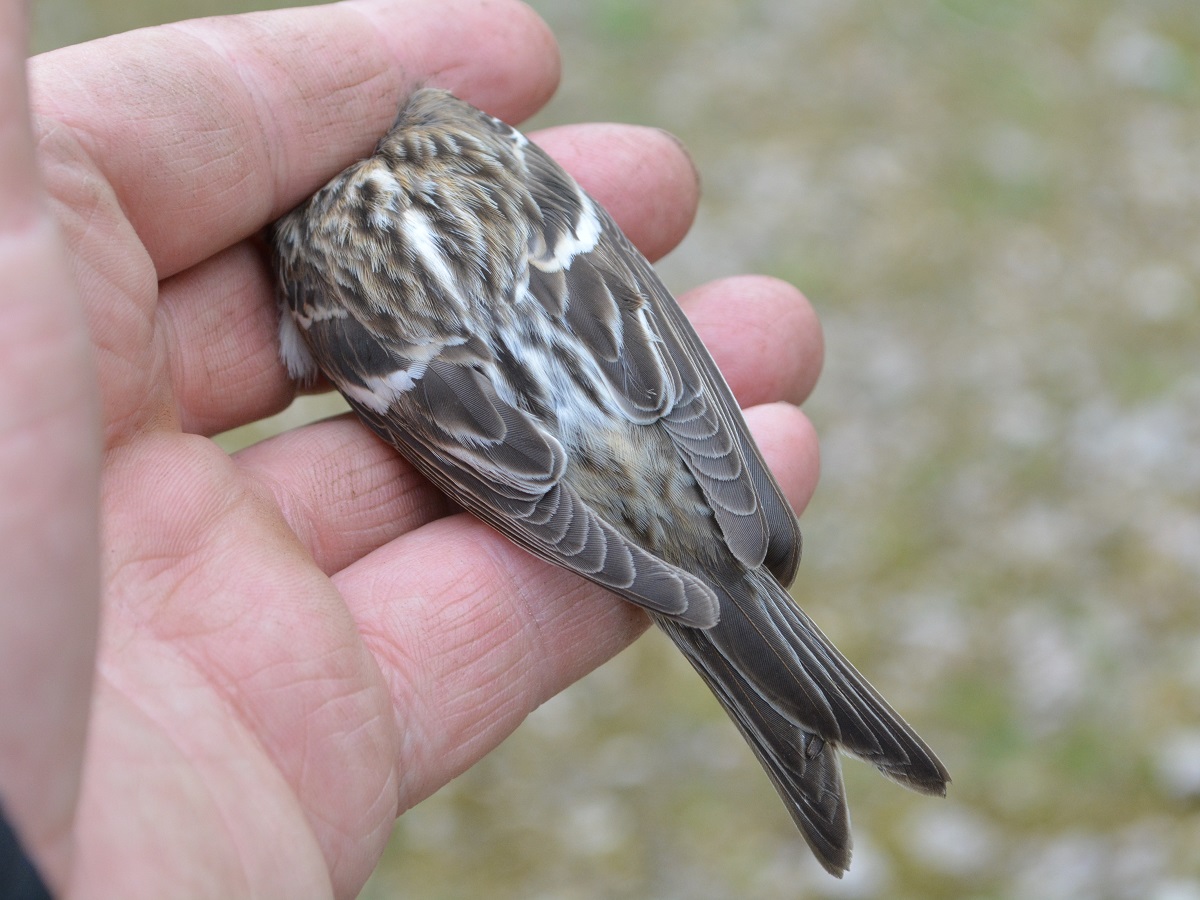
Caught by ringer 10-Sep-2017 Billinge Hill, near Billinge, Merseyside, UK
Duration: 9 days Distance: 68 km Direction: 152deg (SSE)
Goldcrest KJX423
First-year male 02-Sep-2017 Billinge Hill, near Billinge, Merseyside, UK
Found freshly dead 20-Sep-2017 Hannington, Hampshire, UK
Duration: 18 days Distance: 267 km Direction: 158deg (SSE)
Goldcrest KAD230
First-year male 23-Nov-2016 Billinge Hill, near Billinge, Merseyside, UK
Caught by ringer 28-Sep-2017 Oxmoor Wood, near Runcorn, Halton, UK
Duration: 309 days Distance: 17 km Direction: 173deg (S)
Goldcrest EJY447
First-year male 10-Oct-2016 Bidston, Wirral, Merseyside, UK
Caught by ringer 20-Oct-2017 Billinge Hill, near Billinge, Merseyside, UK
Duration: 375 days Distance: 27 km Direction: 66deg (ENE)
Goldcrest KNC292
First-year male 19-Sep-2017 Billinge Hill, near Billinge, Merseyside, UK
Taken by cat 25-Nov-2017 Fromes Hill, Ledbury, Herefordshire, UK
Freshly dead - within about a Week Taken By Cat
Duration: 67 days Distance: 155 km Direction: 175deg (S)
The ringing site at Billinge is the black circle with white cross and is largely hidden behind the purple marker unless viewed full screen and by zooming in.
Showing posts with label control. Show all posts
Saturday, 16 December 2017
Thursday, 7 December 2017
Recoveries catch up
I haven't posted full details of recoveries and controls for quite a while but now that ringing has slowed down there is the opportunity to start catching up. This post covers recoveries of finches that were ringed in my garden and others that were ringed or controlled at Billinge.
Siskin S144871
First-year female 12-Apr-2016 near Orrell, Greater Manchester, UK
Caught by ringer 26-Jun-2017 near Kildary, Highland, UK
Duration: 440 days Distance: 478 km Direction: 350deg (N)
This Siskin recovery is the furthest north of all the reports received so far this year.
Goldfinch S552424
First-year female 27-Dec-2016 near Orrell, Greater Manchester, UK
Caught by ringer 18-Mar-2017 Calf of Man, Isle of Man, UK
Duration: 81 days Distance: 151 km Direction: 294deg (WNW)
There have been previous exchanges of Goldfinches with the Isle of Man from sites in my area but this is the first one from my garden.
Goldfinch S881290
Juvenile 06-Aug-2017 Billinge Hill, near Billinge, Merseyside, UK
Caught by ringer 27-Oct-2017 Dunsby, Bourne, Lincolnshire, UK
Duration: 82 days Distance: 174 km Direction: 116deg (ESE)
Sexed as female when recaptured.
Lesser Redpoll AXA2748
First-year male 18-Sep-2017 Billinge Hill, near Billinge, Merseyside, UK
Caught by ringer 07-Oct-2017 Whixall & Fenn's Mosses, Wrexham, UK
Duration: 19 days Distance: 65 km Direction: 182deg (S)
Lesser Redpoll S800301
First-year 25-Aug-2017 Barnacre Reservoir, Lancashire, UK
Caught by ringer 26-Oct-2017 Billinge Hill, near Billinge, Merseyside, UK
Duration: 62 days Distance: 47 km Direction: 181deg (S)
Lesser Redpoll D717537
Full grown 03-Apr-2014 Llanfyllin, Powys, UK
Caught by ringer 01-Nov-2017 Billinge Hill, near Billinge, Merseyside, UK
Duration: 1308 days Distance: 88 km Direction: 25deg (NNE)
This Lesser Redpoll has also been caught at Crawford (2km from Billinge) on 5 occasions in spring and early summer 2015 and once in spring 2016. It was visiting feeders when caught at Crawford and was thought to be breeding nearby. It was sexed as a male when recaptured.
Lesser Redpoll S275550
First-year 21-Apr-2017 Torwood Lodge, Lockerbie, Dumfries and Galloway, UK
Caught by ringer 05-Dec-2017 Billinge Hill, near Billinge, Merseyside, UK
Duration: 228 days Distance: 185 km Direction: 167deg (SSE)
Sexed male when recaptured.
On the ringing front when there has been the opportunity to get out recently I have caught small numbers of Redwings, a few Blackbirds, a couple of Fieldfare and the odd Redpoll at Billinge and Crawford. The garden has also been reasonably productive with Goldfinches topping the totals there and a few Siskins are also starting to visit the feeders.
The cold weather and snow that has been forecast for this weekend could prove interesting and may bring some thrushes down from further north and see the feeders in the garden get even busier. I haven't had a Blackcap in the garden yet this winter but a good covering of snow and some frost may just help one come my way. So I think it is going to be a case of eyes on the garden this weekend and I may just start the next blog post on recoveries while doing so.
Siskin S144871
First-year female 12-Apr-2016 near Orrell, Greater Manchester, UK
Caught by ringer 26-Jun-2017 near Kildary, Highland, UK
Duration: 440 days Distance: 478 km Direction: 350deg (N)
This Siskin recovery is the furthest north of all the reports received so far this year.
Goldfinch S552424
First-year female 27-Dec-2016 near Orrell, Greater Manchester, UK
Caught by ringer 18-Mar-2017 Calf of Man, Isle of Man, UK
Duration: 81 days Distance: 151 km Direction: 294deg (WNW)
There have been previous exchanges of Goldfinches with the Isle of Man from sites in my area but this is the first one from my garden.
Goldfinch S881290
Juvenile 06-Aug-2017 Billinge Hill, near Billinge, Merseyside, UK
Caught by ringer 27-Oct-2017 Dunsby, Bourne, Lincolnshire, UK
Duration: 82 days Distance: 174 km Direction: 116deg (ESE)
Sexed as female when recaptured.
Lesser Redpoll AXA2748
First-year male 18-Sep-2017 Billinge Hill, near Billinge, Merseyside, UK
Caught by ringer 07-Oct-2017 Whixall & Fenn's Mosses, Wrexham, UK
Duration: 19 days Distance: 65 km Direction: 182deg (S)
Lesser Redpoll S800301
First-year 25-Aug-2017 Barnacre Reservoir, Lancashire, UK
Caught by ringer 26-Oct-2017 Billinge Hill, near Billinge, Merseyside, UK
Duration: 62 days Distance: 47 km Direction: 181deg (S)
Lesser Redpoll D717537
Full grown 03-Apr-2014 Llanfyllin, Powys, UK
Caught by ringer 01-Nov-2017 Billinge Hill, near Billinge, Merseyside, UK
Duration: 1308 days Distance: 88 km Direction: 25deg (NNE)
This Lesser Redpoll has also been caught at Crawford (2km from Billinge) on 5 occasions in spring and early summer 2015 and once in spring 2016. It was visiting feeders when caught at Crawford and was thought to be breeding nearby. It was sexed as a male when recaptured.
Lesser Redpoll S275550
First-year 21-Apr-2017 Torwood Lodge, Lockerbie, Dumfries and Galloway, UK
Caught by ringer 05-Dec-2017 Billinge Hill, near Billinge, Merseyside, UK
Duration: 228 days Distance: 185 km Direction: 167deg (SSE)
Sexed male when recaptured.
| S275550 adult male Lesser Redpoll, controlled at Billinge 05/12/2017 |
The cold weather and snow that has been forecast for this weekend could prove interesting and may bring some thrushes down from further north and see the feeders in the garden get even busier. I haven't had a Blackcap in the garden yet this winter but a good covering of snow and some frost may just help one come my way. So I think it is going to be a case of eyes on the garden this weekend and I may just start the next blog post on recoveries while doing so.
Sunday, 10 September 2017
More Goldcrests on the move.
There was a brief lull in the unsettled weather this morning so I headed up to Billinge to make the most of the calmer conditions. I set 3 nets in the top willows but used a different net configuration to the one I have been using recently as the breeze was due to strengthen from mid morning. It would have been a fairly quiet session but there was a rush of birds about an hour after sunrise that boosted the totals and accounted for nearly half of the 50 birds that were caught over the course of the morning.
The catch was dominated by Goldcrests (19) and Chiffchaffs (14) as is often the case at this time of year and one of the Goldcrest, a 1cy female, was a control (a bird ringed elsewhere). I suspect this Goldcrest may have been ringed on Walney Island (68km NNW of Billinge) as the ring number was fairly close to one I have had from there before, although that is only an educated guess at this stage and I will only know its origin for certain when the recovery report comes through. The best of the rest were a Grey Wagtail, the first Willow Tit for a while and 2 Yellowhammers.
There were a few more Meadow Pipits moving overhead than there have been so far this autumn but it was still not much more than a trickle and petered out as the breeze picked up. A few Reed Buntings were also on the move early on and was the first obvious movement of that species this autumn and resulted in 3 being caught. However, it very much had the feel that the weather was holding up diurnal migrants and more would have been moving had the conditions been clearer and the breeze hadn't increased so much.
Ringing totals (retraps/controls in brackets) for 10/09/17 were: Goldcrest 17(2); Blue Tit 1; Great Tit 1; Willow Tit 1; Long-tailed Tit 1; Chiffchaff 13(1); Willow Warbler 2; Blackcap 1; Wren 1; Grey Wagtail 1; Chaffinch 1; Greenfinch 2; Yellowhammer 2; Reed Bunting 3.
The catch was dominated by Goldcrests (19) and Chiffchaffs (14) as is often the case at this time of year and one of the Goldcrest, a 1cy female, was a control (a bird ringed elsewhere). I suspect this Goldcrest may have been ringed on Walney Island (68km NNW of Billinge) as the ring number was fairly close to one I have had from there before, although that is only an educated guess at this stage and I will only know its origin for certain when the recovery report comes through. The best of the rest were a Grey Wagtail, the first Willow Tit for a while and 2 Yellowhammers.
| Control 1cy female Goldcrest HDB637 |
| 1cy Willow Tit |
Ringing totals (retraps/controls in brackets) for 10/09/17 were: Goldcrest 17(2); Blue Tit 1; Great Tit 1; Willow Tit 1; Long-tailed Tit 1; Chiffchaff 13(1); Willow Warbler 2; Blackcap 1; Wren 1; Grey Wagtail 1; Chaffinch 1; Greenfinch 2; Yellowhammer 2; Reed Bunting 3.
Thursday, 8 June 2017
Siskin Movements: Spring 2017
I haven't posted details of any recoveries for a while so I thought it was time to rectify that. I have received quite a few recovery reports for Siskins over the past few months so it made sense to start with that species. Details of 3 of the movements were posted earlier in the spring but as others started to come in I decided to wait and show them all together rather than post details when they were received. All of the movements involve birds that were ringed or controlled in my garden near Orrell, Greater Manchester (purple & white circle on map).
It is interesting that there are no movements to or from SE England as large numbers of Siskins usually winter in that area. The two recoveries well south of my garden are both in Wales and this suggest that many of the bird that visit my garden winter there and perhaps further south in SW England.
D874496 first year female Siskin
Ringed 18/03/2014 near Orrell, Greater Manchester.
Controlled 14/02/2017
Witton-le Wear NR, Durham. 143 km NNE, duration 1064 days.
S192064 first-year male Siskin
Ringed 11/04/2016 Peebles, Scottish Borders.
Controlled 07/03/2017 near Orrell, Greater Manchester. 293 km S,
duration 330 days
S144873 first-year female Siskin
Ringed
12/04/2016
near Orrell, Greater Manchester.
Controlled 30/01/2017 Ffynnon Gro, Llanfynydd, Carmarthenshire.
201 km S, duration 293 days.
S411915 first-year female Siskin
Ringed 24/02/2017
Sychdyn, Mold, Flintshire.
Controlled 24/03/2017 near Orrell, Greater Manchester. 47 km NE,
duration 28 days.
S264860 first-year male Siskin
Ringed 03/03/2017
Broken Cross, Nr Macclesfield,
Cheshire.
Controlled 24/03/2017 near Orrell, Greater Manchester. 46 km
NW, duration: 21 days.
S785508 first-year male Siskin
Ringed 19/02/2017 near
Orrell, Greater Manchester.
Controlled 02/04/2017 Dalston, Carlisle, Cumbria. 148 km N,
duration: 42 days.
S144876 adult female Siskin
Ringed 12/04/2016 near Orrell, Greater Manchester.
Controlled 02/04/2017
Cnoc, Argyll and Bute. 324 km NNW, duration: 355 days.
S144643 first-year male Siskin
Ringed 07/03/2016 near Orrell, Greater Manchester.
Controlled 21/02/2017 Townhill, Dunfermline, Fife. 289 km N,
duration: 351 days.
S144511 adult male Siskin
Ringed 18/02/2016 near Orrell, Greater Manchester.
Controlled 18/04/2017
Millhousebridge, Dumfries and Galloway. 188 km
NNW, duration: 425 days.
S144657 first-year male Siskin
Ringed
08/03/2016
near Orrell, Greater Manchester.
Found
26/03/2017
Pont-rhyd-y-groes, Ceredigion. 152 km SSW,
duration 414 days. Dying, found sick,
S552459 adult female
Siskin
Ringed 22/01/2017 near Orrell, Greater Manchester.
Controlled 23/03/2017 Glebe
Farm, Salsburgh, North Lanarkshire. 268 km, duration: 60 days.
Wednesday, 26 April 2017
Billinge: 9th to 23rd April 2017
Apologies for the lack of updates recently but other things have just got in the way. I put in quite a bit of effort at Billinge in the two weeks following my last post but the results were mixed to say the least. A couple of ringing sessions were reasonably productive while others saw only a handful of birds caught or drew a blank. The cumulative totals for the period were 59 new birds, 15 retraps and 4 controls, although 2 of the controls are likely to have been ringed at sites nearby.
Lesser Redpolls were the most numerous species with 37 new birds and 1 control being caught. The control Lesser Redpoll had been ringed at Clow Bridge in Lancashire last autumn, 41 km to the NE of Billinge. Willow Warbler was next in terms of numbers with 9 new birds and 6 retraps captured. It has been a good spring for Willow Warblers with 23 (15 new birds and 8 retraps from previous years) caught so far this month. Of these 21 were males and only 2 were females with the first male being caught on the 1st and the first female just over 3 weeks later, on the 23rd.
Other captures and sightings of note were as follows:
14th - 2 Siskins were ringed including a female with a wrinkled brood patch which indicates she had already made an early breeding attempt somewhere. I am not aware of any breeding sites near Billinge which makes this record all the more interesting. Is it a failed breeder on the move or could it be breeding nearby?
17th - A short, rain restricted ringing session didn't produce single bird but a late Fieldfare was seen flying east.
19th - A very quiet ringing session produced just 2 Lesser Redpolls but this was offset by a Woodlark seen flying north first thing followed by a couple of Tree Pipits later in the morning. Woodlark is a county rarity and this record, assuming it is accepted, will only be the 3rd record for the county.
23rd - The first Whitethroat of the spring was ringed and a female Blackcap was controlled. I have received the ringing details for the control Blackcap and it had been ringed at Stanford Reservoir in Northamptonshire, 162 km SE of Billinge, on 24th September last year.
Hopefully I will be back to posting on the blog at least once a week from now on.
Lesser Redpolls were the most numerous species with 37 new birds and 1 control being caught. The control Lesser Redpoll had been ringed at Clow Bridge in Lancashire last autumn, 41 km to the NE of Billinge. Willow Warbler was next in terms of numbers with 9 new birds and 6 retraps captured. It has been a good spring for Willow Warblers with 23 (15 new birds and 8 retraps from previous years) caught so far this month. Of these 21 were males and only 2 were females with the first male being caught on the 1st and the first female just over 3 weeks later, on the 23rd.
Other captures and sightings of note were as follows:
14th - 2 Siskins were ringed including a female with a wrinkled brood patch which indicates she had already made an early breeding attempt somewhere. I am not aware of any breeding sites near Billinge which makes this record all the more interesting. Is it a failed breeder on the move or could it be breeding nearby?
17th - A short, rain restricted ringing session didn't produce single bird but a late Fieldfare was seen flying east.
19th - A very quiet ringing session produced just 2 Lesser Redpolls but this was offset by a Woodlark seen flying north first thing followed by a couple of Tree Pipits later in the morning. Woodlark is a county rarity and this record, assuming it is accepted, will only be the 3rd record for the county.
23rd - The first Whitethroat of the spring was ringed and a female Blackcap was controlled. I have received the ringing details for the control Blackcap and it had been ringed at Stanford Reservoir in Northamptonshire, 162 km SE of Billinge, on 24th September last year.
| The Whitethroat was carrying a passenger in the form of a tick under its left eye. |
| The control female Blackcap. |
Thursday, 6 April 2017
Another Mealy
I made the effort to get up to Billinge at first light this morning and set 3 nets but my optimism didn't look like it was going to be rewarded with only 7 birds being caught in the first couple of hours. I had hoped some Redpolls would be on the move but there was nothing moving overhead and not a great deal moving through the bushes either. Things hadn't improved much by 09:30 so I started to think about packing up but then 3 Redpolls went north and rekindled my optimism. Better still the next check of the nets produced a nice Mealy Redpoll so any thought of packing up was put firmly on hold.
The remainder of the morning saw further improvement with a little trickle of Redpolls heading north and a better catching rate. While I didn't catch any more Mealies a total of 7 Lesser Redpolls were caught including one that had been ringed elsewhere. With a bit of luck I should get confirmation of where this bird was ringed back from the BTO tomorrow, although I do have good reason to believe it was originally ringed in East Sussex.
Chiffchaff numbers had increased since my last visit and all 5 that were caught were retraps from previous years (1 from 2015 and 4 from 2016). One of them had a cracking pollen horn. This bird must have spent a lot of time with its face in flowers, feeding on insects and probably drinking nectar, whilst fattening up for the return journey.
The final tally of 18 new birds and 19 retraps was well worth the effort and made up for the slow start. Ringing totals (retraps or controls in brackets) were: Woodpigeon 1; Blue Tit 2; Great Tit 1 (3); Coal Tit (1); Long-tailed Tit (3); Chiffchaff (5); Willow Warbler 2 (1); Robin (2); Chaffinch 2 (2); Lesser Redpoll 6 (1); Mealy Redpoll 1; Goldfinch 3; Yellowhammer (1).
07/04/16 update
The recovery report for the control Lesser Redpoll arrived today as predicted and it was originally ringed as a first-year at Icklesham in East Sussex in October 2011. This makes it just under 6 years old which is a good age for a Lesser Redpoll. The current longevity record in the BTO online report for 2015 is not much older at just over 6 years between time of ringing and recovery and that bird would have been around six and a half when recaptured. Full details and a recovery map will be posted in due course.
| Mealy Redpoll 06/04/17 |
| Mealy Redpoll 06/04/17 |
| Mealy Redpoll 06/04/17 |
| The control Lesser Redpoll was a cracking male. Details of where it was ringed will be posted in due course. |
| JTA492 Chiffchaff had the best pollen horn I have seen so far this spring |
| JTA492 Chiffchaff |
07/04/16 update
The recovery report for the control Lesser Redpoll arrived today as predicted and it was originally ringed as a first-year at Icklesham in East Sussex in October 2011. This makes it just under 6 years old which is a good age for a Lesser Redpoll. The current longevity record in the BTO online report for 2015 is not much older at just over 6 years between time of ringing and recovery and that bird would have been around six and a half when recaptured. Full details and a recovery map will be posted in due course.
Friday, 23 December 2016
Goldcrest controls autumn 2016
A total of 757 different Goldcrests were handled at Billinge this year which is a phenomenal total for an inland location and follows on from the 705 caught during 2015. The discovery of this volume of migration through the site has been one of the major findings that ringing has revealed over the last three years and is certainly something I hadn't expected.
The vast majority of birds are caught in the autumn and, in 2016, that started with the appearance of dispersing juveniles in July and August. Autumn migration proper got into full swing in early September and continued throughout October and into the first half of November, before finally fizzling out at the beginning of December. Monthly totals (new birds only) for the second half of 2016 were: July 10; August 39; September 237; October 377; November 85; December 2.
There were 4 controls (birds ringed elsewhere) amongst the birds caught this autumn but, surprisingly, not a single retrap from 2015. This lack of retraps is in stark contrast to the situation in my garden, just a couple of km away, where I ringed 4 Goldcrests in late November / early December 2015 and retrapped 2 of them amongst the 5 caught during a similar period this year. I know the ringing in my garden only involves small numbers by comparison and was outside the main autumn migration period but it does help to emphasise the migratory nature of the birds that move through Billinge.
Details of each of the controls are given below and on the following map.
6T1477 Goldcrest 4F
Ringed 04/10/2015 Oxmoor Wood, Runcorn, Halton.
Controlled 09/10/2016 Billinge Hill, Merseyside. 17km N, duration 371 days.
This bird was on passage when ringed at Oxmoor and its recapture at Billinge just over a year later, also when on passage, shows it was following a similar timing and route through the region.
HDB361 Goldcrest 3M (photo below)
Ringed 04/09/2016 South Walney, Barrow-in-Furness, Cumbria.
Controlled 15/09/2016 Billinge Hill, Merseyside. 68km SSE, duration 11 days.
This bird is likely to have originated from a breeding site in the far north of England or Scotland.
HHJ969 Goldcrest 3M (photo below)
Ringed 05/10/2016 The Headland, Hartepool.
Controlled 14/10/2016 Billinge Hill, Merseyside. 165km SW, duration 9 days.
When it was controlled this Goldcrest was considered to be a 'continental' migrant from its appearance and the ringing location on the east coast just 9 days earlier certainly supports that. This is the second Goldcrest controlled at Billinge to have come from The Headland at Hartlepool, with the first being last year.
HXN392 Goldcrest 3F (photo below)
Ringed 14/10/2016 Isle Of May, Fife, Scotland.
Controlled 03/11/2016 Billinge Hill, Merseyside. 299km S, duration 20 days.
This Goldcrest was also considered to be a 'continental' bird when it was controlled and again the ringing location fully supports that. There was a big 'fall' of migrants on the Isle of May on 14th October that included 400 Goldcrests, 300 Robins, 400 Song Thrush, 150 Blackbirds, and 119 Brambling, just to list a few of the species and numbers recorded on the island that day.
The yellow pins mark the ringing site of each Goldcrest and the purple pin marks the site at Billinge.
.................................................and as it is that time of year
The vast majority of birds are caught in the autumn and, in 2016, that started with the appearance of dispersing juveniles in July and August. Autumn migration proper got into full swing in early September and continued throughout October and into the first half of November, before finally fizzling out at the beginning of December. Monthly totals (new birds only) for the second half of 2016 were: July 10; August 39; September 237; October 377; November 85; December 2.
There were 4 controls (birds ringed elsewhere) amongst the birds caught this autumn but, surprisingly, not a single retrap from 2015. This lack of retraps is in stark contrast to the situation in my garden, just a couple of km away, where I ringed 4 Goldcrests in late November / early December 2015 and retrapped 2 of them amongst the 5 caught during a similar period this year. I know the ringing in my garden only involves small numbers by comparison and was outside the main autumn migration period but it does help to emphasise the migratory nature of the birds that move through Billinge.
Details of each of the controls are given below and on the following map.
6T1477 Goldcrest 4F
Ringed 04/10/2015 Oxmoor Wood, Runcorn, Halton.
Controlled 09/10/2016 Billinge Hill, Merseyside. 17km N, duration 371 days.
This bird was on passage when ringed at Oxmoor and its recapture at Billinge just over a year later, also when on passage, shows it was following a similar timing and route through the region.
-------------------------------------------------------------------------------------------------------------------------
HDB361 Goldcrest 3M (photo below)
Ringed 04/09/2016 South Walney, Barrow-in-Furness, Cumbria.
Controlled 15/09/2016 Billinge Hill, Merseyside. 68km SSE, duration 11 days.
This bird is likely to have originated from a breeding site in the far north of England or Scotland.
![]() |
| HDB361 Goldcrest 15/09/2016 |
----------------------------------------------------------------------------------------------------------------------
HHJ969 Goldcrest 3M (photo below)
Ringed 05/10/2016 The Headland, Hartepool.
Controlled 14/10/2016 Billinge Hill, Merseyside. 165km SW, duration 9 days.
When it was controlled this Goldcrest was considered to be a 'continental' migrant from its appearance and the ringing location on the east coast just 9 days earlier certainly supports that. This is the second Goldcrest controlled at Billinge to have come from The Headland at Hartlepool, with the first being last year.
![]() |
| HHJ969 Goldcrest 14/10/2016 |
-------------------------------------------------------------------------------------------------------------------------
HXN392 Goldcrest 3F (photo below)
Ringed 14/10/2016 Isle Of May, Fife, Scotland.
Controlled 03/11/2016 Billinge Hill, Merseyside. 299km S, duration 20 days.
This Goldcrest was also considered to be a 'continental' bird when it was controlled and again the ringing location fully supports that. There was a big 'fall' of migrants on the Isle of May on 14th October that included 400 Goldcrests, 300 Robins, 400 Song Thrush, 150 Blackbirds, and 119 Brambling, just to list a few of the species and numbers recorded on the island that day.
![]() |
| HXN392 Goldcrest 03/11/2016 |
-----------------------------------------------------------------------------------------------------------------------
The yellow pins mark the ringing site of each Goldcrest and the purple pin marks the site at Billinge.
.................................................and as it is that time of year
![]() |
| ......Merry Christmas and Happy New Year. |
Thursday, 3 November 2016
Billinge: 3rd November 2016
A short ringing session at Billinge got off to a great start when the first bird out of the nets turned out to be a control Goldcrest. I could hear there were a few around and the next couple of hours produced another 14 new birds and a retrap, making 16 Goldcrests in total. That is a decent number for early November and shows some are still on the move.
There weren't many thrushes moving and only a few were caught but they included a Fieldfare so that also added value to the session as I don't catch many. The next net round produced another good bird in the form of a female Blackcap. It wasn't carrying much fat so could be a bird that has migrated here for the winter but there is also a chance of it being a tardy summer visitor; either way a good record as November Blackcaps are few and far between in this area.
I was already very happy with the session when a Woodlark flew over and made it even better. I first picked it up on call and then watched it fly over me as it headed south and was lost to view. It must have u-turned soon after as I heard it come back over the west side of the site but I didn't manage to see it again as it was on the other side of the hill from me. It is probably the first record for the site and it was certainly the first there for me. I had been in two minds about going out this morning as I had a meeting to go to at 10am so wouldn't have much more than a couple of hours with the nets up but I am certainly glad I made the effort now.
Ringing totals (retraps and controls in brackets) for 03/11/16 were: Goldcrest 14 (2); Blue Tit 1; Blackcap 1; Wren 1; Blackbird 1; Fieldfare 1; Redwing 5. 24 new birds, 1 retrap and 1 control.
There weren't many thrushes moving and only a few were caught but they included a Fieldfare so that also added value to the session as I don't catch many. The next net round produced another good bird in the form of a female Blackcap. It wasn't carrying much fat so could be a bird that has migrated here for the winter but there is also a chance of it being a tardy summer visitor; either way a good record as November Blackcaps are few and far between in this area.
| Adult male Fieldfare |
| Only the 16th ringed at the site this autumn. |
| Today's female Blackcap. |
Ringing totals (retraps and controls in brackets) for 03/11/16 were: Goldcrest 14 (2); Blue Tit 1; Blackcap 1; Wren 1; Blackbird 1; Fieldfare 1; Redwing 5. 24 new birds, 1 retrap and 1 control.
Monday, 19 September 2016
Billinge: 15th & 18th September 2016
The 15th was one of those days were expectations were high but very murky conditions stifled overhead passage and kiboshed my hopes of a good catch of Meadow Pipits and Grey Wagtails. Visibility was poor and restricted to about 1 or 2 km for much of the morning and while you could call it misty the vegetation and nets remained bone dry because of the high temperature. Some birds were moving despite the conditions and a few Meadow Pipits shot through and the odd Siskin and Song Thrush was heard calling through the murk but there were big gaps with nothing moving overhead.
Fortunately there were a good few birds in the bushes and a total of 49 were caught. Chiffchaffs topped the totals once again with 15 new birds and 1 retrap but Goldcrests weren't far behind with 12 new birds and a control (a bird ringed elsewhere). It shouldn't take long to get the ringing details back for this bird and it will be interesting to find out when and where it was ringed as we are still in the early stages of autumn migration for this species.
The remainder of the catch didn't produce any surprises and the totals for the morning were: Goldcrest 12 (1); Blue Tit 1; Coal Tit 1; Chiffchaff 15 (1); Willow Warbler 1; Blackcap 6 (1); Robin 4; Dunnock 1; Bullfinch 1; Lesser Redpoll 1; Reed Bunting 3. Total 46 new birds, 2 retraps and 1 control.
The 18th started off a bit misty but soon became depressingly foggy. The fog just wouldn't burn off and although it thinned from time to time it didn't finally clear until late in the morning when it was time to start packing up. The conditions severely limited movement overhead, as you would expect, although the occasional stratospheric Siskin was heard and the fog also made the nets more visible for much of the session.
One or two Song Thrushes were calling as I was setting up so it wasn't a surprise when one was in the net on the first round. However, it wasn't one of the locals and its colder and more olive upper parts pointed to it being of continental origin. The first migrant Song Thrushes usually arrive in early to mid September and more continental birds reach this part of the country than is often appreciated.
The catching rate was much slower than the final total of 40 new birds might suggest and there were several blank net rounds. Goldcrests topped the totals and the 18 ringed is the biggest catch of the autumn to date. It also brought the number ringed so far this month to 106. There were very few Chiffchaffs around compared to recent visits and only 4 were ringed but Blackcaps continue to move through the site in similar numbers with another 6 being caught.
Ringing totals for 18/09/16 were: Goldcrest 18; Blue Tit 1; Great Tit 1; Chiffchaff 4; Blackcap 6; Wren 1; Song Thrush 1; Robin 3; Chaffinch 5. Total 40 new birds.
Fortunately there were a good few birds in the bushes and a total of 49 were caught. Chiffchaffs topped the totals once again with 15 new birds and 1 retrap but Goldcrests weren't far behind with 12 new birds and a control (a bird ringed elsewhere). It shouldn't take long to get the ringing details back for this bird and it will be interesting to find out when and where it was ringed as we are still in the early stages of autumn migration for this species.
![]() |
| Control Goldcrest. Details of when and where it was ringed will be posted in due course. |
| I suppose you could call it a brown crown with black highlights or streaks. |
| September usually sees some good movements of Robins through the site but numbers have been much lower than usual so far this autumn. |
One or two Song Thrushes were calling as I was setting up so it wasn't a surprise when one was in the net on the first round. However, it wasn't one of the locals and its colder and more olive upper parts pointed to it being of continental origin. The first migrant Song Thrushes usually arrive in early to mid September and more continental birds reach this part of the country than is often appreciated.
The catching rate was much slower than the final total of 40 new birds might suggest and there were several blank net rounds. Goldcrests topped the totals and the 18 ringed is the biggest catch of the autumn to date. It also brought the number ringed so far this month to 106. There were very few Chiffchaffs around compared to recent visits and only 4 were ringed but Blackcaps continue to move through the site in similar numbers with another 6 being caught.
Ringing totals for 18/09/16 were: Goldcrest 18; Blue Tit 1; Great Tit 1; Chiffchaff 4; Blackcap 6; Wren 1; Song Thrush 1; Robin 3; Chaffinch 5. Total 40 new birds.
Labels:
Billinge,
Blackcap,
Chiffchaff,
control,
Fog,
Goldcrest,
Robin,
Song Thrush
Monday, 18 January 2016
17/01/16: Water Rail and BLB Blackcap steal the show.
I woke to find there was a decent covering of snow so I decided to have a walk around the park across the road from my home before everybody and their dogs decided to do so. I headed up to the small reserve area to see if the Water Rail would put in an appearance before the site got too busy but as a made my way there it was clear that many dog walkers were already out and about.
There was no sign of the Water Rail at first but Robins were following me around hoping I had some food in my pocket. I have loads of photos of Robins but it is hard to resist taking more when they pose in the snow, so now I have even more.
On getting home I grabbed a coffee and was watching the birds in the garden when I noticed a ringed male Blackcap on one of the fat cakes. I assumed it was the male I had ringed in late December even though I hadn't seen it for a couple of weeks. I decided to try and grab a few photos of it to see if I could read the ring number and luckily I managed to get a few good shots quite quickly. On reviewing them on the back of the camera I could see the ring number was above the address rather than below it which meant it must be a foreign ring !!!! (the address would be above the number if it were a British ring of that size). Obviously it wasn't the bird I had ringed in December as I had initially thought and I was so glad that I had decided to photograph it.
I went through the images several times and manipulated the usable ones in different ways and I am now happy it does say Brussels and it is a Belgian ring. I will be submitting the details to the BTO in the next few days and I will post details of when and exactly where the bird was ringed in due course.
![]() |
| The wintry scene that greeted me as I made my way through the park. |
![]() |
| B80 was ringed in the garden on 26/05/15 and was a breeding adult male when ringed. The base of its bill has already turned blue even though the breeding season is some way off. |
It didn't look like the Water Rail would show for me but then I noticed it lurking under some overhanging branches. Eventually it moved into a more open area and I manged to get a few shots.
A Grey Wagtail was feeding in the same area but the light levels were too low to get any really good shots.
![]() |
| The Moorhen looked the more nervous of the two as it made its way past. |
A Grey Wagtail was feeding in the same area but the light levels were too low to get any really good shots.
![]() |
| Bathing and feather maintenance is important whatever the weather. |
![]() |
| After bathing it was time for a good scratch and a preen. |
![]() |
| Where are you from. |
![]() |
| It also fed on the ground below one of the feeders but this was too far away to get good images of the ring even when it was showing the ringed leg. |
![]() |
| Although the ring is upside down you can make out a 2 and a 9. I rotated the image to make it easier to read. |
The ringed leg of the Blackcap was often obscured while it was feeding and after a short bouts of feeding it would disappear for a while making the task far from easy. I thought about putting a net up to try and catch it but decided against it as there was a bit of a breeze and with so much snow on the bushes and on the ground the net would have been easier for the bird to see. The camera seemed the best option in the circumstances and while I was waiting for the Blackcap to feed I photographed a few of the other birds that were visiting the garden.
A few hundred photographs and a few hours later I still wasn't sure if I had managed to get the full number or the address on the ring. I loaded all of the images onto my computer and sifted through them. It was impossible to make out the numbers on the ring in most of the images but with a lot of cropping and a bit of manipulation there was just enough detail in some of them to make out all of the numbers and a few of the letters of the address. I was confident I had the full number but I couldn't quite make out the address which is just as important when it comes to tracing a ring. However, when I looked at images of foreign rings on the web and compared them with mine I soon became certain that it was a Belgian ring and the letters I could read were from the middle part of the word 'Brussels'.
![]() |
| Male Starling |
![]() |
| 2CY male Blackbird |
![]() |
| Long-tailed Tits |
![]() |
| This Grey Wagtail is a regular visitor to the garden and feeds on scraps that have fallen from the feeders. |
![]() |
| Goldfinch |
![]() |
| The 2 was the give away that the numbers were above the address and those letters on the lower line of the address appear to be part of the word 'Brussels'. |
![]() |
| Cropping and manipulation of this image revealed the last two numbers - 8 and 6. |
Subscribe to:
Posts (Atom)