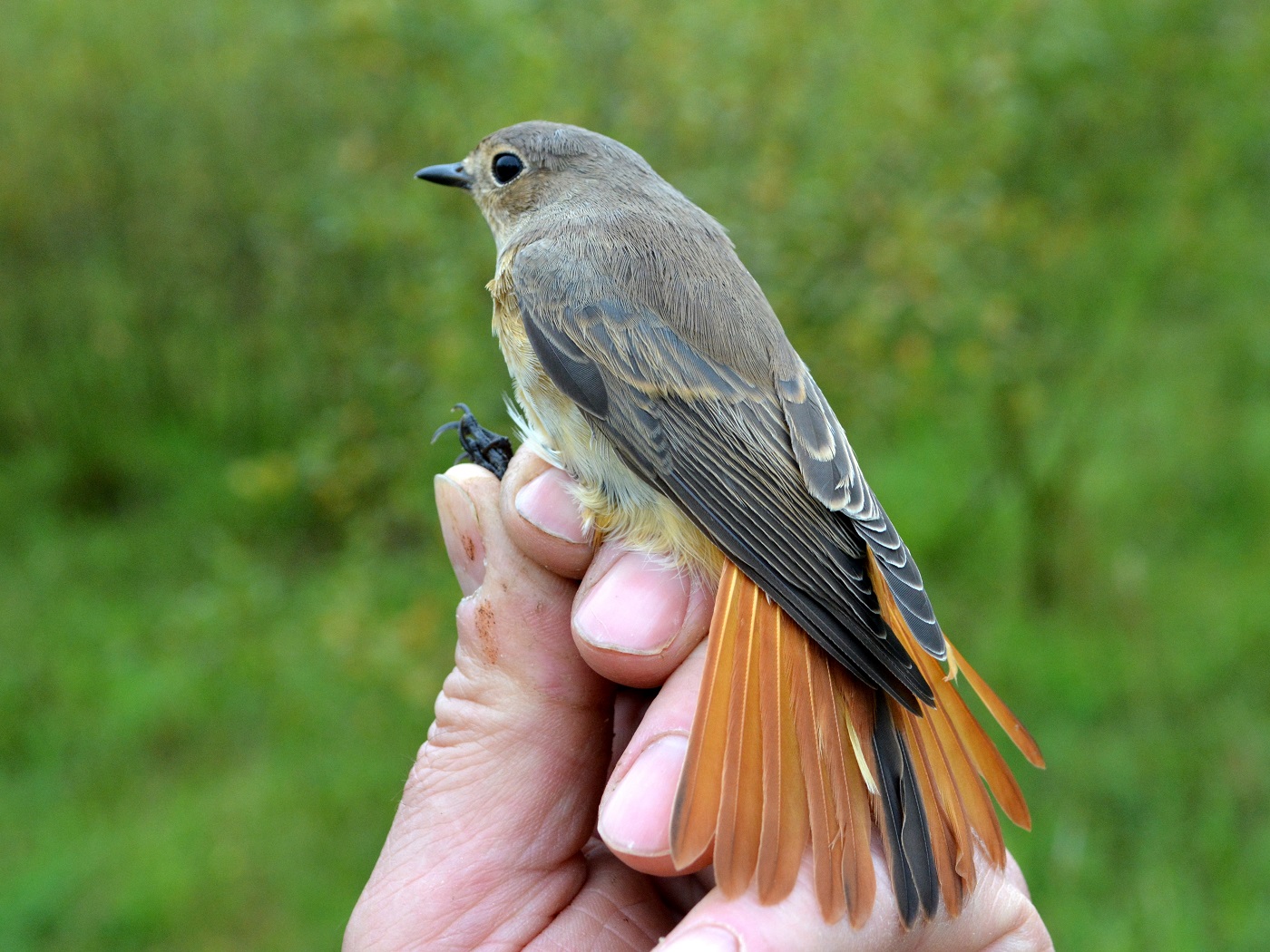
Showing posts with label Willow Warbler. Show all posts

Monday, 22 April 2019

Billinge: 6th to 22nd April

I have been up to the ringing site at Billinge twelve times since 6th April but the catches have been quite small, hence the lack of blog posts about individual visits.  While the catches have been small they haven't been without interest and what you don't catch can be as important as what you do, or at least that is what I tell myself.

It looks like being another poor spring for Redpoll passage but that is hardly surprising as last autumn was very poor for Redpolls going south so a poor showing the following spring is no big surprise. Having said that you have to put the effort in to find out and I can certainly say I have put the effort in with only 18 Lesser Redpolls caught over twelve visits. One of the Redpolls caught on 10/04/2019 was a retrap that had been ringed at the site on 13/08/2017 as an adult female so perhaps a bird that breeds not too far away.

The most interesting Redpoll, for me at least, was a little adult male caught yesterday (21/04/2019). I say little as its wing length was 69mm which is fairly small or very small for a male of any race. We still don't know what to do with Redpoll species and races because they don't play by the rules as we would like to apply them. If my understanding is correct they should all be lumped at a genetic level, every last one of them, into one species because they are not distinct enough genetically despite their varying appearance. Arctic, Common, Lesser or whatever you want to call them they are all far more similar on the inside than they appear on the outside but that is what makes them even more fascinating. While they may be similar on the inside the difference on the outside largely determines where they will breed and that is why we like them so much.

A bit or quite a bit greyer than your typical Lesser and probably breeds well north of Billinge.

Broad white fringes to the greater coverts, tertials and inner webs of tail feathers.
A touch of tram lines up the mantle too.

Broad white fringes to the greater coverts and tertials.

Broad white fringes to inner webs of tail feathers.

Unstreaked under-tail coverts which is normally a feature of Arctic Redpolls.

Pure white, unstreaked, under-tail coverts, including the feather shafts. If you hadn't seen the rest of the bird you could be thinking Arctic Redpoll. I have seen Lesser types like this before so not as exceptional as it may appear.
The first Willow Warbler was noted on the 6th and it was good to find that 9 of the 20 that were caught between the 10th and 22nd were retraps. Of the retraps one was originally ringed in 2016 and eight were originally ringed in 2017. On the other hand Chiffchaffs have been thin on the ground this spring with only 3 caught but all were retraps - one from 2017 and two from 2018. Blackcaps have put in a pretty good showing so far with 12 caught - 10 new, 1 retrap and 1 control. The retrap was ringed as a first-year in August 2017 and the control was ringed 16 km away at Woolston Eyes in April 2018.

Unusual captures were a pair of Mistle Thrushes that found their way into one of the nets on the 16th and were a first to be ringed at the site. However, the highlight of the period, and what made the effort worthwhile, was the capture of six Tree Pipits with the first caught on the 13th.

Tree Pipit 19/04/2019

Tree Pipit 21/04/2019
The twelve visits yielded 54 new birds, 18 retraps and 1 control as follows (retraps in brackets): Lesser Redpoll 17 (1); Willow Warbler 11 (9); Chiffchaff  (3); Goldcrest 2 (1); Blackicap 10 (1) +1 control; Robin 3; Long-tailed Tit (1); Tree Pipit 6; Mistle Thrush 2; Bullfinch 1 (1); Dunnock 1; Yellowhammer 1; Willow Tit (1).

Monday, 8 October 2018

Late Willow Warbler

I nearly didn't go out this morning as the forecast said there was going to be more of a breeze than yesterday but the chance of catching more Redwings or something unusual got the better of me. The south-westerly breeze was a bit too strong for the net rides in the top willows so I opted for the more sheltered rides in north-east corner of the site. I set up the first net before it started to get light and unlike yesterday there were the occasional calls of Redwings flying overhead to give me some encouragement.

It turned out to be a much busier morning at the nets than I had expected so I didn't have much time for looking up to see what was passing overhead but at least 200 Redwings went south and many others would have been missed. Redwings were also the most numerous birds in the nets with a total of 19 caught but unlike yesterday there weren't many Goldcrests around and only 4 were ringed. It was almost a repeat performance as far as Coal Tits were concerned with a total of 7 ringed which becomes the second highest day total after yesterday's 8 and it increasingly looks like some are genuinely on the move. The poor autumn for Lesser Redpolls continued with only 3 ringed and 2 of those were adults which, as I said in yesterday's post, isn't a good sign. The most unusual capture was a Willow Warbler as it is a very late date for the species in this area.  It is only the second I have recorded in October but it still well short of the latest which was a bird ringed on 23rd October 2014.

Adult female Lesser Redpoll.

Ageing was straightforward as it hadn't finished moulting with the inner secondaries still growing in both wings. The tertials and coverts were also very fresh and similarly coloured as they should be.

If any further confirmation was required the tail was about as fresh and rounded as they get in adult Lesser Redpolls in autumn.

An October Willow Warbler is rarer than Yellow-browed Warbler at Billinge.
Ringing totals (retraps in brackets) for 08/10/2013 were: Coal Tit 7; Blue Tit 6; Great Tit 8 (2); Long-tailed Tit 7 (4); Willow Warbler 1; Chiffchaff 2; Goldcrest 4; Blackbird 1; Redwing 19; Song Thrush 2;  Robin 2; Chaffinch 1; Lesser Redpoll 3. Total 63 new birds and 6 retraps.

Tuesday, 25 September 2018

Billinge: 25th September 2018

The prospect of catching more Redpolls tempted me out again this morning and the usual 3 nets produced 34 birds in just over 3 hours but no Redpolls were ringed.

Highlights and observations of note were as follows:

  • A Willow Warbler was ringed and is a fairly late record but still well short of the latest for the site which was on 23/10/2014.
  • Goldcrests just managed to scrape into double figures for the first time this month with 10 ringed but it still looks like the UK population has taken a tumble as double figure totals should be the norm for much of September. Interestingly, 9 of the 10 Goldcrests were females.
  • This was the first session of the autumn without a Blackcap being ringed and none were seen or even heard.
  • Tits are starting to show signs of getting itchy feet with Coal Tits becoming much more vocal and flighty. While I sure some do move others may just go through the motions and turn back or only go a relatively short distance.
  • Great Tits also showed a sex bias today with the 7 ringed all being females.
  • There was next to no visible migration despite the clear conditions and fairly light breeze with only a handful of Meadow Pipits, a few Skylarks, 4 Reed Buntings, 2 Siskins and 3 Redpolls being noted.
Ringing totals for 25/09/2018 were: Coal Tit 3; Blue Tit 4; Great Tit 7; Willow Warbler 1; Chiffchaff 4; Goldcrest 10; Chaffinch 2; Yellowhammer 2; Reed Bunting 1.

Willow Warbler 25/09/2018


Saturday, 15 September 2018

Mainly negative news

Another 2 disappointing visits to the site at Billinge but at least the garden is producing better than expected results.

Billinge 12th September 2018
A total of 31 birds from 3 nests may not sound too bad but it was well below what I have come to expect from this site in mid-September. The big news was the continued lack of Goldcrests, only 1 caught and that was the only one seen or heard, and the low numbers of Chiffchaffs, 2 being a pitiful total for the date. Visible migration was almost none existent and the few Meadow Pipits that were moving were not even passing over at the rate of a trickle, more of an an intermittent drip. The only highlights were a late(ish) Willow Warbler and a similar late(ish) Whitethroat.
Ringing totals (retraps in brackets) were: Blue Tit 8 (1); Great Tit 4; Willow Warbler 1; Chiffchaff 2; Blackcap 2; Whitethroat 1; Goldcrest 1, Song Thrush 1, Robin 1, Meadow Pipit 4, Linnet 2, Goldfinch 2, Reed Bunting 1.


Willow Warbler 12/09/2018


Whitethroat 12/09/2018

Billinge 13th September 2018
If I thought the 12th was poor the 13th was even worse. Nothing was caught in the first hour and only 9 birds were caught after 3 hours so I cut my losses and packed up early. Goldcrests were absent again which continues to suggest there has been a crash in their population; I have only ringed 3 so far this September compared to 56 by the same date in 2014, 34 in 2015, 58 in 2016, and 90 in 2018. The lower than usual numbers of Chiffchaff also continued. Sightings of note were limited to a high flying Song Thrush that was heading south, a Siskin south and another or the same north later, and a grounded Wheatear.
Ringing totals were: Blue Tit 1; Great Tit 3; Chiffchaff 3; Blackcap 1; Reed Bunting 1.

Garden 1st to 14th September 2018
Back home Starlings are visiting the feeders in bigger numbers and more often than they usually do at this time of year. A total of 53 were ringed from the 1st to the 13th and I manged to ring another 8 on the 14th which is unprecedented for my garden. While I catch large numbers in May and June numbers usually fall off sharply in July and I don't normally catch any in August or September. This year numbers dropped off as usual through most of July but then they started to pick up again towards the end of that month and they have continued to increase since then. Now a mob of up to 30 Starlings visit the feeders periodically throughout the day and more than one mob may be involved.


A retrap Starling caught on the 13th was suffering from avian pox. It had at least 11 lesions of various sizes dotted about its body although most (6) were on its head. It was originally ringed on 20th May when it showed no sign of the disease. A set of images and details will be sent to the Garden Wildlife Health project via their website.


Tuesday, 11 September 2018

Billinge: 5th & 10th September 2018

September is a month when autumn migration is normally in full swing and even if one species doesn't deliver another usually does. However, this September is starting to look very different to those of the past 4 years at Billinge and although there is still time for things to change things don't look very promising at the moment.

5th September 2018
A morning that got off to a good start with a Song Thrush caught in the first net just as the last guy rope was being tied off. September sees British Song Thrushes starting to move and the first continental migrants arriving with this bird likely to be one of the former. After that it was generally a lacklustre session with the numbers bulked up by a few too many tits. If I had to pick a highlight it would be the capture of the first 4 Meadow Pipits of the autumn although 4 is a relatively poor total for this date in September. The biggest news, if you can call it that, was the near absence of Goldcrests with only 2 caught. Goldcrests usually start to move through the site in good numbers from the start of September so a total of 2 is well below the norm of the past 4 years.


Meadow Pipit 05/09/2018
Totals for 05/09/2018 were: Blue Tit 11; Great Tit 6;  Willow Warbler 2; Chiffchaff 6; Blackcap 4; Goldcrest 2; Song Thrush 1; Meadow Pipit 4; Chaffinch 1; Linnet 3.

10th September 2018
If the session on the 5th fell short of what I have come to expect from the site in September this one was even more disappointing. The near absence of Goldcrests of the 5th became a total absence with none being caught, seen or even heard. To give that some context last September saw 21 ringed on the 1st, 17 ringed on the 10th September and a total of 77 over the first 10 days. In 2016 it was a similar picture with 50 ringed over the first ten days of the month and no blank sessions. It is starting to look like Goldcrests were hit really hard by spell of severe cold weather back in March.
It is getting a bit late for Willow Warblers so the capture of 2 was noteworthy but the near absence of Chiffchaffs was far more unusual with none caught and only 2 heard all morning. Chiffchaffs numbers normally peak in September and a capture total in low double figures should have been on the cards. The quiet theme was also reflected in the visible migration with only a few Meadow Pipits moving. It was the quietest I have known the site to be in September by some margin and it is to be hoped the rest of the month doesn't carry on that way.

Totals for 10/09/2018 (retrap in brackets) were: Sparrowhawk 1; Blue Tit 4 (1); Willow Warbler 2; Blackcap 2; Dunnock 1; Meadow Pipit 7; Chaffinch 2.


One of the Blackcaps caught on the 10th was still largely in juvenile plumage which is suggestive of some very late breeding.

The last bird caught on the 10th was this juvenile female Sparrowhawk.


Sunday, 29 April 2018

Quiet at Billinge but busy in the garden.

It has been very quiet at Billinge over the last week and 4 visits (22nd, 24th, 25th & 28th) only resulted in a combined total of 7 birds caught [Willow Warbler 1, Blackcap 2, Robin 1, Tree Pipit 1, Great Tit 1 (1)]. Visible migration was minimal, to say the least, and there was no significant change in the numbers of warblers present with Chiffchaff, Willow Warbler and Blackcap the only species on territory.


It may have been a poor week but a Tree Pipit, the 2nd to be ringed this spring, provided some consolation.
While there has not been much happening at Billinge the garden has been getting very busy. The cold spring has delayed breeding in many species but it doesn't appear to have had much of an effect on the local Starlings and most pairs are feeding nestlings now. I run a RAS project on Starlings and attract them to the garden with home made fat blocks but more about that in a future post.


The vast majority of Starlings coming to the feeders were colour-ringed in previous years and 77 individuals have been re-sighted in the last week.

Sunday, 22 April 2018

Billinge: 21st April 2018

There was a general lack of birds and in many respects it was very disappointing morning but there were a few bits of interest that were topped off in fine style by an Osprey that flew directly over me towards the end of the session. Only 9 birds were caught over the best part of 5 hours but they did include a Tree Pipit and a couple of interesting retraps. Once again visible migration was virtually none existent with 3 Tree Pipits, 5 Lesser Redpolls and the aforementioned Osprey being the only birds seen moving north.


You can't complain about only catching 9 birds when one of them is a Tree Pipit. 
The first of the interesting retraps was a female Blackcap which was originally ringed as a first-year bird in August 2014 and hadn't been recaptured during the intervening period.

At nearly 4 years old this Blackcap has reached quite a good age.
The other interesting retrap was a Willow Warbler that, at first glance, looked more like a Chiffchaff than your typical spring Willow Warbler. 

You can make your own mind up from the photos but the supercillium is quite dull and indistinct, especially behind the eye.

There was no doubt about it being a Willow Warbler albeit a rather drab looking one. It had been ringed as an adult in August 2015 and retrapped in May & August 2016 and again in May 2017 and was sexed as a male. The wing formula was as it should be for Willow Warbler and the wing length was 69mm. 

Interestingly, the legs were quite dark too.

There has been a distinct lack of Lesser Redpolls moving through so far this month and the 5 seen on this visit is the largest count. They have been absent on most days and on the few occasions any have been recorded it has only been ones and twos.

Only 3 Lesser Redpolls have been ringed so far this month compared with 66 from a similar amount of effort in the same period last year. Numbers and timing do vary from year to year but this April looks like being an exceptionally poor one for this species.
Ringing totals (retraps in brackets) for 21st April 2018 were: Willow Warbler 1 (2); Blackcap 1 (2); Dunnock 1; Tree Pipit 1; Lesser Redpoll 1.

Thursday, 5 April 2018

A few morsels of interest.

Lots of sunshine but not many birds just about sums up the visit to Billinge this morning. I had thought the clear conditions would prompt some vis mig and that there could be a few warblers working their way through the bushes but the birds clearly had other plans. There was virtually nothing moving overhead save for the merest trickle of Meadow Pipits and that soon petered out. There wasn't much happening in the bushes either, apart from a couple of singing Chiffchaffs that were sorting out their territories, and the nets only produced 1 Blackbird in the first couple of hours.

It did look like it was going to be a complete write-off of a morning but then a fine male Brambling was caught and lifted my spirits. Shortly after a Willow Warbler uttered a few subdued snippets of song and while I was trying to locate it a Tree Pipit called as it flew over; both were firsts for the year and helped give the morning a whole new feel. I didn't manage to get any views of the Willow Warbler where it had been singing but that didn't matter as it turned up in one of the nets a little while later.


Male Brambling. There are still a few around in the area and I even had one on the feeders in the garden yesterday.

Willow Warbler.
Things slowed down after that little flurry of activity but another morsel of interest came when a ringed Chiffchaff was caught in the last net round. It was a retrap from last year and had been ringed as a juvenile on 5th August. It is always good to retrap returning migrants and hopefully there will be many more in the coming weeks.

Returning Chiffchaff  KJX121 was ringed as a juvenile on 5th August last year.
It may have been a very slow morning for the most part but it was an interesting one nevertheless.

Ringing totals (retraps in brackets) for 5th April 2018 were: Blue Tit (1); Great Tit 1; Chiffchaff (1); Willow Warbler 1, Blackbird 1; Brambling 1.


Friday, 1 September 2017

Billinge 22nd - 30th August 2017

I have managed to get out nearly every morning since my last post although some of the sessions were affected by fog, delayed and/or curtailed by showers or a strengthening breeze. A total of 200 birds were ringed and another 13 were retrapped over the period which is reasonable number given the mixed weather conditions and the limited number of nets used. There were no major surprises although sylvia warblers were in short supply throughout. Chiffchaffs took over from Willow Warblers as the most numerous warbler species as is usual in late August and all the less frequently caught species were what could be termed the usual suspects.


Species
New
Retrap
Species
New
Retrap
Goldcrest
18
1
Blackbird
2
0
Blue Tit
11
1
Song Thrush
2
0
Great Tit
15
2
Robin
5
0
Coal Tit
2
0
Redstart
3
0
Long-tailed Tit
0
3
Dunnock
1
0
Chiffchaff
54
3
Tree Sparrow
1
0
Willow Warbler
20
1
Grey Wagtail
2
0
Blackcap
8
0
Tree Pipit
9
0
Garden Warbler
0
1
Chaffinch
21
0
Grasshopper Warbler
1
0
Bullfinch
6
0
Reed Warbler
1
0
Greenfinch
3
0
Nuthatch
1
0
Linnet
3
0
Treecreeper
2
0
Goldfinch
5
0
Wren
1
1
Yellowhammer
3
0
Total for the period: 200 new birds and 13 retraps

Ringing highlights and noteworthy sightings were as follows:

22/08/17 - At least 12 Tree Pipits were on the move despite early fog and generally poor visibility but only 1 was ringed.

23/08/17 - This session was also affected by fog, some light drizzle and stayed quite murky once the fog cleared. It went so dark at one point birds went very quiet and some seemed to go to roost. However, this visit produce the first Redstart of the autumn, a 1cy female, amongst a catch of only 15 birds. At least 7 Tree Pipits headed south despite the conditions and 2 of them were caught. As the light drizzle stopped there was an unexpected sighting of a flock of 11 Dunlin flying low over the site and heading NNE, they may have been disorientated in the very murky conditions or simply been forced down by the very low cloud.

25/08/17 - Chiffchaffs really took over from Willow Warblers with ringing totals of 14 and 1 respectively. Another 2 Tree Pipits were ringed from a total of 6 recorded.

27/08/17 - Grey Wagtail passage got going with at least 4 passing over the site and 1 was ringed. Interestingly, similar movements were reported from sites across the country. Another 2 Tree Pipits were ringed from a total of 9 recorded. A juvenile Tree Sparrow was an unusual capture although a few had been recorded flying high over the site on the previous 2 days.


The first Grey Wagtail ringed this autumn
28/08/17 - A 1cy Reed Warbler was well away from its usual habitat and was only the 2nd to be ringed this autumn. This species is a scarce but regular autumn passage migrant at the site and 9 of the previous 13 records have been in the narrow period 23rd to 31st July with the remainder being on widespread dates in August. This session was also noteworthy for being the first of the autumn without a Willow Warbler being ringed or recorded.

1cy Reed Warbler
29/08/17 - A short, rain delayed session produced a Blackbird with an interesting plumage and not much else.


This 1cy male Blackbird is similar to what is sometimes referred to as the 'Stockamsel' variety. Had this bird been seen later in the autumn or during the winter it may have been thought to be of continental origin but there is virtually no chance of that in late August.

Its post-juvenile moult was almost complete.

It had a wing length of 131 mm which is towards the longer end of the range for locally bred birds but is not exceptional by any means.

1cy male Blackbird. A locally bred 'Stockamsel' type.
30/08/17 - Highlights were a Grasshopper Warbler and 2 Redstarts. At least 9 Tree Pipits were recorded 2 of which were caught. A few Grey Wagtails were on the move but only 1 was caught. There was a little flurry of Willow Warblers with 8 being ringed and this was more noteworthy as it followed a total absence of the species on the previous two days and was the only day that they outnumbered Chiffchaffs during the period.


1cy female Redstart 30/08/17

1cy male Redstart 30/08/17
S881488 adult Tree Pipit. This adult had retained 2 old lesser coverts. Apparently it is not uncommon to see this in adult Tree Pipits. There is certainly no doubt about the age of such birds. 

S881488 adult Tree Pipit. The tail feathers were much more rounded than those of the adults shown in my last post.

S881489 1cy Tree Pipit

S881489 1cy Tree Pipit. The 2nd outermost tail feather was missing on the right side of the tail. The shape of the tail is similar to the adult above but the contrast between the light and dark areas on the tail feathers isn't quite as strong. This difference in contrast can be a useful feature when ageing, according to some guides, although it isn't an easy difference to get to grips with and reportedly takes plenty of practice.


S881489 1cy Tree Pipit

Saturday, 19 August 2017

Billinge 13th & 16th August: mixed weather and mixed results.

Decent weather has been at a premium this August so it has been a case of trying to get out ringing whenever conditions and circumstances allow. The 13th provided one of those opportunities and produced a catch of 50 new birds with Willow Warblers and Chiffchaffs making up half the total. Willow Warblers topped the totals with 18 ringed, their highest total of the month, but the juvenile:adult ratio remained quite low at 2.6:1 (13 juveniles to 5 adults). At the other end of the scale only 1 Tree Pipit was ringed which was very disappointing as we are approaching peak passage for that species and only 4 were seen all morning, on the other hand the capture of a Spotted Flycatcher was a very nice surprise as they are a very scarce passage migrant these days and it's even rarer for one to find its way into a net.


Spotted Flycatcher

Spotted Flycatcher 13/08/17 - the only record of the autumn so far.
Ringing totals for 13/08/17 were: Goldcrest 2; Blue Tit 5; Great Tit 2; Coal Tit 1; Chiffchaff 7; Willow Warbler 18; Blackcap 3; Whitethroat 1; Blackbird 1; Spotted Flycatcher 1; Robin 1; Tree Pipit 1; Chaffinch 3; Bullfinch 3; Lesser Redpoll 1.

The 16th turned out to be a fairly quiet day with many birds having departed since my previous visit and precious little coming through to replace them. Only 25 birds were ringed which is below the average for mid-August. There was a bit of movement overhead with a party of 5 Snipe flying high to the north (the first record of the autumn) and a total of 9 Tree Pipits flying south (the second highest total recorded this autumn) being the best of what little there was. Warblers were in short supply and only 5 Willow Warblers were ringed which suggests they have passed their peak. The proportion of juvenile Willow Warblers continues to be unusually low with just 3 of the 5 ringed being youngsters. Two of the Chiffchaffs ringed were interesting in that they had completed their post juvenile moult and this should signal an increase in the numbers migrating through the site from now on.

Chiffchaffs can start migrating in earnest once they have completed their pj moult.
Ringing totals for 16/08/17 were: Goldcrest 2; Blue Tit 2; Chiffchaff 5; Willow Warbler 5; Blackcap 2; Whitethroat 2; Tree Pipit 4; Chaffinch 2; Linnet 1.

Tree Pipit - one of four ringed on the 16th.