Showing posts with label Redstart. Show all posts

Sunday, 23 September 2018

Two good birds save the day.

The silence that greeted me at dawn this morning did not bode well for a ringing session in the top willows at Billinge and pointed to another poor showing by Goldcrests in particular. In previous autumns, when Goldcrests have passed through in large numbers, they have usually been the first species to call at daybreak and early net rounds nearly always produced the bulk of the birds. This morning the first Goldcrest wasn't heard until well after after sunrise and there wasn't much happening at the nets either.

To say it was quiet and slow going is an understatement and I thought I would end up cutting my losses by packing up early. However, the first Chiffchaff caught was really quite striking and wasn't your typical September green and mustard-yellow 'collybita'.  It was distinctly paler having much greyer tones to the upperparts, was much whiter underneath and the flanks were washed with pale brown and I immediately thought this must be a Scandinavian 'abietinus' Chiffchaff. It was certainly very different to any 'collybita' I have ever seen and I have ringed well over a thousand at Billinge and many more elsewhere.


A very grey and white looking Chiffchaff compared to your typical autumn 'collybita'. It was aged as a first-year from the shape and wear of the tail feathers.
A typical autumn 'collybita' photographed the same day in similar lighting conditions and also aged as a first-year.
The different races of Chiffchaffs present all manner of problems when it comes to identification as shown by the DNA analysis of birds caught in Holland that were identified as 'abietinus' on appearance and proved to be 'tristis' from their DNA. This and other studies have thrown the status of abietinus in western Europe into question and it now appears to be much rarer than its more easterly Siberian (tristis) counterpart. 

There are a couple of other factors that make today's bird even more interesting: one is the date, it is quite early for seeing a dodgy looking Chiffchaff which are usually associated with late autumn or winter; the other is lack of easterly winds so far this autumn which are generally needed to drift birds of such origin to the UK. Had I caught this bird in late October or early November I may have thought it to be a bird with more easterly credentials and possibly from the intergrade zone between abietinus and tristis. It has certainly got some of that look about it.


A collage of both birds. Whatever it is, and potentially proves to be in due course from its DNA, is going to be interesting.
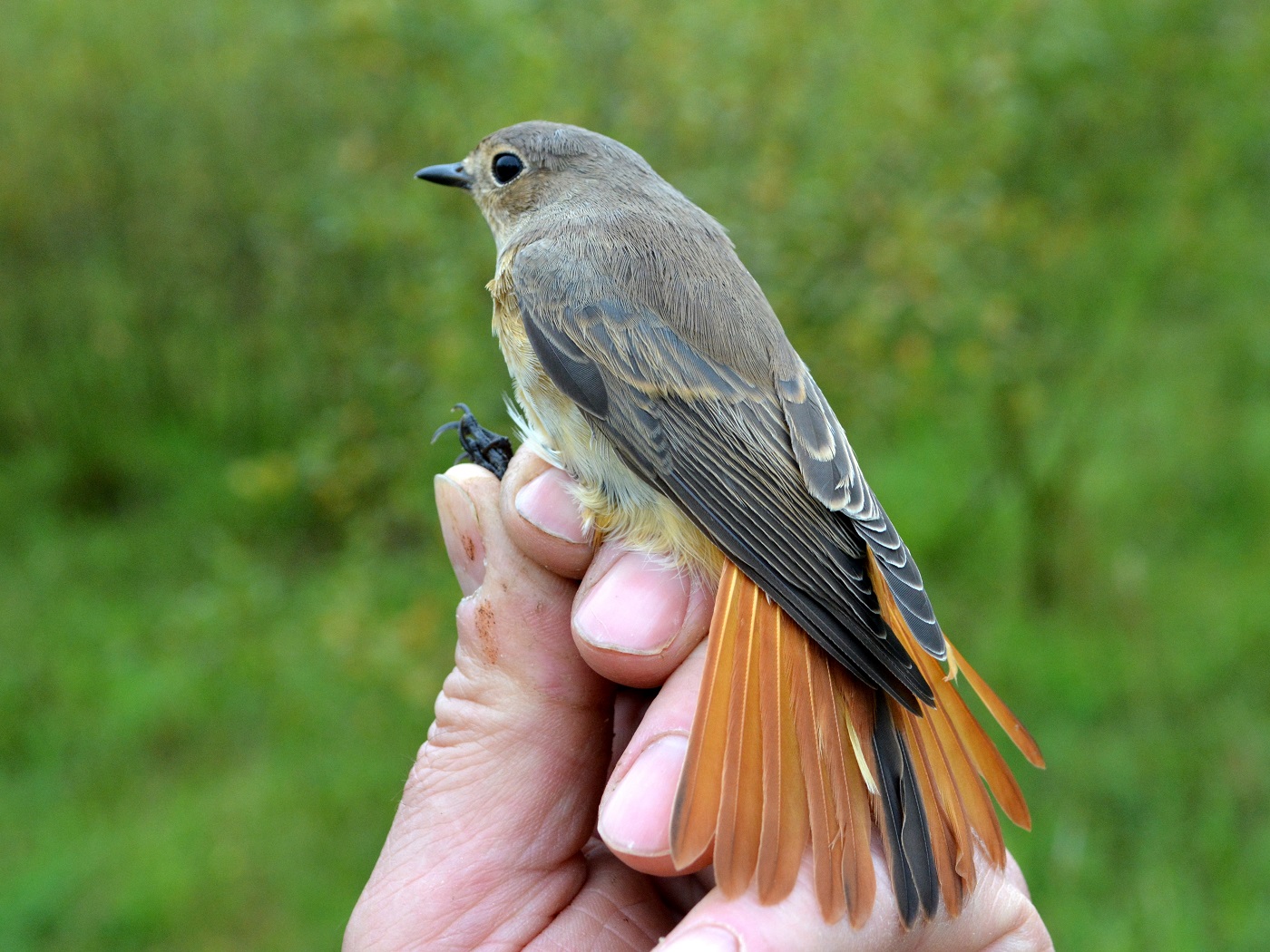
Had I not caught that Chiffchaff I may have packed up by 9:00 but I decided to stick it out and I am glad I did as the second bird that helped 'save the day' was a 1cy female Redstart. This species is a regular but scarce passage migrant at the site and this one was only my second of the autumn and my latest by some margin. Redstarts are usually a bird of late August and early September at this site and my previous latest was caught on 14th September 2017 with all the others recorded between 23rd August and 7th September.


1cy female Redstart


The are not called Redstarts for nothing.
The final total of 30 new birds wasn't too bad but was below the average for the time of year, largely due to the continued lack of Goldcrests. Only 5 Goldcrests were caught compared to 25 on the same date in 2016 and 14 on the same date last year. One minor point of interest about today's Goldcrests is that they were all first-year females, not that anything significant should be read into that as the sex ratios usually even out over time. So while the catching rate was slow from start to finish a couple of interesting birds really did 'save the day' and made staying the course worthwhile.

Ringing totals for 23/09/2018 were: Coal Tit 1; Blue Tit 4; Great Tit 2;  Chiffchaff 6; Blackcap 2; Goldcrest 5; Wren 3; Robin 2; Redstart 1; Chaffinch 1; Linnet 1; Reed Bunting 2.

Monday, 3 September 2018

Back to blogging

It has taken a while, and much longer than I would have liked, but I have finally got round to posting on the blog again. I am not one for mentioning much about my personal life but the ups and downs of life, with all their twists and turns, have taken up a lot of my time over the last few months and pushed the blog to the bottom of the things to do list. Principal amongst the lows was the failing health of my 97 year old mother and the difficulty of trying to meet her wish of staying in her own home. Eventually, caring for her there became impractical and we had to move her in with us until old age and age related heart failure finally got the better of her. That is more detail than I would normally give on such matters and was only one of the factors involved but I thought such a long absence from the blog merited some explanation.

So enough about that stuff, this blog is about birds and other wildlife and I have managed to fit in some ringing despite all the other things that have been going on. Back in late May I completed my Starling RAS project for this year and it was another successful season with a total of 168 different adults encountered (31 new birds and 137 colour-ringed birds re-sighted). Starlings appear to have had a good breeding season and I have ringed more juvenile Starlings in the garden than in any previous year with the total currently standing at 489 (it increased by 3 whilst writing this post). I don't usually catch many juvenile Starlings after the middle of June and, initially, that was the case again this year but numbers visiting the feeders started to pick up again in late July and small numbers have been making regular raids on the fat feeders since then. This has resulted in 85 being ringed since late July compared to only 25 over the same period last year.

Visits to other sites have been less frequent than in other years but I started to rectify that once we got into August. A visit to the site at Billinge on 30th August was the most productive of the recent sessions and is worthy of specific mention. I had been joined by Mark, who was over from America to visit family, and we set 3 nets in the top willows. Conditions were ideal for mist netting, being calm and largely overcast, and while ideal netting conditions don't always coincide with good numbers of migrants this was one day when they did. Blackcaps were the most numerous species and the total of 20 ringed was a new day record for the site. Twenty isn't a big catch by the standards of some sites but it is for the Billinge site which isn't blessed with much in the way of berries. The most unusual captures were a male Redstart, which Mark was especially pleased to see in the hand, and 2 Spotted Flycatchers which were caught just after he had to leave, well you can't win them all. A catch of 9 Willow Warblers was also a decent number for late August. A total of 60 birds were ringed which broke down as follows: Blue Tit 10; Great Tit 5; Chiffchaff 9; Willow Warbler 9; Blackcap 20; Robin 2; Spotted Flycatcher 2; Redstart 1; Goldfinch 1; Yellowhammer 1.


1cy male Redstart


1cy Spotted Flycatcher
I can't promise when the next post will be but hopefully there won't be anything like a gap of 3 months before the next one comes along. In fact it should be fairly soon as I hope to get out on Wednesday and failing that there are some interesting recoveries that I want to share.

Friday, 8 September 2017

Billinge 7th September 2017

The 7th provided a brief interlude in the current run of unsettled weather so got up at daft o'clock to make the most of it. I set the usual 3 nets in the top willows at first light and the following few hours produced a decent catch of 60 new birds and 1 retrap. Ringing highlights were a Redstart which continued the exceptional run of records of that species, 3 Grey Wagtails was a good total as I didn't see more than 6 going south and 4 1cy Coal Tits hinted at the start of some movement in that species.

The Redstart was the 6th to be ringed this autumn and to put that into context only 4 were ringed during the previous three. Interestingly 5 of the 6 have been females.

1cy Coal Tit, noisy individuals and the occasional small group are usually seen or heard heading south on fine days through much of September and well into October.
There was very little movement overhead but there were a few interesting bits a pieces in the form of a group of 3 Song Thrush flying very high to the west, 2 Tree Pipits going south and a Crossbill also going south. There were surprisingly few Meadow Pipits going over and a trickle amounting to no more than about 30 were noted heading SSW. The only other sighting of note was another Redstart that was seen after I had packed up and was carrying my gear back to the car.

Only 2 Willow Warblers were caught and this one hadn't finished its pj moult but it had a weight of 9.4g and enough fat to migrate a good distance.
Ringing totals for 07/09/17 were: Goldcrest 9; Blue Tit 8; Great Tit 2; Coal Tit 4; Chiffchaff 14 (1); Willow Warbler 2; Blackcap 2; Whitethroat 1; Robin 2; Redstart 1; Grey Wagtail 3; Chaffinch 6; Goldfinch 6.

Sunday, 3 September 2017

2nd is better than 1st

The ringing session at Billinge on the 1st was good but the 2nd's proved to be even better. It was similar in many respects but had the added bonus of some infrequently caught species in the form of 2 Redstarts and a Spotted Flycatcher. Both are scarce passage migrants in the area these days and I consider myself lucky if I catch one or two of each over the autumn. The 2 Redstarts brought this autumn's total to 5 which is exceptional as I have never caught more than 2 in previous years and the Spotted Flycatcher was the second of the autumn. Interestingly, the Spotted Flycatcher was caught in the same part of the same net as the previous one and while no more than a coincidence such 'deja vu' type occurrences always stand out and stick in one's mind.

Both Redstarts were 1cy females.

1cy Spotted Flycatcher. Only the 6th to be ringed at the site in the last 4 years.
Once again Goldcrests dominated proceedings with most of the 23 new birds and single retrap being caught in the first couple of hours. The retrap wasn't from the previous day as some might expect and was originally ringed on 13th August when part way through its post-juvenile moult. At this time of year there are frequent movement of Goldcrests through the site and it is rare for any to hang about for more than a day once they start moving.

Chiffchaff was the second most numerous species with 14 new birds and 1 retrap being caught and while numbers were down on those of the 1st it is still a good total for that species. Once again the retrap hadn't been ringed recently and had been ringed as a scruffy juvenile on 9th July this year which gives an indication of how long it takes them to complete their protracted post-juvenile moult.

There were more Robins about than there have been recently and the 5 ringed is a sign they were on the move. The first half of September usually sees quite a few Robins pass through site, more so following a good breeding season, and is largely made up of displaced birds that are looking for somewhere to carve out a winter territory but may also include some genuine migrants.

The weather is looking pretty ropey for the next week so opportunities to get out ringing could be very limited to say the least. Is this going to be a year we don't get an Indian summer ? 

Ringing totals (retraps in brackets) for 02/09/17 were: Goldcrest 23(1); Blue Tit 2(1); Great Tit 6; Chiffchaff 14(1); Willow Warbler 4; Blackcap 4; Spotted Flycatcher 1; Robin 5; Redstart 2; Tree Pipit 1; Chaffinch 4; Goldfinch 4; Reed Bunting 1. A total of 71 new birds and 3 retraps.

Friday, 1 September 2017

Billinge 22nd - 30th August 2017

I have managed to get out nearly every morning since my last post although some of the sessions were affected by fog, delayed and/or curtailed by showers or a strengthening breeze. A total of 200 birds were ringed and another 13 were retrapped over the period which is reasonable number given the mixed weather conditions and the limited number of nets used. There were no major surprises although sylvia warblers were in short supply throughout. Chiffchaffs took over from Willow Warblers as the most numerous warbler species as is usual in late August and all the less frequently caught species were what could be termed the usual suspects.


Species
New
Retrap
Species
New
Retrap
Goldcrest
18
1
Blackbird
2
0
Blue Tit
11
1
Song Thrush
2
0
Great Tit
15
2
Robin
5
0
Coal Tit
2
0
Redstart
3
0
Long-tailed Tit
0
3
Dunnock
1
0
Chiffchaff
54
3
Tree Sparrow
1
0
Willow Warbler
20
1
Grey Wagtail
2
0
Blackcap
8
0
Tree Pipit
9
0
Garden Warbler
0
1
Chaffinch
21
0
Grasshopper Warbler
1
0
Bullfinch
6
0
Reed Warbler
1
0
Greenfinch
3
0
Nuthatch
1
0
Linnet
3
0
Treecreeper
2
0
Goldfinch
5
0
Wren
1
1
Yellowhammer
3
0
Total for the period: 200 new birds and 13 retraps

Ringing highlights and noteworthy sightings were as follows:

22/08/17 - At least 12 Tree Pipits were on the move despite early fog and generally poor visibility but only 1 was ringed.

23/08/17 - This session was also affected by fog, some light drizzle and stayed quite murky once the fog cleared. It went so dark at one point birds went very quiet and some seemed to go to roost. However, this visit produce the first Redstart of the autumn, a 1cy female, amongst a catch of only 15 birds. At least 7 Tree Pipits headed south despite the conditions and 2 of them were caught. As the light drizzle stopped there was an unexpected sighting of a flock of 11 Dunlin flying low over the site and heading NNE, they may have been disorientated in the very murky conditions or simply been forced down by the very low cloud.

25/08/17 - Chiffchaffs really took over from Willow Warblers with ringing totals of 14 and 1 respectively. Another 2 Tree Pipits were ringed from a total of 6 recorded.

27/08/17 - Grey Wagtail passage got going with at least 4 passing over the site and 1 was ringed. Interestingly, similar movements were reported from sites across the country. Another 2 Tree Pipits were ringed from a total of 9 recorded. A juvenile Tree Sparrow was an unusual capture although a few had been recorded flying high over the site on the previous 2 days.


The first Grey Wagtail ringed this autumn
28/08/17 - A 1cy Reed Warbler was well away from its usual habitat and was only the 2nd to be ringed this autumn. This species is a scarce but regular autumn passage migrant at the site and 9 of the previous 13 records have been in the narrow period 23rd to 31st July with the remainder being on widespread dates in August. This session was also noteworthy for being the first of the autumn without a Willow Warbler being ringed or recorded.

1cy Reed Warbler
29/08/17 - A short, rain delayed session produced a Blackbird with an interesting plumage and not much else.


This 1cy male Blackbird is similar to what is sometimes referred to as the 'Stockamsel' variety. Had this bird been seen later in the autumn or during the winter it may have been thought to be of continental origin but there is virtually no chance of that in late August.

Its post-juvenile moult was almost complete.

It had a wing length of 131 mm which is towards the longer end of the range for locally bred birds but is not exceptional by any means.

1cy male Blackbird. A locally bred 'Stockamsel' type.
30/08/17 - Highlights were a Grasshopper Warbler and 2 Redstarts. At least 9 Tree Pipits were recorded 2 of which were caught. A few Grey Wagtails were on the move but only 1 was caught. There was a little flurry of Willow Warblers with 8 being ringed and this was more noteworthy as it followed a total absence of the species on the previous two days and was the only day that they outnumbered Chiffchaffs during the period.


1cy female Redstart 30/08/17

1cy male Redstart 30/08/17
S881488 adult Tree Pipit. This adult had retained 2 old lesser coverts. Apparently it is not uncommon to see this in adult Tree Pipits. There is certainly no doubt about the age of such birds. 

S881488 adult Tree Pipit. The tail feathers were much more rounded than those of the adults shown in my last post.

S881489 1cy Tree Pipit

S881489 1cy Tree Pipit. The 2nd outermost tail feather was missing on the right side of the tail. The shape of the tail is similar to the adult above but the contrast between the light and dark areas on the tail feathers isn't quite as strong. This difference in contrast can be a useful feature when ageing, according to some guides, although it isn't an easy difference to get to grips with and reportedly takes plenty of practice.


S881489 1cy Tree Pipit

Monday, 29 August 2016

Billinge: 25th to 29th August 2016 and a couple of recoveries.

I have managed to get out every morning recently and the results can be seen in the table below. Only 3 nets were deployed each time but there was some chopping and changing between the net rides used each day depending on the wind speed and direction and, just as importantly, the forecast cloud cover.

Retraps in brackets.
Monitoring the movements of Tree Pipits at the site has been the main reason behind these daily visits with counts being as important as the numbers caught. There was a decent movement on the 25th when at least 18 went south; counts for the following days were 5+ (26th), 10 (27th), 5 (28th) and 1 (29th).

The 10 Tree Pipits ringed over the last 5 days brings the total ringed in August to 48.
While the autumn passage of Tree Pipits usually extends from early August to late September, in this area, the bulk of migration takes place in the last 3 weeks of August and generally peaks in the 3rd week of the month. Many people think of Tree Pipits as being a September migrant but most will have left our shores by then.

Willow Warblers continued to outnumber Chiffchaffs during the period as a whole, only just, but that should change once we get into September. Both Chiffchaff and Blackcap have been present in relatively low numbers during August and there is no sign of that changing at present so it will be really interesting to see what happens with them next month.

On the other hand Goldcrests have been caught in higher numbers than usual and the 20 ringed over the last 5 days brings the total for the month to 36 which is more than double last August's total. If that is replicated in September and October then we could be in for another bumper Goldcrest autumn without any influx of birds from the continent.

Male Goldcrest
Goldcrest
Less usual captures over the period included 2 Tree Sparrows 25th, single Spotted Flycatchers 25th & 29th and a Redstart 29th. To put the capture of the 2 Spotted Flycatchers into context a check of the BTO online ringing reports revealed that only 3 were ringed in the whole of the recording area of Lancashire and North Merseyside in 2013 followed by 7 in 2014 and just 3 again in 2015, so a very infrequently ringed bird at a county level.

First year Spotted Flycatcher
First year male Redstart
Recent recoveries included a first year Willow Warbler ringed at Billinge on 6th August that was controlled 8 days later on the south coast at Durlston Country Park in Dorset. This site in Dorset saw some large arrivals of Willow Warblers in early August with the largest fall being on the 5th when 210 were ringed. Details of the ringing totals for Durlston Country Park can be found on the Trektellen website (link here).

JTA193         Willow Warbler
Ringed          06/08/16   Billinge Hill, Merseyside
Controlled    14/08/16   Durlston Country Park, Dorset. 329 km S, duration 8 days.

b

Details were also received of a Siskin that was ringed in the garden in February and caught by a ringer in Drummond, Inverness, Highland in July.

S144547        Siskin
Ringed          25/02/16   near Orrell, Greater Manchester
Controlled    03/07/16   Drummond, Inverness, Highland. 448 km NW, duration 129 days.


Wednesday, 10 September 2014

Spurn Migration Festival 2014

I have just spent a long weekend at Spurn Bird Observatory helping out with the Migration Festival. This is the second year the event has been held and, like last year, my role was to give some of the bird ringing demonstrations. The weather was kind and provided a good selection of drift and passage migrants to the delight of the many people that attended. Guided walks, workshops, optics stands and entertaining and informative talks all helped make it a really good event. On top of that a good pub and a chance to catch up with old friends made it a great weekend. More information on Spurn Bird Observatory and the birds seen over the festival weekend can be found here and here.

Barred Warbler (Sylvia nisoria), a real crowd-pleaser.
Pied Flycatcher (Ficedula hypoleuca), a classic drift migrant at Spurn.
Adult male Redstart (Phoenicurus phoenicurus).
 They don't get much better looking than this.

Adult male Redstart (Phoenicurus phoenicurus), same bird as above.
Mike Dilger, TV presenter and Patron of Spurn Bird Observatory, showed his naturalist's credentials with a really entertaining presentation.
It was not just the birds on show, the warm weather meant there were plenty of insects around like this Common Darter (Sympetrum striolatum). 
Quite a few Reed Buntings (Emberiza schoeniculus) were on the move. The bird on the left had a plumage aberration that gave it very pale sandy wings although the rest of the plumage wasn't much paler than normal. Normal bird on right for comparison.
Another view of the 2 Reed Buntings with wings held open to show the marked difference in the colour of the wings.
Sunset over the Humber from the Crown and Anchor.
Andy Roadhouse enjoys a cigar and a pint outside the Crown and Anchor after a very busy and rewarding weekend.

Sunday, 31 August 2014

'trivialis' pursuits

The weather has continued to put a spanner in the works over the last week with showers and blustery conditions restricting opportunities for ringing to just 3 early morning sessions including one this morning. This has really hampered the monitoring of Tree Pipit movements over Billinge for a second week and crucially when autumn passage normally peaks. On the plus side the showers have grounded some nocturnal migrants as can be seen from the ringing totals below.   

A rain curtailed session on the 27th produced 32 new birds and 1 retrap. There was a noticeable arrival of Robins with many heard ticking before first light and 6 were subsequently ringed. Tree Pipits also featured with 4 ringed from the 13 recorded going south. Goldcrests were more vocal than they have been and may have included birds on the move. Ringing totals were (retraps in brackets) - Robin 6, Chaffinch 7, Willow Warbler 5 (1), Chiffchaff 3, Goldcrest 3, Blackcap 1, Tree Pipit 4, Goldfinch 1, Reed Bunting 1, Yellowhammer 1.

The 28th was a quieter day with only 19 birds ringed. The previous day's Robins had moved on and warblers were few and far between. The only Robin caught was of interest because it was still in full juvenile plumage with no sign of post-juvenile moult so must have come from a very late brood. Tree Pipits continued to move in small numbers with another 6 ringed from a total of 9 recorded going south. Other birds going south were 2 Grey Wagtails and a trickle of Meadow Pipits. Ringing totals were - Tree Pipit 6, Chaffinch 4, Bullfinch 1, Chiffchaff 4, Willow Warbler 2, Blackcap 1, Robin 1.


A very late spotty juvenile Robin (Erithacus rubecula).
This morning (31st) was affected by a few brief light showers but saw a marked increase in Willow Warblers with 13 ringed; the only other grounded migrants of note were 2 Redstarts and a few more Robins. Visible migration was fairly limited but included 7 Grey Wagtails, 3 Tree Pipits, at least 35 Meadow Pipits and a trickle of Swallows. The weather brightened up as the morning progressed but so did the breeze and I finally packed up at 12:30 having ringed 50 birds - Grey Wagtail 2, Tree Pipit 1, Meadow Pipit 10, Willow Warbler 13, Chiffchaff 4, Goldcrest 1, Blackcap 1, Whitethroat 1, Redstart 2, Robin 4, Chaffinch 8, Goldfinch 1, Jay 2.


Grey Wagtail (Motacilla cinerea).

Adult Willow Warbler (Phylloscopus trochilus). A rather pale bird with very little yellow and probably of northern origin.

Robin (Erithacus rubecula). Arrivals of migrant Robins are easily noticed at this site due to the nature of the habitat and limited number of resident birds.

Adult female Redstart (Phoenicurus phoenicurus).
The first of the autumn and the first I have caught locally.

Juvenile Male Redstart (Phoenicurus phoenicurus).
Caught in the same net round as the female above.

Juvenile Male Redstart (Phoenicurus phoenicurus).

Adult Tree Pipit (Anthus trivialis). The only bird caught today but it brought the total ringed during the month to 51. This total would have been unimaginable just a few weeks ago.

Adult Meadow Pipit (Anthus pratensis).
The weather is set to improve next week and it will be interesting to see what impact this has on Tree Pipit movements. If a significant number of birds have delayed their migration due to the unsettled conditions it should become apparent over the next few days. Upsurge in numbers or not I will be sure to let you know in due course.