Showing posts with label abietinus. Show all posts

Friday, 9 November 2018

Collybita, abietinus or tristis: the Chiffchaff conundrum.

Regular readers of the blog may remember that I caught a very interesting looking Chiffchaff back in September (link here). Its largely greyish-green and white livery was very different to the standard olive-green and mustard-yellow of the nominate race (collybita) Chiffchaffs that I normally catch in autumn. I thought it was likely to be a Chiffchaff of the race abietinus (the range of which includes large parts of Scandinavia, parts of eastern Europe and European Russia) but, as I commented in that earlier post, I also thought it had a look about it that potentially gave it more easterly credentials, although the early date (23/09/2018) seemed to make that unlikely.


Luckily I was able to salvage a few small feathers that it dropped in a bird bag and submitted them to Professor Martin Collinson for DNA analysis. I was certain that it would prove to be a very interesting individual whatever the result of the DNA analysis turned out to be:
  1. It would be very interesting if it turned out to be collybita simply because its appearance is so unlike that of collybita.
  2. It would be equally if not more interesting if it proved to be abietinus as very few have been confirmed by DNA in western Europe and also because there had been no easterly winds up to that point in September to help drift a migrant of such origin to the UK (especially the west side of the UK).
  3. It would also be very interesting (if not remarkable) if it was shown to have tristis origins because of the early date, again because there had been no easterly winds up to that point in September and because its abietinus like appearance would point to it being a abietinus x tristis hybrid.
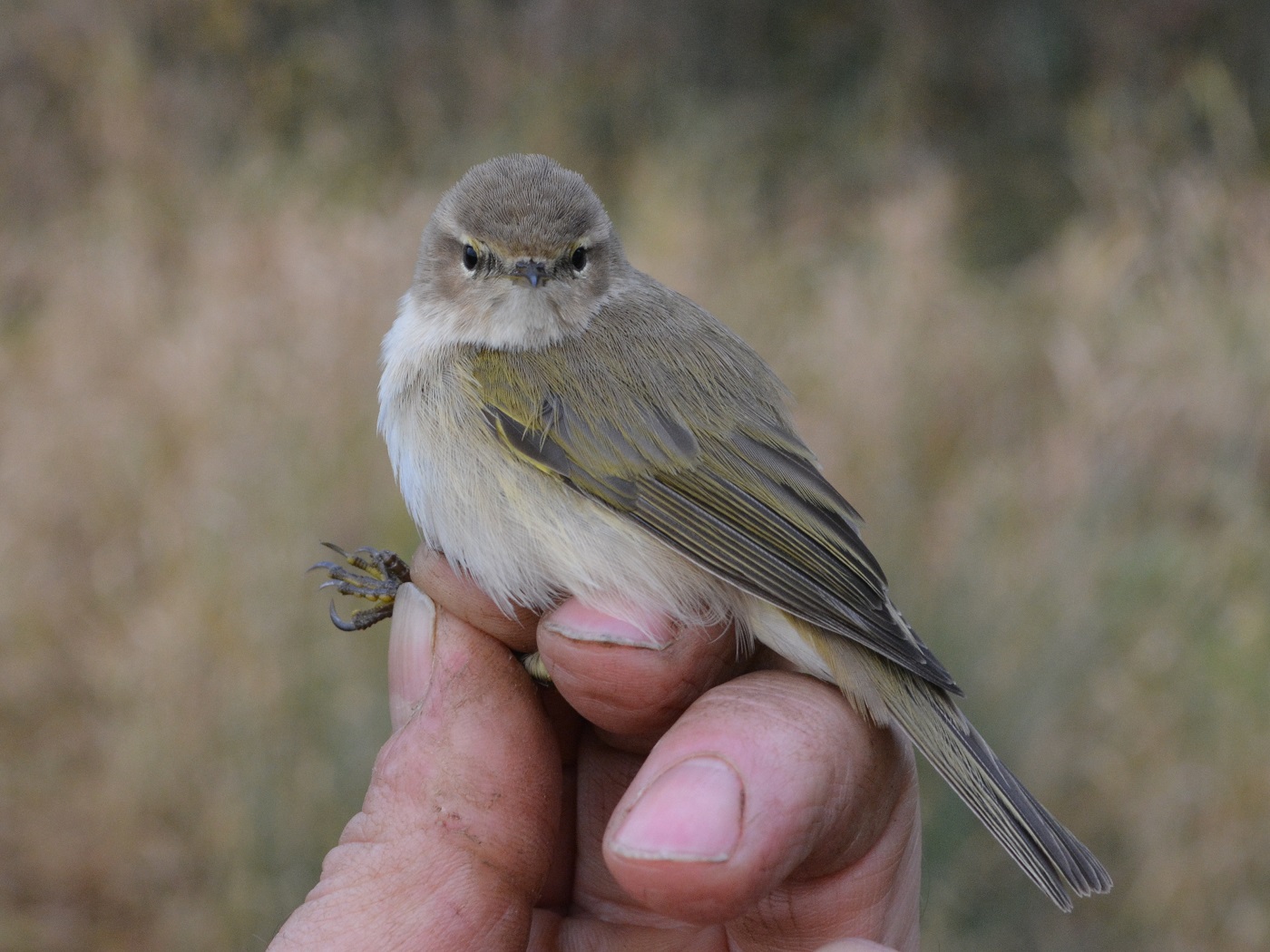
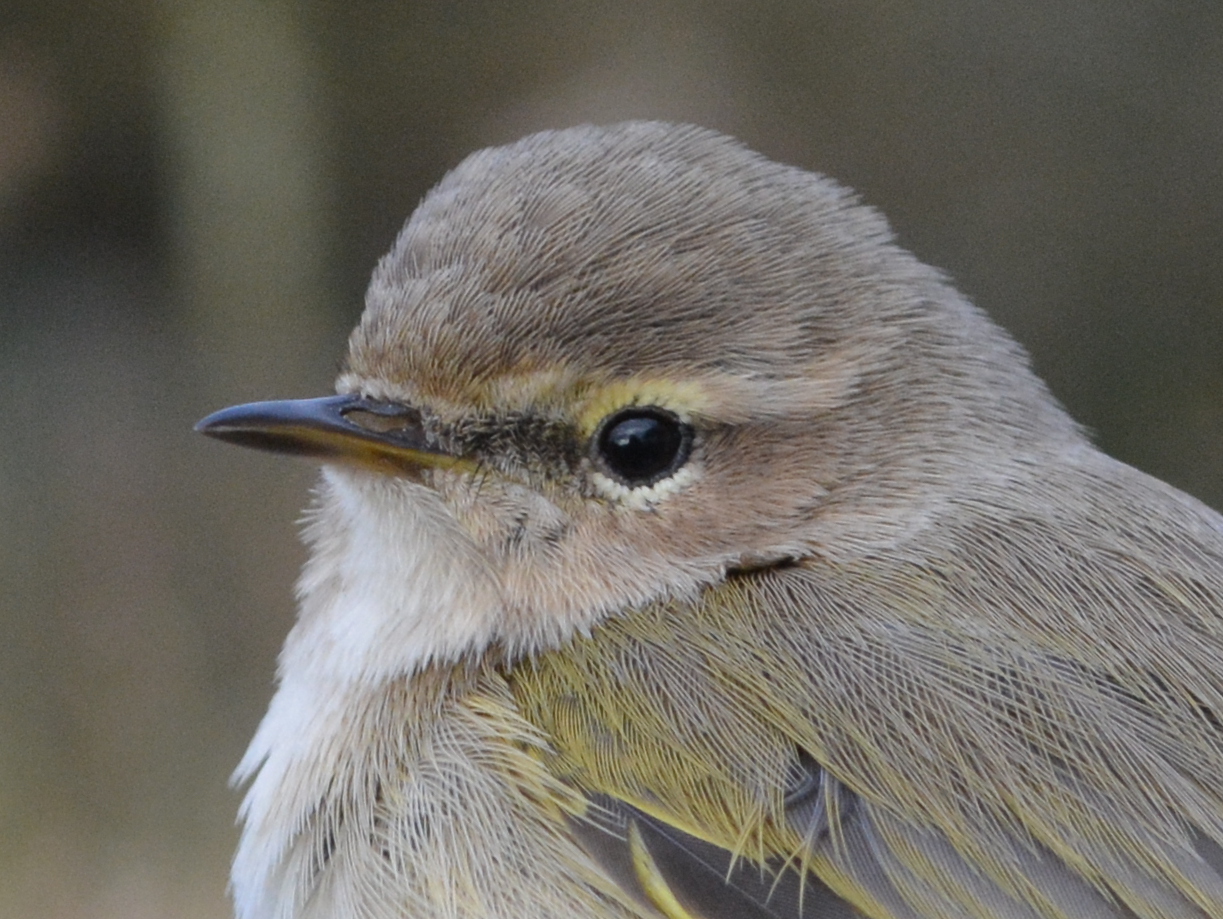
Greyish-green and white Chiffchaff caught at Billinge 23/09/2018.
Unfortunately it was not heard to call so there were no clues there. Its appearance most closely matches the descriptions for abietinus but I also knew the identification of abietinus was not necessarily that straightforward. A genetic study of migrant Chiffchaffs caught in the Netherlands found that all 23 of the birds that were identified by ringers as being abietinus, based on their appearance, turned out to have tristis mtDNA (de Knijff et al.)


The flanks were washed with pale brown similar to a tea or coffee stain on a white cloth.


The belly, breast and throat were largely white. The undertail coverts were similar to the flanks but there was a stronger buff to yellowish-buff suffusion around the vent.


The supercillium had yellow tones above and in front of the eye but was pale brown and much less distinct behind the eye. 
To say the result was eagerly awaited is a bit of an understatement and my interest was heightened after reading a paper on the genetics of Chiffchaffs caught in Britain and Ireland (Collinson et al.that was published in British Birds earlier this year (link here). That paper looked at the genetics of 149 migrant and wintering Chiffchaffs caught during 2009 - 2017. It was interesting to see that only 9 birds in that study were found to have abietinus mtDNA and only one of those 9 was actually identified as abietinus by the ringer with the other 8 being tentatively identified as collybita or at least 'not tristis'. As for timing of autumn occurrences the few abietinus were within the same period that tristis were found with the earliest of either race being a tristis caught on the Isle of May on 28/09/2015. The study also found one Chiffchaff that was submitted as a potential tristis actually had collybita mtDNA, however, its quite dull grey appearance was considered to be unlike any of the Chiffchaff races and it was suggested that it was an aberrantly plumaged collybita.

Well I didn't have to wait too long to get the DNA result and I received an email from Thom Shannon, a PhD student working with Martin Collinson, saying that the mtDNA they recovered was that of a tristis Chiffchaff. Thom also commented that the plumage was a much better fit for an abietinus type and that they were of the opinion that it was a clear abietinus/tristis intergrade. As I said earlier the result was going to be interesting whichever way it went and to my mind the combination of its abietinus type appearance, its tristis mtDNA and the early date is the most intriguing outcome of all. 

For those of you that may not know mtDNA is only inherited through the maternal line so it only tells us that its Mum, Grandma or a direct female relative further back through the generations was a 'pure' tristis Chiffchaff. There is no way of knowing from the mtDNA or the bird's appearance if its genetic make-up is more tristis than abietinus or vice versa. Some may be tempted to think it is more abietinus than tristis because its appearance is a much better fit for abietinus but genetic studies on the breeding grounds have shown that is not necessarily the case (Shipilina et al.; Marova et al.). In those studies some birds with abietinus morphology (appearance) were found to have tristis mtDNA and a predominance of tristis DNA overall.


So the mismatch between the Billinge bird's appearance and its mtDNA points to it being an abietinus/tristis intergrade (hybrid) and one thing we can we can say with some certainty about such intergrades is where they originate. The contact zone (the area where the two races meet and overlap) is a relatively narrow band running from the southern Urals northwards to the White Sea and genetic studies have shown that past and ongoing hybridisation occurs in this area and that a similar mismatch of appearance and mtDNA is not found in other parts of either subspecies breeding range (Marova et al and Shipilina et al). Therefore, it is reasonable to conclude that this particular bird originated in that contact zone and will have travelled around 3250 km to reach Billinge.


Approximate zone of contact between abietinus and tristis (redrawn from Shipilina et al. and Marova et al.) and location of the site where the bird was caught.

There are other aspects to this record that make it particularly interesting with the early date being one of them. The Billinge bird is a week earlier than the earliest tristis identified in genetic study by Collinson et al and if you factor in the westerly location and absence of easterly winds up to that point in September it makes that early date even more exceptional. We will never know when it actually arrived in the UK but it was presumably at least a day or two before the capture date at Billinge, if not longer. In addition, it is a bird that calls into question what we know or think we know about the likelihood of abietinus occurring in western Europe and the UK in particular. I appreciate it is not safe to draw any firm conclusions from just one individual but if abietinus is the regular, if relatively scarce, passage migrant it is generally thought to be then the Billinge bird should have had a much greater chance of being found to have abietinus mtDNA as opposed to the tristis mtDNA that was found.


I am no expert on the subject but I would have thought there are far more 'pure' abietinus in this world (birds with abietinus appearance and abietinus mtDNA) than there are abietinus looking hybrids that have tristis mtDNA, especially when you consider the large range that abietinus occupies west of the overlap zone and the relatively small area of overlap zone itself, where all abietinus x tristis intergrades are thought to originate. It has been suggested, by some who know far more about this subject than me, that many abietinus are so similar to collybita that they probably go unnoticed in western Europe but even if that is the case I would have still thought that should leave enough abietinus that look sufficiently different to be picked out with relative ease, at least in the hand if not in the field. More importantly I would have also thought it more likely that those abietinus that can be identified from their appearance should still outnumber abietinus/tristis intergrades with abietinus morphology, assuming they are the regular and more common passage migrant that presumed wisdom suggests.


As I said earlier it is not safe to draw any conclusions from one individual but the Billinge bird is another record that adds to the uncertainty that surrounds the true status of abietinus as a migrant to the UK. In addition it extends the period when birds of tristis origin can occur and, if nothing else, is simply a very interesting record in its own right as we can be reasonably certain of the region it came from.


References:
Collinson, J.M., Murcia, A., Ladeira, G., Dewars, K., Roberts, F. & Shannon, T. 2018. Siberian and Scandinavian Common Chiffchaffs in Britain and Ireland - a genetic study. British Birds 111: 384-394.

Shipilina, D., Serbyn, M., Ivanitskii, V., Marova, I. &  Backström, N. 2017. Patterns of genetic, phenotypic, and acoustic variation across a chiffchaff (Phylloscopus collybita abietinus/tristis) hybrid zone. Ecology and Evolution 2017; 1–12.


Marova, I.M.,
Shipilina, D., Federov, V., Alekseev, V. & Ivanitskii, V. 2017. Interaction between Common and Siberian Chiffchaff in a contact zone. Ornis Fennica 94: 66-81.

de Knijff, P., van der Spek, V. & Fisher, J. 2012. Genetic identity of grey chiffchaffs trapped in the Netherlands in autumns of 2009 - 2011. Dutch Birding 34: 386-392.


Sunday, 23 September 2018

Two good birds save the day.

The silence that greeted me at dawn this morning did not bode well for a ringing session in the top willows at Billinge and pointed to another poor showing by Goldcrests in particular. In previous autumns, when Goldcrests have passed through in large numbers, they have usually been the first species to call at daybreak and early net rounds nearly always produced the bulk of the birds. This morning the first Goldcrest wasn't heard until well after after sunrise and there wasn't much happening at the nets either.

To say it was quiet and slow going is an understatement and I thought I would end up cutting my losses by packing up early. However, the first Chiffchaff caught was really quite striking and wasn't your typical September green and mustard-yellow 'collybita'.  It was distinctly paler having much greyer tones to the upperparts, was much whiter underneath and the flanks were washed with pale brown and I immediately thought this must be a Scandinavian 'abietinus' Chiffchaff. It was certainly very different to any 'collybita' I have ever seen and I have ringed well over a thousand at Billinge and many more elsewhere.


A very grey and white looking Chiffchaff compared to your typical autumn 'collybita'. It was aged as a first-year from the shape and wear of the tail feathers.
A typical autumn 'collybita' photographed the same day in similar lighting conditions and also aged as a first-year.
The different races of Chiffchaffs present all manner of problems when it comes to identification as shown by the DNA analysis of birds caught in Holland that were identified as 'abietinus' on appearance and proved to be 'tristis' from their DNA. This and other studies have thrown the status of abietinus in western Europe into question and it now appears to be much rarer than its more easterly Siberian (tristis) counterpart. 

There are a couple of other factors that make today's bird even more interesting: one is the date, it is quite early for seeing a dodgy looking Chiffchaff which are usually associated with late autumn or winter; the other is lack of easterly winds so far this autumn which are generally needed to drift birds of such origin to the UK. Had I caught this bird in late October or early November I may have thought it to be a bird with more easterly credentials and possibly from the intergrade zone between abietinus and tristis. It has certainly got some of that look about it.


A collage of both birds. Whatever it is, and potentially proves to be in due course from its DNA, is going to be interesting.
Had I not caught that Chiffchaff I may have packed up by 9:00 but I decided to stick it out and I am glad I did as the second bird that helped 'save the day' was a 1cy female Redstart. This species is a regular but scarce passage migrant at the site and this one was only my second of the autumn and my latest by some margin. Redstarts are usually a bird of late August and early September at this site and my previous latest was caught on 14th September 2017 with all the others recorded between 23rd August and 7th September.


1cy female Redstart


The are not called Redstarts for nothing.
The final total of 30 new birds wasn't too bad but was below the average for the time of year, largely due to the continued lack of Goldcrests. Only 5 Goldcrests were caught compared to 25 on the same date in 2016 and 14 on the same date last year. One minor point of interest about today's Goldcrests is that they were all first-year females, not that anything significant should be read into that as the sex ratios usually even out over time. So while the catching rate was slow from start to finish a couple of interesting birds really did 'save the day' and made staying the course worthwhile.

Ringing totals for 23/09/2018 were: Coal Tit 1; Blue Tit 4; Great Tit 2;  Chiffchaff 6; Blackcap 2; Goldcrest 5; Wren 3; Robin 2; Redstart 1; Chaffinch 1; Linnet 1; Reed Bunting 2.

Thursday, 8 February 2018

Siberian Chiffchaff inside and out ???

Regular readers of the blog may remember that I posted details of a Siberian Chiffchaff (P. c. tristis) caught at Billinge on 17/11/2017 and that I said it may not be the last time you would hear about about it (link here). It was an interesting looking bird and did have a trace of yellow in the supercillium, just above the eye, which 'classic' tristis is not supposed to have but its call was spot on for tristis. Being aware of some of the ongoing debate about the plumage limits of tristis I contacted Martin Collinson to see if he would be willing to undertake DNA analysis of a couple of small body feathers it had dropped, which he kindly agreed to do. I hoped having the birds DNA analysed would confirm its identity and help inform the debate surrounding the appearance of tristis type Chiffchaffs that reach our shores.


I received the results of the DNA analysis last week and it was an unequivocal result for tristis. Unfortunately that isn't quite the slam dunk the average person tends to associate with DNA results these days. The result came from an analysis of the mtDNA (mitochondrial DNA) which is commonly used for confirming the identity of bird species and is usually conclusive. However, mtDNA is only inherited through the female line and doesn't always tell the whole story where subspecies and possible hybridisation are concerned.


mtDNA result for the Billinge bird (lab reference CC243 tristis)
I have done a lot of reading up on the issues surrounding the identification of Siberian Chiffchaff since catching the bird and I think I have got my head around the current state of play, more or less. There is a lot of information and opinion out there on the web but the best 'one stop shop' that gives a thorough account of the issues surrounding the identification of Siberian Chiffchaffs can be found on Alan R. Dean's website (link here). This site gives the most comprehensive and authoritative discussion of the subject that I have come across and provides links to and or references just about everything that is worth reading on the subject if you want to delve even deeper. The text is inevitably lengthy and quite technical so if you are not familiar with terms like allopatry, sympatry, morphotypes, haplotypes and the like then you will find helpful if you brush up on their meaning first. The terms 'fulvescens' and 'riphaeus' are also used for birds of particular plumage types but an explanation of their origin and how they are currently used is given.

At this point it is worth having another look at the bird and, as noted earlier, it has a slight trace of yellow in the supercilium just above the eye. The images also show the fringes of the remiges (flight feathers to you and me) and wing coverts are olive green, and that there is a slight olive cast running into the edges of an otherwise greyish-brown mantle. There is no yellow on the underparts with the belly and lower breast being white. The undertail coverts have a buff wash, stronger towards the vent, while the flanks have more of khaki wash but with a buffish tinge running through. The upper breast had a slight khaki wash which increased in strength towards the sides.


The trace of yellow in the supercillium above the eye was only noticeable on close inspection and couldn't be detected when the bird was held at arms length.


The ear coverts have a distinct rufous tinge which is often considered a hallmark of 'classic' tristis. The crown, nape and upper mantle are an unadulterated greyish-brown.


The rufous tinge to the ear coverts is even stronger in this image.


So what are my thoughts on the Billinge bird now? well I am still happy it is a tristis. It doesn't meet all the plumage criteria for what are termed 'classic' tristis but it only falls down on that trace of yellow in the supercillium and the touches of olive running into the edge of the mantle, both of which wouldn't have been noticeable in the field. It closely matches birds described by Dean as non-classic Siberian Chiffchaffs ('fulvescens') that occur in the allopatric West Siberian plain (link here) but it is also possible, and some may consider just as likely, that it is a 'fulvescens' type bird from the the overlap zone between abietinus and tristis, which runs from the southern Ural Mountains to the Archangelsk region. Either way it had travelled a long way to get to Billinge, around 3,500km in the case of the overlap zone and at least 4,000km if from the West Siberian Plain.

Is it 100% tristis? well that is a different matter altogether and the simple answer I don't know and the only way to find out would be an analysis of the whole genome. The recent research by Shipilina et al involved analysis of whole genome sequence data and has shown that there are varying degrees of genetic admixing in the overlap zone and confirms there is some hybridisation between abietinus and tristis in that area. That study and another by Morova et al also points to genetic mixing being the underlying cause of variation in plumage traits, mixed vocalisations and reaction to each others typical song. Their findings also show that some birds from the overlap zone that looked like 'pure' examples of tristis and abietinus did in fact harbour some genetic material of the other, although this was less frequent and to a much lesser extent in the tristis examples.

The traces of yellow and olive seen in 'fulvescens' type birds from the West Siberian Plain may prove to be a result of there being a touch of abietinus somewhere in their distant ancestry, although that is purely conjecture at this stage. The genetic legacy of historic hybridisation may get diluted to a large degree over time but can be very persistent, as is aptly shown by the small percentage of Neanderthal DNA that can be found in all people of European origin even though Neanderthals became extinct about 40,000 years ago.

Finally, while I can't say it is a 100% thoroughbred tristis I am more than happy it is sufficiently tristis, inside and out, to be classed as one.


Acknowledgements:
Thanks to Martin Collinson and his team for undertaking the mtDNA analysis of the feather sample.

References:
Dean, A.R. 2009.  'Siberian Chiffchaff' Phylloscopus collybita tristis: discussion and photo gallery. http://deanar.org.uk/tristis/tristis.htm  (With updates to 2017, including the significant 'whole genome sequence data' established by Shipilina et al. 2017)

Shipilina, D., Serbyn, M., Ivanitskii, V., Marova, I. &  Backström, N. 2017. Patterns of genetic, phenotypic, and acoustic variation across a chiffchaff (Phylloscopus collybita abietinus/tristis) hybrid zone. Ecology and Evolution 2017; 1–12.

Marova, I., Shipilina, D., Fedorov, V,. Alekseev, V. & Ivanitskii, V. 2017. Interaction between Common and Siberian Chiffchaffin a contact zone.  Ornis Fennica 94: 66–81.