Showing posts with label Siberian Chiffchaff. Show all posts

Thursday, 8 February 2018

Siberian Chiffchaff inside and out ???

Regular readers of the blog may remember that I posted details of a Siberian Chiffchaff (P. c. tristis) caught at Billinge on 17/11/2017 and that I said it may not be the last time you would hear about about it (link here). It was an interesting looking bird and did have a trace of yellow in the supercillium, just above the eye, which 'classic' tristis is not supposed to have but its call was spot on for tristis. Being aware of some of the ongoing debate about the plumage limits of tristis I contacted Martin Collinson to see if he would be willing to undertake DNA analysis of a couple of small body feathers it had dropped, which he kindly agreed to do. I hoped having the birds DNA analysed would confirm its identity and help inform the debate surrounding the appearance of tristis type Chiffchaffs that reach our shores.


I received the results of the DNA analysis last week and it was an unequivocal result for tristis. Unfortunately that isn't quite the slam dunk the average person tends to associate with DNA results these days. The result came from an analysis of the mtDNA (mitochondrial DNA) which is commonly used for confirming the identity of bird species and is usually conclusive. However, mtDNA is only inherited through the female line and doesn't always tell the whole story where subspecies and possible hybridisation are concerned.


mtDNA result for the Billinge bird (lab reference CC243 tristis)
I have done a lot of reading up on the issues surrounding the identification of Siberian Chiffchaff since catching the bird and I think I have got my head around the current state of play, more or less. There is a lot of information and opinion out there on the web but the best 'one stop shop' that gives a thorough account of the issues surrounding the identification of Siberian Chiffchaffs can be found on Alan R. Dean's website (link here). This site gives the most comprehensive and authoritative discussion of the subject that I have come across and provides links to and or references just about everything that is worth reading on the subject if you want to delve even deeper. The text is inevitably lengthy and quite technical so if you are not familiar with terms like allopatry, sympatry, morphotypes, haplotypes and the like then you will find helpful if you brush up on their meaning first. The terms 'fulvescens' and 'riphaeus' are also used for birds of particular plumage types but an explanation of their origin and how they are currently used is given.

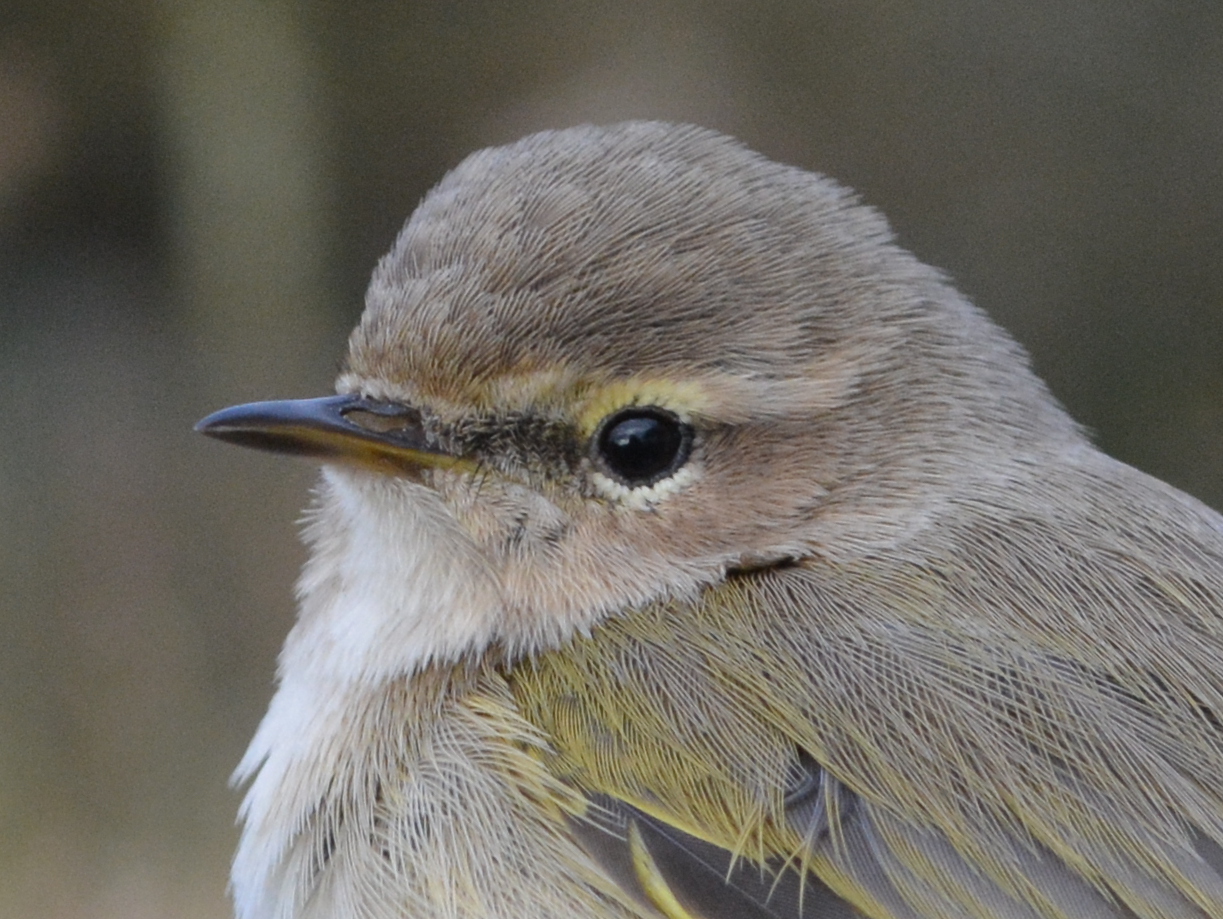
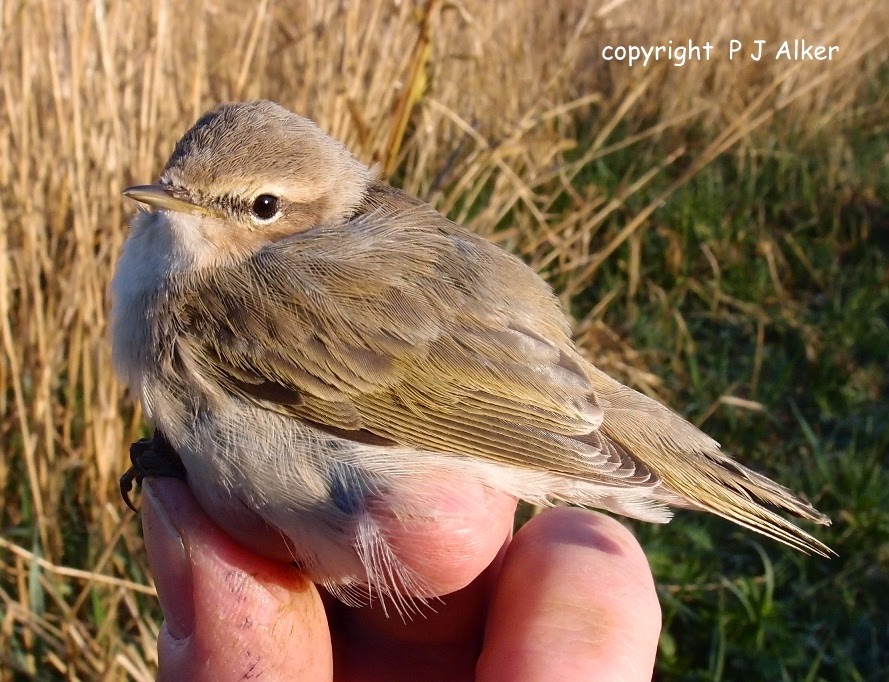
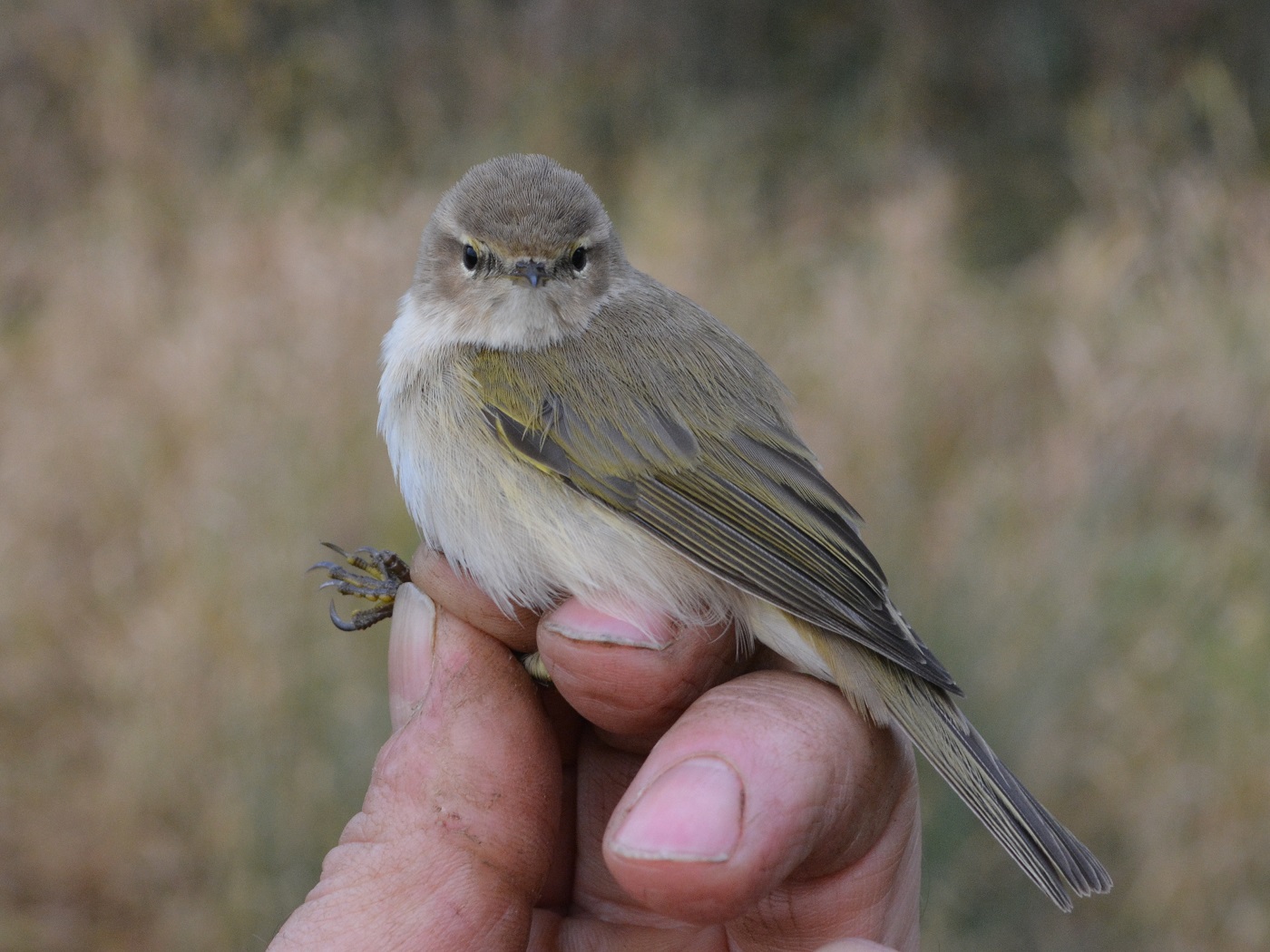
At this point it is worth having another look at the bird and, as noted earlier, it has a slight trace of yellow in the supercilium just above the eye. The images also show the fringes of the remiges (flight feathers to you and me) and wing coverts are olive green, and that there is a slight olive cast running into the edges of an otherwise greyish-brown mantle. There is no yellow on the underparts with the belly and lower breast being white. The undertail coverts have a buff wash, stronger towards the vent, while the flanks have more of khaki wash but with a buffish tinge running through. The upper breast had a slight khaki wash which increased in strength towards the sides.


The trace of yellow in the supercillium above the eye was only noticeable on close inspection and couldn't be detected when the bird was held at arms length.


The ear coverts have a distinct rufous tinge which is often considered a hallmark of 'classic' tristis. The crown, nape and upper mantle are an unadulterated greyish-brown.


The rufous tinge to the ear coverts is even stronger in this image.


So what are my thoughts on the Billinge bird now? well I am still happy it is a tristis. It doesn't meet all the plumage criteria for what are termed 'classic' tristis but it only falls down on that trace of yellow in the supercillium and the touches of olive running into the edge of the mantle, both of which wouldn't have been noticeable in the field. It closely matches birds described by Dean as non-classic Siberian Chiffchaffs ('fulvescens') that occur in the allopatric West Siberian plain (link here) but it is also possible, and some may consider just as likely, that it is a 'fulvescens' type bird from the the overlap zone between abietinus and tristis, which runs from the southern Ural Mountains to the Archangelsk region. Either way it had travelled a long way to get to Billinge, around 3,500km in the case of the overlap zone and at least 4,000km if from the West Siberian Plain.

Is it 100% tristis? well that is a different matter altogether and the simple answer I don't know and the only way to find out would be an analysis of the whole genome. The recent research by Shipilina et al involved analysis of whole genome sequence data and has shown that there are varying degrees of genetic admixing in the overlap zone and confirms there is some hybridisation between abietinus and tristis in that area. That study and another by Morova et al also points to genetic mixing being the underlying cause of variation in plumage traits, mixed vocalisations and reaction to each others typical song. Their findings also show that some birds from the overlap zone that looked like 'pure' examples of tristis and abietinus did in fact harbour some genetic material of the other, although this was less frequent and to a much lesser extent in the tristis examples.

The traces of yellow and olive seen in 'fulvescens' type birds from the West Siberian Plain may prove to be a result of there being a touch of abietinus somewhere in their distant ancestry, although that is purely conjecture at this stage. The genetic legacy of historic hybridisation may get diluted to a large degree over time but can be very persistent, as is aptly shown by the small percentage of Neanderthal DNA that can be found in all people of European origin even though Neanderthals became extinct about 40,000 years ago.

Finally, while I can't say it is a 100% thoroughbred tristis I am more than happy it is sufficiently tristis, inside and out, to be classed as one.


Acknowledgements:
Thanks to Martin Collinson and his team for undertaking the mtDNA analysis of the feather sample.

References:
Dean, A.R. 2009.  'Siberian Chiffchaff' Phylloscopus collybita tristis: discussion and photo gallery. http://deanar.org.uk/tristis/tristis.htm  (With updates to 2017, including the significant 'whole genome sequence data' established by Shipilina et al. 2017)

Shipilina, D., Serbyn, M., Ivanitskii, V., Marova, I. &  Backström, N. 2017. Patterns of genetic, phenotypic, and acoustic variation across a chiffchaff (Phylloscopus collybita abietinus/tristis) hybrid zone. Ecology and Evolution 2017; 1–12.

Marova, I., Shipilina, D., Fedorov, V,. Alekseev, V. & Ivanitskii, V. 2017. Interaction between Common and Siberian Chiffchaffin a contact zone.  Ornis Fennica 94: 66–81.


Friday, 17 November 2017

Siberian Chiffchaff

This was a very nice surprise this morning as it is a bird I thought was likely to stay on my 'Billinge possibles' come 'wish list'. The site is looking quite bleak now that most of the trees and bushes have lost their leaves and being on a hill it does not have the sort of micro climate that attracts and holds late autumn and winter warblers. However, it is a great site for migrants and this Siberian Chiffchaff ('tristis') is presumably still on route to a nice warm sewage works or some wetland scrub on lower ground.


I am not going to go through all the plumage criteria as the images speak for themselves and there is plenty of information out there on the web, but it ticks all the boxes with one teeny weeny exception. The one thing it has that 'tristis' is not supposed to have is a hint of yellow in the supercillium immediately above the eye but then the full plumage limits of 'tristis' have yet to be determined so it isn't necessarily a problem. However, if a clincher was needed it came when it conveniently called, once in the hand and several times after release, with the call being a monosyllabic 'peep', a bit like a high pitched Bullfinch, and perfectly fitting the diagnostic call of 'tristis'.

Given that hint of yellow in the supercillium (not that I think it would have been noticed in the field) and as the plumage limits of 'tristis' are not fully understood I retained a couple of small feathers that the bird dropped. Hopefully, they will allow the bird's identity to be confirmed from their DNA so this may not be the last you here about this particular Chiffchaff.

Ringing totals for 17/11/17 were: Goldcrest 1; Siberian Chiffchaff 1; Blackbird 1; Redwing 11; Chaffinch 1.

Tuesday, 15 April 2014

Surprise 'Sibe'

I was joined by Wayne for a Redpoll ringing session at the baited site near Scotman's Flash this morning or at least that was plan. We erected 2 nets near the feeders and another net further away with an MP3 lure playing redpoll song. The idea of the set-up being that we would either catch birds coming to the feeders and or attract any others passing over to the lure and with a bit of luck both. The feeders had clearly been well used since I had last topped them up so we were optimistic about our chances of catching a few birds although the current fine spell of weather could have caused them to disperse or move on.

We heard the first Redpolls before we had finished erecting the nets but it was only a couple of small groups. There didn't seem to be that many birds about and the initial 2 rounds of the nets only produced 5 new Lesser Redpolls. Similarly, there seemed to be very little in the way of newly arrived migrants and literally nothing on passage overhead; no pipts, finches or wagtails of any description. A few Sand Martins were seen along with the odd Swallow but they didn't appear to be going in any particular direction in a hurry so may have been local breeders.

Quite a few Lesser Redpolls were attracted into the net by the MP3 lure and may just have been intercepted on their way to the feeders but interestingly we only caught unringed birds in this net whereas birds caught in the nets by the feeders were close to a 50:50 split of retraps and new birds. It may be that there were a few Redpolls on passage with some being attracted to the lure but if there were they must have been passing over a considerable height.

On approaching the net with the lure at about 07:30 we could see we had caught a couple of birds. One was obviously a Lesser Redpoll but the other was totally unexpected and a complete surprise.


What have we here then.
OK I have strung this out for long enough, it was a Siberian Chiffchaff as you may have guessed from the post title and a proper one at that. Proper in that it that it was the classic grey-brown and white of a 'tristis' without a hint of yellow and what little olive green there was being confined to the fringes of the primaries and tail feathers. Also it was just finishing its moult as some of the body feathers were still growing and partially 'in pin'. This late moult is also characteristic of Siberian Chiffchaffs from what I have read.


Siberian Chiffchaff (Phylloscopus collybita tristis)
Separating Chiffchaff races is not easy and there is a degree of overlap between tristis and abietinus in particular. A quick search on the Internet will find loads of articles on the subject some of which are much more helpful than others but beware some of the photographs and descriptions may leave you even more confused. Anyway in the absence of DNA confirmation I am as happy as anyone can be that this is a 'classic' Siberian Chiffchaff.

Ringing totals for the morning with retraps in brackets:
Lesser Redpoll 15 (6)
Willow Tit 1 (1)
Chiffchaff (tristis) 1
Robin 1
Reed Bunting (1)
Total 18 (8)