Showing posts with label Reed Warbler. Show all posts

Friday, 1 September 2017

Billinge 22nd - 30th August 2017

I have managed to get out nearly every morning since my last post although some of the sessions were affected by fog, delayed and/or curtailed by showers or a strengthening breeze. A total of 200 birds were ringed and another 13 were retrapped over the period which is reasonable number given the mixed weather conditions and the limited number of nets used. There were no major surprises although sylvia warblers were in short supply throughout. Chiffchaffs took over from Willow Warblers as the most numerous warbler species as is usual in late August and all the less frequently caught species were what could be termed the usual suspects.


Species
New
Retrap
Species
New
Retrap
Goldcrest
18
1
Blackbird
2
0
Blue Tit
11
1
Song Thrush
2
0
Great Tit
15
2
Robin
5
0
Coal Tit
2
0
Redstart
3
0
Long-tailed Tit
0
3
Dunnock
1
0
Chiffchaff
54
3
Tree Sparrow
1
0
Willow Warbler
20
1
Grey Wagtail
2
0
Blackcap
8
0
Tree Pipit
9
0
Garden Warbler
0
1
Chaffinch
21
0
Grasshopper Warbler
1
0
Bullfinch
6
0
Reed Warbler
1
0
Greenfinch
3
0
Nuthatch
1
0
Linnet
3
0
Treecreeper
2
0
Goldfinch
5
0
Wren
1
1
Yellowhammer
3
0
Total for the period: 200 new birds and 13 retraps

Ringing highlights and noteworthy sightings were as follows:

22/08/17 - At least 12 Tree Pipits were on the move despite early fog and generally poor visibility but only 1 was ringed.

23/08/17 - This session was also affected by fog, some light drizzle and stayed quite murky once the fog cleared. It went so dark at one point birds went very quiet and some seemed to go to roost. However, this visit produce the first Redstart of the autumn, a 1cy female, amongst a catch of only 15 birds. At least 7 Tree Pipits headed south despite the conditions and 2 of them were caught. As the light drizzle stopped there was an unexpected sighting of a flock of 11 Dunlin flying low over the site and heading NNE, they may have been disorientated in the very murky conditions or simply been forced down by the very low cloud.

25/08/17 - Chiffchaffs really took over from Willow Warblers with ringing totals of 14 and 1 respectively. Another 2 Tree Pipits were ringed from a total of 6 recorded.

27/08/17 - Grey Wagtail passage got going with at least 4 passing over the site and 1 was ringed. Interestingly, similar movements were reported from sites across the country. Another 2 Tree Pipits were ringed from a total of 9 recorded. A juvenile Tree Sparrow was an unusual capture although a few had been recorded flying high over the site on the previous 2 days.


The first Grey Wagtail ringed this autumn
28/08/17 - A 1cy Reed Warbler was well away from its usual habitat and was only the 2nd to be ringed this autumn. This species is a scarce but regular autumn passage migrant at the site and 9 of the previous 13 records have been in the narrow period 23rd to 31st July with the remainder being on widespread dates in August. This session was also noteworthy for being the first of the autumn without a Willow Warbler being ringed or recorded.

1cy Reed Warbler
29/08/17 - A short, rain delayed session produced a Blackbird with an interesting plumage and not much else.


This 1cy male Blackbird is similar to what is sometimes referred to as the 'Stockamsel' variety. Had this bird been seen later in the autumn or during the winter it may have been thought to be of continental origin but there is virtually no chance of that in late August.

Its post-juvenile moult was almost complete.

It had a wing length of 131 mm which is towards the longer end of the range for locally bred birds but is not exceptional by any means.

1cy male Blackbird. A locally bred 'Stockamsel' type.
30/08/17 - Highlights were a Grasshopper Warbler and 2 Redstarts. At least 9 Tree Pipits were recorded 2 of which were caught. A few Grey Wagtails were on the move but only 1 was caught. There was a little flurry of Willow Warblers with 8 being ringed and this was more noteworthy as it followed a total absence of the species on the previous two days and was the only day that they outnumbered Chiffchaffs during the period.


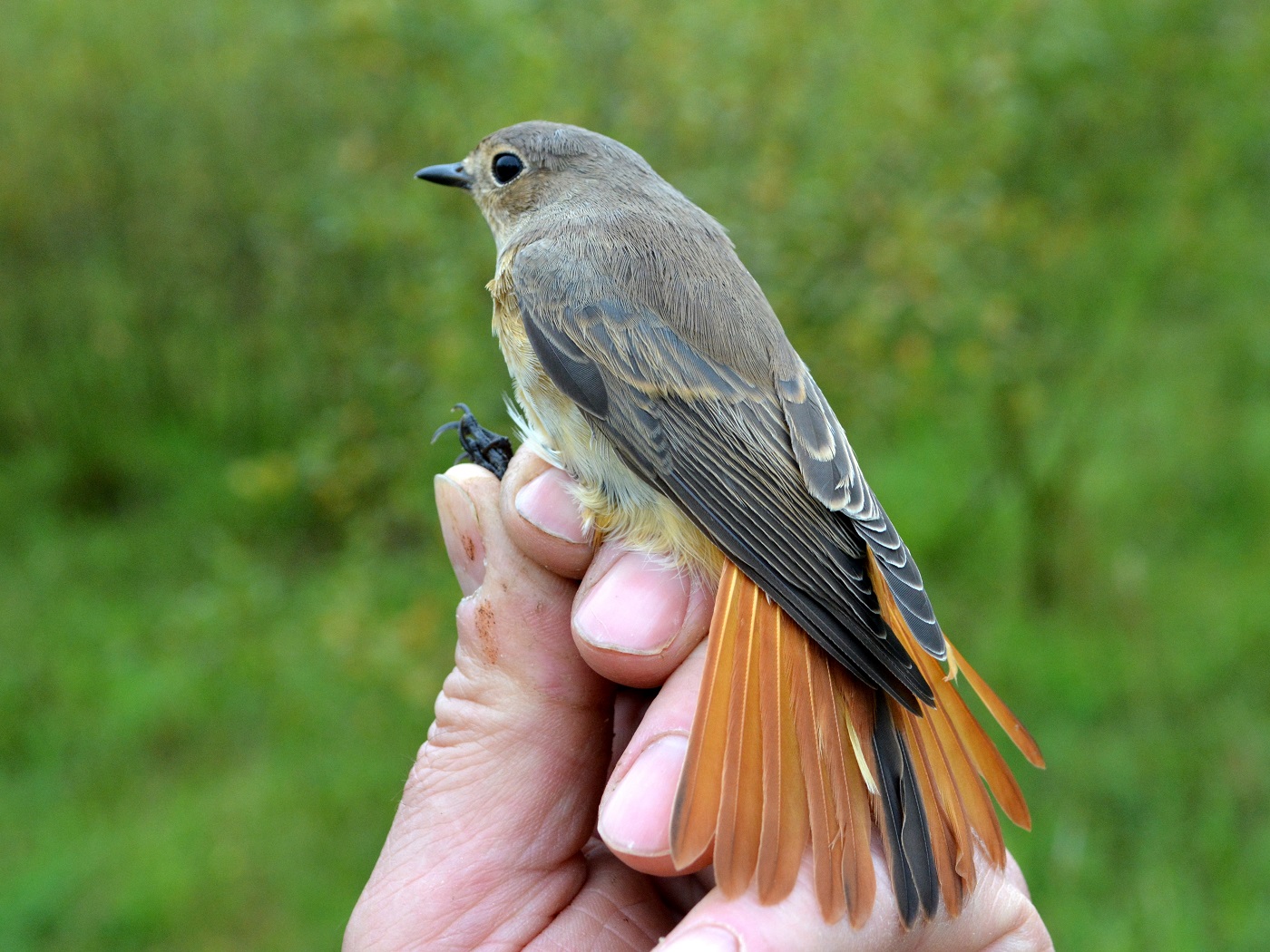
1cy female Redstart 30/08/17

1cy male Redstart 30/08/17
S881488 adult Tree Pipit. This adult had retained 2 old lesser coverts. Apparently it is not uncommon to see this in adult Tree Pipits. There is certainly no doubt about the age of such birds. 

S881488 adult Tree Pipit. The tail feathers were much more rounded than those of the adults shown in my last post.

S881489 1cy Tree Pipit

S881489 1cy Tree Pipit. The 2nd outermost tail feather was missing on the right side of the tail. The shape of the tail is similar to the adult above but the contrast between the light and dark areas on the tail feathers isn't quite as strong. This difference in contrast can be a useful feature when ageing, according to some guides, although it isn't an easy difference to get to grips with and reportedly takes plenty of practice.


S881489 1cy Tree Pipit

Sunday, 21 August 2016

Billinge: 15th to 18th August 2016

Four similar sessions at Billinge on consecutive mornings produced smaller catches than of late. The number of Willow Warblers moving through the site has dropped markedly compared to the highs of last week and was largely responsible for the lower totals.


Willow Warblers - adult left and first year right. Adults generally have whiter bellies than first year birds but ageing this species also involves checking the wear and shape of the tail feathers.
The main target species was Tree Pipit and although 15 were ringed over the four mornings this was less than expected. The passage of this species usually peaks at the site in mid August but has turned out to be weaker than in previous years so far. It remains to be seen how things will turn out and hopefully there will be some good movements to come.


Tree Pipit
Robin is a species that doesn't get mentioned in this blog very often but one ringed on the 15th and another 3 on the 17th hinted at the dispersal and passage that will be a feature of September. The site doesn't hold many breeding pairs or wintering individuals, especially in the vicinity of the net rides, so the majority of birds caught are dispersing or on passage.

Less frequently caught species included a Nuthatch (the 2nd of the year), a Willow Tit (the 5th individual of the year but only the 2nd juvenile of the autumn) and a Reed Warbler (the 5th of the autumn with the previous 4 being in late July).


First year Willow Tit.

A view of the underside of the Willow Tit's tail and included for those interested in separating Willow Tit and Marsh Tit in the hand. It is all to do with the relative distances between the tips of the tail feathers and distance between the tip of the longest and shortest tail feather in particular. Willow Tits usually have more rounded corners to the tail and this results in more of the tips of the tail feathers being visible on the underside of the closed tail. This particular Willow Tit had a tail that was closer in appearance to that usually illustrated for Marsh Tit and demonstrates why separating these two species can be tricky for those who rarely handle them as they are more likely to consider such features.


First year Reed Warbler
Last but not least 2 Wood Pigeon nestlings were ringed on the 17th with the nest being noteworthy for being very low down in a hawthorn at just over a metre off the ground. A similarly low nest was found in the same area at this time last year and it is tempting to conclude that the same pair may have been involved in each case.

Combined ringing totals (retraps in brackets) for 15th to 18th August 2016 were: Woodpigeon 2 pulli; Goldcrest 2; Blue Tit 4 (1); Great Tit 3; Coal Tit 2; Willow Tit 1; Long-tailed Tit 3 (3); Chiffchaff 6 (1); Willow Warbler 29; Blackcap 3; Reed Warbler 1; Nuthatch 1; Wren 1; Robin 4; Dunnock 1; Tree Pipit 15; Chaffinch 8; Linnet 9; Yellowhammer 1; Reed Bunting 2. Total 99 new birds and 6 retraps.

Monday, 1 August 2016

Late July: a quick update.

I managed to get out to Billinge a few times during the period 24th to 31st July but some of the sessions were weather restricted. The generally unsettled conditions with bands of showers and spells of rain also had an impact on the number of birds moving through the site on some days so the combined total of 140 new birds and 16 retraps was quite good, all things considered. 

The main target species was Willow Warbler with a total of 45 ringed during the period. This brings the number of Willow Warblers ringed in July to 105 with 101 of those having been ringed in the last 2 weeks. This is a slightly better total than last year, when 84 were ringed in July, but the increase has been achieved through extra effort rather than there being more birds around. I am still of the opinion that Willow Warblers have had a relatively poor breeding season, locally at least.

Willow Warbler migration is getting into full swing.
 A late evening visit on the 25th, to check if any Swallows were roosting, revealed that only 30 or so were gathering to roost. These were harassed a few times by a young male Sparrowhawk and this caused them to settle in a different area of the willows but not before 18 had been caught and ringed.

Juvenile Swallow
Adult Swallow
Acros continued to put in an appearance now and again with another Sedge Warbler ringed on the 28th followed by single Reed Warblers on the 30th and 31st; all were young birds. 

Sedge Warbler
Reed Warbler
Bullfinches are starting to take advantage of the Knapweed and other meadow plants that are going to seed and this resulted in 4 juveniles and 3 adult males being ringed.

Male Bullfinch
Tits continued to be very thin on the ground, to say the least, but Long-tailed Tits finally put in an appearance with a party of 3 seen on the 28th one of which, a juvenile, was caught and ringed.

Combined totals (retraps in brackets) for the period 24th to 31st July were: Swallow 18; Chiffchaff 19 (3); Willow Warbler 45 (4); Blackcap 13 (5); Whitethroat 5 (2); Reed Warbler 2; Sedge Warbler 1; Goldcrest 4 (1); Blackbird 1; Long-tailed Tit 1; Blue Tit 4; Great Tit 4; Coal Tit 1; Chaffinch 4; Goldfinch 8; Linnet 2; Bullfinch 7; Reed Bunting 1 (1).

I don't see many dragonflies at the site as the nearest pond is some distance away but this Brown Hawker (Aeshna grandis) found its way into one of the mist-nets. 
Brown Hawker (Aeshna grandis)


Saturday, 23 July 2016

Acros on cue.

I wasn't going to go out this morning but an ideal weather forecast and the likelihood of more warblers being on the move was just too tempting to pass up. We are at a time when more juvenile warblers will be dispersing from their natal areas and some of the early migrating species will be starting to head south in earnest, so I decided to go up to Billinge again. As I was driving towards the site I could see it was shrouded in fog, which hadn't been forecast, so I just had to hope it would lift and burn off quite quickly.

I arrived at the site just after 06:00, with the fog already starting to thin and lift, and I was greeted by a reeling Grasshopper Warbler. I don't think they have bred on site this year although one had been reeling in the spring in a different part of the site but that bird was only heard on one day for certain. Wherever it had come from it was the first record for the autumn and a good start to the morning.

Further promise of a good session came while I was putting up the nets with a few phylloscopus warblers flitting around and young Willow Warbler and Blackcap trying out their voices. I set the usual 3 nets in quick order and on going back to the first net I found it had already caught 7 Willow Warblers and a Chiffchaff, all of which were unringed.

It always feels like autumn migration has got going properly when you catch a species that doesn't breed at the site or even close by and is out of its usual habitat. Well that happened a few rounds in when a 1CY Reed Warbler turned up in a net and was quickly followed by an adult in the next net round. The nearest breeding site is a few kilometers away and although Reed Warblers can happily feed in willows it is far more unusual when those willows are at a dry site and near the top of a hill. I have only caught 6 Reed Warblers at the site in the previous 2 years but interestingly 5 of those were caught in the last week of July with the other being at the end of August.


1CY Reed Warbler. 
Adult Reed Warbler.

The dry willow scrub habitat at the ringing site with the farmland in the distance giving an idea of its elevation.
Two Reed Warblers had already made it a very interesting session but then I caught an adult Sedge Warbler and a little while later a juvenile found its way into a net. I obviously don't catch many Sedge Warblers either but these two are within the range of the 10 previous autumn records which run from 22nd July to 22nd August. Interestingly, the first Sedge Warbler was caught on 22nd July in both 2014 and 2015 so the two today were very much on cue.


Adult Sedge Warbler.
1CY Sedge Warbler
While the Reed and Sedge Warblers were the icing on the cake the cake wasn't bad either as can be seen in the totals below. The turnover of  Willow Warblers and Blackcaps has been greater than expected with 62 Willow Warblers and 50 Blackcaps ringed at the site in just the last 7 days. Once again it was a relatively titless session with Long-tailed Tits continuing to be absent.

Ringing totals (retraps in brackets) for 23/07/16 were: Sedge Warbler 2; Reed Warbler 2; Blackcap 15 (1); Willow Warbler 15 (1); Chiffchaff 7 (1); Wren 1; Blue Tit 1; Great Tit 2; Chaffinch 2; Goldfinch 17; Lesser Redpoll 2; Reed Bunting 1.


Juvenile Lesser Redpoll. The two juveniles ringed today add to the evidence of successful breeding at the site.


Sunday, 30 August 2015

Billinge 30/08/15

This morning's weather was perfect for ringing, flat calm with a thin veil of broken high cloud, and with August coming to a close it was perhaps the last chance for a good catch of Tree Pipits. I had 3 nets set up shortly after first light and the morning got off to a reasonable start with 6 Swallows that were caught as they exited their roost in the willows. There hasn't been a big Swallow roost this year but small numbers of around 20 or 30 have roosted at the site since early July.


Juvenile Swallow and a pale one at that. This bird lacks the usual rusty coloured throat and forehead

This juvenile Swallow has the more usual rusty coloured throat and forehead. It is also a younger bird and still has prominent gape flanges.
There was little in the way of visible migration but 12+ Tree Pipits were recorded and more than made up for the lack of other birds on the move. Six of these Tree Pipits were caught bringing the total ringed this autumn to 55 which is only 1 short of the total ringed last year. The number of Tree Pipits moving will fall rapidly over the next 2 or 3 weeks but there is still a chance I will catch a few more yet. I hadn't been sure if the number of Tree Pipits ringed and recorded last year was due to an exceptional set of circumstances (good breeding season plus prevailing weather) as it was the first year I had ringed at the site. However, the similar numbers ringed and recorded this year show that it is a regular occurrence and confirm that the site is one of the best for the species in the whole of the Northwest, if not the best. Other birds moving south during the morning were 25+ Siskins, 3 Grey Wagtails and 1 Tree Sparrow.


The first of the six Tree Pipits ringed this morning and the 50th of the autumn.
While there didn't seem to be much of anything about in the bushes a few birds filtered through resulting in a fairly steady catching rate throughout the morning. It became clear that the majority of Willow Warblers have now migrated as only 2 were caught while the number of Chiffchaffs showed an increase as is typical at this time of year. A Reed Warbler was the most unusual capture being well away from the nearest wetland habitat and is only the 3rd to be caught this autumn. The final total of 42 new birds and 2 retraps was really quite good all things considered.


Reed Warbler
Ringing totals (retraps in brackets) for 30th August 2015 were: Tree Pipit 6; Reed Warbler 1; Whitethroat 2; Blackcap 6; Chiffchaff 11 (1); Willow Warbler 2; Long-tailed Tit 1; Blue Tit 1; Chaffinch 1; Greenfinch 1; Goldfinch 1; Lesser Redpoll 1; Yellowhammer 1; Reed Bunting 1 (1). 

Saturday, 26 July 2014

24th to 26th July

The weather has been favourable for ringing over the past few days and the fine conditions with light winds at either end of the day have helped produce some very good catches. I have managed to fit in 2 evening and 2 morning sessions over the past 3 days and was tempted to put in that amount of effort because of the good weather and number of birds that have been about.

There appears to have been a bit of an influx of Willow Warblers which has supplemented the locally bred birds and resulted in a good number being caught. This influx of Willow Warblers has coincided with arrivals on Bardsey Island over the same period and suggests there has been a large scale movement down the west coast. Willow Warblers have declined markedly in recent years and have been outnumbered by Chiffchaffs in the ringing totals for quite a few years now so it is good to see them show some signs of a resurgence. Evidence of migration also came in the form of a Reed Warbler which was well away from the nearest breeding habitat along with 2 adult Garden Warblers which were similarly on the move.


A freshly moulted adult Willow Warbler (left) and juvenile right showing the difference in the colour of the underparts. Adults are generally much whiter below whereas juveniles have extensive lemon yellow underparts.

Juvenile Reed Warbler 26/07/14

Adult Garden Warbler 26/07/14. 

Garden Warblers don't breed at any of my ringing sites and only occur as a
scarce and less than annual passage migrant.
Goldfinch family parties are starting to merge into flocks and although most of the birds caught have been juveniles there have been a few adults which I have photographed to add to my sexing guide update or may even result in a new post. Being able to confirm the sex of the birds from the presence of a good brood patch or the shape of the cloaca has been really useful; I now have some photographs that show how much overlap there is in the plumage features of the sexes especially with regard to the extent of the red on the face.


Female left and male right. The slight difference in colour cast was caused by the lighting conditions with the female caught on a dull evening and the male caught in bright morning sunshine. The female clearly has an extensive red face mask that extends well behind the eye and bit further than that of the male. There is not a lot of difference in the lesser coverts although the fringes of the male's lesser coverts were golden (brownish-yellow) and the fringes of the female's were brown and a bit more extensive. In terms of plumage features the nasal hairs stand out as being the most different with the female's being white and the males being black.
There were roughly between 100 and 300 Swallows using the roost but some birds only dropped in late and from some height making numbers hard to gauge. These late arrivals were presumably birds that had been on the move and were looking for a roost to join.  At the other end of the scale in terms of numbers I am still catching the odd wandering juvenile Willow Tit with another ringed this morning. All in all it has been a very interesting and productive few days especially when you consider that I only used 2 nets for each session.

Ringing Totals 24th to 26th July (retraps in brackets).
Willow Warbler 32 (3)
Chiffchaff 10 (1)
Blackcap 10
Whitethroat 5
Garden Warbler 2
Reed Warbler 1
Goldcrest 3
Goldfinch 24
Linnet 8 (1)
Chaffinch 5
Reed Bunting 2
Yellowhammer 1
Swallow 41
Blackbird 3
Long-tailed Tit 2
Great Tit 1
Willow Tit 1
Total 151 (5)

Sunday, 11 August 2013

More moths, birds and bites

On Friday evening I went back to the reedbed site to put out the actinic moth trap for National Moth Night and to ring more Swallows at the roost. I had been on my own for the two previous Swallow roost sessions but this time I was joined by Mike C, a trainee ringer. We caught 73 Swallows which was a comfortable number to deal with and I limited the catch by careful use of the MP3 lures.
 
The next morning I was back there at daft o'clock to check the moth trap and to join John G for an early morning ringing session. The moth trap produced a smaller catch than I expected especially as I had placed it near a patch of Purple Loosestrife that was in full flower. However, the catch included a few reedbed / wetland specialists that I don't or rarely catch at home.
 
Brown-veined Wainscot (Archanara dissolute)
 
Wainscot Veneer aka Reed Veneer (Chilo phragmitella)
 
Silky Wainscot (Chilodes maritimus)
Typical form left and form 'wismariensis' right.
The final tally was 8 Brown-veined Wainscot, 1 Chilo Phragmitella, 5 Silky Wainscot, 3 Small China-mark, 2 Small Phoenix, 2 Dark-barred Twin-spot Carpet, 3 Oblique Carpet, 1 Pale Prominent, 1 Currant Pug and 1 as yet to be identified micro moth.
 
Pale Prominent (Pterostoma palpina).
This species has amazing camouflage and looks like a fragment of dead wood.
It is one species that appears to be expanding its range northwards.
 
Oblique Carpet (Orthonama vittata)
I had to photograph this species in a plastic pot hence the less than sharp photo.
We had 8 nets up and catching was what you might call slow but steady. The target species were Reed and Sedge Warblers and they made up just over half the catch. There doesn't seem to be any evidence of late nesting by Reed Warblers as often happens and no retrap adults were caught. Mixed flocks of tits and warblers, as would be expected at this time of year, were conspicuous by their absence. Catching tailed off by 9:30 am and we took the nets down shortly after as we planned to come back in the evening for another ringing session at the Swallow roost.
 
adult Reed Warbler (Acrocephalus scirpaceus)
 
juvenile Reed Bunting (Emberiza schoeniclus)
Conditions were near perfect when we returned in the evening with generally overcast conditions and a very light breeze. John had got there ahead of me and had put up 3 nets. A few Swallows were already around so we set the MP3 players and waited for the rest to arrive. As the number of birds started to build up it as obvious that there were a lot more Sand Martins in the flock than there had been or we normally see. This increase in Sand Martins was reflected in the evening ringing total of 103 Swallows and 25 Sand Martins.

juvenile Sand Martin (Riparia riparia)
One less than pleasant consequence of all the recent ringing activity has been the number of insect bites I have suffered despite the use of repellents. I don't mind a few mosquito bites and don't react adversely to them but some little biting black flies took a real liking to an area of skin near my right elbow. They left a number of painful lumps and the area became inflamed and hot to the touch for a few hours. Eventually I managed to get a photo of one of the little sods but have yet to identify it to a species but it is probably one of the Blackflies (Simuliidae).

Blackfly (simulium spp?)
 
Ouch


Ringing totals for 10/08/13 with retraps in brackets.
Reed Warbler  19 (1)
Sedge Warbler  8 (1)
Reed Bunting  6
Willow Warbler  10
Chiffchaff  1
Whitethroat  1
Blackcap  3
Willow Tit  2
Wren  1
Blue Tit  (1)
Swallow  103
Sand Martin  25
Total  182