Earlier this month, in a blog post titled 'fatties', I mentioned catching some Goldfinches at Crawford that had significant fat deposits. I went on to say that they were migrants that would be heading much further north to breed and presumably to somewhere in Scotland or Northern Ireland. Since then I have caught other Goldfinches at Crawford with varying amounts of fat and I recently received a recovery report for one of them. Goldfinch ACF5670 was ringed at Crawford on 07/04/2019 at 09:20 and was subsequently caught by a ringer in Leswalt, Stranraer, Dumfries and Galloway just 2 days later on 09/04/2019 at 14:00.
It was a small female that wasn't particularly fat and weighed 15.2g at the time it was ringed and subsequently weighed 13.9g when it was recaptured at Leswalt. The weight difference of 1.3g gives some indication of how much fat it used to make the journey. The straight line distance from Crawford to Leswalt is 219 km but most of that direct route is over the sea, as can be seen from the map. Goldfinches generally avoid making long sea crossings and migrate overland as much as possible so it is unlikely to have taken the shortest direct route. If this bird took an overland route to Leswalt it will have travelled around 300km and possibly quite a bit further than that if it followed the convoluted coast of Northwest England and Southwest Scotland, even with a bit of a shortcut across an estuary here and there. There is also the possibility that it took a relatively direct route via the Isle of Man and there have been some recoveries that make that a realistic option but it still involves quite long sea crossings. One thing is sure it is an interesting movement for its speed whatever route was actually taken.
Goldfinch (Carduelis carduelis) Ring no: ACF5670
First-year Female 07-04-2019 Crawford, near Up Holland, Lancashire, England
Caught by ringer 09-04-2019 Leswalt, Stranraer, Dumfries and Galloway, Scotland
Duration: 2 days Distance: 219 km Direction: 317deg (NW)

Showing posts with label Crawford. Show all posts
Showing posts with label Crawford. Show all posts
Monday, 15 April 2019

Saturday, 13 April 2019
11/04/2018: Ivy berry Blackcaps and continental Song Thrush.
I went up to Billinge first thing but there wasn't much doing so I packed up early and went to Crawford to top up the feeders. As I had my ringing gear with me I decided to put a net up there for an hour and as things turned out I am certainly glad that I did. There weren't many birds coming to the feeders, at least not while I was there, but the ivy berries worked their magic and I caught 6 new Blackcaps, all males. These 6 Blackcaps came hot on the heels of 5 that were caught at the site on the 7th and made me wonder how many have taken advantage of this particular abundance of ivy berries so far this spring or will do so while the they last.
While it was good to catch the Blackcaps the highlight, for me least, was catching 2 Song Thrush as one of them was a small and very grey individual of the continental race (T. p. philomelos).
Ringing totals (retraps in brackets) for 11/04/ 2019 were: Blue Tit 1; Long-tailed Tit (1); Blackcap 6; Blackbird (2); Song Thrush 2; Dunnock (1) ;Chaffinch (1).
 |
| Some parts of the ivy have been stripped of their berries but there are plenty left. |
 |
| Today's 6 Blackcaps came hot on the heels of 5 caught at the site on the 7th. Everyone is familiar with concentrations of birds on berries in autumn but less so with returning birds in spring. |
While it was good to catch the Blackcaps the highlight, for me least, was catching 2 Song Thrush as one of them was a small and very grey individual of the continental race (T. p. philomelos).
 |
| Continental Song Thrushes don't get any greyer than this one. |
 |
| I would put money on this bird originating from a long way east. Song Thrush of the British race (T. p. clarkei) are much browner and are generally bigger. |
 |
| There wasn't a hint of warm brown anywhere in its plumage. |
Ringing totals (retraps in brackets) for 11/04/ 2019 were: Blue Tit 1; Long-tailed Tit (1); Blackcap 6; Blackbird (2); Song Thrush 2; Dunnock (1) ;Chaffinch (1).
Sunday, 7 April 2019
Unexpected Blackcaps
I had a bit of a lie in today because the forecast was for heavily overcast conditions and little or no breeze that would last throughout morning. Luckily the forecast looked like it was going to hold true and I headed off to the baited site at Crawford at 8:00am under a completely grey sky and with little or no breeze to speak of. I didn't go earlier as there doesn't seem to be any advantage in setting up at dawn at this site now the days are much longer and had I thought the conditions would have remained the same throughout the day I would have opted for another afternoon visit.
First job was topping up the feeders and judging by how much the food had gone down since they were filled on Friday they were still being well used. I quickly set up the usual 18m net and I didn't have long to wait before the first bird was caught. There were a few Goldfinches and Tree Sparrows around but the first bird caught turned out to be a Blackcap. One had been singing while I was setting up and I assumed it was the bird I had first heard a few days ago (on the 3rd). A pair normally breed at the site so a singing Blackcap wasn't unexpected and nor was catching it. However, I didn't expect that 5 of the total of 20 birds caught over the next 3 hours would be Blackcaps (4 males and 1 female).
 |
| Male Blackcap |
 |
| Female Blackcap |
Looking at other blogs and sightings reports there appears to have been a bit of an influx of Blackcaps into the region overnight and it is likely that some of the Crawford birds fall into that category. The glut of ivy berries in the hedge by the feeders probably helped by providing a good refuelling point for recently arrived migrants.
The rest of the catch was pretty much as expected in terms of species but wasn't without interest. Two of the Goldfinches were fat with the heaviest weighing 19.7g which was 5.3g heavier than the lightest Goldfinch caught. The retrap Tree Sparrow was interesting as it was the first one from a previous year and was originally ringed as a breeding female on 9th June 2016. It was also interesting because of the state of its plumage. It basically looked like it had been attacked by a mad hairdresser for want of a better description. Many of the barbs of the feathers of the underparts appeared to have broken off and other feathers were similarly affected to a lesser degree. As to the cause I have no idea but I have caught Blue Tits that were similarly affected in the past.
Ringing totals (retraps in brackets) for 07/04/2019 were: Blue Tit 1; Great Tit 1; Blackcap 5; Blackbird 1; Tree Sparrow 3 (1); Robin 1; Chaffinch 1; Goldfinch 4(2).
 |
| Female Tree Sparrow S144976 |
 |
| A close up of the junction between the affected and the seemingly unaffected feathers. |
 |
| Many of the wing feathers had a ragged edge. |
 |
| The tail was in a poor state, the breakages didn't follow any fault lines and appeared to be quite random. It is as if the feathers have become brittle and the breakages happened during preening and that is perhaps why the head and neck appear to be the least affected. |
Ringing totals (retraps in brackets) for 07/04/2019 were: Blue Tit 1; Great Tit 1; Blackcap 5; Blackbird 1; Tree Sparrow 3 (1); Robin 1; Chaffinch 1; Goldfinch 4(2).
Wednesday, 3 April 2019
Fatties
I hadn't expected to do any ringing today but I had planned to go to the baited site at Crawford in the afternoon to top up the feeders. As I was getting ready to go the wind dropped away completely so I decided to take advantage of the calm conditions and took my ringing gear too. It was 3pm by the time I got to the site and I quickly set up an 18m net after topping up the feeders. There were plenty of Goldfinches and Tree Sparrows around and first birds were caught as I walked away from the net.
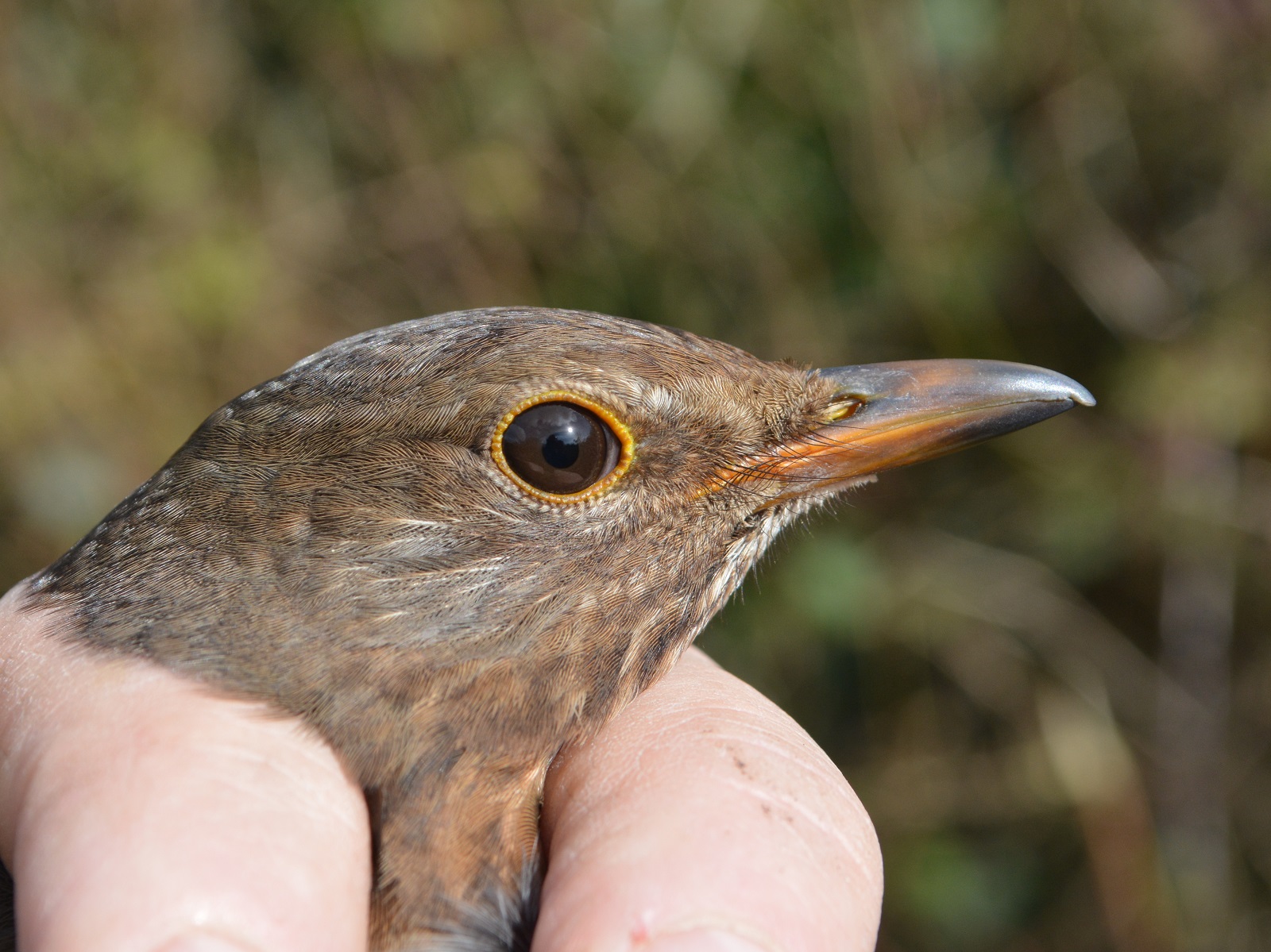
A busy little session followed with 27 new birds and 2 retraps caught during the 2 hours the calm conditions lasted. It was interesting that 4 of the 10 Goldfinches caught were very fat and had bulging fat deposits in the tracheal pit and over the abdomen; these birds will be migrants that will be heading much further north and presumably to somewhere in Scotland or Northern Ireland to breed. One of the Blackbirds (a 2cy female) was similarly very fat and weighed a whopping 126.7g. A lean Blackbird weighs around 90g so this bird will have been carrying in the region of 35 to 40g of fat and will be migrating back to Scandinavia or somewhere further east fairly soon.
A Blackbird ringed at Crawford in the winter of 2016/17 was caught by ringers on the island of Utsira, off the coast of Norway, in spring last year and gives an indication of where today's fat Blackbird could be heading in the coming days.
Blackbird (Turdus merula) Ring no: LK25293
Ringing details
First year female 29-NOV-2016 Crawford, near Up Holland Lancashire, England
Finding details
Caught by ringer 29-MAR-2018 Sore Merkeskog, Utsira, Rogaland, Norway
Duration: 485 days Distance: 795 km Direction: 37deg (NE)
Ringing totals (retraps in brackets) for 03/04/2019 were: Collared Dove 1; Coal Tit 1; Song Thrush 1; Blackbird 4; Tree Sparrow 8; Robin 1 (1); Chaffinch (1); Greenfinch 1; Goldfinch 10.
A busy little session followed with 27 new birds and 2 retraps caught during the 2 hours the calm conditions lasted. It was interesting that 4 of the 10 Goldfinches caught were very fat and had bulging fat deposits in the tracheal pit and over the abdomen; these birds will be migrants that will be heading much further north and presumably to somewhere in Scotland or Northern Ireland to breed. One of the Blackbirds (a 2cy female) was similarly very fat and weighed a whopping 126.7g. A lean Blackbird weighs around 90g so this bird will have been carrying in the region of 35 to 40g of fat and will be migrating back to Scandinavia or somewhere further east fairly soon.
 |
| Female Blackbird |
 |
| Blowing back the feathers reveals the tracheal pit which is normally deeply concave in a bird that isn't carrying much or any fat but has been completely filled with fat and is bulging in this individual. |
 |
| This slightly more angled view shows the yellow fat is bulging by several mm and overlaps the pink breast muscles. The abdomen was similarly full of and covered in fat. This bird must be at or very close to the point where it is ready to migrate and it is likely to set off on the next suitable night. |
 |
| Ivy Berries. The hedge on one side of the ringing site is full of ivy which is currently covered in ripe berries. These berries help migrant Blackbirds fatten up in readiness for the long journey back to their breeding grounds. |
A Blackbird ringed at Crawford in the winter of 2016/17 was caught by ringers on the island of Utsira, off the coast of Norway, in spring last year and gives an indication of where today's fat Blackbird could be heading in the coming days.
Blackbird (Turdus merula) Ring no: LK25293
Ringing details
First year female 29-NOV-2016 Crawford, near Up Holland Lancashire, England
Finding details
Caught by ringer 29-MAR-2018 Sore Merkeskog, Utsira, Rogaland, Norway
Duration: 485 days Distance: 795 km Direction: 37deg (NE)
Ringing totals (retraps in brackets) for 03/04/2019 were: Collared Dove 1; Coal Tit 1; Song Thrush 1; Blackbird 4; Tree Sparrow 8; Robin 1 (1); Chaffinch (1); Greenfinch 1; Goldfinch 10.
Sunday, 10 March 2019
Crawford 08/03/2019: more Goldfinches and some dodgy looking Blackbirds
The weather has been pretty poor for mist-netting recently and the forecast looks even worse for next week so I decided to make the most of a brief weather window on Friday morning. A weak ridge of high pressure provided near perfect mist netting conditions for a few hours and, luckily, I was able to rearrange other commitments to take advantage of it.
The ringing site is baited every two or three days with the aim of ensuring food is never allowed to run out or run too low and ringing visits are generally limited to once per week or less, depending on the weather. As a general rule I would rather skip a week or two when it comes to ringing visits than try mist-netting in suboptimal conditions. That approach paid off again on Friday morning as the 3 hour session with one 18m net resulted in a catch of 48 new birds and 11 retraps.
Goldfinches topped the totals yet again, although that is not surprising given the success the species is currently enjoying and the high proportion of nyger and sunflower hearts in the seed on offer, but on the other hand Yellowhammers have been absent full stop and Greenfinches had been absent prior to this visit. The 2 Greenfinches caught in this session were the only ones recorded which is a very poor showing given the site has been baited for well over a month now. Greenfinch populations have seen a massive decline nationally large due to disease (trichomonosis) and there doesn't appear to be any prospect of that situation improving any time soon, if anything their decline appears to be continuing.
I don't catch many Reed Buntings at the site (only 11 individuals over the past 5 years) so it was good to catch one and more so because it was a retrap. Interestingly this male Reed Bunting was originally ringed 3km away on Billinge Hill in September 2015 and was previously retrapped at Crawford in March 2016. Most of the other retraps were from recent visits but all 3 retrap Blue Tits were much older with one having been ringed as a juvenile in June 2014 and the other two were ringed as first-years in December 2015.
The second Blackbird caught during the session was interesting in that it had an unusual plumage. It was a brownish individual but the orange-yellow bill was strongly suggestive of it being a male. Some first year male Blackbirds can have a female like plumage and these birds are often termed 'Stockamsel' types which I have blogged about before (link here). However, it also had some feathers with what could be termed a frosted or white appearance. These frosty looking feathers were asymmetrical in that more were present left wing than the right. The tail was also affected but there was a bit more symmetry in the appearance of the tail.

The term 'Stockamsel' is attributed to the naturalist Johann Andreas Naumann and was first used a couple of centuries ago and has been used in the literature occasionally since then for those first-year male Blackbirds that have a more female like plumage. There is also the possibility that some of these 'Stockamsel' type birds are actually intersex as they display a mixture of male and female characteristics. That doesn't appear to have been considered before and I don't know that it has ever been ruled out. I found an interesting blog post which touches on this subject relating to wildfowl and possible confusion between hybrids and intersex birds which is worth a read (link here). I am no expert so I will stick with calling these dodgy looking Blackbirds 'Stockamsel' types until some research is done that confirms their sex and establishes the cause or causes for their appearance.
Now one 'Stockamsel' type Blackbird in a ringing session is interesting but I ended up catching another two which is exceptional in my experience.The other two didn't have the white frosting but in other respects were similar. In my previous blog post on the subject I refer to two I caught in the garden just over a week apart and I commented that if such birds weren't supposed to be of continental origin you would have thought they came out of the same nest. Now I have caught 3 on the same day and at the same site I do think local origin and same parentage could be a real possibility. Perhaps 'Stockamsel' types can originate anywhere in the species range if both parents possess a particular gene. There was nothing about the wing lengths of the three birds to suggest they were of continental origin in fact 2 of the 3 had relatively short wing lengths which, if anything, suggests they were more likely to be of British origin but then the fact that they have aberrant plumages probably means we shouldn't try and read anything into their wing lengths. Catching 3 on the same day certainly seems to make the chances of any of them being intersex a bit less likely but it can't be ruled out entirely.
I didn't photograph the 3rd Stockamsel type as it was very similar to the 2nd plus I had quite a few other birds to deal with at the time. The main difference was that it only had one old greater covert plus it was slightly longer winged (the wing lengths of the three birds were 126mm, 129mm and 132mm if you were wondering). Bottom line I caught 3 Stockamsel types out a total of 6 Blackbirds trapped in one session which, as I said before, is exceptional in my experience.
I am sure there could be a PhD for some upcoming ornithologist or geneticist if they do some research into this phenomena. Are they all males with some female characteristics or females with some male characteristics or something in between? Is there more than one cause? Do they originate more frequently in some parts of the species range than others? Is it purely a first-year phenomena and do they always conform to type with the first full moult or is it the fact that Stockamsel types are relatively rare that makes finding a Stockamsel type adult that much rarer? If anyone out there has more information or has answers to any of these questions then please get in touch as I would be interested to know.
Ringing totals (retraps in brackets) for 08/03/2019 were: Collared Dove 1; Coal Tit 1; Blue Tit (3); Great Tit 2; Long-tailed Tit (2); Blackbird 5 (1); House Sparrow 2; Tree Sparrow 5 (1); Dunnock 1 (1); Chaffinch 1; Greenfinch 2; Goldfinch 28 (2); Reed Bunting (1). A total of 48 new birds and 11 retraps.
The ringing site is baited every two or three days with the aim of ensuring food is never allowed to run out or run too low and ringing visits are generally limited to once per week or less, depending on the weather. As a general rule I would rather skip a week or two when it comes to ringing visits than try mist-netting in suboptimal conditions. That approach paid off again on Friday morning as the 3 hour session with one 18m net resulted in a catch of 48 new birds and 11 retraps.
Goldfinches topped the totals yet again, although that is not surprising given the success the species is currently enjoying and the high proportion of nyger and sunflower hearts in the seed on offer, but on the other hand Yellowhammers have been absent full stop and Greenfinches had been absent prior to this visit. The 2 Greenfinches caught in this session were the only ones recorded which is a very poor showing given the site has been baited for well over a month now. Greenfinch populations have seen a massive decline nationally large due to disease (trichomonosis) and there doesn't appear to be any prospect of that situation improving any time soon, if anything their decline appears to be continuing.
I don't catch many Reed Buntings at the site (only 11 individuals over the past 5 years) so it was good to catch one and more so because it was a retrap. Interestingly this male Reed Bunting was originally ringed 3km away on Billinge Hill in September 2015 and was previously retrapped at Crawford in March 2016. Most of the other retraps were from recent visits but all 3 retrap Blue Tits were much older with one having been ringed as a juvenile in June 2014 and the other two were ringed as first-years in December 2015.
 |
| Retrap male Reed Bunting |
 |
| The appearance of the head and neck was not dissimilar to an old adult (2CY+) female as female Blackbirds occasionally acquire a near full yellow or orange-yellow bill with age. |

 |
| The right wing was more female like than male with some slight frosting to the inner secondaries. There were 3 old greater coverts which points to it being a first-year bird and is part of my reasoning for thinking it is more likely to be a male as the bill is far too orange-yellow for it to be a first-year female. |
 |
| The frosty effect was much more extensive on the left wing but it still looks brownish overall and generally a bit more like a female than a male. There is one old greater covert which is shorter and just visible by the 2 heavily frosted greater coverts so points to it being a first-year bird like the right wing. The asymmetry wasn't just in the frosting as there were 3 old greater coverts on the right wing and there was only 1 on the left. |
 |
| The tail was interesting in that the shape of the feathers was not dissimilar to those of an adult by being quite square ended but there are some obvious fault bars and other structural issues. The right central tail feather was a bit more pointed than the left but in all other respects (colour and wear) they were the same so it didn't look like one had been replaced. The frosting affected the the end portions of the 3rd, 4th and 5th feathers on the right and 2nd,3rd and 4th on the left. The outermost (6th) tail feather on the left was being replaced but you can see from the part that has emerged from the sheath that it is a similar colour to the main part of the other tail feathers and isn't coming through jet black like a male. It suggests this bird's appearance will remain similar to how it is now with any difference being more to do with the freshness of the feathers as can be seen in the upper-tail coverts with the newer longest upper-tail covert being a darker blackish-brown compared to the old worn brown upper-tail coverts. So this bird may not get any or much blacker as it gets older |
The term 'Stockamsel' is attributed to the naturalist Johann Andreas Naumann and was first used a couple of centuries ago and has been used in the literature occasionally since then for those first-year male Blackbirds that have a more female like plumage. There is also the possibility that some of these 'Stockamsel' type birds are actually intersex as they display a mixture of male and female characteristics. That doesn't appear to have been considered before and I don't know that it has ever been ruled out. I found an interesting blog post which touches on this subject relating to wildfowl and possible confusion between hybrids and intersex birds which is worth a read (link here). I am no expert so I will stick with calling these dodgy looking Blackbirds 'Stockamsel' types until some research is done that confirms their sex and establishes the cause or causes for their appearance.
Now one 'Stockamsel' type Blackbird in a ringing session is interesting but I ended up catching another two which is exceptional in my experience.The other two didn't have the white frosting but in other respects were similar. In my previous blog post on the subject I refer to two I caught in the garden just over a week apart and I commented that if such birds weren't supposed to be of continental origin you would have thought they came out of the same nest. Now I have caught 3 on the same day and at the same site I do think local origin and same parentage could be a real possibility. Perhaps 'Stockamsel' types can originate anywhere in the species range if both parents possess a particular gene. There was nothing about the wing lengths of the three birds to suggest they were of continental origin in fact 2 of the 3 had relatively short wing lengths which, if anything, suggests they were more likely to be of British origin but then the fact that they have aberrant plumages probably means we shouldn't try and read anything into their wing lengths. Catching 3 on the same day certainly seems to make the chances of any of them being intersex a bit less likely but it can't be ruled out entirely.
 |
| Stockamsel type number 2 appeared to have 4 old greater coverts although the 3 outer were paler and shorter than the 4th but the outer 4 were browner than the blacker and newer looking next 3 inner greater coverts. Aberrant plumages can make ageing feathers more difficult for a variety of reasons not least because feathers of different colour can wear differently and birds with plumage aberrations may not always moult in the normal way, we simply don't know or can't be 100% sure. The 3 black greater coverts help make this one look more like a male. |
 |
| Overall the 2nd bird was a bit blacker than the first individual but it is certainly not your typical first year male Blackbird |
 |
| As with the first bird it is the near full orange-yellow bill that draws the eye and makes it look more like a male. Forget the bill and the plumage is intermediate. |
I am sure there could be a PhD for some upcoming ornithologist or geneticist if they do some research into this phenomena. Are they all males with some female characteristics or females with some male characteristics or something in between? Is there more than one cause? Do they originate more frequently in some parts of the species range than others? Is it purely a first-year phenomena and do they always conform to type with the first full moult or is it the fact that Stockamsel types are relatively rare that makes finding a Stockamsel type adult that much rarer? If anyone out there has more information or has answers to any of these questions then please get in touch as I would be interested to know.
Ringing totals (retraps in brackets) for 08/03/2019 were: Collared Dove 1; Coal Tit 1; Blue Tit (3); Great Tit 2; Long-tailed Tit (2); Blackbird 5 (1); House Sparrow 2; Tree Sparrow 5 (1); Dunnock 1 (1); Chaffinch 1; Greenfinch 2; Goldfinch 28 (2); Reed Bunting (1). A total of 48 new birds and 11 retraps.
Monday, 25 February 2019
Crawford: 24/02/2019
Fog delayed the start of the session and strong sunshine brought it to a close but in the two and a half hours the tall hedgerow provided shade for the 18m net a decent total of 41 new birds and 5 retraps were caught. The catch was dominated by Goldfinches but a few more Tree Sparrows appear to have found the seed and 9 were caught along with a couple of House Sparrows. There was no sign of farmland species like Yellowhammer but they may still be finding enough food in the surrounding fields. It appears to be a similar story with Corn Bunting with birds thinly scattered across the adjacent farmland and some appearing to be back on territory.
The current spell of unseasonably warm weather is clearly having an effect with a Linnet back on territory and singing at the ringing site; Chaffinch, Goldcrest and Song Thrush were also in full song. Spring was in the air for Dunnocks too with a lot of singing, wing flicking and chasing going on while a pair of Long-tailed Tits was prospecting for a nest site in the brambles. A reminder that we are still in winter came in the form of a male Chaffinch and a male Blackbird that were caught and found to have long wing lengths. Both of these birds were likely to be winter visitors from the continent with the colour of the underparts of the Chaffinch also pointing to a continental origin.
Ringing totals for 24/02/2019 were: Blue Tit 6 (4); Great Tit 2 (1); Blackbird 2; House Sparrow 2; Tree Sparrow 9; Dunnock 1; Chaffinch 2; Goldfinch 17.
 |
| Tree Sparrows have increased in this area in recent years but their distribution is patchy and they are still absent from some of their former haunts. |
 |
| House Sparrows don't seem to be doing very well anywhere and while the steep decline in their numbers may have levelled off to some extent there doesn't seem to be any indication their numbers are likely to recover anytime soon. |
Ringing totals for 24/02/2019 were: Blue Tit 6 (4); Great Tit 2 (1); Blackbird 2; House Sparrow 2; Tree Sparrow 9; Dunnock 1; Chaffinch 2; Goldfinch 17.
Monday, 18 February 2019
First outing in a while.
I obviously I haven't posted anything on the blog for a couple of months and that has been due to a number of factors, not least two more deaths in the family, but I have been keeping my hand in by doing a bit of ringing in the garden and keeping a look out for ringed gulls on Orrell Water Park.
However, I started baiting the farmland ringing site a Crawford a couple of weeks ago and decided to make my first ringing visit this morning. I knew there were plenty of birds coming to the feeders from the numbers I had seen on my last visit to top them up and by the rate the seed was being eaten so I only set up one 18m net.
The catching rate was brisk, as can be the case when you haven't ringed at a site for some time, and 18 birds were caught within 20 minutes of the net going up. The catching rate remained fairly brisk despite a bit of a breeze developing and a total of 50 birds were caught in a little over two hours. Not bad going for my first ringing session away from the garden this year.
Ringing totals for 18/02/2019 were: Blue Tit 8; Great Tit 2; Long-tailed Tit 2; Song Thrush 1; Robin 3; House Sparrow 1; Tree Sparrow 2; Dunnock 6; Chaffinch 2; Goldfinch 23.
However, I started baiting the farmland ringing site a Crawford a couple of weeks ago and decided to make my first ringing visit this morning. I knew there were plenty of birds coming to the feeders from the numbers I had seen on my last visit to top them up and by the rate the seed was being eaten so I only set up one 18m net.
The catching rate was brisk, as can be the case when you haven't ringed at a site for some time, and 18 birds were caught within 20 minutes of the net going up. The catching rate remained fairly brisk despite a bit of a breeze developing and a total of 50 birds were caught in a little over two hours. Not bad going for my first ringing session away from the garden this year.
 |
| This looks like a fairly standard male Goldfinch from this angle. |

 |
| However, its chin was pure white and bisected the red bib. |

 |
| This patch of white feathers wasn't quite symmetrical but certainly made for an interesting looking bird |
 |
| Only 2 Tree Sparrows were caught but there was a flock of about 15 feeding near the net and more are likely to be caught on subsequent visits. |

Ringing totals for 18/02/2019 were: Blue Tit 8; Great Tit 2; Long-tailed Tit 2; Song Thrush 1; Robin 3; House Sparrow 1; Tree Sparrow 2; Dunnock 6; Chaffinch 2; Goldfinch 23.
Wednesday, 14 December 2016
Crawford: 12/12/2016 and wing moult in first year Blackbirds
I don't know what is happening with thrushes and Redwings in particular but there seems to more nocturnal movement than is usual at this time of year, especially given the absence of any cold weather. Some large nocturnal movements of thrushes were noted at Spurn Bird Observatory towards the end of last week and some of those continued in daylight hours at Spurn but more so at Sunk Island. These unexpected movements attracted the tongue in cheek comment 'Mild weather movement?' in the list of sightings for 9th December on the Spurn Bird Observatory website.
I have heard Redwings overhead well before first light on numerous occasions recently and that happened again when I was loading the car to go ringing on the 12th. When I got to Crawford I heard the calls of a few more Redwings going over in the dark in the short time it took me to set up the line of two nets. Whatever the reasons are for these movements it seems to translate into more Redwings being in the area and good catches at dawn, although they are remarkably inconspicuous during rest of the day. The net result, no pun intended, was that I caught another 16 Redwings on the 12th which took the number ringed so far this month to 131. It also took the number ringed since early October past the 1100 mark and to 1110 to be precise. How long these nocturnal movements and dawn catches will continue is anybody's guess but now that I have mentioned them they will probably come to an abrupt end. I will find out soon enough as I hope to get out to Billinge and/or Crawford later this week.
Whenever there are a good number of thrushes around one or more Sparrowhawks are never too far away and that was also the case on the 12th. Their presence sometimes reduces the catch of Redwings, especially when they make frequent sorties, but that is quickly forgotten about when one ends up being caught in one of the nets. Sparrowhawks have a bit of a reputation for getting out of nets, especially the larger females, but I have been lucky enough to catch 10 since early October with 5 of them being females.
Blackbird was the only other species handled with 8 new birds and 2 retraps being caught. One of the first year males was particularly interesting because it had replaced some of its secondary flight feathers in both wings, which first years don't normally do. There was some asymmetry to the moult but it certainly didn't appear to be due to any accidental loss of feathers.
A bit like the stockamsel plumage Blackbirds that I wrote about in my last post this was the second first year male Blackbird to come my way that had undergone a partial moult of the flight feathers. The first was a Blackbird that I retrapped in the garden on 22nd November, it had been ringed as a juvenile on 7th August so wasn't from a particularly early brood but it definitely made it a bird of UK origin. The moult of this bird was far more extensive and involved some of the primaries, primary coverts and secondaries, and all of the greater coverts, tertials of both wings, although there was some asymmetry. The entire tail had also been replaced.
In recent decades it has become more common for finches to undergo a limited moult of the flight feathers as part of their (partial) post-juvenile moult but this phenomena appears to be a far more recent occurrence in Blackbirds and these two examples are the first I am aware of for the UK. A search of the Internet revealed a short paper about a juvenile Blackbird that was found moulting its primaries and secondaries in Poland in 2004. That appears to be the first account of a juvenile Blackbird replacing its primaries and secondaries and moult aficionados can find that paper here or by searching for the reference below.
As for the cause of the change in the extent of the pj moult in some birds I would put climate change as the number one suspect but as many of the species involved are also frequent visitors to gardens the more extensive and much improved quality of food provided in gardens may also be playing a part. It is certainly an area that is ripe for research and hopefully it will become something that the BTO will take more of a lead on by encouraging ringers to record and report any examples they come across.
References:
Zieliñska M., Zieliñski P., Mokwa T. 2005. Juvenile Blackbird (Turdus merula) moulting primaries and secondaries. Ring 27, 1: 121-123.
I have heard Redwings overhead well before first light on numerous occasions recently and that happened again when I was loading the car to go ringing on the 12th. When I got to Crawford I heard the calls of a few more Redwings going over in the dark in the short time it took me to set up the line of two nets. Whatever the reasons are for these movements it seems to translate into more Redwings being in the area and good catches at dawn, although they are remarkably inconspicuous during rest of the day. The net result, no pun intended, was that I caught another 16 Redwings on the 12th which took the number ringed so far this month to 131. It also took the number ringed since early October past the 1100 mark and to 1110 to be precise. How long these nocturnal movements and dawn catches will continue is anybody's guess but now that I have mentioned them they will probably come to an abrupt end. I will find out soon enough as I hope to get out to Billinge and/or Crawford later this week.
 |
| This is the one thousand, one hundred and ninth (1109) Redwing ringed this autumn/winter. Yes I know it is an odd number but the light levels were too low when number 1100 came along. |
 |
| 2nd year Female Sparrowhawk. It is bigger than it looks in this photo. |
 |
| Eccentric moult in 1CY Blackbird LK6922 caught at Crawford 12/12/2016 |
 |
| Left wing of 1CY Blackbird LK25176 retrapped in the garden 22/11/2016 |
 |
| Tail of 1CY Blackbird LK25176 retrapped in the garden 22/11/2016 |
As for the cause of the change in the extent of the pj moult in some birds I would put climate change as the number one suspect but as many of the species involved are also frequent visitors to gardens the more extensive and much improved quality of food provided in gardens may also be playing a part. It is certainly an area that is ripe for research and hopefully it will become something that the BTO will take more of a lead on by encouraging ringers to record and report any examples they come across.
References:
Zieliñska M., Zieliñski P., Mokwa T. 2005. Juvenile Blackbird (Turdus merula) moulting primaries and secondaries. Ring 27, 1: 121-123.
Saturday, 3 December 2016
Another Redwing recovery, 1011 ringed and a 'coburni' too.
Another recovery report for a Redwing landed in my inbox yesterday and gives further support to my view that most of the birds that migrate via Billinge in October and early November are heading for wintering areas much further south. While this movement isn't as quick as the recent recovery in Spain it still shows a good onward movement in the main migration period. It was almost certainly still on passage when recaptured on Guernsey and will probably spend the winter further south in France or Iberia.
RZ37675 Redwing (first year)
Ringed 12/10/2016 Billinge Hill, Billinge, Merseyside.
Caught by ringer 02/11/2016 Jerbourg, Guernsey, Channel Islands. 454 km S, duration 21 days.
Redwing passage appeared to have ended at Billinge by mid Novemeber, when the ringing total stood just under the 780 mark, but after a lull of around ten days there has been an upsurge in Redwing numbers/movements in the area that hasn't ended yet. This has resulted in another 232 Redwings being ringed at the Billinge and Crawford sites between 23rd November and today. Quite why this is is hard to say but a northerly (NW to NE) push of Redwings has been recorded at vis mig sites in Staffordshire and on the West Pennine Moors in the same period, including 3464 moving NW over Winter Hill on 29/11/2016.
I caught another 15 Redwings at Billinge this morning which brought the combined ringing totals for Billinge and Crawford to 1,011 and all since 3rd October; a good effort even if I do say so myself. I didn't take a photo of the thousandth Redwing but thousand and eighth certainly got my attention as it was a very obvious Icelandic Redwing, the first and perhaps the only one of this autumn. It didn't have a particularly long wing at 120mm but far too much is made of their wing length considering there is a huge overlap between the two races. The real indicator is their much darker appearance, not their wing length.


While on the subject of Redwings I will be updating the Redwing ageing page fairly soon. Any new information/images will be tagged on at the end and labelled as an update to make them easier to find.
RZ37675 Redwing (first year)
Ringed 12/10/2016 Billinge Hill, Billinge, Merseyside.
Caught by ringer 02/11/2016 Jerbourg, Guernsey, Channel Islands. 454 km S, duration 21 days.
I caught another 15 Redwings at Billinge this morning which brought the combined ringing totals for Billinge and Crawford to 1,011 and all since 3rd October; a good effort even if I do say so myself. I didn't take a photo of the thousandth Redwing but thousand and eighth certainly got my attention as it was a very obvious Icelandic Redwing, the first and perhaps the only one of this autumn. It didn't have a particularly long wing at 120mm but far too much is made of their wing length considering there is a huge overlap between the two races. The real indicator is their much darker appearance, not their wing length.
 |
| If a Redwing as dark and as well marked as this doesn't get your attention I don't know one that will. |


 |
| The legs and toes were quite dark, although not as dark as some 'coburni', but darker than most 'iliacus'. |
 |
| Strongly marked undertail coverts seem to be a feature of Icelndic birds. While the tail itself is broad and quite rounded there is plenty of wear. |
 |
| A very obvious moult limit with 4 ogcs'; old tertials are present too. There is no doubt that this is a first year bird. |
While on the subject of Redwings I will be updating the Redwing ageing page fairly soon. Any new information/images will be tagged on at the end and labelled as an update to make them easier to find.
Saturday, 26 November 2016
Ringing update
I have not posted anything about my ringing activities recently but I have been quite busy despite the period of unsettled weather. The garden has been very productive with the feeders attracting a lot of Goldfinches and I have ringed 62 in the last couple of weeks along with few of the other resident garden species. The most unusual garden visitor, however, was a female Brambling which proved to be an adult when caught. I have also been getting quite a few Starlings coming to the fat cakes which is unusual for my garden at this time of year and this has allowed me to colour-ring 19 new Starlings as well as obtain over 50 re-sightings of further 21 individuals that were colour-ringed over the past couple of years.
I have not done much ringing away from the garden prior to the last few days because the weather hasn't been suitable, apart from the odd hour or two here and there which I took advantage of for garden ringing, but with the onset of settled conditions on Thursday (24th) I decided to see if there were any thrushes at the farmland site in Crawford. I set a line of 2 nets by the hawthorn hedge at first light and used audio lures for to attract any Redwings and Fieldfares that may be near by or passing over. There were a lot more thrushes around than I had expected and I caught 25 Redwings, 7 Blackbirds and a female Sparrowhawk in just over an hour. I saw well over 200 Fieldfares in total but, frustratingly, those that dropped into the hedge stayed just above net height. I packed up just after 9 am as I had other commitments but most movement had already stopped by that time.
I went back yesterday morning (25th) and the same set up produced 37 Redwings and just 1 Blackbird in similar amount of time. Again there were a lot of Redwings and Fieldfares moving over the site in the period from first light to about half an hour after sunrise. I presume the ringing site is near or in between a roost site and favoured feeding locations as the movement slows down at sunrise and more or less stops not long after. The clear conditions has also seen some nocturnal movement as I have had Redwings calling overhead when I have been loading the car each morning so there is a chance some of the birds were migrating, although I suspect they are mainly local movements as previously outlined.
Another visit this morning saw a similarly brief but even bigger movement of thrushes that involved well over 200 Redwings and at least 350 Fieldfares. Unfortunately, I was extracting birds from the nets when some of the bigger flocks came over and those birds veered away when they saw me. The catch was still very good and was made up of 27 Redwings, 1 Fieldfare, 1 Blackbird and a Great Tit. Again nearly all the birds were caught in the first hour.
Although the conditions are forecast to be good again in the morning I am going to give the site a rest. It doesn't mean I will be having a rest as I may go up to Billinge to see if similar movement happens there as some of the Crawford thrushes were heading in that direction and it is only about 3km between the two sites.
I have not done much ringing away from the garden prior to the last few days because the weather hasn't been suitable, apart from the odd hour or two here and there which I took advantage of for garden ringing, but with the onset of settled conditions on Thursday (24th) I decided to see if there were any thrushes at the farmland site in Crawford. I set a line of 2 nets by the hawthorn hedge at first light and used audio lures for to attract any Redwings and Fieldfares that may be near by or passing over. There were a lot more thrushes around than I had expected and I caught 25 Redwings, 7 Blackbirds and a female Sparrowhawk in just over an hour. I saw well over 200 Fieldfares in total but, frustratingly, those that dropped into the hedge stayed just above net height. I packed up just after 9 am as I had other commitments but most movement had already stopped by that time.
 |
| Many of the Redwings have soil on their beaks which shows they are spending plenty of time feeding on soil invertebrates. |
Another visit this morning saw a similarly brief but even bigger movement of thrushes that involved well over 200 Redwings and at least 350 Fieldfares. Unfortunately, I was extracting birds from the nets when some of the bigger flocks came over and those birds veered away when they saw me. The catch was still very good and was made up of 27 Redwings, 1 Fieldfare, 1 Blackbird and a Great Tit. Again nearly all the birds were caught in the first hour.
 |
| 89 Redwings ringed in 3 mornings is good going in late November |
 |
| There was a good frost this morning |
 |
| There are plenty of berries around on the hedges as we have not had much in the way of frost prior to the last few days. |
Subscribe to:
Posts (Atom)