Showing posts with label fat. Show all posts

Wednesday, 3 April 2019

Fatties

I hadn't expected to do any ringing today but I had planned to go to the baited site at Crawford in the afternoon to top up the feeders.  As I was getting ready to go the wind dropped away completely so I decided to take advantage of the calm conditions and took my ringing gear too. It was 3pm by the time I got to the site and I quickly set up an 18m net after topping up the feeders. There were plenty of Goldfinches and Tree Sparrows around and first birds were caught as I walked away from the net.

A busy little session followed with 27 new birds and 2 retraps caught during the 2 hours the calm conditions lasted. It was interesting that 4 of the 10 Goldfinches caught were very fat and had bulging fat deposits in the tracheal pit and over the abdomen; these birds will be migrants that will be heading much further north and presumably to somewhere in Scotland or Northern Ireland to breed. One of the Blackbirds (a 2cy female) was similarly very fat and weighed a whopping 126.7g. A lean Blackbird weighs around 90g so this bird will have been carrying in the region of 35 to 40g of fat and will be migrating back to Scandinavia or somewhere further east fairly soon.

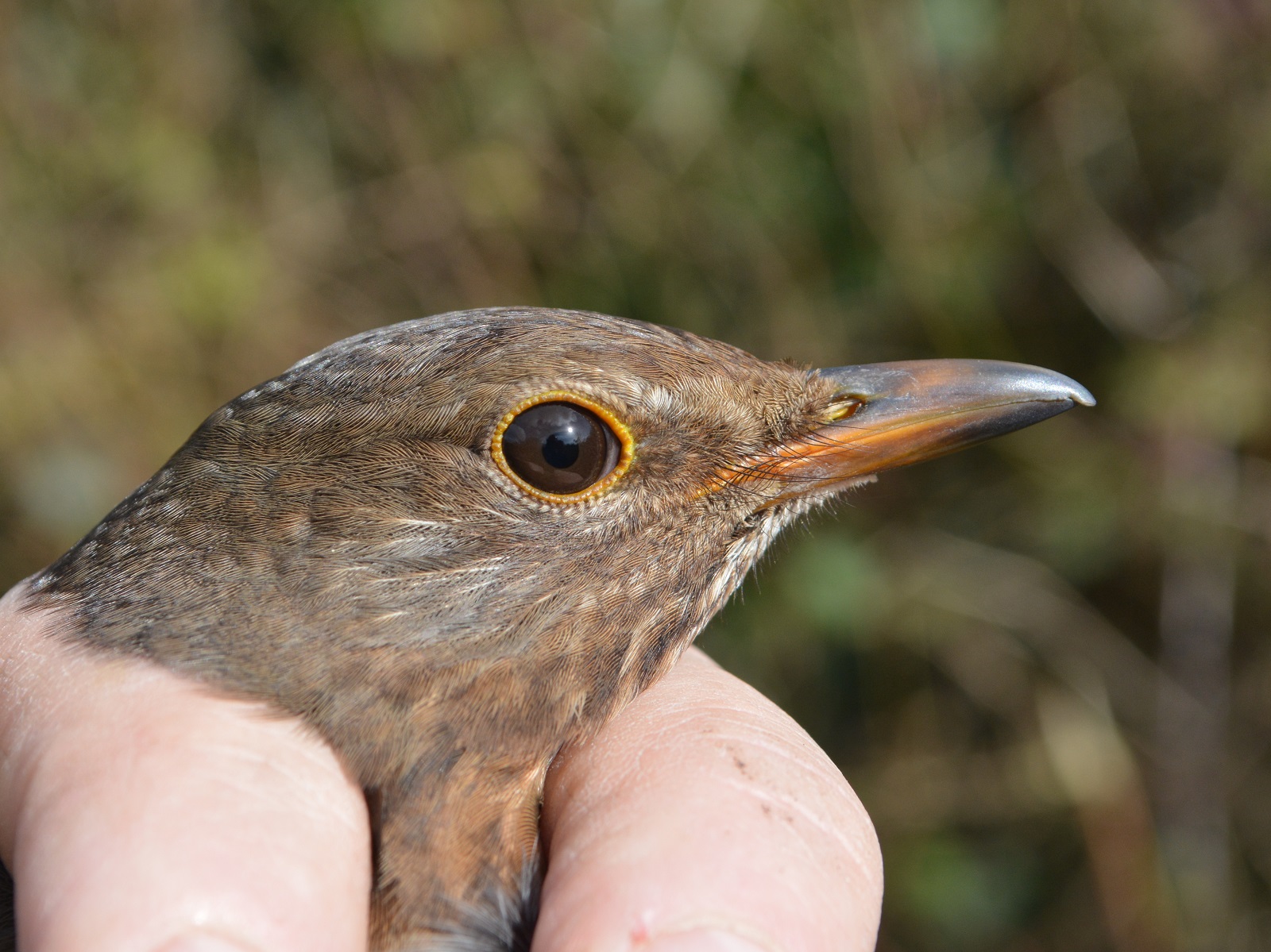
Female Blackbird

Blowing back the feathers reveals the tracheal pit which is normally deeply concave in a bird that isn't carrying much or any fat but has been completely filled with fat and is bulging in this individual.

This slightly more angled view shows the yellow fat is bulging by several mm and overlaps the pink breast muscles. The abdomen was similarly full of and covered in fat. This bird must be at or very close to the point where it is ready to migrate and it is likely to set off on the next suitable night.

Ivy Berries.
The hedge on one side of the ringing site is full of ivy which is currently covered in ripe berries. These berries help migrant Blackbirds fatten up in readiness for the long journey back to their breeding grounds.

A Blackbird ringed at Crawford in the winter of 2016/17 was caught by ringers on the island of Utsira, off the coast of Norway, in spring last year and gives an indication of where today's fat Blackbird could be heading in the coming days.

Blackbird (Turdus merula)   Ring no: LK25293
Ringing details
First year female   29-NOV-2016   Crawford, near Up Holland Lancashire, England
Finding details
Caught by ringer   29-MAR-2018   Sore Merkeskog, Utsira, Rogaland, Norway
Duration: 485 days Distance: 795 km Direction: 37deg (NE)


Ringing totals (retraps in brackets) for 03/04/2019 were: Collared Dove 1; Coal Tit 1; Song Thrush 1; Blackbird 4; Tree Sparrow 8; Robin 1 (1); Chaffinch (1); Greenfinch 1; Goldfinch 10.


Thursday, 5 October 2017

Fat crests and a pink lady.

The 3rd and 4th may have been a bit windy but I managed to find enough shelter in some of the net rides on the east side of the site at Billinge. These net rides were sheltered from the worst of the stiff westerlies by higher ground, including the hill summit, and tree/shrub cover provided the additional shelter required. Unsettled conditions can produce interesting birding with some birds being held up or forced down by the weather and others battling through and the only way to find out is to get out there. 

The first bird caught on both days was a Song Thrush and the greyer tones and slightly smaller size of both suggested they were of continental origin. There were a decent number of Goldcrests present and 19 were ringed over the two sessions. Many of the Goldcrests were carrying quite a bit of fat with 8 weighing 5.8g or more and the two heaviest birds weighed in at 6.3g. Birds in this weight range are carrying more than enough fat to fly to southern England in a single non stop night flight and some may even go on to winter in France. Interestingly, a recovery report showing a movement of one of this autumn's Goldcrests came through just the other day, it was ringed on 2nd September and found dead 18 days later in Hampshire, 267km SSE of Billinge. Full details of this and some other recoveries will be posted in due course.

A Stonechat that suddenly appeared on a fence line on the 3rd was the first of the autumn but it didn't linger and quickly moved on. There was a bit of movement overhead despite the strength of the wind and showed how strong the urge to migrate can be. Meadow Pipits and Chaffinches were the most numerous species on the move but a few Lesser Redpolls were also heading south and 4 were caught. One of the Lesser Redpolls had a bit of a pink flush to some of the breast feathers and it almost had me thinking it was a male for a second, but on further examination it was obviously an adult and didn't have any pink in the cheeks or on the rump, concealed or otherwise, which ruled out the possibility of it being a male.

It isn't always appreciated that adult female Lesser Redpolls can have pink feathers on the breast and or rump in addition to those that are more commonly present on the cheeks. However, the pink, when present, is never quite as strong or as extensive as it is in adult males and is usually only noticeable at very close range (generally arms length or less). It is all too easy to rely on the sexing criteria that are given in Svennson and forget some of the other literature that has been produced and younger ringers may not even be aware of some of it. A very useful paper on the subject was published back in 1981, link here: M. Boddy (1981) Ageing and sexing British lesser redpolls, Ringing &Migration, 3:4, 193-202, DOI: 10.1080/03078698.1981.9673780 

Adult female Lesser Redpoll. The pink centres to some of the breast feathers aren't as obvious in the photograph as they appeared in the hand but you can still see they are there.

A side view of the same adult female Lesser Redpoll. 
One of the other Redpolls that was caught was interesting for not having a red poll. There was a slight amber cast to some of the feathers of the fore-crown but it was only very slight. This pigment variation is fairly uncommon but individuals like this do crop up from time to time although the poll is usually a bit more yellow or amber than it was in this case. While this is a first year bird it is trait that I have seen in adults too and I suspect it is more common in females, although it obviously makes sexing birds very difficult outside the breeding season.

Lessser Redpoll without a red poll 03/10/17

The amber coloured cast to the poll is there but it was very slight and barely noticeable in this individual.
One thing that has been a feature of late September and now early October has been a general lack of Blackcaps and Chiffchaffs. There seems to have been a slightly earlier and more complete departure of these two species, and Blackcaps in particular, with fewer late birds coming through or lingering compared to the last couple of autumns. The more unsettled weather and lack of easterly winds have almost certainly played a part so it will be interesting to see if this trend continues through the remainder of the autumn.

So an interesting couple of mornings and well worth the effort even though the combined total was a relatively modest 46 birds. Species totals (retraps in brackets) for 3rd & 4th October were: Goldcrest 19; Blue Tit 3; Great Tit 2 (1); Coal Tit 3; Chiffchaff (1); Song Thrush 2; Robin 1; Dunnock 2 (1); Chaffinch 6; Lesser Redpoll 4; Reed Bunting 1.

Wednesday, 19 October 2016

Fat Yellow-browed

With the showery conditions of the last few days moving away there was an opportunity to get out to Billinge this morning. The session was brief as I had other commitments from 09:30 but it still gave me a couple of hours of ringing in largely clear conditions with a only light NNW breeze. There weren't many thrushes moving with most of the 15 Redwing and 4 Song Thrush caught being birds that had probably roosted nearby, and what movement there was mainly involved Woodpigeons with around 500 heading south although at least 80 U-turned and came back north.


Redwing
With the influx of Yellow-browed Warblers seemingly well past its peak the chances of catching another seemed to have diminished significantly, although I was still hopeful. Well that bit of wishful thinking turned into reality when one was captured, along with a Goldcrest and a Coal Tit, on the penultimate net round. On extraction it felt quite chunky and when it was processed it weighed 8.4g and had a fat score of 5 which suggests it had been feeding up for quite a few days, and presumably somewhere nearby. When I got home and put the details into the IPMR ringing database it flagged up the weight as being outside the expected upper limit of 8.0g, although that limit will probably have been based on data gathered prior to the big influxes of the past few years. The other Yellow-broweds caught at Billinge this autumn weighed 6.6g and 6.1g so this latest bird was carrying at least 2g of fat which could give it a significant flight range for the next stage of its journey, perhaps as much as 1,000 km or more. Its next stop could easily be somewhere in southern France, a favourable wind and fair weather permitting.


The wing and tail length of today's Yellow-browed Warbler indicated that it was a male.
With the wind set to turn easterly again from Friday I will continue to allow myself a bit of wishful thinking and perhaps another Yellow-browed or something a bit scarcer may just come my way. 

Ringing totals (retraps in brackets) for 19/19/2016 were: Goldcrest 7; Coal Tit 2;  Yellow-browed Warbler 1; Blackbird; 1 Song Thrush 4; Redwing 15; Bullfinch (1); Lesser Redpoll 1.

Tuesday, 5 April 2016

Bulging Siskins.
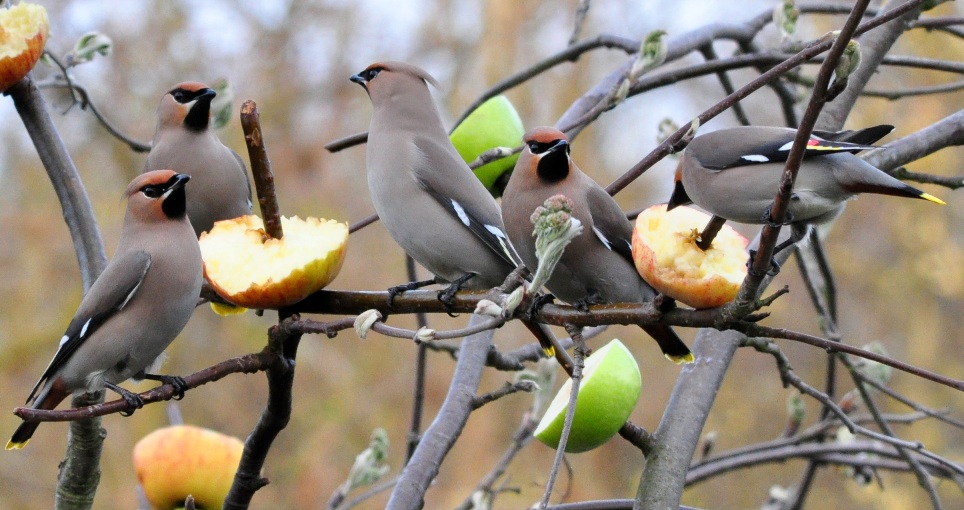
The drop in Siskin numbers that I commented on at the end of my last post was short lived and the number visiting the feeders in the garden went back up to around 15 on 2nd April and numbers have remained there or thereabouts since. I managed to get a net up for a short time on the 3rd and 4th and again late this afternoon which resulted in a combined total of 35 different individuals being caught (29 new birds and 6 retraps). This shows there are more around than counts alone would indicate and or that there is plenty of turnover due to birds migrating through the area.


A fairly average looking male Siskin for comparison with the bird below (both caught today).
This is a particularly bright and intensely coloured individual.
The retraps were interesting in that only one had been ringed relatively recently and that bird had been ringed on 23rd March. The other retraps involved 3 that were ringed in February (11th & 24th x 2) and another from early March (5th) but most surprising of all was a bird that had been ringed on Billinge Hill on 9th October last year, a distance of around 2km from the garden, and it was thought to have been migrating south at the time. Did this bird stay and winter in the region or is it returning north along a similar migration route to the one it used to go south in the autumn?

The retraps from February and early March are intriguing as their weights haven't changed all that much and the little change there has been can be attributed to normal diurnal variation rather than any pre-migratory fattening. Age doesn't seem to be a factor as one of these long stayers is an adult male so perhaps they are just going to be late migrants that will fatten up in due course.

Despite some retraps showing little or no weight gain the proportion of heavy birds in catches has been increasing with 8 of the 9 birds caught this afternoon having substantial fat deposits and a weight range of 15.1g to 16.3g. These very heavy birds are likely to be going back to breeding grounds on the continent rather than in Scotland. The lighter bird from today was one of the retraps referred to above and weighed 13.1g at 18:30 compared to 11.9g at 07:30 when ringed on 5th March. This change of 1.2g fits in with normal diurnal weight changes and had it been caught at the same time on both days it may well have weighed the same, or very nearly so.


 Fat Female Siskin
The lump is the birds crop full of seeds but it is also covered in a layer of fat which extended across the back of the neck.


Blowing back the feathers on the throat reveals the tracheal pit bulging with fat (appears pinky-orange compared to the deep red of the breast muscle).


Blowing back the feathers of the belly also reveals a thick bulging layer of fat.
These heavy birds aren't going to stay around for much longer so it will be interesting to see what happens over the rest of this week. Will numbers finally dwindle or will other birds replace those that leave?

Sunday, 11 October 2015

Billinge: 5th-11th October

I haven't had any more Yellow-browed Warblers or dodgy Redpolls but it has been a very productive week. I have managed to get out on 5 mornings, including today, and it is fair to say that those early starts have taken their toll and I am feeling cream crackered as I write this. Highlights have included the continued passage of Goldcrests, some reasonable thrush movements and a few late-ish warblers.

The number of Goldcrests moving through this site continues to impress me with the 95 ringed this week bringing the total for the month to 162 and the total for the autumn to 447. Redwings and other thrushes started arriving early this autumn with the first big arrival on the east coast and northern isles happening on the 5th. It didn't take long for some of these birds to move across and down to the west side of the country and around 200 passed over the site on the 8th. Similarly there has been a good movement of Song Thrush in the last week with small numbers 'zipping' over the site each day. Song Thrush is often under-recorded as a passage migrant as they can be hard to pick out when mixed in with flocks of Redwings but at least 20 have passed through on each of the last 2 days. Warblers are thin on the ground now but there was a little flurry of Chiffchaffs in the week with 5 on the 8th being a good number for the date. Many of the Blackcaps caught in recent weeks have been carrying a lot of of fat and one of the birds ringed today was probably the heaviest bird I have handled this autumn and weighed 22.2 g which could give it the range to reach Spain or Portugal in a single flight.

(Retraps and controls in brackets)
One of the Redwings still had some spotty juvenile feathers on the flanks suggesting it was from a late brood. It also had some juvenile median coverts..

One of today's Song Thrushes
The fat 22.2 g Blackcap is just over 5g heavier than the average weight of 17g.

Blow back the feathers of the upper breast and you can see the pinky-yellow fat bulging from the normally concave tracheal pit.
Coal Tits are very much in the birding news with an irruption of birds currently underway in Britain and on the continent. A couple of high flying birds were recorded today in addition to the one that was ringed.

A bobby dazzler of an adult male Lesser Redpoll. He will be a stunner in spring when those pale fringes have worn off the red feathers.

Looking at the forecast I could be seeing the sun rise a few more times next week although I may not have the time to appreciate it.

Saturday, 27 April 2013

Waxwing lyrical part 34 - counting down

The number of Waxwings continues to decline each day. The birds have been piling on weight and the weather has been generally favourable for migration so there is nothing to hold them back once they are ready to go. The graph below shows the numbers I have recorded each day since the first bird turned up and shows the trend in numbers. During March there were still plenty of berries around and numbers didn't really take off until the end of March when the berry supplies had been exhausted and the birds also started to fatten up.

copyright P J Alker


The weight increases some of the birds have shown recently is quite impressive - NW31951, a first winter female, weighed 62.8g on 20/04/13 but weighed 74.3g when retrapped this morning, an increase of 11.5g in 7 days or 18.3%.
NW31942, an adult female, weighed 63.3g on 19/04/13 but weighed 78.5g when retrapped this evening, an increase of 12.2 g in 8 days or 19.3%.


Apples may not be a natural food supply in spring but the data is still valuable and a good measure of their ability to put on weight. The birds are actually less dependant on the apples now and are also feeding on the emerging flowers of various trees. I have seen them feeding on Poplar flowers recently and the emerging flowers of Ash today.


There must be significant nutritional and or energy value in the emerging flowers given the effort the birds put in to get at them. I have  also seen quite a few Wood pigeons feeding on Ash flowers in the past few days.
I only caught 1 new and 4 retrap Waxwings today but one of the retraps was my favourite bird if you can ever have a favourite Waxwing. It was the colour-ringed bird from Aberdeen that was first seen in the garden on 18th February. This bird is a first winter female and has been recorded in the garden 32 times since then and has been caught 4 times. She hasn't shown the rapid weight increases of some birds but is making steady progress. She only weighed 49.3g on 30th March but was 63.0g when retrapped today.


NW65022 retrapped today.
She was first seen on 18th February amd her details can be found by clicking here.
This afternoon I dragged myself away from the Waxwings and surveyed one of my river sites as I normally would at this time of year. A Dipper was carrying food but the nest was inaccessible and a net across the river only produced a Kingfisher although they aren't known to nest on that particular stretch. There will be plenty for me to do once the Waxwings have finally gone but I may have a lie-in or two first.


Kingfisher (Alcedo atthis) 27/04/13


Tuesday, 23 April 2013

Waxwing lyrical part 33 - full to bursting

Waxwing numbers have continued to decline as more birds have reached the desired weight for migration. This seems to be around 75g judging by the weights of the birds retrapped recently and means that around one third of their body weight will be made up of fat deposits. This will allow them to migrate a long distance without the need to stop and feed or with limited stop overs to top up and if bad weather halts their migration.

There were only 111 birds this morning give or take one or two. Only is probably the wrong word as 111 Waxwings in the garden was unimaginable just a few weeks ago but numbers have almost halved over the last week. This fits in well with the decline in sightings being reported across the uk. Some birds will already be well on their way back to the main breeding grounds in Russia and a few early birds may have even arrived at the closest breeding grounds in Finland and western Russia.

The Waxwings as they gathered at sunrise this morning (23/04/13)
Most of the remaining birds actually look really fat now so they may not be here for much longer and most are likely to depart over the next week with just a chance of a few lingering into early May. They also appear to be less agile and a bit more sluggish when taking off as a result of the extra weight they are carrying. This probably makes them a little more vulnerable when the Sparrowhawk attacks and predation by Sparrowhawks has increased over the past few days.

Fatwings (Bombycilla blubberus), These birds were still feeding at 19:40 this evening.

Fatwings (Bombycilla blubberus), The same two birds as above..
This bird is clearly very fat. It is the same bird as the one on the left in both photos bove.
I would like to be able to catch it for ringing and to see what it weighs.
I suspect it would be over 75g and could even be over 80g so is likely to leave any time now.
One birdwatcher witnessed a Waxwing being taken by a Sparrowhawk the other day but overall Sparrowhawk predation has generally been less than than it might have been. However the attacks do cause the birds to go elsewhere for long periods and if predation increases it could hasten their departure. Some Sparrowhawks in Aberdeen seem to specialise on Waxwings and you can find out more by clicking here.

You can see how some birds look much plumper than others.
The bird on the lower left is likely to be the light weight in this bunch.
 

Friday, 19 April 2013

Waxwing lyrical part 31 - ready for the off

On Wednesday (17th) there were still at least 200 Waxwings but I didn't manage to get more accurate count before I had to head off to work via Sainsbury's. A weather warning was in force for strong winds and even gales from Wednesday evening through to Thursday morning so I wasn't looking forward to putting out the apples that night. When I got home that evening the Waxwings had eaten almost all of the apples so I quickly put out a few more kilos and a good number continued feeding until almost 8 o'clock.

It was very windy and some of the gusts were really strong but I decided to try and put the apples out as normal. As I climbed the ladder at the first tree it was swaying quite a bit so I did have to wrap my arms around the tree once or twice to hold on. I stuck with it and carried on putting out the apples and although I am no tree hugger I certainly had to be a few times that night. I was more bothered that the wind might shake the apples off the branches and undo all my work.

Next morning it was still really windy with near gale force gusts but, thankfully, most if not all of the apples were still up in the trees. The birds arrived a bit later than usual but 178 were present by 07:00 although I struggled with that count in the wind. That was the best count I managed before heading off on the college run and then on to work, again via Sainbury's.


Around 133 of the 178 Waxwings present early morning 18.04.13.
32 Waxwings in the evening sunshine 18.04.13 looking fat and ready to go.
It was still quite windy when I got home from work it but was forecast to drop overnight. I had booked today (Friday) off as I hoped to do some ringing to see how much weight the birds were gaining. The high pressure that is forecast for tomorrow could also provide the ideal conditions for the birds to leave so I thought it may be the last opportunity to catch a good sample of the flock.

This morning I was up at 05:30, I say up but I didn't actually go to bed as I fell asleep on the couch again. It was a little bit breezier than I would have liked but it was nice and overcast. I only put up one 18ft net in the most sheltered position because of the breeze but I still didn't think I would catch much. To my surprise and delight I caught 12 new and 12 retrap Waxwings over the next couple of hours. Some of the retraps were particularly interesting as they showed the weight the birds have gained over the past couple of weeks. A bird ringed on 05/04/13 when it weighed 58.3g was retrapped today and weighed 72.3g, an increase of 14g in 14 days. That may not seem much but it is an increase of around 24% and equivalent to an 8 stone person putting on the best part of 2 stone in only 2 weeks, now that takes some eating to do that whatever you eat and especially apples!

Looks fat and is fat, this bird weighed 72.1g but has someway to go to match the heaviest caught today.
It also has some way to go to get back to it's breeding grounds and hopefully all the apples have helped
 improve it's and the others chances.
One bird caught this morning was the heaviest caught to date and weighed a whopping 82.2g. I could tell it was really fat as soon as I took it out of the net but it was a new bird so I don't know how quickly it achieved that weight. From what I have read it must be about as fat as they get as it is heavier than the weight ranges shown in all the publications I have read to date. There were only 120 to 150 birds feeding this morning so the tide appears to have turned and the birds have started to move on. The weight increases and ideal migration conditions tomorrow's high pressure will present are also likely to see a good number head off back towards their breeding grounds.

One thing for sure I will be up bleary eyed and early to find out.