Showing posts with label Yellow-browed Warbler. Show all posts

Wednesday, 9 October 2019

Yellow-browed Warbler

I have not had time for blogging over the past few months but I have not totally given up on the idea of reviving it, yet. I hope to post some monthly summaries by way of a catch up sooner or later but in the meantime here is an image of a Yellow-browed Warbler that was ringed at Billinge yesterday (08/10/2019).

Yellow-browed Warbler 08/10/2019 © P J Alker
It is the 6th to be caught since ringing started at the site in 2014 and follows one that first year, another in 2015 and 3 in 2016. One was heard and seen briefly in 2017 but there were no records last year, although coverage in 2017 was less than in previous years. Yellow-browed Warblers may not be the rarity or scarcity they once were but they haven't lost any of their appeal or magic because of that.

It was a relatively quiet morning in all other respects with a totals of just 20 new birds and 1 retrap, although a first-year male Sparrowhawk did liven things up a bit and was the first to be ringed this autumn. 

Ringing totals (retraps in brackets) were: Sparrowhawk 1, Blue Tit 3, Coal Tit 2, Great Tit (1), Goldcrest 1, Long-tailed Tit 1, Yellow-browed Warbler 1, Blackbird 2, Redwing 5, Song Thrush 3, Bullfinch 1.

Thursday, 19 October 2017

That's more like it.

Things have been relatively quiet at Billinge since my last post but that changed this morning with the biggest movement of Redwings of the autumn so far. I was kept busy ringing and didn't have time to look up very often so the 1500+ I managed to record was probably less than half the number that actually went through. There weren't many other thrushes with them and only half a dozen Song Thrush were noted along with a couple of small groups of Fieldfares; Blackbirds were surprisingly scarce and no migrants were seen or heard.

There were a good number of Goldcrests around with 22 being caught but they were eclipsed by a Firecrest, which is even rarer than Yellow-browed Warbler at the site. I have ringed over 2,200 Goldcrests in the past 4 years but Firecrests have remained stubbornly scarce and today's is only the 3rd record. When I first realised the site was so good for migrating Goldcrests I thought there was a chance that one or two Firecrests would occasionally tag along with them but that hasn't proven to be the case.

1cy male Firecrest 19/10/17
Other birds around included: a Hawfinch seen flying south by CAD; 2 or possibly just 1 rapidly moving Yellow-browed Warbler that was heard briefly by myself and shortly after by CAD on the other side of the site but didn't hang around long enough for either of us to get any views; 4 Bramblings seen by CAD were the first of the autumn; 2 Swallows, also seen by CAD, are obviously quite late for that species.

Ringing totals for 19/10/17 were: Goldcrest 22; Firecrest 1; Great Tit 1; Blackcap 1; Song Thrush 2; Redwing 53; Chaffinch 1; Lesser Redpoll 5; Goldfinch 1. A total of 87 new birds.

Wednesday, 19 October 2016

Fat Yellow-browed

With the showery conditions of the last few days moving away there was an opportunity to get out to Billinge this morning. The session was brief as I had other commitments from 09:30 but it still gave me a couple of hours of ringing in largely clear conditions with a only light NNW breeze. There weren't many thrushes moving with most of the 15 Redwing and 4 Song Thrush caught being birds that had probably roosted nearby, and what movement there was mainly involved Woodpigeons with around 500 heading south although at least 80 U-turned and came back north.


Redwing
With the influx of Yellow-browed Warblers seemingly well past its peak the chances of catching another seemed to have diminished significantly, although I was still hopeful. Well that bit of wishful thinking turned into reality when one was captured, along with a Goldcrest and a Coal Tit, on the penultimate net round. On extraction it felt quite chunky and when it was processed it weighed 8.4g and had a fat score of 5 which suggests it had been feeding up for quite a few days, and presumably somewhere nearby. When I got home and put the details into the IPMR ringing database it flagged up the weight as being outside the expected upper limit of 8.0g, although that limit will probably have been based on data gathered prior to the big influxes of the past few years. The other Yellow-broweds caught at Billinge this autumn weighed 6.6g and 6.1g so this latest bird was carrying at least 2g of fat which could give it a significant flight range for the next stage of its journey, perhaps as much as 1,000 km or more. Its next stop could easily be somewhere in southern France, a favourable wind and fair weather permitting.


The wing and tail length of today's Yellow-browed Warbler indicated that it was a male.
With the wind set to turn easterly again from Friday I will continue to allow myself a bit of wishful thinking and perhaps another Yellow-browed or something a bit scarcer may just come my way. 

Ringing totals (retraps in brackets) for 19/19/2016 were: Goldcrest 7; Coal Tit 2;  Yellow-browed Warbler 1; Blackbird; 1 Song Thrush 4; Redwing 15; Bullfinch (1); Lesser Redpoll 1.

Sunday, 9 October 2016

More Redwings and Goldcrests plus another Yellow-browed

A fantastic bird filled weekend at Billinge with 113 birds caught yesterday and another 120 today (including 1 control). Both ringing sessions were a bit longer than usual as birds continued to move throughout the morning. Redwings comfortably topped the totals on both days with 78 ringed yesterday and another 74 today. I had no time to count the flocks passing overhead but a very rough estimate of 1,000+ for yesterday and 900+ today were based on quick glances while ringing.

Redwings are fairly easy to age in the main but some are more of a challenge and a few seem to be down right confusing. This is because there is more variation in the salient features (greater coverts, tertials and tail) than the standard guides show and that is where some of the confusion lies, or at least I think so. I probably get to see more of this variation than most ringers so I have been taking photographs of their wings and tails, when there has been time, and will put together a post on the subject when I have gathered enough suitable material. So no images of Redwings today but plenty showing their wings and tails to come.

Goldcrest was the next most numerous species in the nets with 21 caught yesterday and another 28 today. One of today's birds was a control and had been ringed at Oxmoor, near Runcorn, about 17km south of Billinge, when on passage last October. The first obviously 'continental' Goldcrest was caught yesterday followed by two more today. Some 'continental' Goldcrests really stand out and are noticeably paler and brighter than our own birds. They are much greyer around the head and have a brighter green mantle and make our birds look a bit grubby by comparison. Good examples like the one in the image below are thought to originate from quite a long way east. A bit more reading on this can be found by clicking here.


'Continental' Goldcrest 09/10/2016. Well marked birds like this are thought to have a more easterly origin.

The 'continental' Goldcrest on the left is clearly that bit brighter and is much greyer around the head and neck. Also the mantle is greener and brighter. Generally a cleaner looking bird.
It was nice to catch another Yellow-browed Warbler today but hardly surprising given there are so many in the country at present. If anything it is more of a surprise that I haven't seen or caught more, especially now many are working their way west and south through the country. Anyway still a great bird and a delight, hopefully more will come my way in the coming weeks.


Today's Yellow-browed Warbler was a female based on wing and tail measurements, as was the previous bird.
So a great end to a great week and the prospect of more good days to come.

Ringing totals for 08/10/2016 were: Goldcrest 21; Blue Tit 3, Great Tit 2; Coal Tit 1; Chiffchaff 1; Blackcap 1; Blackbird 2; Song Thrush 2; Redwing 78; Chaffinch 1; Lesser Redpoll 1. Total 113 new birds.

Ringing totals (control in brackets) for 09/10/2016 were: Goldcrest 27 (1); Blue Tit 2; Great Tit 3; Coal Tit 1; Yellow-browed Warbler 1; Chiffchaff 1; Blackcap 1; Song Thrush 2; Redwing 74; Robin 1; Chaffinch 3; Bullfinch 1; Lesser Redpoll 1; Siskin 1. Total 119 new birds and 1 control.

Thursday, 22 September 2016

Yellow-browed Warbler - just the one.

What was looking like being a very disappointing ringing session, that didn't even include the customary decent haul of Goldcrests, ended in style with a Yellow-browed Warbler caught in the last net round this morning. It had been a relatively poor session and I had struggled to get past 20 birds so I started taking the nets down just before 11am. When I went to the last net to take it down there were 3 birds in it - a Treecreeper, a Chiffchaff and the aforementioned Y-b Warbler. There hadn't been any birds in that particular net on the previous two net rounds and not a sniff of a Yellow-browed Warbler up to that point.


Yellow-browed Warbler 22/09/16
Catching one is not the surprise it once was as this is the 3rd I have had at the site in the last 3 years but it is still a good record for the west side of the country, especially away from the coast. In fact this could be the first one on the west side of the country this autumn and if it doesn't turn out to be the first it will probably be equal first or in the first few. As parts of the east coast and places like Fair Isle have been awash with them in the last couple of days there are plenty more that could come this way over the next week or so.

Ringing totals for 22/09/2016 were: Goldcrest 6 (1); Blue Tit 1; Great Tit 2; Yellow-browed Warbler 1; Chiffchaff 3, Blackcap 2; Treecreeper 1; Robin (1); Dunnock 2; Meadow Pipit 4; Bullfinch 1; Yellowhammer 1; Reed Bunting 3. Total 27 new birds and 2 retraps.

I had much better sessions, in terms of numbers, earlier in the week with Goldcrests moving through the site in reasonable numbers. A catch of 52 birds on 20/09/16 included 22 new Goldcrests and the number of Goldcrests ringed this month, up to and including today's, now stands at 162. Add to that the the 10 ringed in July and 39 ringed in August and the total rises to 211 which is ahead of the number ringed up to this point last year. So I am still on track for another bumper Goldcrest autumn but I won't mind if there are 1 or 2 more Yellow-browed Warblers too.

Sunday, 4 October 2015

1st to 4th October highlights include a YBW.

The new month has got off to a flying start, no pun intended, and I have been able to get out each morning. The 1st was fine and clear but the 2nd and 3rd were badly affected by mist and fog and this morning was murky and overcast although it did clear towards lunchtime.

Suprisingly the largest ringing total of the 4 mornings came on the 3rd when 83 birds were processed despite the foggy conditions, including 33 Chaffinches and 20 Goldcrests. The Chaffinches were presumably grounded by the fog although a party of Crossbills was heard and suggested some birds were on the move despite the conditions.


Although large numbers of Chaffinches move over the site on some days in autumn I don't usually catch many so the 33 ringed on the 3rd is quite exceptional.
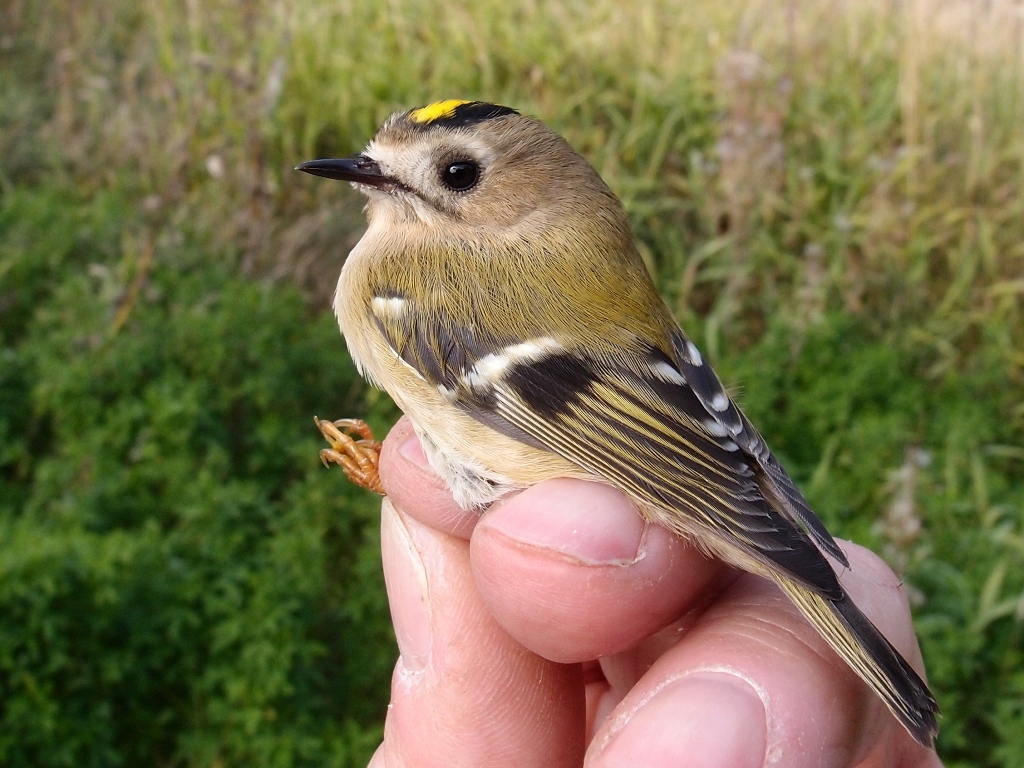
Goldcrests continue to move through the site in good numbers with 349 having been ringed so far this autumn. This Goldcrest was a fat 6.1g so will probably be on the move tonight.
Ringing highlights during the period included a Redwing on the 1st (first to be ringed this autumn), good numbers of Goldcrests each day, the aforementioned Chaffinches, more Lesser Redpolls, good numbers of Blackcaps and Chiffchaffs for October (up here at least) and today's gem - a Yellow-browed Warbler.


The first Redwing ringed this autumn was caught on the 1st just before sunrise, the only Redwing seen that day.


Today's Redwing (one of seven seen) had a wing length of 128mm which is at the top end of the range for 'iliacus' with only a tiny proportion being that large. More to be added on this subject when I have time to look up the stats.

The late breeding season means there are a few more Blackcaps around than usual at this time of year. Most have been juveniles but there have been a couple of adults recently including this female. The late breeding season has had a similar affect on some other migrants including Chiffchaffs.
A 'Poll' to ponder on. A bit paler than your average Lesser and larger too with a wing of 75mm. There seem to be more dodgy (paler) Lessers around this autumn or is it just me.
An adult female Lesser Redpoll with an amber poll. Thinking about it I am fairly sure that all the Redpolls with amber coloured polls that I have caught and was able to sex have been females.
With so many Yellow-browed Warblers in the country it was perhaps almost inevitable that one would come my way sooner or later.
Such a smart bird deserves a second photo.
Combined ringing totals for 1st to 4th October (retraps/controls in brackets) were: Great Spotted Woodpecker 1; Dunnock 1; Robin 4 (2); Song Thrush 2; Redwing 2; Blackcap 7; Yellow-browed Warbler 1; Chiffchaff 14 (1); Goldcrest 67 (1); Long-tailed Tit 8 (1); Willow Tit (1); Coal Tit 1 (1), Great Tit 1 (1); Chaffinch 40; Greenfinch 1; Goldfinch 1; Siskin 2; Lesser Redpoll 31 (1); Yellowhammer 1. Total 185 new birds, 8 retraps and 1 control.

Friday, 19 September 2014

Eastern delight.

It is always good to catch a Yellow-browed Warbler especially when it is almost on your doorstep. They say every picture paints a thousand words.............................................


...............................................................................................enough said.

Saturday, 6 October 2012

Yellow-browed Warbler brightens a quiet day


The fairly light winds tempted me to try a late afternoon and evening ringing session at Scotman’s Flash to see if there were any late Reed Warblers present or Swallows coming to roost. I only put up two nets; one in the reeds and another in a patch of willows within the reeds. 


Willow net ride
The net in the willows produced the only birds starting with a Chiffchaff, a Blue Tit and two Willow Tits. The second Willow Tit had just gone in the net when I noticed a small warbler flitting in the crown of the large willow at the side of the net. As soon as I got my bins on it I was blown away by a stunning Yellow-browed Warbler illuminated by the last rays of the day’s sunshine. I watched it for about 15 seconds before it was lost to view. I scanned the bush for a minute or so but couldn’t relocate it and then realised why; it was in the bottom of the net.


Yellow-browed Warbler (Phylloscopus inornatus)


Yellow-browed Warbler (Phylloscopus inornatus)

Scotman’s Ringing Totals
Chiffchaff 1
Yellow-browed Warbler 1
Blue Tit 3
Willow Tit 1 (+1)
Total 7 

I had been out ringing earlier in the day at Longshaw but packed up after a couple of hours as the ringing was so slow. There was virtually nothing passing overhead despite the clear blue skies and very little in the bushes. 

Longshaw Totals
Goldcrest 2
Chiffchaff 1
Treecreeper 1
Blackcap 2
Coal Tit 1
Robin 1
Total 8
Treecreeper (Certhia familiaris)