Showing posts with label Waxwings. Show all posts

Friday, 10 May 2013

Waxwing lyrical part 39 - this could be it.

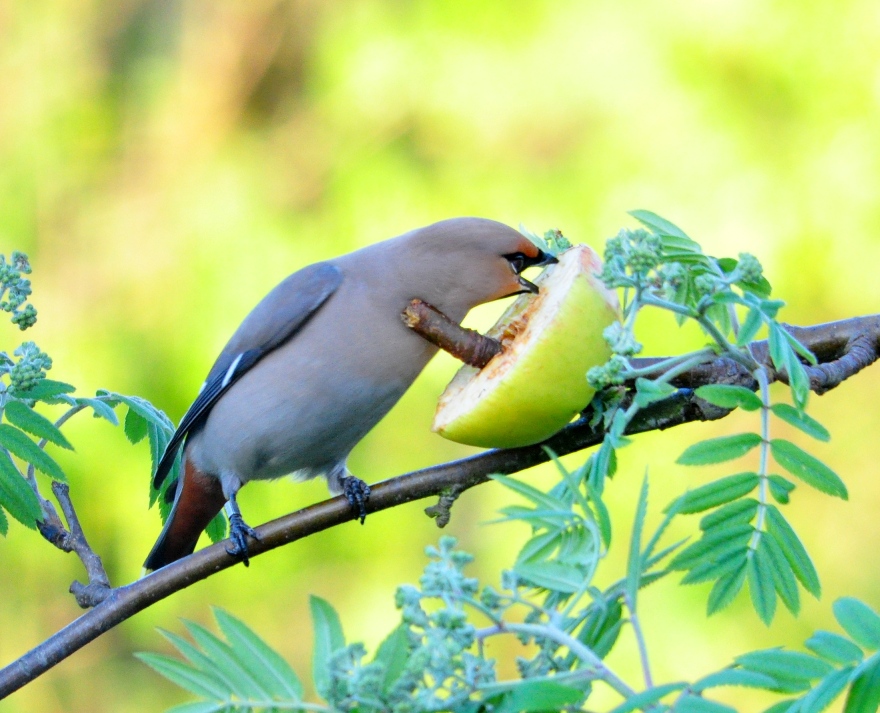
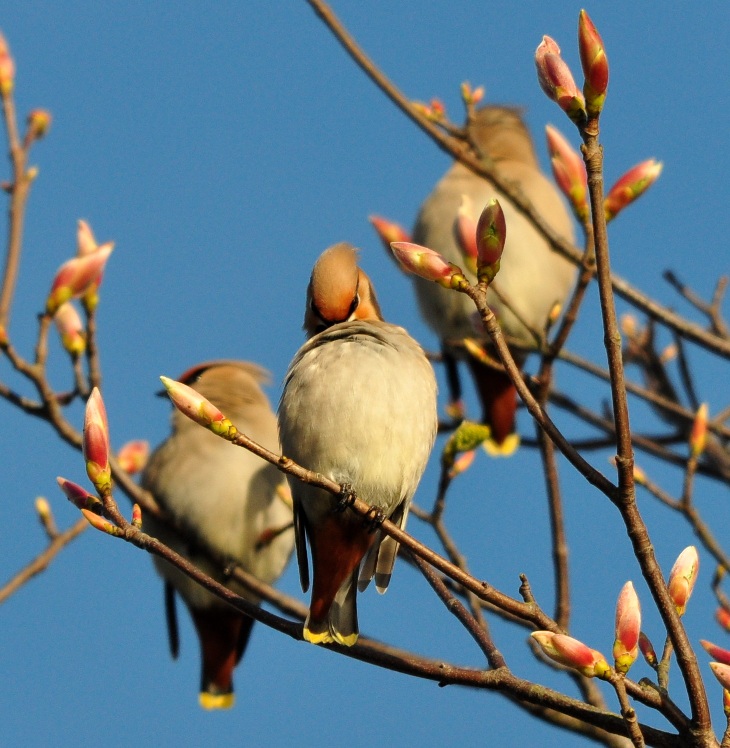
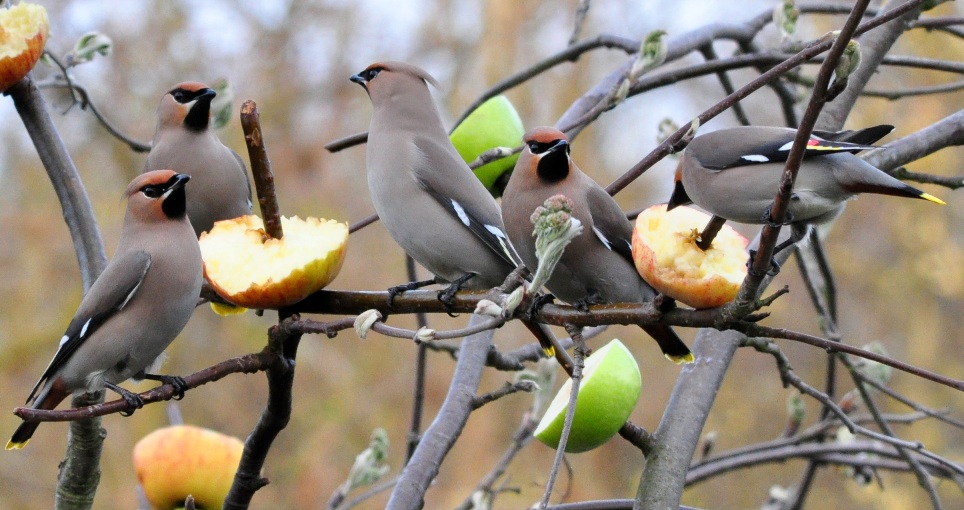
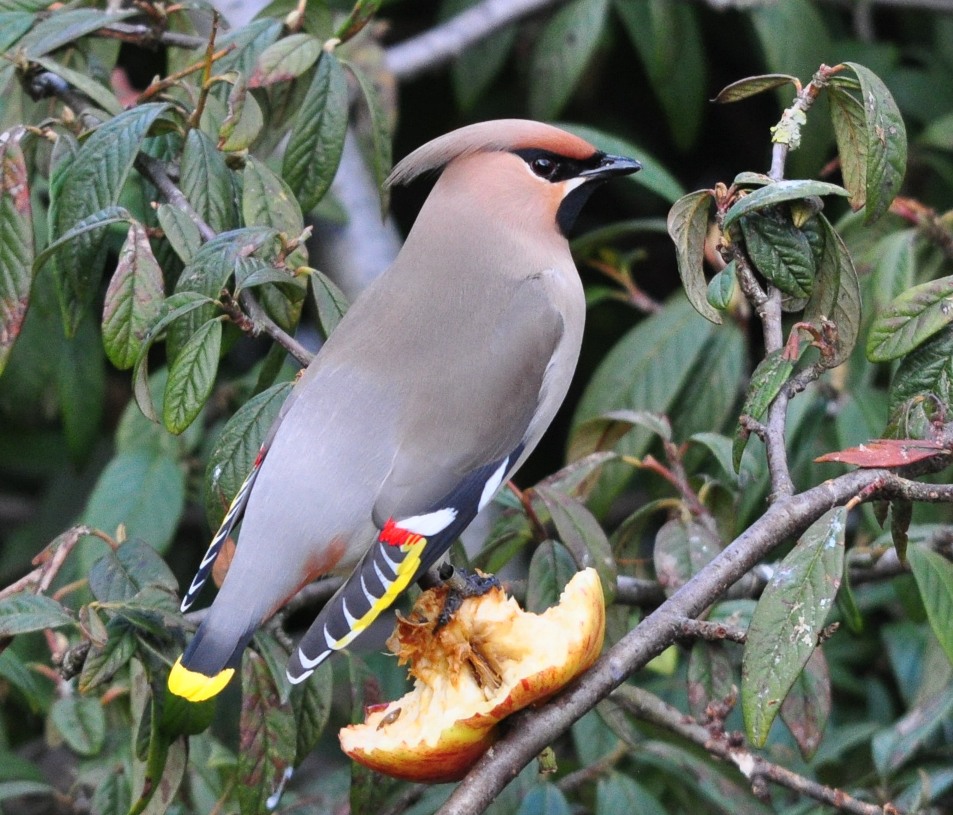
I managed a bit of a lie in yesterday morning but I was still up quite early as I can't seem to shake the habit. I didn't see any Waxwings before going to work so it looks like the last few have now gone. There were only three in the garden on Wednesday and they were last seen at 8pm. I managed to get a few photos in the evening as I suspected it could be the last time I would see them. The tree they were feeding in was shaded by the house but the trees in the background were lit by the setting sun which made for difficult lighting conditions.

The last 3 are in here. Photo taken 19:58hrs 08/05/13


One last bite.


"до свидания"

As alert as ever.
Now we seem to have reached the end I would like to thank those who have donated apples or money so I could see this through to its natural conclusion. At peak it was costing around £25 each day in apples and the support at that time made it more affordable so a big thank you to you all. It also means the data accumulated is all the more valuable as food supply has not been a limiting factor to the numbers recorded. The graph below shows how the number of Waxwings has declined from its peak as birds have left for their breeding grounds.


The decline in the number of Waxwings recorded.
This will not be the last Waxwing lyrical post but any future posts are likely to be few and far between. There will be a round-up of the ringing totals and all the controls in due course along with a review in pictures. At some point there could be some interesting recoveries to report and then there is the retrap data to look at especially the weight increases as the birds prepared to migrate.

Anyway I hope you have enjoyed these posts over the past 3 months.

Monday, 6 May 2013

Waxwing lyrical part 38 - and then there were 9

I still haven't had the proper lie-in that I have been promising myself for the past 3 months but I should be able to any day now. I was up at daft o'clock again today to see how many Waxwings would arrive and as the post title has already indicated there were only 9. Just before sunrise has been the best time to count the Waxwings as they generally sit up in the trees before coming down to feed and that now means being up just after 5:00am. I have gone back to bed for an hour our two after counting them on a couple of occasions but those have been very rare exceptions.

It is clear from the weight data I have gathered when ringing the birds that reaching the right weight is key to the timing of their departure. That weight may vary slightly between individuals but they generally need to increase their body weight by about 40% from their lean winter weight before they are ready to go. That extra weight is predominantly fat but there will be an associated increase in muscle simply to carry all the extra weight.


This one is surely ready to go.
Today has been very warm and a complete contrast to when the first bird turned up on a snowy February morning. It was interesting to watch and photograph them in the fresh greenery of the trees now that they are finally coming into leaf. Waxwings can be very unobtrusive against the bark of the trees and in the dappled light under the canopy.
 

Waxwings are really quite well camouflaged against the bark of trees and a jumble of branches.

Zoom in and you can see how the body feathers matches the colour of the bark.
The mask, bib and under tail coverts help break up the bird's outline.
The following 3 photographs are included for the fresh greenery and glorious sunshine of today; not how you would normally expect to see Waxwings in this country.


I wish I had used a faster shutter speed and this had been sharp
...................and finally one bird actually waved me goodbye.
 
 
If you believe that you will believe anything but photoshop was not involved! Still a great photo whether today turns out to be the last day they are here or not. When I was taking the photographs someone passing by said 'hasn't the novelty worn off'. With Waxwings and photographs like these what do you think.


Friday, 3 May 2013

Waxwing lyrical part 37 - fat but not enough

Well they are still here or 19 of them are to be more precise. They are getting the same care and attention as the first bird did and the hundreds since. I am going to see this through in the same way as I started with the last bird being valued as much as the first. I only need to put out 3kg of apples now but the birds have eaten well over a tonne of apples since the first bird turned up back in February or over 2,200lb if you prefer imperial.


The 19 present today.
 

A tonne of apples works out at around 7,000 apples so that means I have put out around 14,000 apple halves over the past 80 days. Quite a lot of those apples have been put in the trees using the extension ladder and I estimate that I have climbed over 3,000ft in the process. If you total up the number of Waxwings I have seen over the past 80 days it gives a total of 5951 bird days. These figures give an average of 168g of apple per day per bird over the period although I have yet to crunch the numbers in detail and there is some wastage to make an allowance for. The average consumption is likely to be just under 150g per bird each day over the time I have been feeding them.


A very green scene compared to a couple of weeks ago.
I put a couple of nets up this morning and caught 5 of the remaining Waxwings in one catch. They were all retraps although one of these retraps was a control (ringed elsewhere) that I had caught before. None of the birds caught today was particularly heavy so these birds may be around for a few days yet (famous last words). All but one bird had shown a weight gain but all were still under 70g so need to put on a bit more weight before migrating.


Looks quite plump but still needs to put on a few more grams.

A very pear shaped Waxwing, all the weight has gone south on this bird.
Sparrowhawks are still paying the birds quite a bit of attention and usually flush them several times a day but they have not been seen making a kill recently. I grabbed the photo below through the front window yesterday. Today the birds were also flushed by a stunning Hobby which wasn't interested in the Waxwings and was just passing through over the roof tops.

This bird attacked out of the sun early yesterday morning.
One of several failed attacks made yesterday.
A few Blackcaps are still taking advantage of the apples even though there are quite a few insects around now. The bird photographed today may still be on passage rather than being a local breeding bird. Its feeding behaviour was suggestive of it being a migrant and it looks quite fat too.

Male Blackcap.
After the Waxwing catch I went to my ringing site at Longshaw to try and catch up on some of the routine ringing I would normally do at this time of year. I was hoping for a few passage Redpolls and wasn't disappointed. I caught 10 including a control (a bird ringed elsewhere). These birds showed just about every variation in colour you can get in Lesser Redpolls.
The bird on the right is a warm brown colour typical of Lesser Redpolls but the bird on the left is a much colder grey colour with whiter wing bars more suggestive of Common (Mealy) Redpoll.


Wednesday, 1 May 2013

Waxwing lyrical part 36 - 1st May 2013

My wish to see Waxwings in May came true this morning when 6 arrived at 05:40. I was more than happy with that number but more arrived over the next half hour or so and a maximum of 23 were counted a little while later. They spent more time feeding in the garden today than they have done of late although they still went elsewhere for a while around midday. They were back by mid-afternoon and stayed feeding on and off until 20:05.

The fine weather gave me plenty of opportunities to get a few more photographs although, with more leaves on the trees, getting a clear shot is becoming increasingly difficult. Blackcaps are still taking advantage of the apples too and at least 3 were feeding in the garden today.  I have now ringed 17 Blackcaps since 15th April and many more have passed through without being caught and ringed. Like the Waxwings this number of Blackcaps is totally unprecedented for the area.

The following selection of photos sums up the activity in and around the garden today. Hope you enjoy them.

Soaking up the rays and preening after the initial feed.

Feather management is really important and Waxwings spend a lot of time preening.
Very round and plump. This bird will be as fat as it looks.


This bird also looks very fat.
Getting stuck in.


One of the Blackcaps fattening up on apples today.
Not a local breeding bird judging by her weight.

Take off.

Tuesday, 30 April 2013

Waxwing lyrical part 35 - down but not out.

I now seem to wake up at dawn each morning regardless of how little sleep I have had or my intention to do so. This morning was no different and I got up to see how many, if any, Waxwings would arrive without the aid of an alarm. There had been 62 on Sunday and 46 yesterday but this morning the flock was down to 30. This is still an impressive number and now represents (provisionally at least) the latest record for Waxwings in spring for the county. The previous latest record the county recorder has been able to find being at Bredbury on April 29th 1975.

Having the latest record by a day if confirmed is no big deal in the scheme of things but as time has gone on I have developed a sneaking ambition to see a Waxwing or Waxwings in the garden in May, a fourth calendar month. Today has been glorious and the birds have spent very little time in the garden. Recently they have feeding more on tree flowers, on the berries of ivy and by catching insects away from the garden and they have also been avoiding the attention of the local Sparrowhawk by doing so. Tonight the conditions are perfect for migration with high pressure and crystal clear skies so it remains to be seen if any will be here in the morning.

One thing I haven't found in any literature or on the Internet is any reference to Waxwings being nocturnal migrants like thrushes. Waxwings do migrate during the day but then so do thrushes but thrushes are predominantly nocturnal migrants. Waxwings are probably the same and migrate at night in the main but if anyone can point me to a reference that confirms that one way or the other I would appreciate it.

The odds are probably stacked against any birds being here in the morning given the weather and their recent weight gains but there is always hoping. One thing for sure is that I will wake up automatically again and will be watching from first light to find out. Whatever happens there will be a few more Waxwing lyrical posts to come. I will have to confirm the date of last bird(s) seen, there are a few interesting stats around all the apples consumed and effort involved, there are the details of the origins of the birds controlled to date and there are a few other observations to be thrown in. With a bit of luck there may even be some interesting recoveries to report from all the birds ringed and there are loads of previously unpublished pictures.

I will leave you with a little video titled best of the crests but hopefully there will be a few more to come


.


Saturday, 27 April 2013

Waxwing lyrical part 34 - counting down

The number of Waxwings continues to decline each day. The birds have been piling on weight and the weather has been generally favourable for migration so there is nothing to hold them back once they are ready to go. The graph below shows the numbers I have recorded each day since the first bird turned up and shows the trend in numbers. During March there were still plenty of berries around and numbers didn't really take off until the end of March when the berry supplies had been exhausted and the birds also started to fatten up.

copyright P J Alker


The weight increases some of the birds have shown recently is quite impressive - NW31951, a first winter female, weighed 62.8g on 20/04/13 but weighed 74.3g when retrapped this morning, an increase of 11.5g in 7 days or 18.3%.
NW31942, an adult female, weighed 63.3g on 19/04/13 but weighed 78.5g when retrapped this evening, an increase of 12.2 g in 8 days or 19.3%.


Apples may not be a natural food supply in spring but the data is still valuable and a good measure of their ability to put on weight. The birds are actually less dependant on the apples now and are also feeding on the emerging flowers of various trees. I have seen them feeding on Poplar flowers recently and the emerging flowers of Ash today.


There must be significant nutritional and or energy value in the emerging flowers given the effort the birds put in to get at them. I have  also seen quite a few Wood pigeons feeding on Ash flowers in the past few days.
I only caught 1 new and 4 retrap Waxwings today but one of the retraps was my favourite bird if you can ever have a favourite Waxwing. It was the colour-ringed bird from Aberdeen that was first seen in the garden on 18th February. This bird is a first winter female and has been recorded in the garden 32 times since then and has been caught 4 times. She hasn't shown the rapid weight increases of some birds but is making steady progress. She only weighed 49.3g on 30th March but was 63.0g when retrapped today.


NW65022 retrapped today.
She was first seen on 18th February amd her details can be found by clicking here.
This afternoon I dragged myself away from the Waxwings and surveyed one of my river sites as I normally would at this time of year. A Dipper was carrying food but the nest was inaccessible and a net across the river only produced a Kingfisher although they aren't known to nest on that particular stretch. There will be plenty for me to do once the Waxwings have finally gone but I may have a lie-in or two first.


Kingfisher (Alcedo atthis) 27/04/13


Tuesday, 23 April 2013

Waxwing lyrical part 33 - full to bursting

Waxwing numbers have continued to decline as more birds have reached the desired weight for migration. This seems to be around 75g judging by the weights of the birds retrapped recently and means that around one third of their body weight will be made up of fat deposits. This will allow them to migrate a long distance without the need to stop and feed or with limited stop overs to top up and if bad weather halts their migration.

There were only 111 birds this morning give or take one or two. Only is probably the wrong word as 111 Waxwings in the garden was unimaginable just a few weeks ago but numbers have almost halved over the last week. This fits in well with the decline in sightings being reported across the uk. Some birds will already be well on their way back to the main breeding grounds in Russia and a few early birds may have even arrived at the closest breeding grounds in Finland and western Russia.

The Waxwings as they gathered at sunrise this morning (23/04/13)
Most of the remaining birds actually look really fat now so they may not be here for much longer and most are likely to depart over the next week with just a chance of a few lingering into early May. They also appear to be less agile and a bit more sluggish when taking off as a result of the extra weight they are carrying. This probably makes them a little more vulnerable when the Sparrowhawk attacks and predation by Sparrowhawks has increased over the past few days.

Fatwings (Bombycilla blubberus), These birds were still feeding at 19:40 this evening.

Fatwings (Bombycilla blubberus), The same two birds as above..
This bird is clearly very fat. It is the same bird as the one on the left in both photos bove.
I would like to be able to catch it for ringing and to see what it weighs.
I suspect it would be over 75g and could even be over 80g so is likely to leave any time now.
One birdwatcher witnessed a Waxwing being taken by a Sparrowhawk the other day but overall Sparrowhawk predation has generally been less than than it might have been. However the attacks do cause the birds to go elsewhere for long periods and if predation increases it could hasten their departure. Some Sparrowhawks in Aberdeen seem to specialise on Waxwings and you can find out more by clicking here.

You can see how some birds look much plumper than others.
The bird on the lower left is likely to be the light weight in this bunch.
 

Saturday, 20 April 2013

Waxwing lyrical part 32 - Blackcap bonanza

It may seem strange including Blackcap in the title but this post is still about the Waxwings. I had arranged to do another ringing session this morning and was joined by Duncan Bell who had driven up from Hampshire overnight such is the lure of Waxwings. Duncan drove up a few weeks ago and featured in my post Waxwing lyrical part 10 - the big grin. We arranged to meet at around 05:30 and John G also joined us before going to work.

The first few birds arrived just as we had finished putting up the nets at around 06:00. We retired to the house and waited for the rest of the birds to arrive. Duncan was in the chair by the window and counted in the squadrons of Waxwings as they arrived. Numbers built up quite quickly with at least 120 present by 06:20. This is a significant reduction in numbers on a few days ago and shows that the birds are finally starting to leave in good numbers. This was fairly predictable given the weights some of the birds had reached and the good weather.

Birds soon dropped down and started feeding on the apples in the garden with Duncan describing it as the greatest show on earth; it is something quite special watching them all glide down into the garden. On the first round of the nets we caught 11 Waxwings and 2 Blackcaps. Now a couple of Blackcaps isn't that unusual in the second half of April but we subsequently noticed that there were quite a few around feeding on the apples. There must have been an arrival of these warblers overnight and they were taking full advantage of the Waxwing's apples to refuel. It was difficult to gauge their numbers as some birds seemed to feed for a while and then move on but there were at least 9 Blackcaps and there could have been a few more. That sort of concentration wouldn't be very unusual on the coast in autumn but is exceptional inland in spring and in such a small area.

I get the odd Blackcap in winter so I have seen Blackcaps feeding with the Waxwings before but to see several in amongst the Waxwings seemed really strange. Unfortunately they weren't easy to photograph as they didn't go quite as far as sharing an apple.


Who has been eating my apples.
Spot the female Blackcap
We caught quite a few retrap Waxwings that showed good weight gains and most were carrying moderate levels of a fat. There were few very heavy birds that weighed over 70g and these are likely to be the next to leave. One of the birds caught was a control (ringed elsewhere) and its ring number was very close to the ring numbers of two other birds we have controlled; the ring numbers of these three birds almost being consecutive (NW236 _ _ series). It will be interesting to find out where these birds were ringed. We took the nets down before mid morning having caught 28 Waxwings including retraps and the control, 4 Blackcaps and a Wren.

Much of the rest of the morning and afternoon was spent taking a few photographs and inputting the ringing data onto the computer. Blackcaps continued to feed on the apples with the Waxwings so I put a net up again in the early evening and caught 2 more along with 2 Long-tailed Tits and a Great Tit.


Female Blackcap.
Male Blackcap
adult male Waxwing

adult female Waxwing

This bird is fat but not as fat as it looks in this shot.
It had just fluffed up and was shaking its feathers.
Ringing totals for 20/04/13 with retraps in brackets.
Waxwing 12 (15 + 1 control)
Blackcap 6
Great Tit 1
Long-tailed Tit 2
Wren 1
Total 22 (15 + 1 control)