Showing posts with label Black-headed Gull. Show all posts

Wednesday, 28 October 2020

Many happy returns

Last Friday, 23/10/2020, I was really pleased to find the German ringed Black-headed Gull (IA141745) had returned to Orrell Water Park. This bird has featured on the blog many times and its return always cheers me up. It was first sighted at Orrell Water Park on 27/10/2012 and has been recorded numerous times each winter since then, usually between late October and late February or early March. It was ringed as an adult on 29/04/2012 in northern Germany, not far from the Baltic coast and the border with Poland, and presumably breeds in that area.


IA141745 photographed 23/10/2020


A well worn and photographed ring.

Thursday, 31 October 2019

Black-headed Gulls - old and new.


A few days ago (26/10/19) I went to feed the Black-headed Gulls at Orrell Water Park to check for ringed birds and one of the first to come to the bread had a metal ring on the right leg. I quickly identified it as the German ringed bird from the Hiddensee scheme that has wintered at the park each year since 2012. It has been recorded on over 90 occasions and is usually present from October to late February or early March. It appeared to be the only ringed gull present and I had almost run out of bread when a colour-ringed bird joined the 40 or so gulls present. It had a yellow colour-ring inscribed with the code T3WA on the right leg and a metal ring on the left. I hadn't seen this this particular individual before and had no idea where it had been ringed.

On getting home I checked the cr-birding website (link here) and quickly found that T3WA was a Polish ringed bird. I submitted details of the sighting on the Polish ringing scheme website and received details of where it was ringed the next day. It had been ringed on 17/06/2019 in central Poland at Skoki Duze, Kujawsko-Pomorskie, which is 1472km east of Orrell Water Park.

I didn't have my camera with me that first day but I have photographed both birds since.

DEH IA141745 photographed 27/10/2019

T3WA photographed 30/10/2019

T3WA photographed 30/10/2019


Map to be added in due course.


Tuesday, 4 December 2018

Returning Black-heads

No lotions, potions or squeezing required in this case as the returning Black-heads, as you will have realised, are Black-headed Gulls. I started checking the gulls that come to bread at Orrell Water Park back in October and I was really pleased to find IA141745 was present on 08/10/2018. This bird was ringed as an adult on 29/04/2012 at Bohmke und Werder, Germany, near the Baltic coast and border with Poland, and has been recorded at Orrell Water Park each winter since then.


Black-headed Gull IA141745 back for its 5th winter.
This photograph was taken yesterday but it has been present since 08/10/2018, at least.

The next ringed Black-head to return was photographed on 29/10/18 and was another German bird. This bird was originally ringed as a nestling on 10/06/2016 at Esterweger Dose, Weser-Ems in north-west Germany and was previously recorded at Orrell Water Park from 02/10/2017 to 17/03/2018.


Black-headed Gull 5437612
Photographed on 29/10/2018 and recorded several times since, most recently on 29/11/2018.
A check of the gulls on 11/11/2018 produced another returning bird but this time it was a British ringed Black-headed Gull EZ33149. This bird was ringed as a nestling on 20/06/2017 at Elvanfoot, South Lanarkshire and was previously recorded at Orrell Water Park between 10/11/2017 and 17/03/2018.


EZ33149 just wouldn't stand still for very long so I concentrated on getting photographs of the ring rather than the bird. I only just managed to get the full number but it took 25 photographs along with a lot of cropping and some enhancement afterwards.
Only 4 ringed Black-headed Gulls were recorded at Orrell Water Park in the whole of last winter so to have 3 of them back already is a very good return rate and shows how site faithful they can be.


Sunday, 4 March 2018

Not much to report from the cold weather.

The recent cold weather didn't result in any significant increase in birds visiting my garden and perhaps that is because we didn't get much snow in this area. Siskin, Long-tailed Tit and Starling actually visited less frequently and in smaller numbers than they had before the onset of the cold weather, which was a bit of a surprise. The smaller numbers of Siskin and Long-tailed Tit was mirrored by a dip in the BirdTrack reporting rate so it wasn't just a local phenomena as far as those species were concerned. On the other hand, the reporting rate for Starling increased on BirdTrack so my garden bucked the trend in that case. Garden birds just didn't seem to be pushed for food in this neck of the woods and the only unusual visitor I had in the garden was a Black-headed Gull that dropped in and took some bread from the lawn. It was a one legged individual and would have found feeding more difficult at the best of times so the fact that it risked landing in a small enclosed garden, crossed by telephone lines, during a severe cold spell is not as surprising as it otherwise might have been.

I have seen some effects of the cold weather when out an about including a few Woodcock in unexpected places, a sizeable flock of Redwing foraging in a woodland and a few displaced Meadow Pipits, but that is about it for me. Several checks of the Black-headed Gulls on Orrell Water Park have only produced one ringed bird that I have not encountered before and that bird was ringed as an adult near Hempsted in Gloucestershire on 13th  January 2007. The Scottish and 2 German ringed Black-headed Gulls have been seen from time to time and all 4 ringed Black-headed Gulls were photographed yesterday along with a ringed Coot that was originally ringed in south Wales. 

EL71428 first photographed on 28/02/2018 and again yesterday.

It rarely kept still so I had to take quite a few photographs before I managed to get the full ring number - EL71428

Scottish ringed Black-headed Gull EZ33149 has been a regular this winter.

German ringed Black-headed Gull DEH IA141745 almost has a full brown hood now.

 German ringed Black-headed Gull DEW 5437612 has barely started to get its brown hood.

Coot GR03863 was originally ringed at Comeston Lakes, near Penarth, Vale of Glamorgan on 23/12/2010 and has been recorded at Orrell Water Park on numerous occasions since. 


Wednesday, 14 February 2018

Recoveries

Details of the Helgoland scheme Black-headed Gull came through recently. It has become a regular at Orrell Water Park since the first sighting last October and has been recorded a total of 17 times up to 9th February.

Black-headed Gull       DEW 5437612
Nestling                       10-Jun-2016       Esterweger Dose, Weser-Ems, Germany
Ring read in field         02-Oct-2017       near Orrell, Greater Manchester, UK
Ring read in field         09-Feb-2018      near Orrell, Greater Manchester, UK
Duration: 609 days      Distance: 688 km       Direction: W


Black-headed Gull 5437612 photographed 09/02/18

The Hiddensee scheme Black-headed Gull IA141745 has featured in this blog many times before and has been a regular at Orrell Water Park again this winter. It was first recorded in autumn 2012 and has been recorded each autumn/winter since then. It has now been sighted on a total of 83 occasions up to 09/02/18 and is possibly one of the most photographed Black-headed Gulls in the UK as a result.

Black-headed Gull        DEH IA141745

Full grown male            29-Apr-2012      Bohmke und Werder, Mecklenburg - Vorpommern, Germany
Ring read in field          27-Oct-2012      near Orrell, Greater Manchester, UK
Ring read in field          09-Feb-2018      near Orrell, Greater Manchester, UK
Duration: 2112 days     Distance: 1102 km      Direction: W


Black-headed Gull IA141745 photographed 09/02/18

British ringed Black-headed Gull EZ33149 has been another regular at Orrell Water Park this winter and has been recorded on 8 occasions so far (first and most recent date given below).

Black-headed Gull        EZ33149

Nestling                        20-Jun-2017      Elvanfoot, South Lanarkshire, UK
Ring read in field          10-Nov-2017     near Orrell, Greater Manchester, UK
Ring read in field          09-Feb-2018     near Orrell, Greater Manchester, UK
Duration: 234 days       Distance: 222 km       Direction: SSE


Black-headed Gull EZ33149 photographed 09/02/18


A Lesser Redpoll controlled at Billinge last October had been ringed just 5 days earlier but the details only came through a little earlier this year. It is unusual in that it had moved in the opposite direction to that usually expected in autumn and the movement is made even more intriguing because it involved an adult.

Lesser Redpoll             S341203

Adult female                 26-Oct-2017     Lichfield Block, Cannock Chase, Staffordshire, UK
Caught by ringer          31-Oct-2017     Billinge Hill, near Billinge, Merseyside, UK
Duration: 5 days           Distance: 94 km          Direction: NNW


Adult female Lesser Redpoll S341203 photographed 31/10/17
                                                                                                            

A Siskin that was ringed in my garden on 14th April 2016, a relatively late spring date for the garden, was caught by a ringer in western Scotland just a few days ago. Siskins migrate more in some years than others in response to the availability of food and this bird has clearly been able to stay much further north this winter.

Siskin                           S144891

2CY Male                     14-Apr-2016      near Orrell, Greater Manchester, UK
Caught by ringer          11-Feb-2018      Kilmartin, Argyll and Bute, UK
Duration: 668 days       Distance: 339 km       Direction: NNW


Lastly, a Yellowhammer was recovered after falling prey to a Sparrowhawk. It hadn't moved far as is to be expected from this largely sedentary species but it still provides valuable information on lifespan along with timing and cause of death. 


Yellowhammer             TP63714
Adult male                   24-Jul-2014      Billinge Hill, near Billinge, Merseyside, UK
Predated                     25-Jan-2018     Houghwood Golf Course, Billinge Hill, Merseyside
Killed by Sparrowhawk under pheasant feeder.

Duration: 1281 days    Distance: 2 km           Direction: W

Friday, 12 January 2018

Still here, and ageing.

Apologies for the lack of posts in recent weeks but there has been a lot going on on the domestic and family front to say the least. Added to that the birding has been fairly quiet around here so there hasn't been a huge amount of interest to blog about anyway. For what it is worth here is a summary of what I have been doing on the avian front over the last few weeks.

A total of 121 birds were ringed during December and another 68 were retrapped or resighted with much of that total coming from birds ringed in the garden. Goldfinches topped the totals with 36 ringed and Starling topped the retraps / resightings with 39 records, mainly resightings of colour-ringed birds. The only unusual ringing activity involved Siskins with a total of 7 ringed (6 in the garden and 1 at Billinge) which is an exceptional number for December.

Interestingly, the first Siskin was seen on the feeders in garden on 20th November and it was already ringed. A few days later 2 were coming to the feeders, both of which were wearing rings and both were adults so there is a chance they were returnees rather than birds that had been ringed elsewhere. I expected to catch one or both of theses birds as they continued to visit fairly regularly so it was a bit of a surprise when I caught 3 new birds in early December. A few Siskins continued to visit the feeders on a daily basis throughout December and at least 8 individuals were involved. In previous winters it has been mid to late January before they start coming to the garden on a regular basis so to have them start two months early is really unusual for here. This change doesn't seem to have been caused by any sort of food shortage as there are still plenty seeds in the alder cones. In fact Goldfinches were more hit and miss in the garden during December and this has continued on into January as they are spending quite a lot of time feeding in alders. This shows there is still an abundance of alder seeds to be had in the local area and it is probably also true of the wider countryside.

I have almost finished submitting my 2017 ringing data to the BTO and just need to do some final checks. Provisional totals for 2017 ended up at 4183 new birds and there were another 958 recaptures or resightings. The top 5 species ringed accounted for more than half the total as detailed below (again provisional totals for now):

Species        New Birds         Retraps/resightings
Goldcrest         669                            30
Starling            621                          567
Redwing          425                              0
Goldfinch         366                            41
Chiffchaff         295                            30

I have also been checking through the gulls and waterfowl that come to bread at Orrell Water Park (as usual) and have photographed the ring numbers of 3 Black-headed Gulls (2 from Germany and 1 from Scotland), a ringed Coot (from south Wales) and a Canada Goose (from Cheshire). All could be considered regulars to a greater or lesser degree as they were all recorded more than once during December and one of the German gulls, the Coot and Canada Goose have been recorded in previous winters.

EZ33149 was ringed as a chick at Elvanfoot, South Lanarkshire on 20/06/2017 which is 222 km NNW of Orrell Water Park.


Sometimes I only need to take a few photos to get the full ring number but in many cases I have to take dozens to be sure. While these are crops most of my photos of ringed birds are just of their legs rather that the whole bird.

Best foot forward. This is the German ringed bird from the Helgoland scheme. It has been recorded 11 times so far this winter but I still haven't received the ringing details so don't know when or where in Germany it was ringed.

I am spoiled for choice when it comes to photos of this bird, or at least its legs. IA141745 has been recorded 15 times so far this winter and over 70 times since the first sighting in October 2012. It was originally ringed as an adult in Bohmke und Werder, Mecklenburg - Vorpommern, Germany on 29/04/2012 and is pretty much a fixture at the park between October and February.

GR03863 is what you could call an old(ish) Coot as it was originally ringed as a first-year on 23/12/10 so is a little over 7 years old. It is well short of the UK longevity record for the species which currently stands at just over 15 years but it is probably older than your average Coot. It was ringed 236 km south at Comeston Lakes, near Penarth in the Vale of Glamorgan during a spell of very cold weather but has been recorded up here 17 times since, most recently on 27/12/2017, so was probably a cold weather refugee when ringed.

The New Year hasn't seen much in the way of change as yet. Both German ringed Black-headed Gulls were photographed on the 1st and both have been recorded since. A few Siskins continue to visit the feeders in the garden on a daily basis and another 2 have been ringed. I have also resighted 25 different colour-ringed Starlings at the feeders and caught and colour-ringed another 2.


7 of the 8 Siskins ringed this winter have been adults. This adult male was caught on 10/01/2018. All the wing feathers including the coverts were relatively fresh, the colours were intense so there was no sign of any moult limits


The tail was equally unworn and again the colours were intense but the shape of the tail feathers was at the more pointed end of the range for adults. Adults with a relatively pointed tail like this can catch out the inexperienced and unwary but close examination reveals a neat pale fringe to the edges of all tail feathers and no signs of wear. In this shot you can just see that the primary tips are similarly fresh looking so no doubt it is an adult.

N34 is a female and was originally ringed as a juvenile on 18th May last year.
One notable absentee from the garden this winter has been Blackcap. I usually get one or two over the course of a winter and the first sighting usually comes before the end of December so to not have seen one by now is bucking the trend of the last few years. While Blackcaps have been absent I have got 2 Goldcrests feeding on the fat balls and fat cakes. This is relatively new behaviour for Goldcrests in my garden and although I have seen it before it is unlikely to become common and widespread, as happened with Long-tailed Tits some years back, as they are not very social in winter or long lived so the opportunities for such behaviour to spread in the population are not there.

Not the best photo but it is what you might call a decent record shot. The tail shape is in the intermediate range but it could be an adult and is possibly an individual that came to the feeders last winter. In addition to feeding on the fat balls and fat cakes direct it also picks up tiny fragments that have fallen on to the wire mesh and branches below or on fragments that have been wiped on the wire mesh and branches by other birds when cleaning their bills.
Another even more notable absentee from the garden, and one that is getting increasingly easy to forget, has been the humble House Sparrow. I haven't seen one at the feeders this year and only saw one during the whole of December, which is a really sorry state of affairs. If records from my garden and the local area are anything to go by they are still in marked decline around here.

So that brings things up to date, more or less, and with a bit of luck it won't be the best part of 4 weeks before my next post.


Monday, 2 October 2017

German ringed Black-headed Gulls

I walked across the road to Orrell Water Park this afternoon to see if the regular German ringed Black-headed Gull had returned for a 6th winter. There were about 50 Black-headed Gulls waiting on the edge of the lake by the car park so I threw them some bread to bring them closer and I soon spotted one with a ring. I managed to get some photographs of it in the melee of feeding gulls and on checking them on the back of the camera I could see it was regular wintering bird that has been recorded more than 60 times over the last 5 winters.

IA141745    Black-headed Gull (ringed as an adult male)
Ringed              29/04/2012  Bohmke und Werder, Mecklenburg-Vorpommern, Germany.
Photographed   02/10/2017 Orrell Water Park, Orrell, Greater Manchester. 1102 km W.
I soon noticed there was another ringed Black-headed Gull but it kept weaving between the other gulls and was a bit more difficult to photograph. I must have taken around 100 photographs before I thought I had secured the full ring number and address on the ring. On returning home I reviewed the photos on the laptop and was able to work out the full ring number and it was a German ring from the Heligoland ringing scheme (ring address Helgoland, Germania).


I have submitted the details of the ring number to BTO and hopefully I will get the ringing information back fairly quickly but it can take several months when a foreign ringing scheme is involved. When I do get the details back I will post them on the blog.

Thursday, 1 December 2016

A walk in the park.

I took one of the dogs for a walk through Orrell Water Park and around some of the adjacent farmland at lunchtime and it produced some really good sightings. I had only just walked into the park when I came across 15 Goosanders on the top lake which is easily a record count for the site. There has been a really confiding bird recently and that one even comes out of the water for bread, but the species is normally a scarce and visitor (in low single figures) and they usually fly off as soon as there are a few people around. This flock was remarkably settled and didn't seem to mind numerous people and their dogs walking round what is only a very small lake. The light wasn't very good but I thought it was worth getting a few record shots so I nipped back home for the camera.


After getting a few photos I carried on through the park and around one of the adjacent fields that has been holding a small roost of Snipe. I only counted 9 but there could have been a few more as they can be difficult to see if they are well hunkered down. I first noticed that Snipe were roosting in this field on 12th November, when I counted 19, and a few days later (15th) there were at least 27. I have not seen Snipe roosting in a field of winter cereal before and it was even more surprising because there is a very popular dog walking route that goes around the perimeter of this field.


There are at least 9 Snipe in this photo, 6 in the little huddle and at least 3 others dotted about to the right.


A zoomed in view of the huddle taken from a closer vantage point.
After checking out the Snipe and throwing a ball for the dog for a while I headed back towards the park and home. The light was a little better as I was passing the top lake in the park and the Goosanders were still there so I took a few more photographs.


12 of the 15 Goosanders plus a Great Crested Grebe.


This Great Crested Grebe is a youngster from a late brood and semi-mingled with the Goosanders. It also indulged in a bit of display towards them at one point as can be seen from the sequence of shots below.


After photographing the Goosanders I decided to check out the gulls by the car park so I took the dog home and grabbed a few slices of bread. Somebody was already feeding the gulls and tame wildfowl as I approached and it wasn't long before I saw a familiar ringed bird. It was the German ringed Black-headed Gull that I first recorded on 27/10/2012 and has wintered at the site each year since. It is usually present from late October to late February and is often one of the first birds to come to any handouts.


German ringed Black-headed Gull.
IA141745    Black-headed Gull (ringed as an adult)
Ringed              29/04/2012  Bohmke und Werder, Mecklenburg-Vorpommern, Germany.
Photographed   01/12/2016 Orrell Water Park, Orrell, Greater Manchester. 1102 km W.


IA141745 wasn't the only ringed Black-headed Gull and I also noticed one with a green colour ring inscribed J360P. This is a bird I hadn't seen or photographed before and it also had a metal ring with number K06036 and Stavanger as part of the address, so it was obviously a Norwegian ringed bird. A did a quick search on the internet when I returned home and soon found the colour ringing scheme and a site where I could report the bird and access the ringing data as detailed below.


Norwegian ringed Black-headed Gull
K06036 (J36P)  Black-headed Gull (ringed as a chick)
Ringed              14/06/2015  Søndre LangÃ¥ra, Frogn, Akershus & Oslo, Norway.
Photographed   01/12/2016  Orrell Water Park, Orrell, Greater Manchester. 1065 km SW.


I also photographed a colour-ringed Canada Goose. This bird was originally ringed in Cheshire and I have recorded it numerous times already this year.


Canada Goose C75
5260475   Canada Goose (ringed as a first year)
Ringed              05/09/2013  Baddiley Meres, Natwich, Cheshire.
Photographed   01/12/2016  Orrell Water Park, Orrell, Greater Manchester. 53 km N.

All in all not a bad set of sightings in the space of an hour or so.

Wednesday, 24 February 2016

Fair weather birding

Today has been a thoroughly nice day. It started with a very brief ringing session in the garden that produced 8 new and 4 retrap Siskins but only 1 new Goldfinch. I then went for a walk around Orrell Water Park to make the most of the glorious weather and got a few nice photos in the process.


It was interesting to see the German-ringed Black-headed Gull now that it is close to having a full brown hood.

Hood development of the German ringed Black-headed Gull IA141745.
It is a shame I didn't photograph it in early February

I nearly missed the drake Mandarin asleep on the bank.


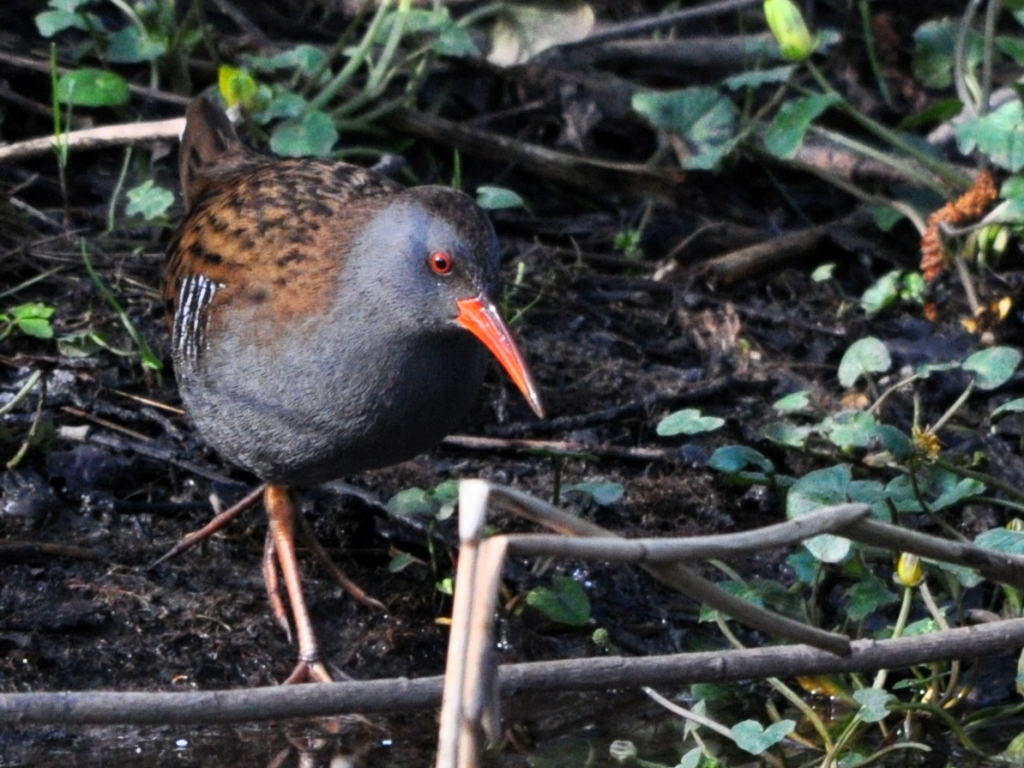
Although the Water Rail showed well it was often partially obscured by vegetation or was in the shade as in this photo.
Eventually I got some photos in better light.
That long bill is being put to good use again but they will also push the whole of the head under water if they need to. The eye isn't clear in this photo because it is covered by the nictitating membrane which is used to protect the eye whilst maintaining some vision at the same time. It mainly seemed to be finding and eating caddisfly larvae.


Birds are accustomed to people putting seed on the top of the fence and quickly respond to any fresh handouts. I managed to get part of this male Reed Bunting's ring number and it is from a sequence that was used between 4 and 6 years ago. It wasn't ringed in the park but it could have been ringed at the nearby Longshaw site.


Female Yellowhammer.
Yellowhammers only take advantage of this food source in late winter and early spring and sometimes allow fairly close approach.

Male Yellowhammer

Male Yellowhammer
I hadn't seen Moorhens feeding on the fence top before today.

The fine weather stimulated many birds to sing and this Robins was in fine voice.

The Mandarin was out on the water when I was making my way back home.

I am not sure how long this Great Crested Grebe has been sitting but I think it has been at least a couple of weeks. 

When I got home I checked through the Siskins that were feeding in the garden and most were unringed. I never see more than about a dozen in the garden at any one time but there could be as many as 30 or 40 that come to the feeders over the course of a day.

Unringed male Siskin

To cap off a good day the Belgian-ringed Blackcap showed well in the late afternoon. 
It spent more time feeding on the ground than it usually does and was eating the scraps that fall from the sunflower heart feeders and fat cakes.