Showing posts with label Moorhen. Show all posts

Sunday, 22 November 2020

Conifer loving Moorhen

The Moorhen has been a regular in the garden all week and its favourite hiding spot is high up in a fairly tall, dense conifer (highlighted by the red box and arrow in the image below). It sits up there for long periods in between bouts of feeding. 


It is not easy to see when it keeps still.


Every now and again it decides to come down for a feed.

Moorhen in conifer, © P J Alker

Getting ready to launch.


And then it goes for it.


It seems quite at home strutting across the lawn and it happily stands its ground against the feral pigeons that visit the garden.


It does appear to be resident in the garden as there haven't been any sightings to suggest that it commutes between the garden and the lakes in the park across the road. It has adapted to the garden habitat and happily struts about on the privet hedge and drinks drops of water from their leaves when it is raining. It occasionally takes cover in the dense yew hedge but its favourite resting spot is up in the conifer or Lawson Cypress to be precise.

Monday, 16 November 2020

Garden Gallinula and Orrell Water Park Dipper

I had an unexpected first for the garden earlier in the week when I spotted a juvenile Moorhen feeding under one of the bird feeders. It has been quite a long time since I recorded a new species in the garden, when I say garden I mean small front garden, and Moorhen isn't one that ever seemed likely. Moorhens breed on the small lakes in Orrell Water Park across the road from where I live so don't have to wander far but there is a mature and quite dense belt of trees that surrounds the park along with the park's perimeter wall, and then there is a fairly busy road to negotiate to reach my front garden and the garden itself is surrounded by dense evergreen hedging. Those features have successfully prevented Moorhens from reaching my garden in the 20 plus years I have lived here, not to mention the local cat population and general levels of human activity.

Moorhen

I didn't manage to get any photographs on that first day but the Moorhen has been seen numerous times since and I managed to get some record shots yesterday (15/11/2020). These regular appearances in the garden beg the question - is it commuting between the garden and the ponds in the park or has it taken up temporary residence in the garden. As I detailed earlier there is no easy route for for a bird like a Moorhen to get between the garden and the ponds in the park even if a mixture of walking and flight is used. Temporary residence seems just as unlikely given the size of the garden and the nature of the neighbouring properties but it has been seen in a tall conifer hedge at the back of a neighbours property and in a tall conifer in the front garden so it knows how to get out of the way when people are around. Either way anyone who knows my garden will find this record just as unexpected and exceptional as I have.

Moorhen

The House Sparrows don't seem too impressed with this new visitor.

Moorhen

The Moorhen wasn't the only first I had in the past week as on Friday the 13th no less I saw a Dipper on Orrell Water Park which was my first record for the site. I had heard a second hand report of one being seen there last winter but I didn't know how reliable that sighting was and I didn't connect with it on my regular walks back then. There is very little suitable habitat for Dippers within the park boundary and the site is heavily disturbed with walkers and dog walkers, with me being one of them, so this is going to be a difficult species to see for anyone who keeps a tick list for Orrell Water Park. I didn't expect to see one despite the report of one being seen last winter so two good firsts for me in the same week. 

Wednesday, 24 February 2016

Fair weather birding

Today has been a thoroughly nice day. It started with a very brief ringing session in the garden that produced 8 new and 4 retrap Siskins but only 1 new Goldfinch. I then went for a walk around Orrell Water Park to make the most of the glorious weather and got a few nice photos in the process.


It was interesting to see the German-ringed Black-headed Gull now that it is close to having a full brown hood.

Hood development of the German ringed Black-headed Gull IA141745.
It is a shame I didn't photograph it in early February

I nearly missed the drake Mandarin asleep on the bank.


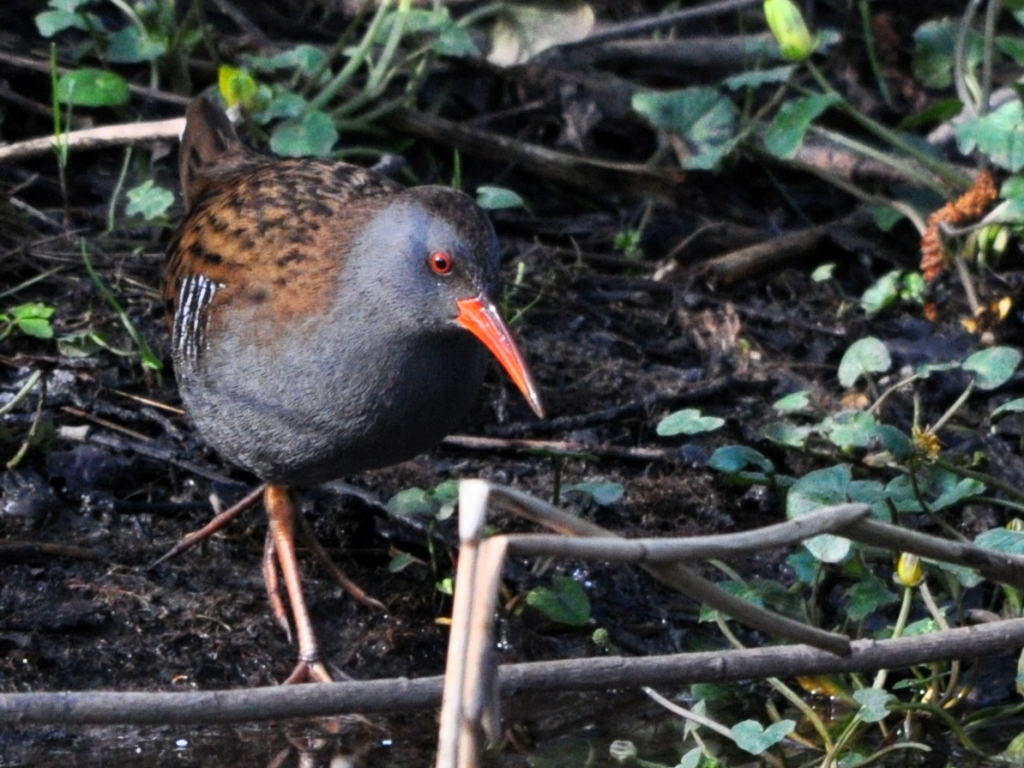
Although the Water Rail showed well it was often partially obscured by vegetation or was in the shade as in this photo.
Eventually I got some photos in better light.
That long bill is being put to good use again but they will also push the whole of the head under water if they need to. The eye isn't clear in this photo because it is covered by the nictitating membrane which is used to protect the eye whilst maintaining some vision at the same time. It mainly seemed to be finding and eating caddisfly larvae.


Birds are accustomed to people putting seed on the top of the fence and quickly respond to any fresh handouts. I managed to get part of this male Reed Bunting's ring number and it is from a sequence that was used between 4 and 6 years ago. It wasn't ringed in the park but it could have been ringed at the nearby Longshaw site.


Female Yellowhammer.
Yellowhammers only take advantage of this food source in late winter and early spring and sometimes allow fairly close approach.

Male Yellowhammer

Male Yellowhammer
I hadn't seen Moorhens feeding on the fence top before today.

The fine weather stimulated many birds to sing and this Robins was in fine voice.

The Mandarin was out on the water when I was making my way back home.

I am not sure how long this Great Crested Grebe has been sitting but I think it has been at least a couple of weeks. 

When I got home I checked through the Siskins that were feeding in the garden and most were unringed. I never see more than about a dozen in the garden at any one time but there could be as many as 30 or 40 that come to the feeders over the course of a day.

Unringed male Siskin

To cap off a good day the Belgian-ringed Blackcap showed well in the late afternoon. 
It spent more time feeding on the ground than it usually does and was eating the scraps that fall from the sunflower heart feeders and fat cakes.

Sunday, 27 January 2013

Gardenfare to start with ......

This could have been three posts rather than one but this is my attempt at stringing them together. A real dump of snow closed the M6 overnight and brought overall snow levels to around a foot deep. A Fieldfare which took up residence in the garden on Tuesday continued to eat and guard all the apples I have been putting out on a daily basis. It drives all the Blackbirds out of the garden as soon as they appear and won't tolerate them anywhere near the apples. There had been up to 8 Blackbirds feeding in the garden on a daily basis prior to the Fieldfare moving in but they don't get much of a look in now.


Fieldfare (Turdus pilaris)


Fieldfare (Turdus pilaris)

Fieldfare (Turdus pilaris)
I started taking photos of the Fieldfare from an upstairs window at first but it allowed me to go into the garden and approach it to within 4 metres; a stunning bird. The garden was quite busy with other birds coming to the feeders and I also  managed to get a good photo of Siskin and Pied Wagtail in the process but my focus was really on the Fieldfare.


Siskin, (Carduelis spinus)
Pied Wagtail (Motacilla alba yarrellii)

Satisfied I had some good shots of the Fieldfare I walked over to Orrell Water Park. The German ringed Black-headed Gull was still present on the lower lake and was the only ringed bird out of about 110 Black-headed Gulls present. A group of 9 Moorhens were stood on the ice and looked rather forlorn. There were 12 Coot present and I watched one dive down and lift a cluster of muscles on to the ice (presumably zebra muscles) and eat each muscle whole.


Moorhens (Gallinula chloropus)


Coot (Fulica atra)
Coot (Fulica atra)
After lunch I went up to my baited site at Haigh to top up the feeders. I put up one 60ft net while I was there and caught 44 birds over the next couple of hours or so. All of the birds caught were in good condition and some were carrying good fat deposits. Only 8 birds were ringed with the other 36 being retraps. A new Redwing was the first for they year as were a retrap Nuthatch and Great Spotted Woodpecker.

Redwing (Turdus ilicacus)

Nuthatch (Sitta europea)
Great Spotted Woodpecker (Dendrocopus major)
Ringing totals 26/01/12 with retraps in brackets.
Redwing 1
Blackbird 1
Brambling 2 (4)
Chaffinch 3 (2)
Robin 1 (1)
Blue Tit - (10)
Greenfinch - (6)
Great Tit - (3)
Coal Tit - (4)
Nuthatch - (1)
Long-tailed Tit - (3)
Great-spotted Woodpecker - (1)
Goldfinch - (1)
Totals 8 new and 36 retraps.


Monday, 9 April 2012

7th April part two

I returned home to drop off the ringing gear and went straight back out with the 'big' camera to make the most of the better light as it wasn't due to last. My main aim was to photograph the Song Thrush nesting in the net ride but happy to take any other opportunities along the way.

Whilst walking through Orrell Water Park a Great Crested Grebe gave me the first chance of a shot if rather distant. The resulting photograph was taken at 450mm and as been heavily cropped but the almost perfect reflection is quite pleasing.

Great Crested Grebe (Podiceps cristatus)

When I got back to the net ride the Song Thrush was still sitting tight. Hopefully they will be successful and give me the opportunity to photograph the nesting attempt through to fledging.

Song Thrush (Turdus philomelos)

Song Thrush (Turdus philomelos)
In a nearby area of mature woodland the first Bluebells were well in flower, the earliest I have ever seen. Similarly adjacent fields of oil seed rape are already turning yellow and will be in full flower before the end of the month.


Bluebells (Hyacinthoides non-scripta)

Oilseed Rape 7th April
Whilst photographing the bluebells I noticed a large crane fly spp crawling over the vegetation. On closer inspection there were three. Two males were fighting over a much larger female. I don't think I have seen this species before and I may be able to identify them as they seem well marked. These photographs were taken with a compact camera which I find more convenient for macro photography. After the fight both males tried to pair with the female.

female crane fly spp.

mating crane fly spp.

On my way home back through the water park I noticed a Moorhen that was clearly brooding some chicks. The other adult was searching for small items of food which were passed to the brooding bird and then the brooding bird passed them on to the chicks or they were passed direct to the chick if it ran out.

Brooding Moorhen (Gallinula chloropus)
 
Moorhens (Gallinula chloropus)
When the brooding bird went off to find food I could see there were six chicks that soon followed their parents into the reeds.


Not a bad day.