Showing posts with label plumage aberration. Show all posts

Sunday, 11 December 2016

Blackish

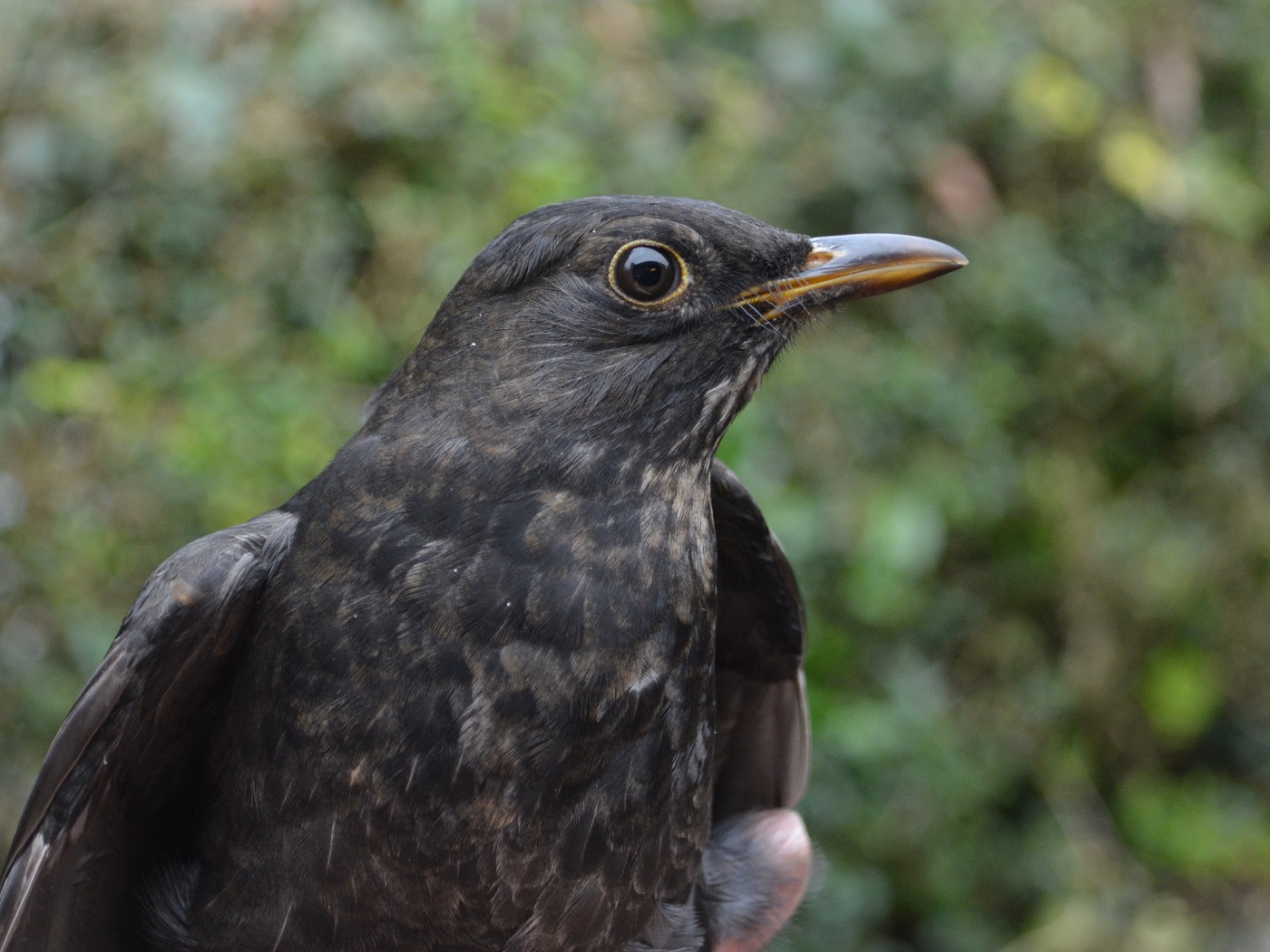
Blackbirds don't feature in the blog very often but I caught one in the garden yesterday (10/12/2016) that merits showing. It was one of those birds that looked a bit different and got me thinking about what sex it was while I was taking it out of the net.


At first glance it looked like a well marked female Blackbird.
The tail was dark brown as you would expect for a female and the pointed shape of the tail feathers indicated that it was a first year bird.


The wing, on the other hand, didn't look quite right for a female. While there was no doubt about the birds age, the new inner greater coverts and median coverts were too black for it to be a female and pointed to it being a male. These new feathers weren't the typical glossy black of a male and were more of a charcoal-black with the slightest hint of brown but they were definitely much blacker than any greater and median coverts a female should have.


The final conclusion was that it is a male Blackbird with a plumage that is sometimes referred to as the 'stockamsel' type. Such birds are generally considered to be of continental origin (Germany and Poland). Obviously I can't be as sure about the sex of this bird as I would be with a more typical example of a male or female but I am as confident as I can be that it is a 'stockamsel' male.
Over the years I have caught a good number of first year male Blackbirds that have had paler fringes to some of the body feathers giving them a quite scalloped appearance and some had quite pale throats but they were all basically black and obviously male. This male Blackbird certainly qualifies as the brownest and most female looking 'stockamsel' type that I have ever caught.

One 'stockamsel' type in the garden is quite interesting but this bird was actually the second I have caught recently. The previous one was caught in the garden just over a week ago, on 02/12/2016. It was just a little blacker than yesterday's bird and there was a bit more of a 'patchwork' appearance to the plumage as can be seen in the images below.


The feathers at the rear of the crown were blacker than you would expect on a female.


The tail was a right old mixture of charcoal-black and dark brown bands caused by fault bars and growth bars. Interestingly the tail feathers were a bit broader and more rounded than is often the case with first year birds.


The new charcoal-black greater coverts were the big giveaway that this bird is a male, if an odd looking one at that.


The feathers in the centre of the mantle were barred brown and charcoal-black while those nearer the nape appear to be browner like the nape itself. It looks like a bird that doesn't know what sex it wants to be or one that has been cobbled together from leftover feathers.


The feathers of the throat and breast were a mixture of brown feathers with paler fringes and charcoal-black feathers with narrow brown fringes giving it a bit of a patchwork effect. On closer inspection a few of the feathers were an odd mixture of charcoal-black and brown. It almost looks like this bird has newer black feathers growing through older faded brown feathers but all the body feathers were same age.
So two 'stockamsel' types in a little over a week and if they weren't supposed to be birds of continental origin you could almost think they had come from the same nest. If you try and look for references to 'stockamsel' Blackbirds they are hard to come by but there is an illustration of one in BWP although it gets no further mention in the text. Stockamsel Blackbirds also get a mention in the Helm Guide to Bird Identification in the section on Ring Ouzels. There are a few others out there on the net and one that throws some light on the origin of the term can be found here.

The unusual plumages didn't end there and yesterday's garden catch also included a Goldfinch that had black feathers peppered throughout the red mask. I have caught thousands of Goldfinches over the years and never seen one like this before. Now I know it is not that dramatic as plumage variations go but I though it was interesting and worth sharing.


Almost half of the feathers that would normally be red were black in this individual.


As for the ringing totals for 10/12/2016 I started the day off at Billinge where I caught 12 Redwings in the period around dawn. The catch would have been higher had it not been for the presence of a Sparrowhawk which spooked some groups of Redwings just as they were heading for the nets. When I got home I set a 6m net in the garden and, over the next 3 hours, caught (retraps in brackets): Goldcrest (1); Blue Tit 1; Blackbird 2; Goldfinch 19 (1).
The retrap Goldcrest had been ringed in the garden just over a year ago, on 26/11/2015 and the retrap Goldfinch was ringed in the garden almost 2 year ago to the day, on 12/12/2014.

Monday, 12 May 2014

Mystery Grasshopper Warbler remains so.

The unusual pale olive-grey Grasshopper Warbler caught on 25/04/14 (previous post can be found here) remains just that an unusual pale olive-grey Grasshopper Warbler. Much trawling of the internet and searching through various reference works and publications hasn't really thrown much light on the matter. I now know a lot more about Grasshopper Warblers but not much more about this particular bird. It still seems to be a potential toss-up between eastern sub-species and plumage aberration or rare colour morph. Whatever it is I haven't come across a comparable photograph including those of the eastern sub-species, straminea. However, some illustrations of straminea show spring birds can be greyish but seemingly not quite as pale as this particular bird.


Below are a couple of images of more typical olive-brown Grasshopper Warblers that were caught in the following days.


To try and progress matters I emailed Martin Garner to see if he had come across anything similar or to see if he could suggest any lines of enquiry. He agreed it was an interesting bird and requested some images for the Birding Frontiers website (link here) which focuses on identification issues and has a much better reach than my blog. Hopefully having some images published on that site may spark some suggestions but we still have to accept that we may never really know what it is in the absence of DNA testing. Whatever the outcome I still plan to submit it informally to the British Birds Rarities Committee (BBRC) for their consideration and for reference. If a bird like this can turn up once then it can turn up again.

One of the things I came across when researching via the net was a paper (link here) reviewing claims of Eastern Grasshopper Warblers in Britain (Harvey & Small 2007). This paper reported that the 4th primary was slightly emarginated in just over 50% of a sample of 20 of the eastern subspecies straminea and that this feather wasn't emarginated in any of the 12 nominate birds (naevia) examined. However one of the nominate birds I caught on the same day as the pale bird showed a slight emargination on the 4th primary. 


I had only photographed this bird's wing because it had clearly gone through some kind of eccentric moult and had replaced a number of primaries in both wings. These new feathers also stood out as they appeared longer than they should be relative to the old feathers either side. I only noticed the slight emargination of the 4th primary when comparing photographs of various Grasshopper Warblers subsequently. Although the emargination on the 4th is only slight it is clearly there, especially when the feather is compared with the 5th, and would be recorded as such for the wing formula of this bird. The presence of a slight emargination of the 4th primary may not be the potential indicator of a bird worth further examination as that paper suggests and perhaps more importantly shows how much we still have to learn about Grasshopper Warblers.