Monday, 10 July 2017

Bilinge 9th July 2017 - more Swallows

I had planned an early morning ringing session in the top willows but I just couldn't motivate myself when the alarm went off, despite the weather conditions being near perfect. I decided some extra sleep was the order of the day; a decision that was made much easier because I knew I had the option of going up in the evening instead. I suppose I could, and perhaps should, have done both but I will save that kind of effort for later in the season.

I went to site at 7pm and quickly set 2 nets in the willows. I could hear a few warblers calling in the bushes as I was setting up but one thing that was absent was any sizeable tit flocks, not that I am complaining, although I did hear some Long-tailed Tits in the distance later on. There were quite few Swallows hawking insects overhead so I was hopeful that some would come into roost again and thankfully they did.

Part of the Swallow catch. I don't know why this site usually gets an early Swallow roost but it does, although numbers and duration of occupancy of the roost have varied from year to year. However, its future may be limited by the growth of the trees as the birds seem to prefer to roost in willows that average about 1.5 to 2 metres tall and some are more than twice that height now.

Juvenile Swallow

Adult male Swallow showing a fine pair of tail streamers.
The total of 41 new birds and 1 retrap was a good result with the majority of the catch being made up of Swallows and warblers. The individual totals (retraps in brackets) were: Blue Tit 1; Willow Tit 1; Swallow 23; Chiffchaff 4; Willow Warbler 3 (1); Blackcap 5; Blackbird 1; Goldfinch 2, Reed Bunting 1.

Observations of note were a Noctule Bat, surprisingly the first I have seen over the site, and as I was leaving I could hear a Grasshopper Warbler reeling from the territory in NE corner.

Saturday, 8 July 2017

Billinge: 4th & 7th July 2017

4th July
This was a dual purpose evening visit to do a bit of ringing and work on clearing some of the summer's growth from one of the net rides in the top willows. I didn't get to site as early as I had originally planned so I only put up one 18m net rather than two as intended but that didn't matter as there was plenty of pruning to do.

The single net produced a trickle of birds which left me enough time to get another net ride cleared and ready for the rest of the autumn. As sunset approached I started to think about packing up but then some Swallows appeared so I stayed until they came into roost and I ended up catching 25 of them. The final ringing totals (retraps in brackets) were: Blue Tit 1; Swallow 25; Chiffchaff 2 (1); Willow Warbler 4 (2); Blackcap 2; Goldfinch 1. Total 35 new birds and 3 retraps.

7th July
I only got up after the 3rd alarm and some snoozing so not the early start that I had intended. I set 3 nets in the NE corner of the site and was set up by 06:40. Two Grasshopper Warblers were reeling nearby with one being in the same area as a bird recorded in early May but the other was singing in a less expected location and was reeling in the adjacent field of barley.

The catching rate was slow to start with but improved as the morning went on, although it didn't get busy. Highlights were 2 juvenile and an adult Grasshopper Warbler with the adult being a retrap male that was originally ringed on 2nd May this year. This strongly suggest they have bred successfully and constitutes the first breeding record for the site, although a bird held a territory last year and may have bred. The rest of the catch was fairly typical for this part of the site at this time of year and included the first juvenile Goldcrests and a juvenile Willow Tit.

Juvenile Grasshopper Warbler

Juvenile Grasshopper Warbler,

The two juvenile Grasshopper Warblers showed some of the variation in colour this species can display with one having mainly white underparts and the other having buff coloured underparts.

Juvenile Goldcrests always look scruffy as they go through their post-juvenile moult

This bird was just starting to show orange feathers (encased in sheath) growing in the crown which meant it could be sexed as a male. 

Juvenile Willow Tit.
Another feature of the site at this time of year are frequent encounters horse-flies and clegs and I donated far too much blood to their kind during the session. Luckily I haven't had any adverse reactions but these insects will continue to be a pain in the neck or other parts of the body during visits over the next few weeks.

There was a little bit of movement overhead with 1 Siskin heading south and 3 singles heading north and a Grey Wagtail heading south was particularly early for that species to be on the move.

Ringing totals for the 7th were: Goldcrest 2; Blue Tit 5; Great Tit 4; Coal Tit 1; Willow Tit 1; Chiffchaff 7; Willow Warbler 2; Blackcap 1; Grashopper Warbler 2 (1); Wren 1; Robin 1; Bullfinch (1). Total 27 new birds and 2 retraps.

Tuesday, 4 July 2017

Long time no blogging

Where did June go; it doesn't seem like the best part of a month has gone by since my last post but it has. I've not done much ringing this June compared to previous years but I haven't been idle either, far from it. I have had quite a lot of commitments over the last few weeks and I also decided to get stuck into some jobs around the house and garden and get them out of the way before autumn migration really gets going later this month. Having said that I still managed to ring 162 birds in June but 122 of those were Starlings in the garden.


It is fair to say this has been my best year for Starlings by some margin with 140 adults and 383 juveniles ringed in the garden up to the end of June. In addition there have been 436 resightings/recaptures involving 141 different individuals. Most of these resightings were of birds that were ringed or colour-ringed in previous years with the oldest individuals having been ringed as adults in 2011. The current longevity record for a Starling is 17 years, 7 months and 25 days so my project will have to run for a long time yet for me to see anything approaching that record, although reaching 6 or 7 years is still a very good age for a Starling.


I have been up to Billinge a few times recently to maintain the net rides in preparation for the autumn and I did put up a couple of nets on the evening of 26th June in two of the newly cleared rides. This short session produced 26 new birds and 1 retrap as follows - Willow Warbler 11, Chiffchaff 5 (1), Linnet 4, Great Tit 1, Blue Tit 1, Swallow 4. The 4 Swallows were interesting as they were all adult males that came in to roost in the willows. This site has held an early roost since I first started monitoring there in 2014 and a high proportion of adults has usually been a feature of the early catches.

That pretty much sums up how June went for me but now we are in July and autumn migration is starting to get underway there should be a lot more to blog about. With a bit of luck you should start to see a return to more regular updates from now on.

Thursday, 8 June 2017

Siskin Movements: Spring 2017

I haven't posted details of any recoveries for a while so I thought it was time to rectify that. I have received quite a few recovery reports for Siskins over the past few months so it made sense to start with that species. Details of 3 of the movements were posted earlier in the spring but as others started to come in I decided to wait and show them all together rather than post details when they were received. All of the movements involve birds that were ringed or controlled in my garden near Orrell, Greater Manchester (purple & white circle on map). 

It is interesting that there are no movements to or from SE England as large numbers of Siskins usually winter in that area. The two recoveries well south of my garden are both in Wales and this suggest that many of the bird that visit my garden winter there and perhaps further south in SW England.


D874496      first year female   Siskin
Ringed         18/03/2014   near Orrell, Greater Manchester.
Controlled    14/02/2017   Witton-le Wear NR, Durham. 143 km NNE, duration 1064 days.

S192064       first-year male     Siskin
Ringed          11/04/2016   Peebles, Scottish Borders.
Controlled     07/03/2017   near Orrell, Greater Manchester. 293 km S, duration 330 days

S144873       first-year female  Siskin
Ringed          12/04/2016   near Orrell, Greater Manchester.
Controlled     30/01/2017   Ffynnon Gro, Llanfynydd, Carmarthenshire. 201 km S, duration 293 days.

S411915       first-year female  Siskin
Ringed          24/02/2017    Sychdyn, Mold, Flintshire.
Controlled     24/03/2017    near Orrell, Greater Manchester. 47 km NE, duration 28 days.

S264860      first-year male     Siskin
Ringed         03/03/2017      Broken Cross, Nr Macclesfield, Cheshire.
Controlled    24/03/2017      near Orrell, Greater Manchester. 46 km NW, duration: 21 days.

S785508     first-year male     Siskin
Ringed         19/02/2017      near Orrell, Greater Manchester.
Controlled    02/04/2017      Dalston, Carlisle, Cumbria. 148 km N, duration: 42 days.

S144876      adult female       Siskin
Ringed         12/04/2016       near Orrell, Greater Manchester.
Controlled    02/04/2017       Cnoc, Argyll and Bute.  324 km NNW, duration: 355 days.

S144643     first-year male     Siskin
Ringed          07/03/2016       near Orrell, Greater Manchester.
Controlled     21/02/2017       Townhill, Dunfermline, Fife. 289 km N, duration: 351 days.

S144511    adult male            Siskin
Ringed         18/02/2016       near Orrell, Greater Manchester.
Controlled    18/04/2017       Millhousebridge, Dumfries and Galloway. 188 km NNW, duration: 425 days.

S144657    first-year male      Siskin
Ringed         08/03/2016       near Orrell, Greater Manchester.
Found          26/03/2017       Pont-rhyd-y-groes, Ceredigion. 152 km SSW, duration 414 days. Dying, found sick,

S552459     adult female        Siskin
Ringed          22/01/2017      near Orrell, Greater Manchester.
Controlled     23/03/2017      Glebe Farm, Salsburgh, North Lanarkshire. 268 km, duration: 60 days.


Friday, 2 June 2017

Starling RAS round-up

Sorry for doing another post about my Starling RAS project but it is virtually all I do in May on the birding front. It has been particularly busy this year with 193 different adult Starlings coming to the feeders in the garden between 21st April and 24th May. This is roughly double the number of adults recorded over the same period in the previous 2 years. This big increase has probably been caused by the dry spring which will have made it a lot more difficult for the adults to find enough soil invertebrates to feed to their young and made them more reliant on garden handouts.

A large proportion (118) had been ringed prior to the start of this year's RAS period with 99 having been ringed during the previous two breeding seasons or earlier. Looking at these known age adults 66% were at least 2 years old and 34% were ringed last year, as juveniles, so were breeding for the first time. This is a good sample size and is probably representative of the age structure of the population in this area. As the majority of adult Starlings are faithful to their breeding sites the age structure of the population is largely a function of the adult survival rate so the survival rate for adults in the population will be at least 66%. The actual survival rate is likely to be slightly higher as two adults, both at least 2 years old, have been recorded since the RAS period ended and a few others could have been missed or moved territory outside of the catchment area for my garden. The actual adult survival rate for my population is probably closer to 70%. This fits well with some other studies and shows the RAS project is producing good data for monitoring the annual survival rates of adults in this area.

It is harder to say how the breeding season has gone for Starlings for various reasons; not least because juveniles become very mobile and disperse over a wide area shortly after a fledging. I have ringed 266 juveniles this May compared to 215 in May last year and that is despite broods fledging around a week later this year. However, there is no indication there will be a doubling of the number of juveniles coming to the garden this year, as seen with adults, so productivity may actually be lower than last year as might be expected in a very dry spring when natural food is much harder to come by. The recent rain hasn't improved soil moisture levels all that much so I would also expect juvenile mortality to be higher than it would otherwise be if the spring rainfall had been nearer to average levels.

P45, just one the 266 juveniles ringed this May
My interest in Starlings doesn't end when my RAS period finishes and I will continue to ring and record sightings of colour-ringed birds over the course of the summer. Yesterday I caught a new adult that had already started to moult and is the earliest moulting adult I have ever recorded. It shouldn't really be a surprise that adults are starting to moult earlier as they moult soon after they have finished breeding and the breeding season is averaging earlier now than it used to. There is a chance it could be a failed or non breeder but even if that is the case it is still relatively early for it to be in moult and it is yet another a tiny piece of evidence that birds are responding to changes in our seasons and climate. If nothing else it is a reminder that it is never too early to start checking for moult these days.

Moulting adult Starling photographed 01/06/2017. Both wings were symmetrical.


Thursday, 18 May 2017

Awash with Starlings

I am surprised I have not had complaints from neighbours about the number of Starlings that are coming to the feeders as they have been making a right din and a fair amount of mess too. The begging and contact calls of many dozens of juveniles in and around the garden can be loud enough to wake all but the heaviest of sleepers and starts not long after sunrise, which is just after 5am at the moment. As for the mess it is not that bad unless your a stickler for a clean car and clean windows. On the plus side one of my neighbours certainly got great value for money out of his window cleaners yesterday.


Just a few of the adult and juvenile Starlings that were feeding in the garden yesterday morning.
To give you an update on the number of birds involved 163 different adults have been recorded in the garden since 21st April with that number being made up of 94 birds that were colour-ringed during or prior to the 2016 breeding season and the remaining 69 being ringed over the winter or during this breeding season. On top of that there are still a few unringed adults coming to the feeders so the total number of adults using the garden could be around the 180 mark. Judging by the re-sightings of colour-ringed birds many are visiting the garden on a regular or frequent basis and a total of 78 different colour-ringed adults were recorded in the garden on 15th May alone and I am sure I didn't manage to record them all, but it does give and indication of how busy the garden is.

Most if not all of the adult Starlings have fledged young now and a typical brood size seems to be at least 4, so given there are 80+ pairs using the garden they could be feeding over 320 juveniles and it certainly sounds like they are at times. The first juveniles were seen in the garden on the on the 11th but I didn't ring any until the 14th when 7 were caught. Since then the number of juveniles has rocketed, as is to be expected with a species that has a highly synchronised breeding season, and the number ringed over the last 5 days now stands at 99. As productivity appears to be as good as it was last year I am likely to ring another 200 juveniles over the next few weeks but only time and a lot of effort will tell.


The bird bath gets well used at this time of year and needs filling several times a day.


This adult seemed to want the bird bath to itself.

Young Starlings soon return to feeding in the trap after being ringed and as I colour-ring them all there is no need to trap them again.


This one was in a berberis right in front of a window and was picking midges off the leaves. This and all the photos above were taken through double glazing so aren't as crisp as I would like them to be.
Starlings will continue to take up most of my time until my RAS period ends on 24th May and then I will have a bit more time to get out and about.

Thursday, 11 May 2017

Starling RAS update

The first juvenile Starling of the spring was seen in the garden today. This is a week later than last year and 11 days earlier than in 2015. Juveniles have usually been out of the nest a few days before they appear in the garden but the first date they are seen still gives an indication of variation in timing of the breeding season between years. Quite a few juveniles have fledged judging by the begging calls coming from the trees and roof tops round about so an increasing number will be following their parents into the garden in the coming days.


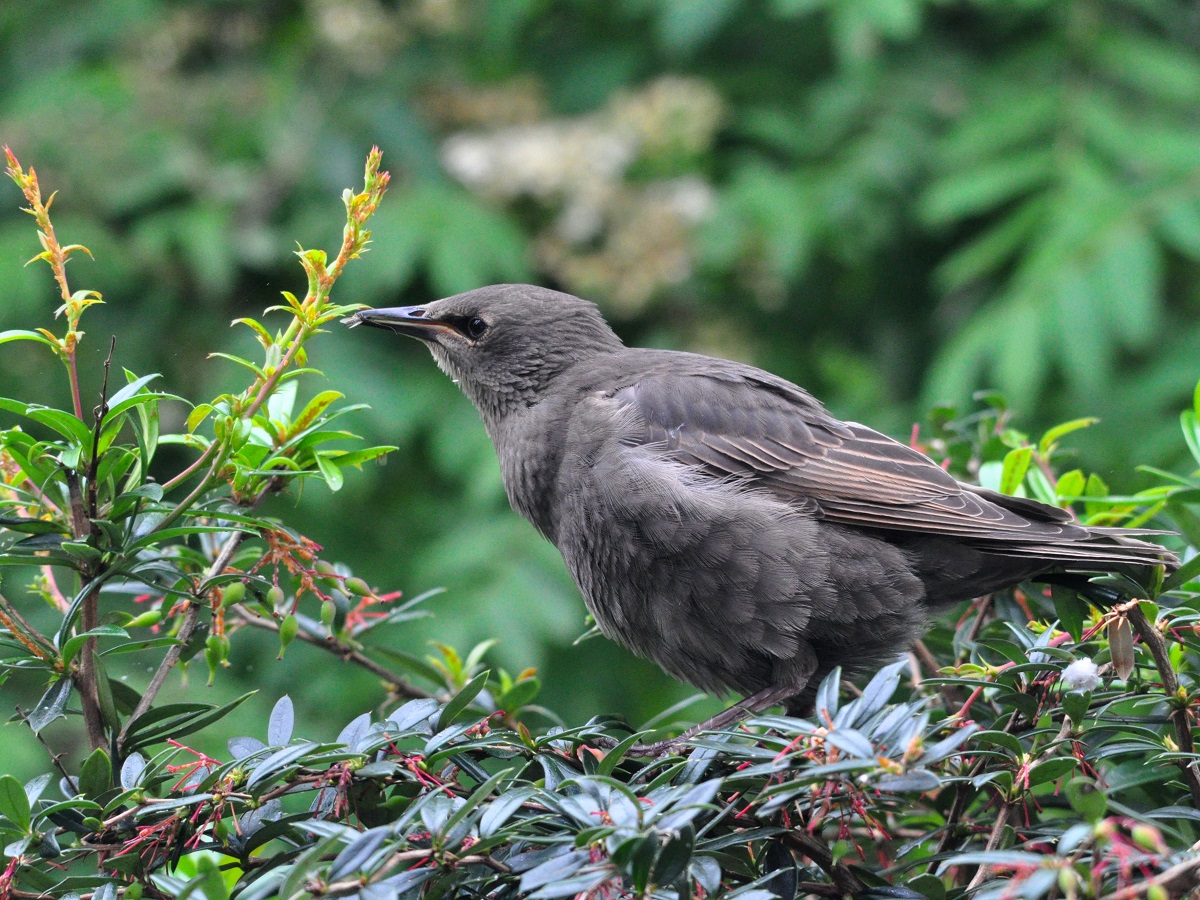
The first juvenile Starling in the garden was probably having its first bath when I noticed it.


I have ringed or recorded an additional 23 adult Starlings in the last 3 days including 10 that were ringed in previous years. This brings the total number of adults recorded since 21st April to 112 with 75 being birds that were ringed in previous years. I am on track for recording more adults this RAS season than in the previous 2 years and this may in part be due to the dry weather having a limiting effect on the availability of soil invertebrates. Adult Starlings are probably turning to garden handouts, like my fat cakes, more than they would if there had been more rain and soil invertebrates were easier to get at.


Not the sharpest of photos as it was taken through double glazing and not the cleanest either, but it does show just how stunningly colourful adult Starlings are.