No this is not news of birds being recovered shortly after ringing but it is about speed in the turnaround of recovery reports from the new BTO ringing application. Ringing details for the controls that I submitted, with other data, on Wednesday evening landed back in my inbox on Friday, just 2 days later. I expected a longer wait but I was wrong and the new system is really starting to show its capabilities now. When the online version is up and running it should be even quicker and I could be posting details of some controls on the day they are caught. This new system may have taken longer to introduce than originally planned but it certainly looks like that wait has been worthwhile.
Lesser Redpoll Y781820 (purple line and markers) was ringed on 02/02/14 in Wilmslow, Cheshire and was controlled at Crawford on 27/05/15. A movement of 41 km NW. It may not be a long distance or quick movement but the speed of the new system means I can post the recovery details just 3 days after the bird was controlled and submitted.
Lesser Redpoll D717537 (red line and markers) was ringed on 03/04/14 in Llanfyllin, Powys and was controlled at Crawford on 13/05/15 and 27/05/15. A movement of 89 km NNE. A similar rapid turnaround of ringing details for this control.
Blackbird CT82386 (blue line and markers) was ringed as a juvenile male in my garden in Orrell on 23/07/14 and was controlled in Darnall, South Yorkshire on 12/04/15. British bred Blackbirds are fairly sedentary in the main so this is quite a good movement especially as it involved a crossing of the Pennines.
The Goldfinch D954944 pictured in my last post and controlled at Crawford on 27/05/15 had been ringed at a Kings Moss on 09/11/14, just 2 km away, so isn't mapped. Interestingly it wasn't sexed when originally ringed so it may not have finished moulting its head feathers at that time and those unusual lesser coverts may have also contributed to the bird being left unsexed. In addition there wouldn't have been the opportunity to confirm the sex of the bird through examination of the cloaca in November so erring on the side of caution was probably the best decision at that time. I only mention this as sexing Goldfinches is one of my pet subjects and it must be of interest to many other people judging by the page views of my previous post on the subject (main link here). Page views of that post still run into the many hundreds each week and seem destined to keep it at the top of the most popular post list.

Sunday, 31 May 2015

Thursday, 28 May 2015
Crawford 27/05/15
Lesser Redpolls are still taking full advantage of the nyger feeders at Crawford and the feeders have needed topping-up every 3 or 4 days as a result. The weather was ideal for mist-netting this morning so I decided to fit in a short visit to see how many Redpolls were about. I expected most to be retraps but the morning got off to a great start with a control (a bird ringed elsewhere) and a new bird. Both were cracking males but one was much darker than the other and they show the variation that Lesser Redpolls can display. The paler example is the sort of bird that is sometimes mistaken for Common Redpoll in the field, especially when seen alone or in the company of darker individuals. Spring Lessers seem to be the most problematic with some seemingly becoming darker with wear and others becoming paler. They really were as different as they look in the photographs below and the paler bird stood out in the field too.
Examples of other types of colour variation were displayed by a couple of birds caught subsequently with one of these birds having a yellowish poll and another having a mixture of red and yellow. Both of these birds were retraps and had been ringed earlier this month.
The bird with the little bit of yellow in the crown was much more noteworthy for another reason as it also had a deformed bill. This bird was originally ringed and photographed on 1st May and I nearly posted pictures of it then. I don't know if this deformity is genetic, a result of trauma or disease but it was odd looking to say the least. Only the upper mandible was affected and an overgrowth, mainly on one side, formed a tube like nostril. The bird didn't seem hampered by the condition and was a good weight. The bird also had a brood patch that indicated she was an actively breeding female.
Although there were plenty of Goldfinches around very few came to the feeders but luckily one that did and was caught had been ringed elsewhere (a control). It also had interesting lesser coverts in that they were broadly tipped golden-yellow. Most male Goldfinches have lesser coverts that are all black or black with well defined brown fringes. However, a few can have more broadly tipped lesser coverts and those do are usually tipped golden-yellow rather than brown and this bird is a good example of that uncommon variation. There seems to be some form of exception to every rule when it comes to sexing Goldfinches from plumage features but then it wouldn't be interesting if it was easy and straightforward. The sex of this bird was confirmed by examination of the shape of the cloaca.
A juvenile Tree Sparrow was also caught and this seems to be quite early judging by reports from nest recorders. The late spring means most Tree Sparrows are still on eggs or are feeding nestlings.
Ringing totals (retraps/controls in brackets) at Crawford were: Lesser Redpoll 2 (9); Goldfinch (1); Tree Sparrow 2; Dunnock 1. All the ringing data has been sent to the BTO so I should be able to post details of where the controls came from in a week or two based on recent turnaround times.
 |
| Control Lesser Redpoll Y781820 |
 |
| Lesser Redpoll Z414896 |
 |
| Redpolls occasionally exhibit Xanthochromism whereby the red pigment in the plumage is replaced by yellow. The cause is usually genetic but some forms of Xanthochromism can be caused by diet. In my experience it seems to be more common in female Redpolls than males and the best examples I have seen have been adult females like this bird. |
 |
| There is only a bit of yellow in the otherwise red 'poll' of this bird but it shows they can have both colours and not just one or the other. |
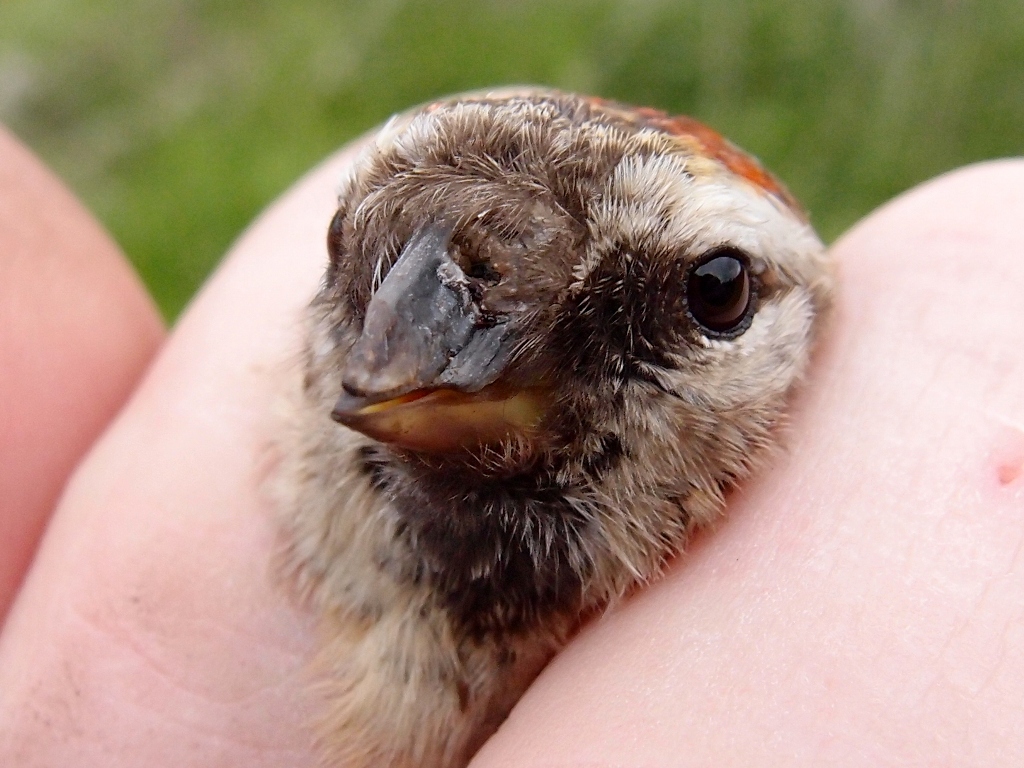 |
| Lesser Redpoll with deformed bill, photographed 27/05/15 |
 |
| Lesser Redpoll with deformed bill, photographed 01/05/15 |
 |
| Lesser Redpoll with deformed bill, photographed 01/05/15 |
 |
| Male Goldfinch D954944 showing broadly tipped golden-yellow lesser coverts. |
 |
| Male Goldfinch D954944 |
 |
| Juvenile Tree Sparrow. |
Sunday, 24 May 2015
Become a birdwatcher for £15.49
I am still not getting out much and have become stir crazy or perhaps I should say Starling crazy as a result. This self imposed incarceration is down to my attempts to catch all the adult Starlings that visit the garden. Recapturing some of the birds that were ringed in previous years has proved to be quite difficult and some individuals have taken many hours to catch. Each bird is caught individually in a manually operated cage trap and I have to watch all the birds that go in the trap to feed to see if they are birds I need to catch for the study. Birds I have already colour-ringed happily come back to feed in the trap and I may have to watch dozens come and go, several times in some cases, before I see one that I need to catch. I have now caught 128 different adults and this probably represents about 95% of the Starlings that breed within feeding range of the garden. With a week of the study period to go I may be able to push that percentage even higher.
So what do I do while waiting for Starlings to enter a trap; well the answer is all manner of useful and not so useful things that don't take me too far from the window. Today I found myself thumbing through a product brochure that had been posted through the door. To my amusement I found becoming a birdwatcher only costs £15.49.

Another advert that caught my eye was for toast tongs. Apparently they have a little magnetic bit for handy storage and I am sure we all know a place that we would like to stick such an item.

The advert that gave me the biggest smile was for coal paint, yes coal paint as in paint for coal. If your imitation nutty slack is not black enough then this is the product for you. I would love to meet the person who has dull and faded coals that are in need of a lick of coal paint. I bet they have toast tongs stored in a very handy location and also became a birdwatcher for £15.49.

Back to more usual blog content and I haven't mentioned moths recently and that is because the moth trap has hardly caught a thing for a while now. It has been one of the worst springs for moths that I can remember and this must be having a knock on effect on some species of birds as there will be fewer caterpillars around as a result. There were only 3 moths in the trap this morning which was really poor given the date. There were 2 Poplar Hawk Moths and a Bright-line Brown-eye, both species being firsts for the year.
 |
| The first juvenile Starling followed its parents into the garden a couple of days ago and the numbers have grown since then. I have only ringed 9 of the juveniles so far as I am still concentrating on the adults but I expect to ring up to 200 juvs over the next month or so. |

Another advert that caught my eye was for toast tongs. Apparently they have a little magnetic bit for handy storage and I am sure we all know a place that we would like to stick such an item.

The advert that gave me the biggest smile was for coal paint, yes coal paint as in paint for coal. If your imitation nutty slack is not black enough then this is the product for you. I would love to meet the person who has dull and faded coals that are in need of a lick of coal paint. I bet they have toast tongs stored in a very handy location and also became a birdwatcher for £15.49.

Back to more usual blog content and I haven't mentioned moths recently and that is because the moth trap has hardly caught a thing for a while now. It has been one of the worst springs for moths that I can remember and this must be having a knock on effect on some species of birds as there will be fewer caterpillars around as a result. There were only 3 moths in the trap this morning which was really poor given the date. There were 2 Poplar Hawk Moths and a Bright-line Brown-eye, both species being firsts for the year.
 |
| Poplar Hawk Moths 24/05/15 |
Saturday, 16 May 2015
Mostly Starlings.
Starlings are still taking up much of my time and will until at least the end of the month. Today I caught the 100th different adult Starling in the garden since the study period started on 14th April. One hundred birds may not sound that many but it has taken a great deal of effort and patience to catch that many. Interestingly, 41 of these birds have been retraps from previous years which is a great start for the project.
The first young Starlings were out of the nest today but they didn't venture far from the nest site. It won't be long before they start following their parents and really make their presence felt with their incessant begging calls and squabbling.
Away from the garden I have been keeping the nyger feeders going at Crawford and had a few short ringing sessions there. Lesser Redpolls are still making use of the feeders but the number of Goldfinches has dropped off markedly. My last visit, on the 13th, only produced 4 Lesser Redpoll and 1 Goldfinch but it was still worthwhile as one of the Lesser Redpolls was a control.
I recently received details of another Lesser Redpoll (Y382442) that I controlled at Crawford on 1st May. This bird had been ringed 26 km away at Bidston, Wirral on 22nd April 2013 so it will be interesting to see where the latest control has come from.
 |
| One of the retrap Starlings caught and colour ringed earlier today. This bird was originally ringed as a breeding adult in May last year. Retrapping or re-sighting birds from year to year is what this type of study is all about. |
 |
| The next batch of fat cakes in the making. Beef dripping, finely chopped peanuts and meal worms. Yum, yum for many species and Starlings in particular. |
Away from the garden I have been keeping the nyger feeders going at Crawford and had a few short ringing sessions there. Lesser Redpolls are still making use of the feeders but the number of Goldfinches has dropped off markedly. My last visit, on the 13th, only produced 4 Lesser Redpoll and 1 Goldfinch but it was still worthwhile as one of the Lesser Redpolls was a control.
 |
| Control (ringed elsewhere) Lesser Redpoll had a ring sequence starting with D717. |
Thursday, 7 May 2015
Staring at Starlings
 |
| Adult Starling probing the lawn for invertebrates such as leatherjackets. They probe the ground with an open bill which they snap shut if prey is detected. |
 |
| They really are good looking birds. |
Thursday, 30 April 2015
Recent recoveries
The latest recoveries received included some interesting movements as follows:
Goldcrest HPV313 (orange line) was ringed at Billinge on 18/09/2014 and was one of 15 caught that day. It was controlled on 07/04/2015 near East Lamington, Morangie Forest, Highland, 483 km to the north, and is my furthest movement of a Goldcrest to date. It was one of 312 Goldcrests ringed at the site last autumn and is the first indication of their origins.
Robin Z273561 (red line) was ringed at Billinge on 10/09/2014 and was subsequently controlled in Newport, Telford and Wrekin, 85 km south, on 13/01/2015 and again on 22/01/2015. There was a good movement of Robins through Billinge last autumn, 74 were ringed with the majority moving through in September like this bird.
Goldfinch D308986 (black line) was a bird I controlled at Crawford on 21/04/2015 and mentioned in a previous post (link here). It had been ringed near Penallt, Monmouthshire on 22/02/2015 and had presumably wintered in that area. I had suspected the recent increase in the number of Goldfinches at Crawford was, in part, due to some birds returning north and this recovery confirms that for this bird at least.
Goldcrest HPV313 (orange line) was ringed at Billinge on 18/09/2014 and was one of 15 caught that day. It was controlled on 07/04/2015 near East Lamington, Morangie Forest, Highland, 483 km to the north, and is my furthest movement of a Goldcrest to date. It was one of 312 Goldcrests ringed at the site last autumn and is the first indication of their origins.
Robin Z273561 (red line) was ringed at Billinge on 10/09/2014 and was subsequently controlled in Newport, Telford and Wrekin, 85 km south, on 13/01/2015 and again on 22/01/2015. There was a good movement of Robins through Billinge last autumn, 74 were ringed with the majority moving through in September like this bird.
Goldfinch D308986 (black line) was a bird I controlled at Crawford on 21/04/2015 and mentioned in a previous post (link here). It had been ringed near Penallt, Monmouthshire on 22/02/2015 and had presumably wintered in that area. I had suspected the recent increase in the number of Goldfinches at Crawford was, in part, due to some birds returning north and this recovery confirms that for this bird at least.
Tuesday, 28 April 2015
Crawford 24th & 27th April 2015
Keeping the feeders going has paid off and resulted in a couple of interesting sessions over the past few days. The natural seed bank is at its lowest at this time of year and seed eating birds can still struggle to find enough food even though the weather is warming up. The number of Goldfinches using the feeders at this site is much greater now than it was earlier in the winter although this has not been reflected by the Goldfinches visiting the feeders in my garden. Lesser Redpolls only started coming to the feeders fairly recently and none had been caught before the 7 yesterday (27th). One of the Redpolls was a control (ringed elsewhere) but I suspect it was ringed at Kings Moss, just a couple of km away, as the ring number is similar to other birds that have come from that site. In addition there were 4 other controls, 2 Goldfinch and 2 Greenfinch, with these birds also likely to have been ringed at Kings Moss.
Ringing totals (retraps and controls in brackets) for 24th April 2015: Goldfinch 18 (3); Greenfinch 4 (1); Chaffinch (3); Yellowhammer (1); Coal Tit 1; Dunnock (1); Blackbird (1); Blackcap 1; Jay 1. Total 35.
Ringing totals (retraps and controls in brackets) for 27th April 2015: Lesser Redpoll 6 (1); Goldfinch 7 (4); Greenfinch 4 (1); Chaffinch 3; Tree Sparrow 2; Dunnock 1. Total 29
Now the breeding season is getting underway the sex of some birds can be confirmed by checking for the presence of a brood patch and or the shape of the cloaca. In many species the female develops a large and distinctive brood patch with the cloaca not being very prominent and generally pointing back towards the tail while the male doesn't develop much of a brood patch, if any, and the cloaca is usually prominent (sometimes bulbous) and sits at a right angle to the body or points slightly forward. It was interesting that 2 of the 3 female Lesser Redpolls had brood patches as I initially thought they would all be birds that were still on passage rather than breeding somewhere nearby.
Regular readers of this blog will know my interest in sexing Goldfinches from plumage features, that interest must be shared be a lot of people as my posts on this subject have and continue to attract the most page views by some margin. Not all Goldfinches are breeding yet but I checked each bird for a brood patch or cloacal protuberance to see if it confirmed the sex that was indicated by the plumage. This revealed a couple of interesting individuals that wouldn't have been easy to sex outside the breeding season although the majority were fairly straightforward.
Z414875 had a fairly extensive red mask for a female Goldfinch and no obvious white or grey nasal hairs. It is the sort of bird that is probably best left unsexed outside the breeding season. The lesser coverts were somewhat intermediate being less brown than some females and almost showing as much black as some less well marked males. Strong sunlight doesn't always help when looking at such features and doesn't help with the photography either. The sex was confirmed by the developing brood patch and shape of the cloaca. The bird is still in the process of losing feathers from the belly and lower breast so is only at the early stages of breeding.


Z414877 had a mask and lesser coverts that are not that dissimilar from the bird above although the black parts of the lesser coverts are much glossier and the brown fringes are more distinct. The thing that made me look twice at this bird was the short wing length of 76mm which is at the bottom end of the range for males and is fairly short for a female. It had a well developed cloacal protuberance which I didn't manage to photograph but confirmed it as a male. There is a difference in the intensity of the red of the mask but that can vary from orange-red to crimson in both sexes and shouldn't be used as a supporting criteria. Again this is a bird that may be better left unsexed outside the breeding season.


......and now for images of a couple of birds that show how different males and females can look and shouldn't pose a problem for sexing at any time of year.
Z414709 is a text book female with a restricted red mask and greyish nasal hairs. Unfortunately Goldfinches don't read text books and many females don't look like this. On the other hand the lesser coverts are broadly tipped brown and form a brown shoulder patch which is fairly common feature of female Goldfinches.


Z414876 is a well marked male with an extensive red mask and black nasal hairs. The lesser coverts are glossy black although it is not uncommon for them to have well defined narrow brown fringes. Note there are a couple of stray brown mantle feathers overlapping a few of the inner lesser coverts.


Among the other birds caught a Jay did what Jays do well and bit me. I got off fairly lightly at first but it flew back into one of the nets on release, despite having been let go in the opposite direction. On being taken out of a net for a second time it really let me have it.
I went back to check the feeders this evening and several were almost empty so I topped them all up and added another. With the feed going down so fast I will try and fit in another visit later in the week.
Ringing totals (retraps and controls in brackets) for 24th April 2015: Goldfinch 18 (3); Greenfinch 4 (1); Chaffinch (3); Yellowhammer (1); Coal Tit 1; Dunnock (1); Blackbird (1); Blackcap 1; Jay 1. Total 35.
Ringing totals (retraps and controls in brackets) for 27th April 2015: Lesser Redpoll 6 (1); Goldfinch 7 (4); Greenfinch 4 (1); Chaffinch 3; Tree Sparrow 2; Dunnock 1. Total 29
Now the breeding season is getting underway the sex of some birds can be confirmed by checking for the presence of a brood patch and or the shape of the cloaca. In many species the female develops a large and distinctive brood patch with the cloaca not being very prominent and generally pointing back towards the tail while the male doesn't develop much of a brood patch, if any, and the cloaca is usually prominent (sometimes bulbous) and sits at a right angle to the body or points slightly forward. It was interesting that 2 of the 3 female Lesser Redpolls had brood patches as I initially thought they would all be birds that were still on passage rather than breeding somewhere nearby.
 |
| A well developed brood patch confirms this Lesser Redpoll is a female. A good blood supply to the bare skin keeps the eggs warm. The presence of a brood patch also indicates that the bird is probably breeding nearby and the condition of the brood patch suggests it already has a clutch of eggs. |
 |
| A Lesser Redpoll with a protruding and slightly bulbous cloaca confirming it is a male. |
Z414875 had a fairly extensive red mask for a female Goldfinch and no obvious white or grey nasal hairs. It is the sort of bird that is probably best left unsexed outside the breeding season. The lesser coverts were somewhat intermediate being less brown than some females and almost showing as much black as some less well marked males. Strong sunlight doesn't always help when looking at such features and doesn't help with the photography either. The sex was confirmed by the developing brood patch and shape of the cloaca. The bird is still in the process of losing feathers from the belly and lower breast so is only at the early stages of breeding.
Z414877 had a mask and lesser coverts that are not that dissimilar from the bird above although the black parts of the lesser coverts are much glossier and the brown fringes are more distinct. The thing that made me look twice at this bird was the short wing length of 76mm which is at the bottom end of the range for males and is fairly short for a female. It had a well developed cloacal protuberance which I didn't manage to photograph but confirmed it as a male. There is a difference in the intensity of the red of the mask but that can vary from orange-red to crimson in both sexes and shouldn't be used as a supporting criteria. Again this is a bird that may be better left unsexed outside the breeding season.
......and now for images of a couple of birds that show how different males and females can look and shouldn't pose a problem for sexing at any time of year.
Z414709 is a text book female with a restricted red mask and greyish nasal hairs. Unfortunately Goldfinches don't read text books and many females don't look like this. On the other hand the lesser coverts are broadly tipped brown and form a brown shoulder patch which is fairly common feature of female Goldfinches.
Z414876 is a well marked male with an extensive red mask and black nasal hairs. The lesser coverts are glossy black although it is not uncommon for them to have well defined narrow brown fringes. Note there are a couple of stray brown mantle feathers overlapping a few of the inner lesser coverts.
Among the other birds caught a Jay did what Jays do well and bit me. I got off fairly lightly at first but it flew back into one of the nets on release, despite having been let go in the opposite direction. On being taken out of a net for a second time it really let me have it.
 |
| About to take a good beak full. |
Subscribe to:
Posts (Atom)