Friday, 9 March 2018

8th March 2018 and it's snow joke.

A real dump of snow greeted me first thing this morning and it continued to snow for a good few hours. Some snow had been forecast but I had expected it to be wet sleety stuff and soon turn to rain but this was the real deal and covered everything in a good 3 to 4 inches of the white stuff before it finally stopped.


The view from the front door.

The view towards Orrell Water Park.
The snow clearly had an impact on the birds and the garden feeders were busier than they had been during the recent severe cold spell. We didn't get much snow then and many species, especially seed eaters, still had access to natural food sources and didn't seem pushed for food despite the very cold temperatures. This morning was a different story with the thick covering of snow limiting their feeding options and causing more birds to come to the feeders. 


Birds were queuing up to use the feeders and I have quite a few dotted around the garden.


The birds gather in the trees across the road from the garden before dropping down to feed.


Another group on its way in.


You could imagine this Goldfinch thinking 'Where did this lot come from'.


and this one was really shaking its head.


Some Goldfinches were clearly in pairs.


and another pair.
This male Chaffinch is in one of those 'what are you looking at' poses.


Looking at its tail shape this female Chaffinch is almost certainly an adult.


Female Chaffinch. I only included this photo because of the lump of snow on her head. The snow really did come down thick and fast.


It was nice to see a few more Greenfinches at the feeders but they are nowhere near as numerous as they used to be in the 'good old days', when Greenfinches were ten a penny.


Male Siskin

I was able to read part of the ring number on this female Siskin and it is not one that I have ringed. It will be really frustrating if I don't manage to catch her and establish where she has come from.
Three Pied Wagtails fed on the lawn below the feeders including this fine male. This bird has been a regular in the garden for much of this winter.

It won't be long before my Starling RAS starts. This adult male (A57) was originally ringed as a juvenile in June 2012.

Female Starling


Male Blackbird


Female Blackbird


Judging by the size of of its bib this Coal Tit is a male.


Woodpigeons haven't visited the garden much recently as they have been spending a lot of time feeding in a nearby field of oil seed rape.


The fat cakes have certainly helped this Goldcrest survive this winter.
Winter may not have released its grip just yet but give it another week and I should be writing posts about returning Chiffchaffs and other spring migrants. 

Tuesday, 6 March 2018

Siskin surge

In my last post I commented on how the number of Siskins visiting the feeders in the garden had gone down as the cold weather moved in and that there had been a similar dip in the reporting rate on BirdTrack. Numbers remained low for the duration of he cold spell when a maximum of 4 visited the feeders but as soon as the thaw set in they started to go back up and at least 8 were present on Sunday (4th). Numbers have continued to increase and at least 20 were in the garden at one point today and 16 new birds were caught and ringed in a very short ringing session that lasted less than an hour. It will be interesting to see if this increase is also mirrored by the reporting rate in BirdTrack when it is next updated.


While photographing the Siskins I couldn't resist taking some photos of a Goldcrest and Wren that frequently feed on the fat cakes. They are not brilliant photos but they were the best I could get in the heavily overcast conditions and through double glazing.


Hopefully Siskin numbers will continue to increase but you never know and today could have been the peak. I will just have to wait and see but whichever way Siskin numbers go I will report it on the blog.

Sunday, 4 March 2018

Not much to report from the cold weather.

The recent cold weather didn't result in any significant increase in birds visiting my garden and perhaps that is because we didn't get much snow in this area. Siskin, Long-tailed Tit and Starling actually visited less frequently and in smaller numbers than they had before the onset of the cold weather, which was a bit of a surprise. The smaller numbers of Siskin and Long-tailed Tit was mirrored by a dip in the BirdTrack reporting rate so it wasn't just a local phenomena as far as those species were concerned. On the other hand, the reporting rate for Starling increased on BirdTrack so my garden bucked the trend in that case. Garden birds just didn't seem to be pushed for food in this neck of the woods and the only unusual visitor I had in the garden was a Black-headed Gull that dropped in and took some bread from the lawn. It was a one legged individual and would have found feeding more difficult at the best of times so the fact that it risked landing in a small enclosed garden, crossed by telephone lines, during a severe cold spell is not as surprising as it otherwise might have been.

I have seen some effects of the cold weather when out an about including a few Woodcock in unexpected places, a sizeable flock of Redwing foraging in a woodland and a few displaced Meadow Pipits, but that is about it for me. Several checks of the Black-headed Gulls on Orrell Water Park have only produced one ringed bird that I have not encountered before and that bird was ringed as an adult near Hempsted in Gloucestershire on 13th  January 2007. The Scottish and 2 German ringed Black-headed Gulls have been seen from time to time and all 4 ringed Black-headed Gulls were photographed yesterday along with a ringed Coot that was originally ringed in south Wales. 

EL71428 first photographed on 28/02/2018 and again yesterday.

It rarely kept still so I had to take quite a few photographs before I managed to get the full ring number - EL71428

Scottish ringed Black-headed Gull EZ33149 has been a regular this winter.

German ringed Black-headed Gull DEH IA141745 almost has a full brown hood now.

 German ringed Black-headed Gull DEW 5437612 has barely started to get its brown hood.

Coot GR03863 was originally ringed at Comeston Lakes, near Penarth, Vale of Glamorgan on 23/12/2010 and has been recorded at Orrell Water Park on numerous occasions since. 


Wednesday, 28 February 2018

Sinensis Cormorant 27/02/2018

There was a good covering of snow first thing this morning so I decided to go out and enjoy it by giving the dogs an early walk. I took my usual route through Orrell Water Park and was surprised to find the lakes largely free of ice, especially as the forecast had predicted the overnight temperature to fall well below freezing. Anyway the local waterfowl weren't complaining and they had been joined by a couple of Cormorants, one of which was a cracking example of the subspecies sinensis.

While I have seen plenty of sinensis at other sites over the years this is the first one I have knowingly encountered at Orrell Water Park, so it was a patch tick of sorts. The lakes at the park are quite small and cormorants don't drop in that often or stay for very long and when they do it is usually only single birds, so seeing two together and having the opportunity to have a good look at them is quite unusual. I didn't have my camera with me while I was out with the dogs but luckily they stayed around long enough for me to get a few record shots afterwards.


A nice comparison shot of a carbo left and the sinensis right.


While there is a striking difference in extent of the white head plumes of these two birds it is the angle of the gular patch that is a more reliable feature for separating sinensis from carbo. The angle ranges between 38° and 72° in carbo and between 66° and 111° in sinensis (Newson et al). The angle on the white headed bird is clearly more than 90° and confirms it as a sinensis. It is also smaller than the carbo, having a noticeably smaller head and bill and more slender neck, which is typical of sinensis.


It is a smart looking bird.


It looks like it will get cold enough to freeze the lakes over in the coming days and with the whole of the country and much of Europe in the grip of this cold spell it could be an interesting few days. I will certainly be doing my bit to monitor its effects on the birds and other wildlife around here.


References:
Newson, S., Hughes, B., Russell, I., Ekins, G. and Sellers, R. (2004) Sub-specific differentiation and distribution of Great Cormorants Phalacrocorax carbo in Europe. Ardea 92, 3–9

Friday, 23 February 2018

Curly claws, pigeon porn and other garden goings on.

I was photographing birds in the garden yesterday afternoon when I noticed a Goldfinch that was sat belly down on a branch. It had its back to me but its abnormal posture clearly indicated that something was wrong. At first I thought it was a sickly individual, perhaps suffering from trichomonosis, but then I realised it had abnormally long claws and couldn't grip the branch normally.


I eventually managed to get some photos of it face on and apart from its feet it appears to be in good condition.


I have occasionally come across birds with overgrown bills but it is more unusual to see birds with hugely overgrown claws. It obviously had some form of skin condition affecting its feet, possibly knemidocoptic mange, and this has presumably led to the overgrowth of the claws. It was able to use the feeders that have perches but the state of its feet must impede it when more acrobatic feeding methods are required. Diseases that affect birds feet are becoming an increasing health issue for birds that are attracted to garden and other feeding stations with Chaffinches being the most affected species.

As for the pigeon porn, it was, as you may have guessed, just a pair of Woodpigeons mating. It is quite early for them to be breeding but then a pair of Woodpigeons usually manages to rear an early brood near the garden. I have seen recently fledged young in early to mid April in previous years and allowing for a nestling period of about 33 days and and incubation period of 17 days that gives a first egg date in mid to late February, so this pair is continuing that early breeding trend.


Mating Woodpigeons. Spring was certainly in the air for this pair.
The last week has seen a increase in the number of Siskins visiting the garden feeders, not a big increase but a noticeable one nevertheless. I still haven't seen more than 10 at the feeders at any one time but the varying proportions of males and females along with ringed and unringed birds shows there is quite a bit of turnover during the course of a day. In addition, recent ringing activity has produced 16 new birds and photography has shown that some of the savvy returning ringed birds are still present and avoiding recapture. However, the most obvious sign of the higher numbers has been the increase in the volume of chatter coming from the birds when they sit in the tops of the trees between bouts of feeding.


Almost two thirds of the Siskins caught this winter have been adults which suggests they didn't have a particularly good breeding season last year.


Although I wasn't able to get the full ring number this bird is almost certainly one that was ringed in the garden last winter or early spring.
Long-tailed Tits are still regular visitors but the flocks have largely split into pairs now. With some very cold temperatures forecast for the next week it will be interesting to see if any of the flocks reform temporarily or if they remain in pairs.


I managed to read just enough of this bird's ring number to be able to say that this one was ringed during the winter of 2014/15.
Robins don't feature in the blog very often but an unringed bird appeared to be a newcomer to the garden and was doing its best to assert its place in the pecking order. There was a lot more in the way of chasing than I have seen of late and it seemed to have claimed top slot by the end of yesterday. Its reign may only be temporary though as there is likely to be a lot more competition and far more aggression between the local Robins as we move into the spring.


Cock Robin 22/02/17.
Goldcrests have been regulars at the feeders this winter and, even though there is usually only one bird in attendance, ringing has shown that four birds have acquired the habit of feeding on the fat cakes and fragments of sunflower hearts.


Lastly, a Wren has also taken to feeding on the fat cakes and is a frequent visitor to the fat cake in the bird table trap. It is free to come and go as often as it likes as the trap has a manually operated door that is left open and is only used very selectively.


For the record all of the photos were taken through double glazing which does have an effect on image quality, well that is my excuse. I have come to the conclusion that it is better to make that compromise on image quality rather than risk missing out on photo opportunities and adding to global warming by leaving the windows wide open for hours at a time. That's all for now and I hope you found something of interest.

Wednesday, 14 February 2018

Recoveries

Details of the Helgoland scheme Black-headed Gull came through recently. It has become a regular at Orrell Water Park since the first sighting last October and has been recorded a total of 17 times up to 9th February.

Black-headed Gull       DEW 5437612
Nestling                       10-Jun-2016       Esterweger Dose, Weser-Ems, Germany
Ring read in field         02-Oct-2017       near Orrell, Greater Manchester, UK
Ring read in field         09-Feb-2018      near Orrell, Greater Manchester, UK
Duration: 609 days      Distance: 688 km       Direction: W


Black-headed Gull 5437612 photographed 09/02/18

The Hiddensee scheme Black-headed Gull IA141745 has featured in this blog many times before and has been a regular at Orrell Water Park again this winter. It was first recorded in autumn 2012 and has been recorded each autumn/winter since then. It has now been sighted on a total of 83 occasions up to 09/02/18 and is possibly one of the most photographed Black-headed Gulls in the UK as a result.

Black-headed Gull        DEH IA141745

Full grown male            29-Apr-2012      Bohmke und Werder, Mecklenburg - Vorpommern, Germany
Ring read in field          27-Oct-2012      near Orrell, Greater Manchester, UK
Ring read in field          09-Feb-2018      near Orrell, Greater Manchester, UK
Duration: 2112 days     Distance: 1102 km      Direction: W


Black-headed Gull IA141745 photographed 09/02/18

British ringed Black-headed Gull EZ33149 has been another regular at Orrell Water Park this winter and has been recorded on 8 occasions so far (first and most recent date given below).

Black-headed Gull        EZ33149

Nestling                        20-Jun-2017      Elvanfoot, South Lanarkshire, UK
Ring read in field          10-Nov-2017     near Orrell, Greater Manchester, UK
Ring read in field          09-Feb-2018     near Orrell, Greater Manchester, UK
Duration: 234 days       Distance: 222 km       Direction: SSE


Black-headed Gull EZ33149 photographed 09/02/18


A Lesser Redpoll controlled at Billinge last October had been ringed just 5 days earlier but the details only came through a little earlier this year. It is unusual in that it had moved in the opposite direction to that usually expected in autumn and the movement is made even more intriguing because it involved an adult.

Lesser Redpoll             S341203

Adult female                 26-Oct-2017     Lichfield Block, Cannock Chase, Staffordshire, UK
Caught by ringer          31-Oct-2017     Billinge Hill, near Billinge, Merseyside, UK
Duration: 5 days           Distance: 94 km          Direction: NNW


Adult female Lesser Redpoll S341203 photographed 31/10/17
                                                                                                            

A Siskin that was ringed in my garden on 14th April 2016, a relatively late spring date for the garden, was caught by a ringer in western Scotland just a few days ago. Siskins migrate more in some years than others in response to the availability of food and this bird has clearly been able to stay much further north this winter.

Siskin                           S144891

2CY Male                     14-Apr-2016      near Orrell, Greater Manchester, UK
Caught by ringer          11-Feb-2018      Kilmartin, Argyll and Bute, UK
Duration: 668 days       Distance: 339 km       Direction: NNW


Lastly, a Yellowhammer was recovered after falling prey to a Sparrowhawk. It hadn't moved far as is to be expected from this largely sedentary species but it still provides valuable information on lifespan along with timing and cause of death. 


Yellowhammer             TP63714
Adult male                   24-Jul-2014      Billinge Hill, near Billinge, Merseyside, UK
Predated                     25-Jan-2018     Houghwood Golf Course, Billinge Hill, Merseyside
Killed by Sparrowhawk under pheasant feeder.

Duration: 1281 days    Distance: 2 km           Direction: W

Thursday, 8 February 2018

Siberian Chiffchaff inside and out ???

Regular readers of the blog may remember that I posted details of a Siberian Chiffchaff (P. c. tristis) caught at Billinge on 17/11/2017 and that I said it may not be the last time you would hear about about it (link here). It was an interesting looking bird and did have a trace of yellow in the supercillium, just above the eye, which 'classic' tristis is not supposed to have but its call was spot on for tristis. Being aware of some of the ongoing debate about the plumage limits of tristis I contacted Martin Collinson to see if he would be willing to undertake DNA analysis of a couple of small body feathers it had dropped, which he kindly agreed to do. I hoped having the birds DNA analysed would confirm its identity and help inform the debate surrounding the appearance of tristis type Chiffchaffs that reach our shores.


I received the results of the DNA analysis last week and it was an unequivocal result for tristis. Unfortunately that isn't quite the slam dunk the average person tends to associate with DNA results these days. The result came from an analysis of the mtDNA (mitochondrial DNA) which is commonly used for confirming the identity of bird species and is usually conclusive. However, mtDNA is only inherited through the female line and doesn't always tell the whole story where subspecies and possible hybridisation are concerned.


mtDNA result for the Billinge bird (lab reference CC243 tristis)
I have done a lot of reading up on the issues surrounding the identification of Siberian Chiffchaff since catching the bird and I think I have got my head around the current state of play, more or less. There is a lot of information and opinion out there on the web but the best 'one stop shop' that gives a thorough account of the issues surrounding the identification of Siberian Chiffchaffs can be found on Alan R. Dean's website (link here). This site gives the most comprehensive and authoritative discussion of the subject that I have come across and provides links to and or references just about everything that is worth reading on the subject if you want to delve even deeper. The text is inevitably lengthy and quite technical so if you are not familiar with terms like allopatry, sympatry, morphotypes, haplotypes and the like then you will find helpful if you brush up on their meaning first. The terms 'fulvescens' and 'riphaeus' are also used for birds of particular plumage types but an explanation of their origin and how they are currently used is given.

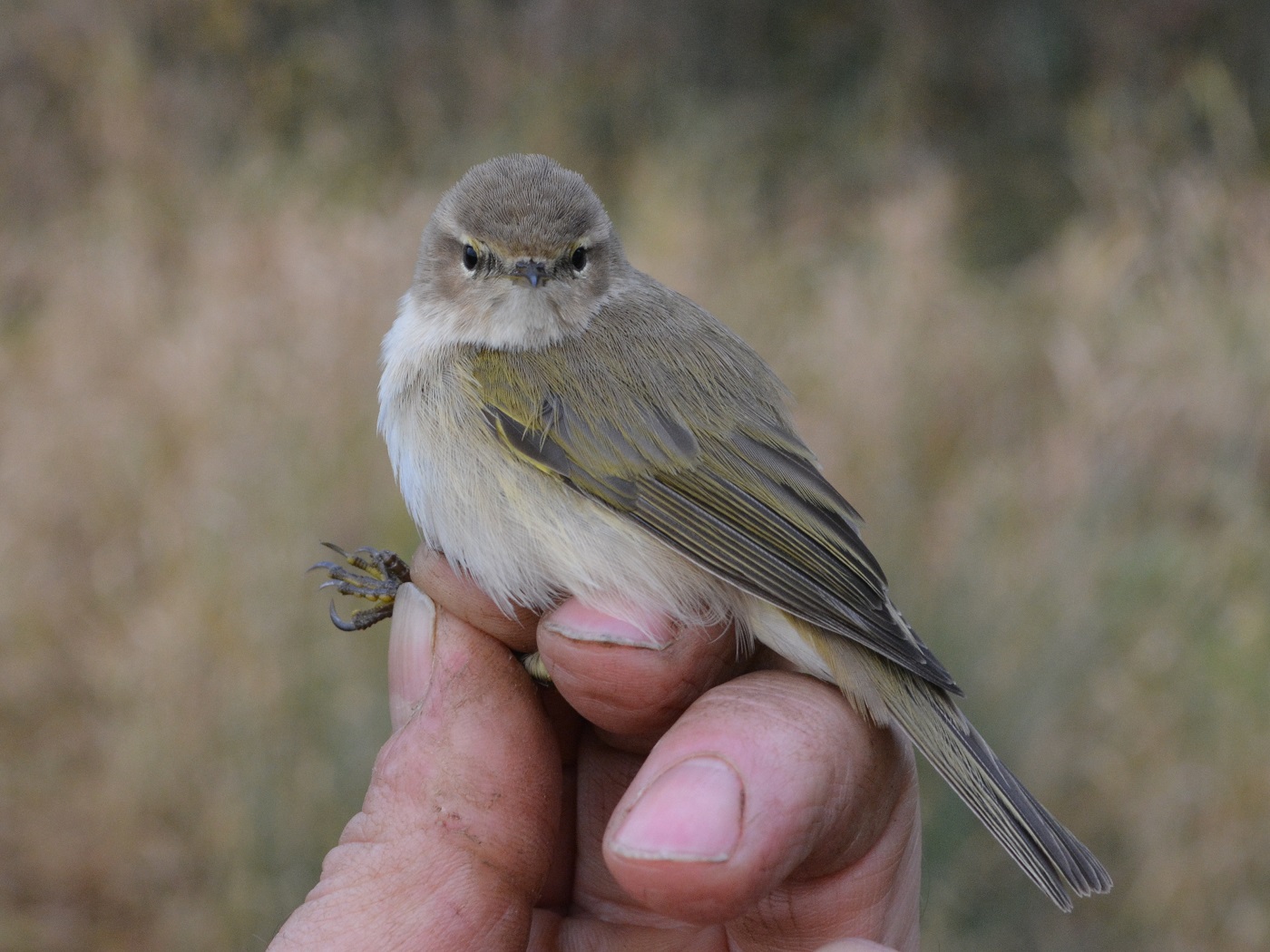
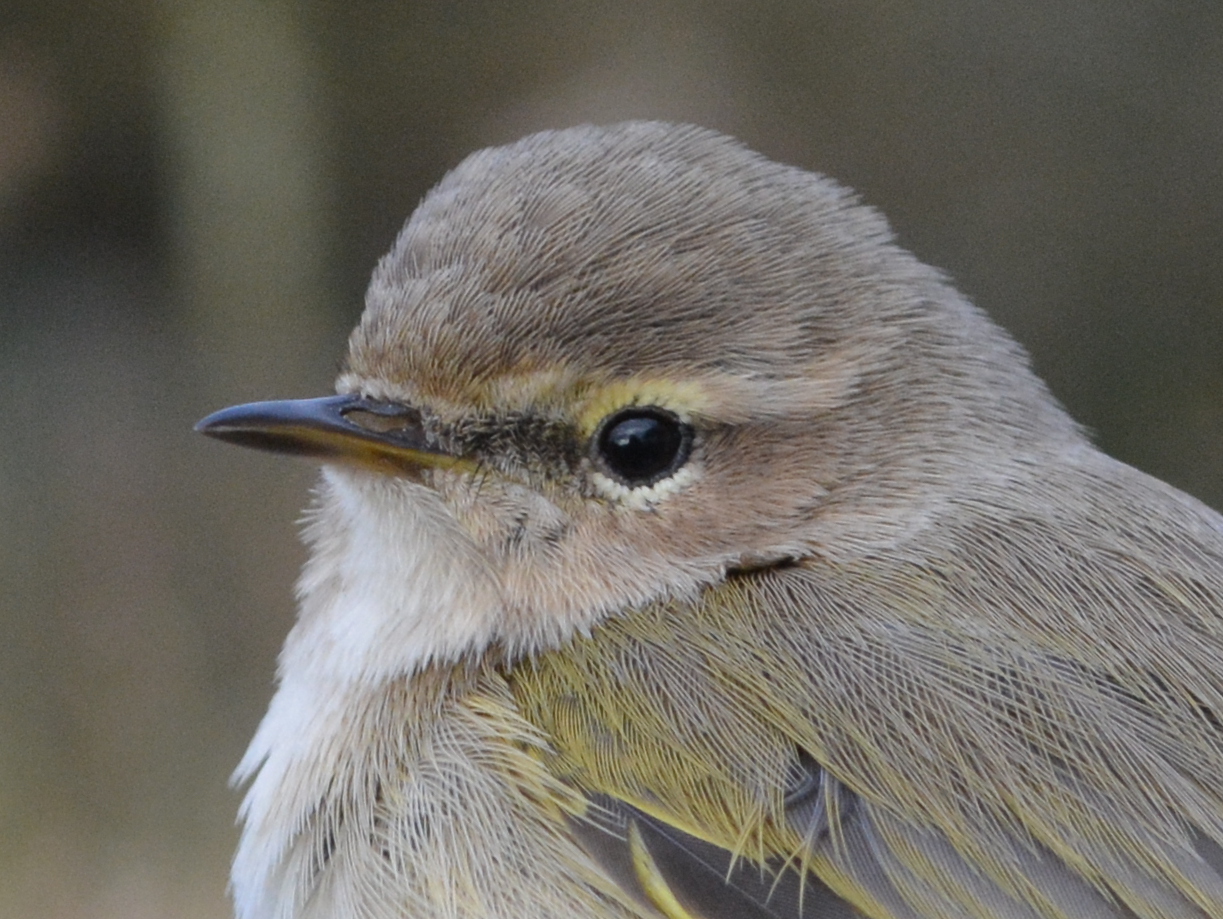
At this point it is worth having another look at the bird and, as noted earlier, it has a slight trace of yellow in the supercilium just above the eye. The images also show the fringes of the remiges (flight feathers to you and me) and wing coverts are olive green, and that there is a slight olive cast running into the edges of an otherwise greyish-brown mantle. There is no yellow on the underparts with the belly and lower breast being white. The undertail coverts have a buff wash, stronger towards the vent, while the flanks have more of khaki wash but with a buffish tinge running through. The upper breast had a slight khaki wash which increased in strength towards the sides.


The trace of yellow in the supercillium above the eye was only noticeable on close inspection and couldn't be detected when the bird was held at arms length.


The ear coverts have a distinct rufous tinge which is often considered a hallmark of 'classic' tristis. The crown, nape and upper mantle are an unadulterated greyish-brown.


The rufous tinge to the ear coverts is even stronger in this image.


So what are my thoughts on the Billinge bird now? well I am still happy it is a tristis. It doesn't meet all the plumage criteria for what are termed 'classic' tristis but it only falls down on that trace of yellow in the supercillium and the touches of olive running into the edge of the mantle, both of which wouldn't have been noticeable in the field. It closely matches birds described by Dean as non-classic Siberian Chiffchaffs ('fulvescens') that occur in the allopatric West Siberian plain (link here) but it is also possible, and some may consider just as likely, that it is a 'fulvescens' type bird from the the overlap zone between abietinus and tristis, which runs from the southern Ural Mountains to the Archangelsk region. Either way it had travelled a long way to get to Billinge, around 3,500km in the case of the overlap zone and at least 4,000km if from the West Siberian Plain.

Is it 100% tristis? well that is a different matter altogether and the simple answer I don't know and the only way to find out would be an analysis of the whole genome. The recent research by Shipilina et al involved analysis of whole genome sequence data and has shown that there are varying degrees of genetic admixing in the overlap zone and confirms there is some hybridisation between abietinus and tristis in that area. That study and another by Morova et al also points to genetic mixing being the underlying cause of variation in plumage traits, mixed vocalisations and reaction to each others typical song. Their findings also show that some birds from the overlap zone that looked like 'pure' examples of tristis and abietinus did in fact harbour some genetic material of the other, although this was less frequent and to a much lesser extent in the tristis examples.

The traces of yellow and olive seen in 'fulvescens' type birds from the West Siberian Plain may prove to be a result of there being a touch of abietinus somewhere in their distant ancestry, although that is purely conjecture at this stage. The genetic legacy of historic hybridisation may get diluted to a large degree over time but can be very persistent, as is aptly shown by the small percentage of Neanderthal DNA that can be found in all people of European origin even though Neanderthals became extinct about 40,000 years ago.

Finally, while I can't say it is a 100% thoroughbred tristis I am more than happy it is sufficiently tristis, inside and out, to be classed as one.


Acknowledgements:
Thanks to Martin Collinson and his team for undertaking the mtDNA analysis of the feather sample.

References:
Dean, A.R. 2009.  'Siberian Chiffchaff' Phylloscopus collybita tristis: discussion and photo gallery. http://deanar.org.uk/tristis/tristis.htm  (With updates to 2017, including the significant 'whole genome sequence data' established by Shipilina et al. 2017)

Shipilina, D., Serbyn, M., Ivanitskii, V., Marova, I. &  Backström, N. 2017. Patterns of genetic, phenotypic, and acoustic variation across a chiffchaff (Phylloscopus collybita abietinus/tristis) hybrid zone. Ecology and Evolution 2017; 1–12.

Marova, I., Shipilina, D., Fedorov, V,. Alekseev, V. & Ivanitskii, V. 2017. Interaction between Common and Siberian Chiffchaffin a contact zone.  Ornis Fennica 94: 66–81.