Showing posts with label bill deformities. Show all posts

Monday, 3 April 2023

Another Un-bill-ievable Blue Tit

 A Blue Tit with a deformed beak has been visiting the garden for the past couple of months. Its very overgrown mandibles clearly cause it problems when feeding but it has adapted by tilting its head to one side and searching through suet pellets on the bird table to try and find smaller pieces and crumbs it can pick up and eat. It frequently feeds on the ground below a fat ball feeder where it can also find small pieces and crumbs that other birds drop or dislodge when feeding on the fat balls.


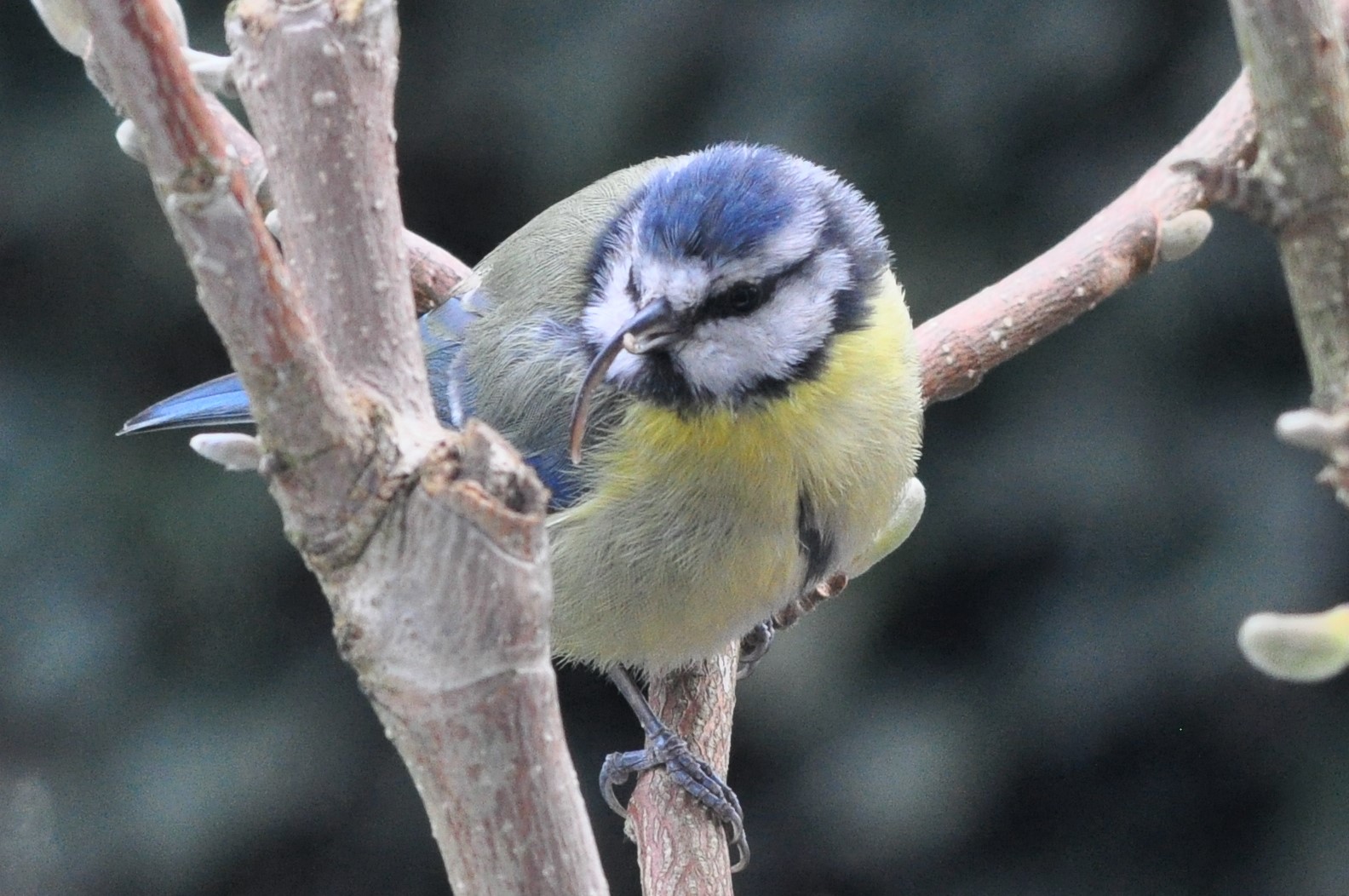
More recently it has taken to using a window feeder that allows it to pick through sunflower hearts, suet pellets and partially crushed dried mealworms. I wouldn't normally use a window feeder but it was bought for me as a Christmas present so I decided to give it a go and I am really glad that I did. Birds didn't go near this feeder for ages but this Blue Tit eventually started to take advantage of it and brought it close enough for me to photograph it.


This isn't the first Blue Tit with an overgrown beak I have recorded in the garden and I did a blog post about one I caught in the garden nearly 10 years ago (blog post link here). That bird was more extreme case and had an even longer lower mandible. One thing I have noticed with the current bird is that its bill still appears to be growing, especially the lower mandible. When I first saw it in the garden the lower mandible barely seemed to extend much beyond the upper mandible where they cross but now it clearly extends past the upper by a few millimetres. I suspect both mandibles are still growing but it is just easier to see the change in the lower mandible. If it hangs around long enough I may be able to take more photographs to show that its bill is still growing in the absence of normal wear from pecking, feeding and bill wiping.


Monday, 21 September 2015

Low 'Vis' Weekend

The weather forecast for the weekend had been looking really good with a large ridge of high pressure positioned over the country and the prospects of clear blue skies. The conditions looked like they would be perfect for migrants to be on the move at Billinge and I was hopeful of getting my first good catch of Meadow Pipits of the autumn. I was really keen to make the most of the weather and was up early on Saturday and had 3 nets set by first light. It was a bit misty but I expected that to burn off quickly once the sun was up. Unfortunately the mist lingered and got worse with visibility restricted to around 2 miles for the first couple of hours or so.

The low visibility had its impact on diurnal migrants and only a few pipits, wagtails and finches pushed through. The bushes seemed to be fairly quiet but there was another little rush of Goldcrests first thing with all but 1 of the 14 ringed being caught in the first hour. One of the Goldcrests was unusual in that it had a slightly longer and down-curved bill that give it a striking appearance. A few Chiffchaffs moved through later in the morning when the mist had started to lift with one being a control and the 3 new Robins were all likely to be migrants. There were a few more Linnets around than of late with birds moving between nearby feeding areas and a few of these were intercepted towards the end of the session.


The bill of this Goldcrest was a bit longer and heavier looking than normal but it was the down curve that made it look really unusual.
Its unusual bill has a little bit of a Treecreeperesque look to it.

Control Chiffchaff HVR169.
Small numbers of migrant Robins have been a feature of recent visits. The site doesn't have many resident Robins and the few there are don't usually frequent the ringing areas so any new Robins that are caught are pretty much guaranteed to be migrants.
Ringing totals (retraps/controls in brackets) for 19/09/15 were: Meadow Pipit 2; Grey Wagtail 2; Robin 3; Blackcap 1; Chiffchaff 5 (2); Goldcrest 14; Chaffinch 1; Linnet 6; Lesser Redpoll 3 (2). Total 37 new birds, 3 retraps and 1 control.

There was meant to be a bit more of a breeze on Sunday and I hoped that would help keep the mist away but when I got up I could see it was foggy and not just misty. I thought twice about going out given the conditions as I knew the fog would make the nets much more visible. Anyway I decided to give it a go just in case the fog lifted when the sun came up.

I put up the usual nets and caught 2 Blackcaps and 2 Goldcrests in the half light but then the fog started to have more impact as the light levels rose. I didn't catch anything in the next net round and thought about packing up but I decided to give it just a bit longer on the off chance the fog would clear. At about the same time a flock of about 50 Linnets gathered in the trees near one of the nets so I decided to play a lure and they immediately came down to investigate. On checking the net I found I had caught 18 Linnets and while I think the fog made the lure more effective it also made the net much more visible so both helped and hindered the catch at the same time.


All bar one of the Linnets caught were first year birds like this bird. The partially concealed red feathers on the breast show this bird is a male. 

1CY Linnet.
By the end of the morning there was a flock of about 90 feeding in a nearby field. 
The conditions slowly improved as the morning wore on but it came too late to stimulate much in the way of movement. Matters weren't helped by lingering fog that affected some of the surrounding areas, especially towards the north and east of the site. The final total of 47 birds was very good given the conditions and was largely due to the 25 Linnets that were caught. 

Ringing totals (retraps in brackets) for 20/09/15 were: Sparrowhawk 1; Robin 2 (1); Blackcap 3; Chiffchaff 3; Goldcrest 6; Blue Tit 1; Greenfinch 1; Linnet 25; Lesser Redpoll 3; Yellowhammer 1. Total 46 new birds and 1 retrap.

Juvenile female Sparrowhawk. Always a delight to catch and always a bit of a handful.

Sparrowhawks often manage to climb out of nets just when you are nearing them and females, being larger, usually find it easier to escape than males. Luckily this one didn't get away but it got very close to doing so.
Now look into my eyes, my eyes.

Sunday, 12 July 2015

This and that

It has been a couple of weeks since my last post so I thought I should cobble something together by way of a catch up. There hasn't been one stand out thing to write about but there have been some bits and bobs worth mentioning. On the birding front I have had Common Crossbills flying over Billinge and Crawford on a total of 4 occasions with most heading west. There have also been some unusually early flocks of Siskins moving south which are likely to be the forerunners or foreflyers of a large scale irruption this autumn. 

Sitka Spruce produced a bumper crop of seeds last year which meant few Crossbills, Siskins and Redpolls migrated in search of food and led to an almost complete absence of Siskins on garden feeders this spring. A bumper crop generally results in better survival and a good breeding season but is often followed by below average seed production and so provides the circumstances that can lead to large scale irruptions of the associated species.

It really looks like we are heading for one of those autumns/winters where the irruptive species come to the fore and steal the birding headlines. I don't think these irruptions will be confined to a few seed eating species either as I also think the conditions are developing for a good arrival of Waxwings. It may not be quite on the scale of the 2012/13 irruption but I certainly think it could be a good one. Why do I think it could be a Waxwing winter and the simple answer is the cold spring and its impact on pollinators and berry production across much of northern Europe. If the Rowan and Hawthorn in this area are anything to go by the berry crop could be down by at least 50% on last year if not more.

So there are some predictions or perhaps I should say educated guesses based on recent observations. Make of them what you will but right or wrong I will refer back to them later in the year when we know what has actually happened. I certainly think it is a year where some big irruptions are on the cards. One thing we don't have to wait for is to know that it has been an abysmal breeding season for many insectivorous species. I have never known so many warblers singing so late in the season such has been the level of nest failure so far and the woods and scrub near me are what you could call almost titless. 

So what have I been ringing? Well I am still catching Redpolls and Goldfinches coming to the feeders at Crawford although Tree Sparrows have dropped off now that winter cereals are starting to ripen. My last visit to Billinge on the evening of the 9th produced a few Willow Warblers, Chiffchaffs and Linnets along with a fairly good catch of 21 Swallows that came to roost in the willows. As for the garden my local Starlings seem to have gone on their summer holidays and have largely vacated the area despite the constant supply of food. However I have caught a few Woodpigeons in the garden including two that needed fishing line removing from their feet. One of these Woodpigeons also happened to be an unusually dark individual.


Adult male Lesser Redpoll

A duskier than normal Woodpigeon and it does stand out as looking dark in the field.


This Woodpigeon was lucky to be caught and have the fishing line removed before any permanent damage was done.
Moth catches have remained below par to say the least and are a fraction of what they should be at this time of year. The only species that seem to be present in near normal numbers are Buff Ermine and perhaps Ghost Moth. Not much else I can say about the moths or lack of them other than it was nice to catch two Garden Tigers today. Garden Tiger is a declining species that is less than annual in the garden despite its name. However, Poplar, Elephant and Eyed Hawk moths are regular in the garden although they have generally emerged later and in smaller numbers this year.


Garden Tiger 12/07/15

Garden Tiger 12/07/15


Poplar Hawk Moth

Poplar Hawk Moth

Elephant Hawk Moths

Eyed Hawk Moth
Finally, an odd looking Blackbird appeared in the garden earlier today. It looked like it was carrying something until I realised it had a huge growth in its bill. It turned out it was a bird that had been ringed in the garden on 9th May when it showed some signs of a problem with the upper mandible but nothing on the scale of its appearance today. I was surprised to see that it was still able to feed with such a large mass growing from the roof of the upper mandible but it managed to pick up some food from the bird table. However, the growth is clearly taking its toll on the bird's ability to preen and clearly limits its forward vision. It is a surprise it has managed to survive thus far and shows how resilient some birds can be.


No it isn't carrying anything it is a growth on the underside of the upper mandible.


The same bird when it it was ringed on 9th May


Saturday, 29 November 2014

Ringing session with a twist.

I am not sure where to start with this post as today's ringing session didn't turn out anything like I expected it to. There have been a dwindling number of thrushes moving over Billinge and I didn't catch a single bird on my last outing (27th) so I thought I would be declaring autumn passage over in this part of the world by today. It has been a fantastic autumn for Redwings at the site but the southward movement of Redwings that had arrived further north had to end some time. However this morning bucked the trend with Redwings passing overhead and calling through the darkness while I was putting up the nets.


Redwing 29/11/14
I had been joined by Paul who had expressed an interest in training to ring but I had warned him that I didn't expect to catch much if anything. Well the birds decided to make a fool out of me with a few Redwings dropping in almost straight away. It wasn't just Redwings as there was a continental Song Thrush amongst them in one of the later catches. A flock of at least 40 Fieldfares narrowly missed the nets and a couple of smaller parties also flew over adding to the migratory feel of the morning. It wasn't just a case of birds moving from their roosts to feeding sites either as the movements went on too far into the morning for that.


Continental Song Thrushes, like this bird, are more olive grey from the nape to the upper tail coverts compared to the British race which have warm brown upperparts.


Continental birds are also much whiter underneath with much less buff on the breast.
We didn't just catch thrushes as there were a good number of Yellowhammers, Chaffinches and Goldfinches about, along with a few Reed Buntings. The real twist to this tale came in the form of one of the Yellowhammers that had an overgrown and twisted upper mandible. Buntings have slightly odd looking bills to start with as the upper mandible is smaller than the lower so it doesn't take much of a deformity to make them look really odd and this was no small deformity. It was a first year bird so this overgrowth had only developed in the last 4 or 5 months or thereabouts. It never ceases to amaze me how birds adapt and survive with such deformities and it was clearly doing quite well as it had a healthy weight (25.1g) and its plumage was in excellent condition.


Yellowhammer with a twist.


It must be really difficult for this bird to pick up seeds.

There was a coating of soil on the end of the upper mandible which suggests it scrapes the ground when the bird is feeding.


The plumage was in pristine condition so it must be managing to preen well enough.


Normal Yellowhammer for comparison.


Paul releasing his first Yellowhammer.
The final surprise was finding a Kestrel in one of the nets when I went to take them down. Kestrels are ever present at the site and are more common than Sparrowhawks but this was the first I have caught there.


Kestrel 29/11/14

Kestrel 29/11/14
Ringing totals (with retraps in brackets): Redwing 14; Song Thrush 1; Yellowhammer 10 (1); Chaffinch 3; Goldfinch 2; Reed Bunting 1 (1); Bullfinch 1; Kestrel 1.


Reed Bunting 29/11/14


Saturday, 30 November 2013

Un-bill-ievable Blue Tit

It was a beautiful day today and far too sunny to put a net up in the garden until the sun moved round behind the house and put the front garden net site and feeders in shade. I put a net up at around 2:15 with the intention of catching a few more Goldfinches and the first birds were caught within a few minutes. These were a Starling, a Goldfinch and a Blue Tit with an incredibly deformed bill.


Un-bill-ievable Blue Tit
I have caught birds with deformed bills before but nothing like on this scale. Both the upper and lower mandibles were hugely overgrown. How it feeds is any ones guess but it clearly does well enough as it was a healthy adult. That makes it in the region of 18 months old at the very least but it could be much older.

The uniform blue colour of all the coverts and blue primary coverts
in particular show that this bird is an adult.
I have not seen this bird in the garden before and it wasn't a bird I had ringed previously so I don't know any of its history. It will be interesting to see if it turns up in the garden again as I would like to see how it feeds. It is always tempting to interfere and trim the bill in a case like this but I didn't and wouldn't. It is a natural deformity and ringing is all about studying birds without any undue interference.

Whichever way you look at this bird it sure looks odd.
BTO garden bird surveys have revealed Blue Tits to be the most frequently recorded species with beak deformities and you can read more by clicking here. Coincidentally a post about a Blue Tit with a deformed bill has been published recently on the BTO 'Demog Blog' and can be seen by clicking here.

Here are some of the measurements.
Ringing totals for 30/11/13 with retraps in brackets.
Goldfinch 5 (1)
Starling 1
Blue Tit 1
Robin 1
Long-tailed Tit (1)
Total 8 (2)