Tuesday, 11 September 2018

Billinge: 5th & 10th September 2018

September is a month when autumn migration is normally in full swing and even if one species doesn't deliver another usually does. However, this September is starting to look very different to those of the past 4 years at Billinge and although there is still time for things to change things don't look very promising at the moment.

5th September 2018
A morning that got off to a good start with a Song Thrush caught in the first net just as the last guy rope was being tied off. September sees British Song Thrushes starting to move and the first continental migrants arriving with this bird likely to be one of the former. After that it was generally a lacklustre session with the numbers bulked up by a few too many tits. If I had to pick a highlight it would be the capture of the first 4 Meadow Pipits of the autumn although 4 is a relatively poor total for this date in September. The biggest news, if you can call it that, was the near absence of Goldcrests with only 2 caught. Goldcrests usually start to move through the site in good numbers from the start of September so a total of 2 is well below the norm of the past 4 years.


Meadow Pipit 05/09/2018
Totals for 05/09/2018 were: Blue Tit 11; Great Tit 6;  Willow Warbler 2; Chiffchaff 6; Blackcap 4; Goldcrest 2; Song Thrush 1; Meadow Pipit 4; Chaffinch 1; Linnet 3.

10th September 2018
If the session on the 5th fell short of what I have come to expect from the site in September this one was even more disappointing. The near absence of Goldcrests of the 5th became a total absence with none being caught, seen or even heard. To give that some context last September saw 21 ringed on the 1st, 17 ringed on the 10th September and a total of 77 over the first 10 days. In 2016 it was a similar picture with 50 ringed over the first ten days of the month and no blank sessions. It is starting to look like Goldcrests were hit really hard by spell of severe cold weather back in March.
It is getting a bit late for Willow Warblers so the capture of 2 was noteworthy but the near absence of Chiffchaffs was far more unusual with none caught and only 2 heard all morning. Chiffchaffs numbers normally peak in September and a capture total in low double figures should have been on the cards. The quiet theme was also reflected in the visible migration with only a few Meadow Pipits moving. It was the quietest I have known the site to be in September by some margin and it is to be hoped the rest of the month doesn't carry on that way.

Totals for 10/09/2018 (retrap in brackets) were: Sparrowhawk 1; Blue Tit 4 (1); Willow Warbler 2; Blackcap 2; Dunnock 1; Meadow Pipit 7; Chaffinch 2.


One of the Blackcaps caught on the 10th was still largely in juvenile plumage which is suggestive of some very late breeding.

The last bird caught on the 10th was this juvenile female Sparrowhawk.


Monday, 3 September 2018

Back to blogging

It has taken a while, and much longer than I would have liked, but I have finally got round to posting on the blog again. I am not one for mentioning much about my personal life but the ups and downs of life, with all their twists and turns, have taken up a lot of my time over the last few months and pushed the blog to the bottom of the things to do list. Principal amongst the lows was the failing health of my 97 year old mother and the difficulty of trying to meet her wish of staying in her own home. Eventually, caring for her there became impractical and we had to move her in with us until old age and age related heart failure finally got the better of her. That is more detail than I would normally give on such matters and was only one of the factors involved but I thought such a long absence from the blog merited some explanation.

So enough about that stuff, this blog is about birds and other wildlife and I have managed to fit in some ringing despite all the other things that have been going on. Back in late May I completed my Starling RAS project for this year and it was another successful season with a total of 168 different adults encountered (31 new birds and 137 colour-ringed birds re-sighted). Starlings appear to have had a good breeding season and I have ringed more juvenile Starlings in the garden than in any previous year with the total currently standing at 489 (it increased by 3 whilst writing this post). I don't usually catch many juvenile Starlings after the middle of June and, initially, that was the case again this year but numbers visiting the feeders started to pick up again in late July and small numbers have been making regular raids on the fat feeders since then. This has resulted in 85 being ringed since late July compared to only 25 over the same period last year.

Visits to other sites have been less frequent than in other years but I started to rectify that once we got into August. A visit to the site at Billinge on 30th August was the most productive of the recent sessions and is worthy of specific mention. I had been joined by Mark, who was over from America to visit family, and we set 3 nets in the top willows. Conditions were ideal for mist netting, being calm and largely overcast, and while ideal netting conditions don't always coincide with good numbers of migrants this was one day when they did. Blackcaps were the most numerous species and the total of 20 ringed was a new day record for the site. Twenty isn't a big catch by the standards of some sites but it is for the Billinge site which isn't blessed with much in the way of berries. The most unusual captures were a male Redstart, which Mark was especially pleased to see in the hand, and 2 Spotted Flycatchers which were caught just after he had to leave, well you can't win them all. A catch of 9 Willow Warblers was also a decent number for late August. A total of 60 birds were ringed which broke down as follows: Blue Tit 10; Great Tit 5; Chiffchaff 9; Willow Warbler 9; Blackcap 20; Robin 2; Spotted Flycatcher 2; Redstart 1; Goldfinch 1; Yellowhammer 1.


1cy male Redstart


1cy Spotted Flycatcher
I can't promise when the next post will be but hopefully there won't be anything like a gap of 3 months before the next one comes along. In fact it should be fairly soon as I hope to get out on Wednesday and failing that there are some interesting recoveries that I want to share.

Saturday, 2 June 2018

Tawny Owl tumble.

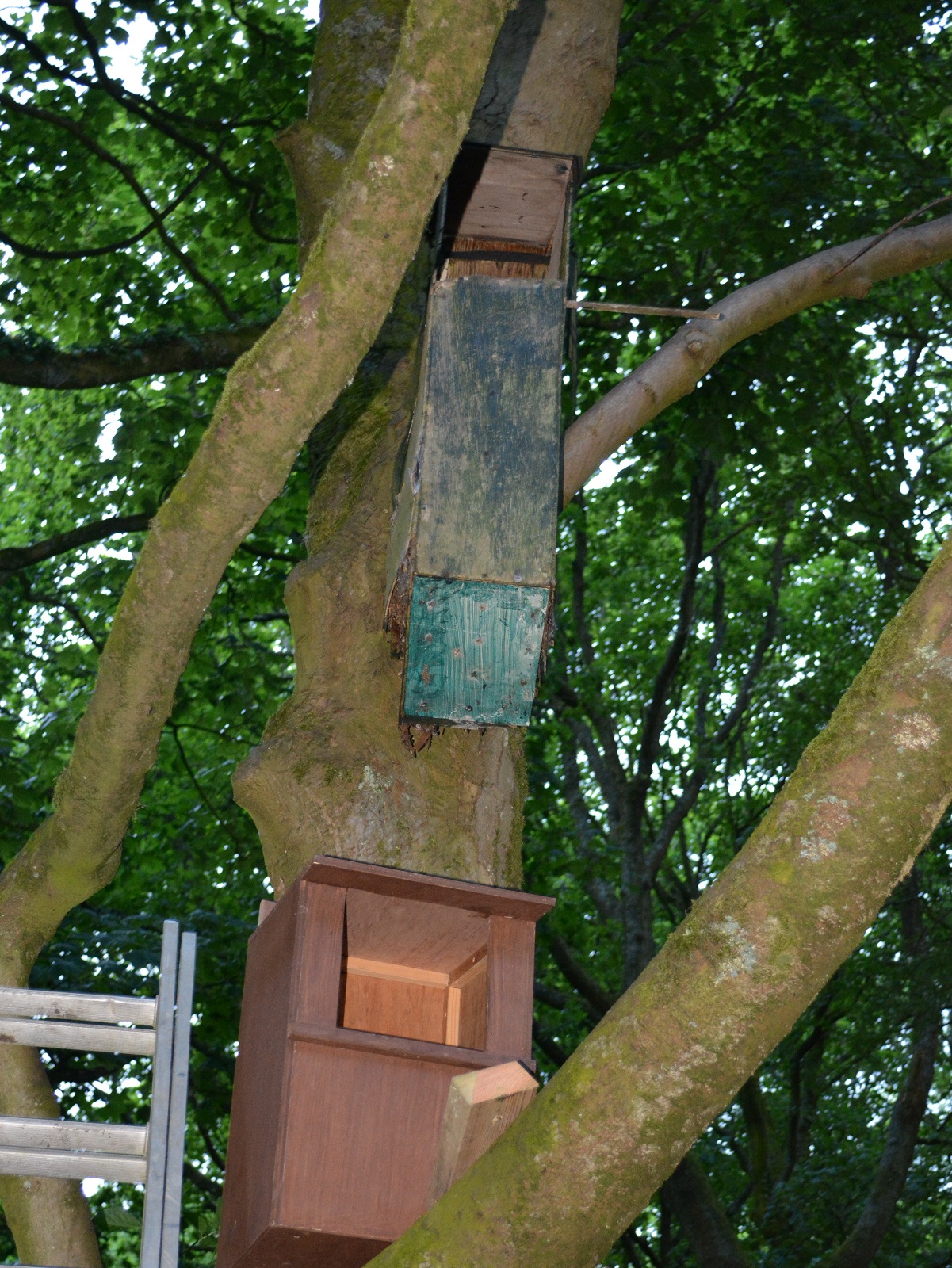
Last weekend I received a call about two young Tawny Owls that had been picked up below a nest box and the family who had found then weren't sure what they should do for the best. I quickly established that the bottom had fallen out of the nest box so I arranged to go round to see if it was possible to do a repair but I also took a spare owl box with me to try and cover all eventualities.

It was only a 5 minute drive to the house of the family that had found the owls and on examining the young Tawnies it was clear they were none the worse for their tumble but they were a bit too young to be out of the nest. It turned out the nest box was one the family had put up many years before in a tree at the end of their long garden and it had been used by owls for most of that time. Luckily the box was only about 4 metres off the ground and there was a deep layer of leaf litter below it which will have helped give the youngters a soft landing.

The ideal solution would have been a permanent or temporary repair to the box and to simply put the youngsters back in it so that is what I tried first. The bottom of the box hadn't completely fallen away and was hanging open but, unfortunately, the box had become far too fragile and flimsy to allow even a temporary repair. With a repair out of the question I decided to try plan B and put up the new box immediately below the old box and put the youngsters in that. The young owls were bill snapping and would have no problem attracting their parents attention by that means or with hunger calls so I had no concerns about the parents finding them. I was reasonably confident that the calls of the young and the parents desire to feed them would overcome any caution they may have about the sudden appearance of an additional box. The new box was quickly erected and the young placed inside and I arranged to go back a few days later to see how they were doing and to ring them if everything was going OK.


Plan B, the temporary box below the old box. 
So I went back a couple of days ago and was delighted to see both youngsters very much alive and well and looking very comfortable in their new home. Both were at an ideal size for ringing with the smaller chick having its primary feathers just emerging from their pins (sheaths) and the bigger one being a bit more advanced and noticeably heavier. Both were duly ringed and quickly returned to the new box. The parents had obviously taken to the new situation well and hadn't been put off by the new box in any way.


Little and large but both seem to be doing well in their new home.
That isn't the end of this story as there will be further follow up and the old box will be replaced by a new one in late summer or early autumn and the temporary box will be taken down and become my spare box again. Beyond that I will stay in touch with the family and help monitor their owl box in future years.


Thursday, 24 May 2018

First 100 juvs and counting.


The first juvenile Starling caught for ringing this morning was the 100th of this season and it was quickly followed by another 24. Productivity seems to be good despite the cold start to the spring and many pairs have 4 juveniles in tow. I haven't had time to total up the number of colour-ringed adults that have been resighted since 21st April but it is at least 130 and in addition another 40 new adults have been ringed and colour-ringed for the RAS project. 


A typical scene on the lawn taken through the window. A similar number of birds were feeding on the suspended fat block and bird table out of the shot
There are usually around 30 Starlings in the garden at any one time but well over 100 individuals visit over the course of a day and the true number could be over 200. They are currently getting through 2kg of home made fat blocks,15 or so shop bought fat balls and the odd loaf of bread each day. The warm and very sunny weather we have been experiencing is helping the Starlings get through the fat blocks and fat balls a bit faster than they otherwise would as it is softens them as the day warms up, so I am currently making batches of the home made fat blocks 3 times a week to keep up with demand.


Melt 6 blocks of dripping in a large jam pan.

Add about 7 margarine tub size scoops of meal worms.

Then add about 20 crushed shop bought fat balls.


Mix well until you have a nice even consistency and fill old margarine tubs to form blocks.


The result is yummy if you're a Starling and should be given how much it costs.
It is not just the Starlings that benefit from the feeding regime and we have one or two Hedgehogs that visits the garden every night to feed on any crumbs from the fat blocks that fall to the ground and don't get cleared up by the Starlings. I also put out a few meal worms for them in a purpose made feeding station.


The current run of sunny weather has resulted in a few of the young Starlings flying into windows from time to time and one of my neighbours upstairs windows in particular. Thankfully the young Starlings don't fly that fast so there haven't been any injuries or fatalities or at least none that I am aware of but they have certainly left their mark on the glass.


My neighbours will get value for money from the window cleaners the next time they come round. I may also have to power wash their garden path by way of a thank you for their tolerance not least because the Starlings are extremely noisy in addition to being a bit messy; the noise being more noticeable as most people have some windows open because of the very warm weather.
That's all for now as I have another batch of fat blocks to make and lots of other stuff to do.

Monday, 14 May 2018

Quick Update and Starling RAS progress.

Apologies for the lack of posts recently but I have been busy with one thing or another and there has not been a great deal of interest to report on the migration front. The dearth of migrants at Billinge and other sites I visit has continued with hirundines being particulary scarce. While it has not been a silent spring it has been a pretty quiet one and it wouldn't surprise me if national population declines are reported for many species when all the data is in.

Much of my ringing effort over the last 3 weeks has been directed towards my Starling RAS project and I have clocked up around 75 hours of recording colour-ringed Starlings feeding on the fat blocks in the garden. As I have been running the project for a few years most of my local Starlings are colour-ringed and I have resighted 100 Starlings that were ringed prior to the start of this year's recording period with over 25% of those birds being more than 3 years old. It didn't take long to record the first 60 or so individuals but after that it became more like looking for a needle in a haystack as it gets progressively harder to pick out any that haven't been recorded before from all the ones that visit the fat blocks on numerous occasions each day. In addition to recording all the previously ringed birds I selectively trap and ring any unringed Starlings to add them to the study population with 20 new adults being ringed and colour-ringed so far.

With at least 70+ different Starlings coming they are currently getting through 1.5 to 2 kg of home made fat blocks each day. This will increase as more young fledge.

It is often a bit of a scrum at the fat blocks with the birds jostling for position. This can make reading the codes on the colour-rings quite difficult.
The timing of breeding has been pretty much as expected and the first adult was seen carrying food on 21st April and this was soon followed by many others. The first young started to fledge about 6 days ago and the first juveniles started to follow their parents to the the fat blocks in the garden in the last couple of days. This is very similar to last year and just over a week later than 2016, which was an earlier than average breeding season anyway. While the severe cold spells in the early part of this spring delayed the onset of breeding in many resident species it doesn't appear to have had much of an affect on Starlings, in this area at least, or that is the initial impression. It still remains to be seen what the fledging rates and brood sizes are like overall so it will be later in June before we get a more complete picture.

Adult male A12 is one of the many regulars and was originally ringed in December 2014. This male has been recorded numerous times in each breeding season since being ringed.

The first juvenile ringed in 2018. This bird was caught earlier this morning (14/05/2018). The first juvenile was ringed on the same date last year and on 7th May in 2016.


Sunday, 29 April 2018

Quiet at Billinge but busy in the garden.

It has been very quiet at Billinge over the last week and 4 visits (22nd, 24th, 25th & 28th) only resulted in a combined total of 7 birds caught [Willow Warbler 1, Blackcap 2, Robin 1, Tree Pipit 1, Great Tit 1 (1)]. Visible migration was minimal, to say the least, and there was no significant change in the numbers of warblers present with Chiffchaff, Willow Warbler and Blackcap the only species on territory.


It may have been a poor week but a Tree Pipit, the 2nd to be ringed this spring, provided some consolation.
While there has not been much happening at Billinge the garden has been getting very busy. The cold spring has delayed breeding in many species but it doesn't appear to have had much of an effect on the local Starlings and most pairs are feeding nestlings now. I run a RAS project on Starlings and attract them to the garden with home made fat blocks but more about that in a future post.


The vast majority of Starlings coming to the feeders were colour-ringed in previous years and 77 individuals have been re-sighted in the last week.

Sunday, 22 April 2018

Billinge: 21st April 2018

There was a general lack of birds and in many respects it was very disappointing morning but there were a few bits of interest that were topped off in fine style by an Osprey that flew directly over me towards the end of the session. Only 9 birds were caught over the best part of 5 hours but they did include a Tree Pipit and a couple of interesting retraps. Once again visible migration was virtually none existent with 3 Tree Pipits, 5 Lesser Redpolls and the aforementioned Osprey being the only birds seen moving north.


You can't complain about only catching 9 birds when one of them is a Tree Pipit. 
The first of the interesting retraps was a female Blackcap which was originally ringed as a first-year bird in August 2014 and hadn't been recaptured during the intervening period.

At nearly 4 years old this Blackcap has reached quite a good age.
The other interesting retrap was a Willow Warbler that, at first glance, looked more like a Chiffchaff than your typical spring Willow Warbler. 

You can make your own mind up from the photos but the supercillium is quite dull and indistinct, especially behind the eye.

There was no doubt about it being a Willow Warbler albeit a rather drab looking one. It had been ringed as an adult in August 2015 and retrapped in May & August 2016 and again in May 2017 and was sexed as a male. The wing formula was as it should be for Willow Warbler and the wing length was 69mm. 

Interestingly, the legs were quite dark too.

There has been a distinct lack of Lesser Redpolls moving through so far this month and the 5 seen on this visit is the largest count. They have been absent on most days and on the few occasions any have been recorded it has only been ones and twos.

Only 3 Lesser Redpolls have been ringed so far this month compared with 66 from a similar amount of effort in the same period last year. Numbers and timing do vary from year to year but this April looks like being an exceptionally poor one for this species.
Ringing totals (retraps in brackets) for 21st April 2018 were: Willow Warbler 1 (2); Blackcap 1 (2); Dunnock 1; Tree Pipit 1; Lesser Redpoll 1.